Author: admin

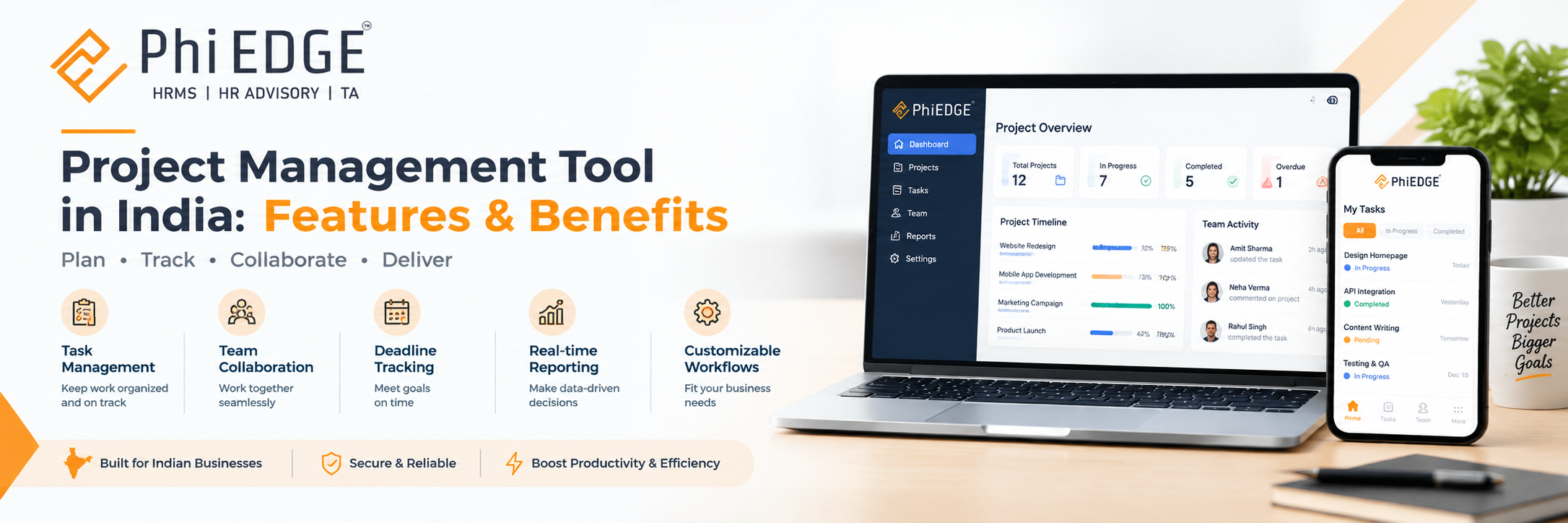
  • Project Management Tool in India: Features & Benefits | Phi EDGE

    Project Management Tool in India: Features & Benefits | Phi EDGE

    Managing projects across teams can become challenging when deadlines, responsibilities, approvals and progress updates are tracked through separate spreadsheets, emails and messaging applications. As businesses grow, they need a more organised way to plan work, coordinate teams and monitor project outcomes.

    A project management tool in India can help businesses centralize project information, organise tasks, improve team coordination and maintain better visibility into ongoing work. The right solution should match the organisation’s workflow, team structure, reporting needs and security requirements.

    In this guide, we explain how project management tools work, which features businesses should evaluate, and how organisations can choose a solution that supports efficient project execution.

    What Is a Project Management Tool?

    A project management tool is software that helps teams plan, organise, assign, monitor and complete project-related activities from a central platform. Depending on the software, it may provide task lists, project timelines, progress tracking, collaboration features, reporting dashboards and automated notifications.

    For example, a marketing team can use project management software to coordinate a campaign, assign creative tasks, set publishing deadlines and monitor approvals. Similarly, an HR team can coordinate recruitment projects, employee onboarding activities or internal training initiatives.

    The primary purpose is to make work more visible, responsibilities clearer and project execution easier to monitor.

    Why Do Businesses in India Need Project Management Software?

    Businesses often manage multiple projects simultaneously, with different departments responsible for individual tasks. Without a structured process, updates may be delayed, ownership may become unclear and managers may struggle to identify bottlenecks.

    Project management software can help address these challenges in several ways:

    • Better task ownership: Assign responsibilities and deadlines to specific team members.
    • Improved project visibility: Review task status and outstanding work from one place.
    • More organised collaboration: Keep project-related discussions and updates accessible to the relevant team.
    • Deadline management: Identify overdue tasks and upcoming milestones.
    • Consistent reporting: Use available dashboards and reports to understand project progress.
    • Process standardisation: Create repeatable workflows for recurring activities.

    The benefits depend on the selected software, implementation quality and whether employees consistently use the system.

    What Features Should You Look for in a Project Management Tool in India?

    Choosing software based only on its feature list can lead to unnecessary complexity. Businesses should prioritise features that solve their actual operational problems.

    1. Task and Project Planning

    The software should allow users to create projects, break them into smaller tasks, assign owners and establish deadlines. Depending on the product, teams may also need milestones, task dependencies and recurring tasks.

    2. Project Progress Tracking

    Managers need a practical way to understand which tasks are pending, in progress, completed or delayed. Visual project boards, timelines and progress dashboards can help teams identify issues before they affect delivery.

    3. Team Collaboration

    Project-related communication should be easy to access. Depending on the tool, collaboration features may include comments, file attachments, notifications, mentions and shared updates.

    4. Workflow and Approval Management

    Businesses with structured approval processes may benefit from configurable workflows. For example, a marketing campaign may require content approval, design approval and final publishing approval before launch.

    5. Reports and Analytics

    Reporting features help managers review task completion, project status, workload and delivery performance. Check whether the available reports support your actual management requirements rather than assuming every platform offers the same analytics.

    6. Integration and Access Control

    Evaluate whether the software integrates with the applications your team already uses. Role-based permissions, secure authentication, access controls and appropriate data protection practices are also important when handling business information.

    How Does Project Management Software Improve Team Productivity?

    Project management software improves productivity primarily by reducing avoidable coordination work and making project responsibilities clearer.

    Consider a company preparing a product launch. The marketing team needs to create campaign content, the design team must prepare creatives, and the sales team needs product information before launch.

    Without a shared workflow, each department may maintain separate updates. Managers then spend time collecting information and resolving conflicting deadlines.

    With a suitable project management tool, the team can organise these activities within a shared project, assign owners, establish deadlines and monitor progress. Dependencies and delays become easier to identify, provided the relevant information is maintained accurately.

    This does not mean software automatically improves productivity. Teams still need realistic timelines, clear ownership, appropriate training and consistent project-management practices.

    Which Project Management Tool Is Best for Indian Businesses?

    The best project management tool depends on the organisation’s size, workflow complexity, budget, reporting needs and integration requirements.

    Business requirementWhat to evaluate
    Small teamsEase of use, task assignment and affordable pricing
    Growing businessesProject dashboards, collaboration and workload visibility
    Multiple departmentsCross-team workflows, dependencies and access controls
    Service businessesClient projects, approvals, deadlines and reporting
    Enterprise organisationsPermissions, integrations, governance, scalability and security

    Before selecting a platform, shortlist suitable solutions and test them against real business scenarios. Ask team members to complete a sample project during the evaluation rather than relying only on a sales demonstration.

    How Is Project Management Software Different from Task Management Software?

    Task management software generally focuses on organising individual activities, assigning responsibilities and tracking completion. Project management software may offer a broader set of capabilities, including project planning, milestones, dependencies, resource coordination and project-level reporting.

    The distinction is not absolute because many modern tools support both task and project management.

    A small team managing daily activities may need only straightforward task tracking. An organisation coordinating multiple projects, departments and deadlines may require more advanced planning and reporting features.

    How Can Phi EDGE Support Better Project and Task Management?

    Phi EDGE provides HR technology and workforce-management solutions. Its website also features content about Task and Project Management Software with Phi EDGE.

    Businesses evaluating Phi EDGE should review the relevant product information and request a demonstration to understand the exact project-management capabilities available, how workflows are configured, and which integrations or reporting features are supported.

    When evaluating the solution, ask how it supports task assignment, project visibility, collaboration, deadline tracking, reporting, user permissions and integration with existing business systems. Confirm the availability of each feature with the product team before making a purchase decision.

    Explore the Phi EDGE official website and Phi EDGE blog for additional information about its HR technology and workforce-management solutions.

    What Should You Check Before Implementing a Project Management Tool?

    A structured evaluation can help businesses avoid choosing software that is difficult to adopt or does not fit their existing processes.

    1. Document the project-management problems you want to solve.
    2. Identify the teams and employees who will use the platform.
    3. Define requirements for planning, reporting, collaboration and approvals.
    4. Check integrations, security controls, data access and support arrangements.
    5. Compare total costs, including implementation, training and additional modules.
    6. Run a pilot project with a small team.
    7. Collect feedback, improve workflows and establish adoption guidelines.

    The objective should be to improve project execution rather than simply move existing spreadsheets into another system.

    Frequently Asked Questions

    What is the best project management tool in India?

    The best tool is the one that matches your team’s workflows, budget, reporting requirements, security needs and integration requirements. Compare shortlisted platforms using a real project before deciding.

    Is project management software suitable for small businesses?

    Yes. Small businesses can use project management software to assign tasks, coordinate activities, monitor deadlines and organise team communication. The ideal solution should be easy to use and proportionate to the team’s needs.

    What is the difference between project tracking and project management?

    Project tracking focuses on monitoring progress, status and deadlines. Project management covers a wider process that can include planning, task allocation, resource coordination, risk management and delivery.

    Can project management software integrate with HRMS?

    Some platforms offer integrations or connected workflows between project management and HRMS systems. Availability varies by vendor and configuration. Businesses should verify which employee, workload or organisational data can be shared and under what permissions.

    How much does project management software cost in India?

    Pricing varies according to the provider, number of users, feature set, billing model and implementation requirements. Check current vendor pricing and request a quote when enterprise features or custom integrations are required.

    How can I evaluate Phi EDGE for project management?

    Review the relevant Phi EDGE product information and request a product demonstration. Ask the team to show the required workflows, reporting, permissions and integrations using a representative business scenario.

    Conclusion

    A well-chosen project management tool in India can help businesses organise tasks, improve collaboration, track deadlines and maintain better visibility across projects. The most effective solution is not necessarily the one with the largest number of features, but the one that supports the organisation’s actual processes and is consistently adopted by its teams.

    Evaluate your requirements, test relevant workflows and verify product capabilities before selecting a platform. Businesses considering Phi EDGE can explore its official website and request further information about the capabilities relevant to their needs.
  • Competency Based Model: Framework, Benefits & Examples | Phi EDGE

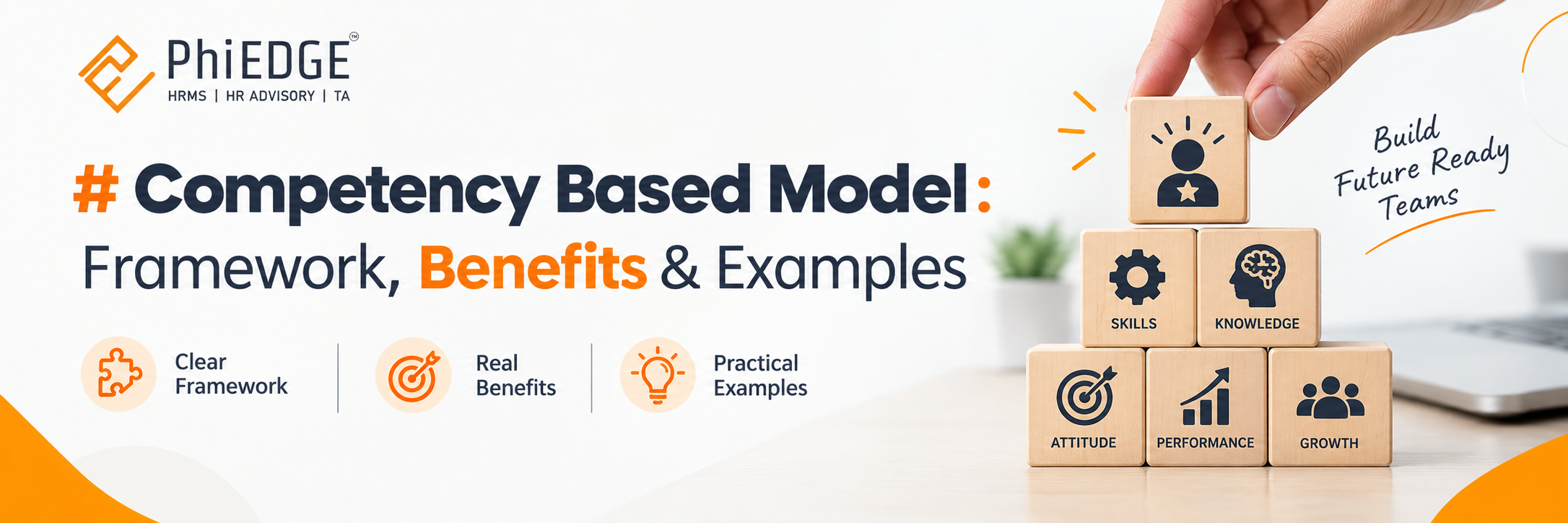
    Competency Based Model: Framework, Benefits & Examples | Phi EDGE

    Every organization wants employees who can perform well today and develop the capabilities required for tomorrow. However, traditional performance reviews often focus mainly on targets, completed tasks, and business results. They may not fully explain which skills, behaviours, and capabilities employees need to improve.

    A competency based model helps organizations define what successful performance looks like for each role. It creates a structured framework for assessing employee capabilities, identifying skill gaps, planning training, and supporting career development.

    With a connected HRMS and talent management approach, organizations can use competency data to support more consistent performance management, employee development, and succession planning.

    In this guide, we explain what a competency-based model is, how it works, its key benefits, and how businesses can implement it effectively with support from Phi EDGE HRMS.

    What Is a Competency Based Model?

    A competency based model is a structured framework that defines the knowledge, skills, behaviours, and capabilities employees need to perform successfully in a specific role.

    For example, a sales executive may need product knowledge, customer communication, negotiation, and relationship management skills. A sales manager may require these capabilities along with team leadership, coaching, decision-making, and strategic planning.

    A competency model makes these expectations clear and helps managers assess employees against defined role requirements rather than relying entirely on subjective opinions.

    A typical competency based model includes:

    • Core competencies: Communication, collaboration, adaptability, and problem-solving.
    • Functional competencies: Technical knowledge and role-specific expertise.
    • Leadership competencies: Decision-making, delegation, coaching, and strategic thinking.
    • Proficiency levels: Clearly defined expectations for beginner, intermediate, advanced, and expert capabilities.

    Why Is a Competency Based Model Important for Modern Businesses?

    Organizations may experience inconsistent performance evaluations, unclear promotion criteria, or training programs that do not address actual employee development needs.

    A competency framework provides a common reference point for HR teams, managers, and employees.

    It helps organizations:

    • Define clear expectations for every role.
    • Identify capability gaps before they affect performance.
    • Make employee development more targeted.
    • Support structured recruitment and internal mobility.
    • Improve consistency in performance assessments.
    • Prepare employees for future responsibilities.

    A well-designed framework should reflect the organization’s actual business objectives and job requirements. It should also be reviewed regularly as roles, technologies, and workforce priorities change.

    How Does Competency Mapping Work?

    Competency mapping identifies the capabilities required for a role and compares them with an employee’s current proficiency.

    For example, a company may define five competencies for a team leader: communication, delegation, conflict resolution, coaching, and decision-making.

    The organization then establishes expected proficiency levels for each competency and assesses the employee using appropriate evidence, such as manager feedback, work examples, assessments, and performance reviews.

    The process generally follows these steps:

    1. Identify the roles and business priorities that matter most.
    2. Define the competencies required for each role.
    3. Establish observable behaviours and proficiency levels.
    4. Assess employees against the defined requirements.
    5. Identify competency gaps and development priorities.
    6. Create individual development plans.
    7. Review progress and reassess capabilities periodically.

    This approach helps HR teams move from general statements such as “improve leadership skills” to specific development goals, such as improving delegation or conducting more effective feedback conversations.

    What Are the Main Benefits of a Competency Model Framework?

    1. More Consistent Performance Management

    A competency framework helps managers assess both what employees achieve and how they achieve it. When combined with measurable goals, it provides a more complete view of performance.

    2. Targeted Learning and Development

    Competency assessments can reveal where employees need support. HR teams can then connect identified gaps with relevant training, coaching, mentoring, or practical assignments.

    3. Better Career Development

    Employees can understand the competencies required for their next role and work toward measurable development goals. This makes career discussions more structured and actionable.

    4. Stronger Succession Planning

    Organizations can assess whether potential successors possess the capabilities needed for critical roles. Development plans can then focus on the gaps that must be addressed before a transition.

    5. Clearer Talent Decisions

    Consistent competency definitions can support recruitment, internal mobility, and development decisions. However, competency scores should be considered alongside job performance, experience, business context, and professional judgement.

    How Is a Competency Based Model Different from a Skills Matrix?

    A skills matrix typically shows which skills employees possess and their proficiency levels. A competency framework has a broader scope: it can include technical skills, behavioural expectations, leadership capabilities, and the behaviours associated with successful performance.

    For example, a skills matrix may record whether a manager can use a reporting tool. A competency model may also assess whether the manager can interpret the report, make informed decisions, communicate findings, and guide the team.

    Both tools can complement each other. A skills matrix provides a snapshot of current capabilities, while a competency framework connects those capabilities to role expectations and development priorities.

    How Can HRMS Software Support Competency Management?

    Managing competency frameworks through disconnected spreadsheets can become difficult as organizations grow. Different departments may use inconsistent definitions, outdated assessments, or separate records for training and performance reviews.

    A suitable HRMS can help centralize competency information, maintain role-based frameworks, record assessments, and connect development needs with other HR processes.

    The Phi EDGE Competency Model supports role-based competency mapping, competency repositories, skill-gap analysis, competency-driven performance management, and talent development.

    Organizations can explore the Phi EDGE Competency Model to understand its capabilities.

    Related HRMS capabilities can also support a connected talent management process:

    Technology should support—not replace—manager judgement, transparent assessment criteria, and meaningful employee conversations.

    What Are the Best Practices for Implementing a Competency Based Model?

    Start with a small number of business-critical roles instead of attempting to map every position at once.

    Involve experienced managers and employees when defining competencies. Use observable behaviours rather than vague descriptions, and explain how assessments will be used.

    Train managers to apply proficiency levels consistently. Give employees opportunities to review feedback and discuss their development needs.

    Finally, evaluate whether the framework is producing useful outcomes. Relevant indicators may include competency improvement, completion of targeted development plans, internal promotion readiness, and time taken to reach proficiency in a role.

    Avoid treating competency scores as a standalone measure of employee value. Assessment methods should be relevant to the role, consistently applied, and reviewed for potential bias.

    What Do Phi EDGE Clients Say About Their Experience?

    Phi EDGE publishes client testimonials describing its work in performance management, goal alignment, organizational development, and HR technology.

    For example, Nicky Sujan, CEO of Mega Rubber Technologies Pvt. Ltd., describes the value of KPI monitoring in improving clarity, accountability, ownership, and decision-making.

    Aman Mehtani, Founder and Group CEO of ADM Group, also describes a long-standing partnership with Phi EDGE in business excellence, culture transformation, and accountability.

    These are broader client testimonials about Phi EDGE’s work; they should not be presented as specific proof of competency-model outcomes unless the client has explicitly confirmed that connection.

    Read the official Phi EDGE Client Testimonials for the full context of these experiences.

    Frequently Asked Questions About Competency Based Models

    What is the main purpose of a competency based model?

    Its main purpose is to define the knowledge, skills, and behaviours required for successful performance in a role and provide a consistent foundation for assessment and development.

    What is competency mapping in HR?

    Competency mapping identifies the competencies required for a role and compares them with an employee’s current capabilities to highlight development needs.

    How does a competency framework improve employee performance?

    It clarifies expectations, helps managers identify capability gaps, and supports focused development activities linked to role requirements.

    What is competency management software?

    Competency management software helps organizations maintain competency frameworks, map capabilities to roles, record assessments, identify gaps, and monitor development activities.

    How does competency management support succession planning?

    It helps organizations identify the capabilities required for future leadership roles and assess development needs among potential successors.

    Can a competency based model be used for performance appraisals?

    Yes. Organizations can combine competency assessments with KPIs, KRAs, feedback, and role-specific objectives to evaluate both results and work behaviours.

    Build a More Structured Approach to Employee Development with Phi EDGE

    A competency based model helps organizations connect role expectations with employee capabilities, targeted learning, performance management, and career development.

    When supported by appropriate HR technology and consistent assessment practices, it can give HR teams and managers a clearer view of workforce strengths and development priorities.

    Explore the Phi EDGE Competency Model or contact Phi EDGE to discuss your organization’s competency management requirements.

  • Employee Satisfaction Survey: Questions, Benefits & Best Practices

    Employee Satisfaction Survey: Questions, Benefits & Best Practices

    Employee satisfaction plays an important role in building a productive, supportive and sustainable workplace. When employees feel that their contributions are valued, their concerns are heard and their work environment supports their needs, organizations gain a clearer understanding of what helps people perform at their best.

    An employee satisfaction survey is a structured way to collect feedback about workplace culture, management, compensation, career development, communication and overall employee experience. It helps HR teams identify workplace strengths, understand employee concerns and make decisions based on feedback rather than assumptions.

    However, collecting responses is only the first step. Organizations must analyze the results, communicate findings and take meaningful action to make employee surveys valuable.

    This guide explains what an employee satisfaction survey is, which questions to ask, how to analyze responses and how HR technology can support continuous improvement.

    Table of Contents

    1. What Is an Employee Satisfaction Survey?
    2. Why Is an Employee Satisfaction Survey Important?
    3. What Questions Should an Employee Satisfaction Survey Include?
    4. How Do You Conduct an Employee Satisfaction Survey?
    5. How Can HR Teams Measure Employee Satisfaction?
    6. What Are the Common Challenges of Employee Surveys?
    7. How Can HR Technology Improve Employee Feedback Management?
    8. Frequently Asked Questions
    9. Conclusion

    1. What Is an Employee Satisfaction Survey?

    An employee satisfaction survey is a questionnaire designed to understand how employees feel about different aspects of their workplace. It gathers feedback on job responsibilities, leadership, compensation, work-life balance, professional development, communication and organizational culture.

    Organizations can conduct these surveys annually, quarterly or through shorter pulse surveys throughout the year.

    For example, employees may be asked whether they understand their responsibilities, receive constructive feedback from managers or have access to opportunities for career growth.

    The responses help HR professionals identify patterns across the organization and determine which workplace improvements deserve attention.

    Employee satisfaction vs. employee engagement: Satisfaction measures how employees feel about their workplace and employment conditions. Engagement focuses more on employees’ emotional commitment, involvement and willingness to contribute toward organizational goals. Although related, the two concepts should not be treated as identical.

    2. Why Is an Employee Satisfaction Survey Important?

    An employee satisfaction survey provides structured feedback that can help organizations understand their workforce more effectively.

    Identify Workplace Concerns

    Employees may experience unclear responsibilities, limited communication, inconsistent management practices or insufficient development opportunities. Surveys give them a structured way to share these concerns.

    Improve Employee Experience

    Feedback helps HR teams understand which policies and workplace practices support employees and which create unnecessary difficulties.

    Support Employee Retention

    Repeated feedback may reveal concerns related to career progression, recognition, workload or management. Addressing these issues can support better retention planning, although surveys alone cannot guarantee lower turnover.

    Strengthen Manager Effectiveness

    Questions about communication, feedback and support can help identify areas where managers may benefit from coaching or additional resources.

    Make HR Decisions More Data-Driven

    Instead of relying only on informal conversations, HR teams can compare survey results over time and prioritize improvements using measurable indicators.

    For additional insights, organizations can explore employee performance management and AI-driven employee engagement tools.

    3. What Questions Should an Employee Satisfaction Survey Include?

    Effective employee satisfaction survey questions should be clear, neutral and relevant to workplace decisions. A combination of rating-scale questions and optional open-ended questions can provide both measurable results and useful context.

    A five-point scale is one practical option:

    1. Strongly disagree
    2. Disagree
    3. Neither agree nor disagree
    4. Agree
    5. Strongly agree

    Job Satisfaction Questions

    • I understand what is expected of me in my role.
    • I have the resources needed to perform my work effectively.
    • My responsibilities align with my skills and experience.
    • I feel satisfied with my current role.

    Leadership and Management Questions

    • My manager communicates expectations clearly.
    • I receive constructive feedback on my performance.
    • My manager listens to my concerns.
    • I feel comfortable sharing ideas with my team.

    Career Development Questions

    • I have opportunities to develop relevant professional skills.
    • My organization supports my career growth.
    • I understand the requirements for progressing in my career.
    • I receive useful guidance about my professional development.

    Workplace Culture Questions

    • Employees are treated fairly and respectfully.
    • Communication between teams is effective.
    • I feel comfortable expressing my opinions.
    • My organization takes employee feedback seriously.

    Work-Life Balance Questions

    • My workload is manageable.
    • I can maintain a reasonable balance between work and personal responsibilities.
    • My organization supports employee well-being.
    • I have sufficient flexibility to manage my responsibilities.

    Open-Ended Questions

    • What is one thing our organization should improve?
    • What do you value most about working here?
    • What prevents you from performing at your best?
    • What additional support would help you succeed?

    Organizations should select questions based on their objectives rather than including every possible question. A focused survey is generally easier for employees to complete and for HR teams to analyze.

    4. How Do You Conduct an Employee Satisfaction Survey?

    A structured process helps organizations collect reliable feedback and translate findings into practical improvements.

    Step 1: Define the Survey Objective

    Determine whether the survey will evaluate overall satisfaction, management effectiveness, workplace culture, career development or a specific organizational change.

    Step 2: Choose Relevant Questions

    Use simple language and avoid leading questions that encourage a particular answer. Select rating-scale questions for measurement and open-ended questions for additional context.

    Step 3: Explain Confidentiality

    Tell employees how their responses will be used, who can access the data and whether responses are anonymous. Do not promise anonymity unless the survey design and data-handling process genuinely support it.

    Step 4: Distribute the Survey

    Choose an accessible channel, such as an HR portal, email invitation or approved survey platform. Give employees reasonable time to respond.

    Step 5: Analyze the Results

    Review overall response rates, question-level scores, recurring themes and changes from previous surveys. Compare departments only when group sizes and privacy safeguards make the comparison appropriate.

    Step 6: Create an Action Plan

    Select a manageable number of improvement priorities. Assign responsibility, define a timeline and establish indicators to evaluate progress.

    Step 7: Share Progress With Employees

    Communicate the main findings and explain what the organization intends to change. If a request cannot be implemented, explain the reason where appropriate.

    Research and guidance from SHRM on employee engagement surveys emphasize the importance of confidentiality, straightforward questions and management action following the survey.

    5. How Can HR Teams Measure Employee Satisfaction?

    Organizations should use a combination of quantitative scores and qualitative feedback instead of relying on a single metric.

    Employee satisfaction score: Calculate the average response to a clearly defined satisfaction question using a consistent rating scale.

    For example, if 100 employees respond to a five-point satisfaction question, their average score can be compared with future survey results using the same methodology.

    Favorable response percentage: Calculate the proportion of respondents selecting the positive response categories, such as 4 or 5 on a five-point scale.

    Survey response rate: Divide the number of completed responses by the number of employees invited, then multiply by 100.

    Recurring feedback themes: Group open-ended comments into topics such as workload, recognition, communication and career development.

    Employee turnover and retention trends: Review these alongside survey results to explore possible relationships. A correlation does not establish that dissatisfaction caused an employee to leave.

    Gallup’s guidance on employee surveys and best practices highlights the importance of connecting survey findings with clear decisions and follow-up actions.

    6. What Are the Common Challenges of Employee Satisfaction Surveys?

    Low Participation

    Employees may avoid surveys if they do not understand their purpose or believe their feedback will be ignored. Explain the purpose clearly and keep questionnaires focused.

    Concerns About Confidentiality

    Employees may hesitate to share honest opinions if they fear identification or negative consequences. Establish transparent data-access rules and appropriate reporting thresholds.

    Too Many Questions

    Long questionnaires can create survey fatigue. Ask only questions that support a meaningful decision.

    No Follow-Up Action

    Collecting feedback without communicating outcomes can weaken employee trust. Share findings and track improvement commitments.

    Misinterpreting the Results

    A single low score does not automatically explain the underlying problem. Combine ratings with appropriate qualitative feedback and follow-up discussions.

    7. How Can HR Technology Improve Employee Feedback Management?

    As organizations grow, managing employee feedback through spreadsheets and email can become difficult. HR technology can help centralize information, organize survey workflows and support consistent reporting.

    Depending on the platform’s actual capabilities, HR technology may help organizations:

    • Distribute surveys and collect responses.
    • Organize feedback by relevant themes.
    • Monitor satisfaction trends over time.
    • Connect feedback with performance and employee development processes.
    • Create reports for HR leaders and managers.
    • Track action items and follow-up activities.

    Technology should support—not replace—human judgment. Employee comments require context, privacy safeguards and careful interpretation. AI-generated summaries should be reviewed for accuracy, bias and confidentiality before being used in decisions.

    Organizations evaluating integrated HR technology can learn more about Phi EDGE HRMS and workforce management.

    8. Frequently Asked Questions

    What is the main purpose of an employee satisfaction survey?

    Its main purpose is to understand how employees perceive their work environment, management, responsibilities, development opportunities and overall employment experience. The findings help organizations identify areas for improvement.

    How often should an employee satisfaction survey be conducted?

    Many organizations use a deeper annual survey alongside shorter quarterly or periodic pulse surveys. The appropriate frequency depends on organizational needs, previous feedback and the capacity to act on results.

    Should employee satisfaction surveys be anonymous?

    Anonymity can encourage honest responses, particularly on sensitive topics. However, it should only be promised when the collection and reporting process genuinely protects employee identities. Confidential surveys and anonymous surveys are not the same.

    What is the difference between an employee satisfaction survey and an employee engagement survey?

    A satisfaction survey focuses on employees’ perceptions of workplace conditions and experiences. An engagement survey focuses more on involvement, commitment and motivation. Organizations may use both to gain a more complete understanding of their workforce.

    How can HR teams improve employee satisfaction survey results?

    Start by identifying recurring concerns, prioritize a few achievable improvements, assign owners and timelines, and communicate progress. Employees should be able to see that their feedback has been considered.

    Can HRMS software help manage employee satisfaction surveys?

    Depending on its features, HRMS software can help centralize employee data, organize feedback workflows, support reporting and connect findings with other HR processes. Organizations should verify survey functionality, analytics, integrations and privacy controls before selecting a platform.

    9. Conclusion

    An employee satisfaction survey is most valuable when it becomes part of an ongoing improvement process rather than a one-time HR activity. Clear questions, trustworthy data handling, meaningful analysis and visible follow-up help organizations understand employee needs and make better workplace decisions.

    By combining employee feedback with thoughtful management practices and suitable HR technology, organizations can develop a more transparent, responsive and supportive employee experience.

    Explore Phi EDGE HRMS to learn about integrated HR technology and workforce management capabilities. Visit the official Phi EDGE website or contact the team to discuss your organization’s HR requirements.

  • Employee Appraisal System: Benefits, Features & Best Practices | Phi EDGE

    Employee Appraisal System: Benefits, Features & Best Practices | Phi EDGE

    Quick Answer: What Is an Employee Appraisal System?

    An employee appraisal system is a structured process or digital HR solution used to evaluate employee performance against defined goals, key performance indicators (KPIs), key result areas (KRAs) and role-specific expectations. It helps organizations document feedback, assess achievements, identify skill gaps and plan employee development.

    A modern employee appraisal system can include self-appraisals, manager reviews, 360-degree feedback, performance ratings, goal tracking and reporting. When implemented effectively, it makes performance reviews more consistent, transparent, and actionable.

    Why Is an Employee Appraisal System Important?

    Employee performance reviews should do more than assign ratings at the end of the year. They should help employees understand expectations, recognize achievements and identify opportunities for improvement.

    Manual appraisal processes often rely on spreadsheets, emails and repeated follow-ups. This can make it difficult for HR teams to maintain consistent records across departments.

    An employee appraisal system helps centralize performance information and establish a structured review process. Managers can assess progress against agreed objectives, while employees receive clearer feedback about their strengths and development areas.

    The objective is not simply to automate paperwork. It is to connect individual performance with organizational goals and employee growth.

    How Does an Employee Appraisal System Work?

    A typical employee appraisal process follows these steps:

    1. Goal Setting: Managers and employees agree on measurable goals, KPIs and KRAs at the beginning of the review period.

    2. Performance Tracking: Progress is documented through regular check-ins, project outcomes and relevant performance indicators.

    3. Self-Appraisal: Employees describe their achievements, challenges, contributions and development needs.

    4. Manager Evaluation: Managers review documented results against predefined expectations and provide constructive feedback.

    5. 360-Degree Feedback: Where appropriate, feedback is collected from peers, team members and other relevant stakeholders.

    6. Performance Review and Calibration: HR and managers review ratings for consistency, using clear criteria and supporting evidence.

    7. Development Planning: The review identifies training requirements, mentoring opportunities and potential career paths.

    8. Recognition and Compensation: Organizations may use appraisal outcomes to inform promotions, recognition and salary-review decisions according to their policies.

    This structured workflow helps organizations make performance reviews more consistent and useful.

    What Are the Key Features of an Employee Appraisal System?

    When evaluating employee performance appraisal software, HR teams should consider the following features:

    • Goal and KPI tracking: Connect individual objectives with department and business priorities.
    • KRA management: Define role-specific responsibilities and expected outcomes.
    • Self-appraisal: Allow employees to document achievements and challenges.
    • Manager reviews: Provide a consistent framework for performance evaluation.
    • 360-degree feedback: Gather relevant perspectives from multiple stakeholders.
    • Continuous feedback: Support regular performance conversations throughout the review cycle.
    • Performance reporting: Help HR identify trends and review outcomes across teams.
    • Development planning: Convert performance feedback into practical learning and growth plans.
    • Review workflows: Organize appraisal timelines, approvals and communication.

    The right feature set depends on organizational size, review policies, integration requirements and management priorities.

    What Are the Benefits of an Employee Appraisal System?

    1. More Consistent Performance Reviews

    Clearly defined goals and rating criteria help managers evaluate employees against relevant expectations rather than relying solely on memory or personal impressions.

    2. Better Employee Development

    Performance reviews can identify skill gaps and support targeted training, coaching and career-development plans.

    3. Improved Goal Alignment

    When employee objectives are connected to department priorities, teams can better understand how their contributions support business outcomes.

    4. Reduced Administrative Work

    Digital workflows can reduce repetitive reminders, scattered spreadsheets and manual report preparation.

    5. More Informed HR Decisions

    Consolidated performance records can support discussions about promotions, succession planning, recognition and workforce development.

    These benefits depend on clear processes, manager training, reliable data and employee participation. Software alone cannot guarantee better performance or eliminate bias.

    What Is the Difference Between Traditional Appraisals and Digital Appraisal Systems?

    Traditional appraisal processes often depend on paper forms, spreadsheets and manually coordinated review meetings. Digital systems can centralize records, standardize workflows and make relevant performance information easier to access.

    For example, HR teams may use a digital platform to track appraisal completion, while managers review documented goals and employees submit self-assessments through a defined workflow.

    However, technology should support—not replace—meaningful conversations. Managers still need to explain ratings, listen to employees and agree on practical next steps.

    How Can Businesses Choose the Right Employee Appraisal Software?

    Before selecting an employee appraisal system, businesses should evaluate:

    1. Whether the platform supports their appraisal policies and review frequency.
    2. Whether it can manage the required KPIs, KRAs and feedback methods.
    3. Whether reporting and dashboards meet HR and management needs.
    4. Whether it integrates with relevant HRMS modules.
    5. Whether permissions and security controls suit the organization’s requirements.
    6. Whether employees and managers can use the system easily.
    7. What implementation, training and ongoing support are available.

    A product demonstration based on real appraisal scenarios can help decision-makers assess whether the platform meets their needs.

    How Does Phi EDGE Support Performance Management?

    Phi EDGE provides a performance management offering designed to help organizations structure employee goals, performance reviews and feedback processes.

    Its broader HRMS and talent-management capabilities include performance management, 360-degree feedback, learning and development, and succession and career planning. Depending on the organization’s requirements and configured modules, these capabilities can support a more connected approach to employee performance and development.

    Businesses should evaluate the platform against their specific workflows, reporting requirements, integrations and security needs before making a purchasing decision.

    Explore the Phi EDGE Performance Management System to learn more about its approach to employee performance management.

    Frequently Asked Questions About Employee Appraisal Systems

    What is the main purpose of an employee appraisal system?

    Its main purpose is to evaluate employee performance against defined expectations, provide feedback, document achievements and identify development opportunities.

    What are the common methods of employee performance appraisal?

    Common methods include goal-based reviews, KPI evaluations, self-appraisals, manager assessments, competency assessments and 360-degree feedback.

    How often should employee appraisals be conducted?

    Organizations can conduct formal reviews annually, half-yearly or quarterly, with regular check-ins between review periods. The appropriate schedule depends on business needs and company policy.

    What is the difference between KPI and KRA?

    A KRA defines an important area of responsibility, while a KPI is a measurable indicator used to assess progress or results within that area.

    Can an employee appraisal system support salary revisions?

    It can help document performance information used in salary-review decisions. Final compensation decisions should follow the organization’s policies, budget and approval process.

    Is employee appraisal software suitable for small businesses?

    Yes. Small businesses can use structured appraisal software to clarify goals, document feedback and establish repeatable performance-review processes as their teams grow.

    How does 360-degree feedback improve performance reviews?

    It provides perspectives from multiple relevant stakeholders. When feedback is collected confidentially and interpreted appropriately, it can help employees understand strengths and development opportunities.

    Conclusion

    An employee appraisal system can help organizations move beyond inconsistent, paperwork-heavy reviews toward a more structured approach to performance, feedback and employee development.

    The most effective approach combines measurable goals, clear evaluation criteria, regular manager conversations and actionable development plans. Businesses should choose technology that supports these practices and fits their operational requirements.

    Looking to improve your organization’s performance-review process? Explore the Phi EDGE Performance Management System or contact Phi EDGE to discuss your requirements.

    Author and Editorial Review

    Author: Add the name and designation of the actual content author.

    Reviewed by: Add an HR or performance-management subject-matter expert who has reviewed the article.

    Last updated: Add the date when the article is reviewed and updated.

    Editorial note: Review the article periodically to keep product information, links and HR guidance accurate.

  • Performance Management Process: Steps, Benefits & Best Practices

    Performance Management Process: Steps, Benefits & Best Practices

    An effective performance management process helps organizations align employee performance with business objectives, identify skill gaps, improve productivity and support professional development. Instead of relying only on annual appraisals, modern organizations use continuous feedback, measurable goals and regular performance discussions to help employees perform at their best.

    For HR leaders, managers and business owners, the challenge is not simply evaluating employees. It is creating a transparent and consistent process that connects individual contributions with organizational growth.

    A structured performance management process combines goal setting, KPI tracking, performance monitoring, employee feedback, performance reviews and development planning. With the support of an appropriate HRMS or performance management system, organizations can make these activities more organized, measurable and easier to manage.

    What Is the Performance Management Process?

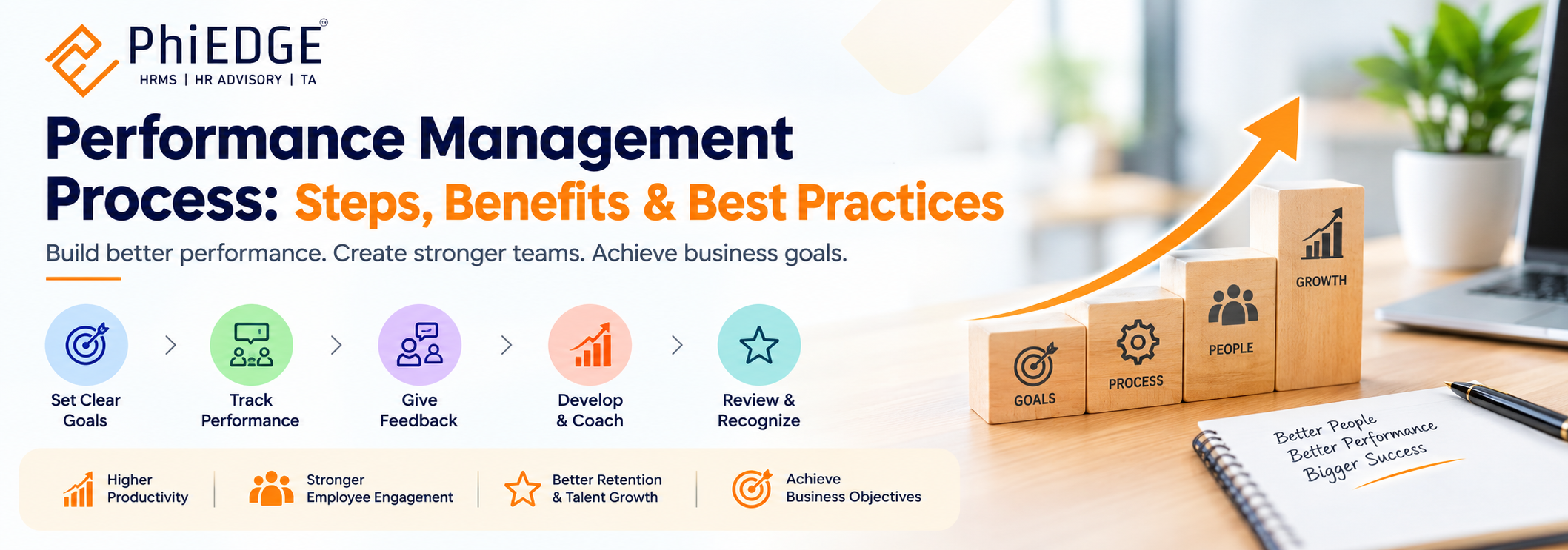
    The performance management process is a continuous framework used to plan, monitor, evaluate and improve employee performance in alignment with organizational goals.

    It helps managers communicate expectations, assess progress, recognize achievements and identify opportunities for improvement. Rather than treating performance appraisal as a one-time event, this process encourages ongoing conversations between employees and managers.

    For example, a sales team may establish quarterly revenue targets, monitor progress through KPIs, review performance during monthly meetings and provide coaching when an employee needs additional support.

    The objective is to create clarity, accountability and opportunities for professional growth while helping the organization achieve its strategic goals.

    Why Is the Performance Management Process Important?

    A well-designed process provides several benefits:

    • Clear expectations: Employees understand their responsibilities, targets and performance standards.
    • Better productivity: Regular goal tracking helps identify delays, obstacles and areas that need improvement.
    • Continuous employee development: Managers can identify skill gaps and recommend relevant training.
    • Fairer evaluations: Documented objectives and consistent evaluation criteria support more transparent decisions.
    • Employee engagement: Constructive feedback and recognition help employees understand the value of their contributions.
    • Data-informed decisions: Performance records help HR teams identify workforce trends and development needs.

    These benefits depend on how consistently the process is implemented. Software can support the workflow, but effective management also requires clear communication, appropriate metrics and responsible decision-making.

    What Are the 7 Steps in the Performance Management Process?

    1. Set Clear Goals and Performance Expectations

    The first step is to establish measurable goals that connect individual responsibilities with departmental and organizational objectives.

    Managers can use SMART goals—Specific, Measurable, Achievable, Relevant and Time-bound—to make expectations clear.

    For example, a customer support employee might aim to resolve a defined percentage of eligible customer queries within the agreed service timeframe while maintaining quality standards.

    Goals should be realistic, role-specific and discussed with employees before the performance cycle begins.

    2. Define KPIs and Success Metrics

    Key Performance Indicators (KPIs) help organizations measure progress against established objectives.

    The right KPIs depend on the employee’s role. Sales teams may track revenue and conversion rates, while customer support teams may measure resolution time, customer satisfaction and quality scores.

    Organizations should avoid measuring performance through numbers alone. Quality, collaboration, compliance, customer experience and other role-specific factors may also be important.

    A well-defined KPI framework makes performance expectations more objective and easier to review.

    3. Monitor Performance and Progress Regularly

    Performance monitoring helps managers understand whether employees are progressing toward their goals.

    Instead of waiting until the end of the year, managers can conduct weekly check-ins, monthly reviews or quarterly progress discussions, depending on the nature of the work.

    These conversations should focus on achievements, obstacles, changing priorities and the support employees need.

    A performance management system can help centralize goals, progress updates and review records, reducing dependence on disconnected spreadsheets and manual follow-ups.

    4. Provide Continuous Feedback and Recognition

    Feedback should be timely, specific and constructive. Employees need to understand what they are doing well, what needs improvement and how they can improve.

    For example, instead of saying, “Your performance needs improvement,” a manager could explain which project milestone was missed, discuss the underlying challenge and agree on practical next steps.

    Recognition is equally important. Acknowledging meaningful contributions can reinforce positive behaviours and encourage employees to maintain high standards.

    Regular feedback also helps prevent misunderstandings from building up over an entire appraisal cycle.

    5. Conduct Structured Performance Reviews

    Performance reviews bring together goals, KPI results, feedback and relevant evidence to evaluate progress over a defined period.

    Depending on the organization’s requirements, the process may include self-assessments, manager evaluations, competency assessments and 360-degree feedback.

    Managers should use consistent criteria and consider the context behind the results. For example, changes in responsibilities, resource limitations or revised business priorities may influence an employee’s outcomes.

    A structured review should end with a clear discussion of achievements, improvement areas and future expectations—not merely a rating.

    6. Create Employee Development and Improvement Plans

    Performance management should help employees develop their capabilities, not just identify shortcomings.

    Based on review outcomes, managers can recommend training, mentoring, stretch assignments, competency development or an individual development plan.

    When an employee is not meeting expectations, a Performance Improvement Plan (PIP) may be appropriate. It should clearly define the improvement areas, support available, measurable expectations and review timeline.

    Development plans should be practical, documented and reviewed regularly so employees understand how progress will be assessed.

    7. Review Outcomes and Plan the Next Performance Cycle

    The final step is to evaluate the effectiveness of the performance cycle and prepare for the next one.

    HR teams and managers can review goal completion, feedback quality, development progress and recurring performance gaps. They can also identify employees who may benefit from new responsibilities or additional development opportunities.

    The findings should inform future goal setting, training priorities and workforce planning.

    This creates a continuous cycle in which planning, monitoring, evaluation and development reinforce one another.

    How Does Performance Management Software Improve the Process?

    Managing goals, reviews and feedback through separate spreadsheets can become difficult as organizations grow. Performance management software helps centralize information and organize recurring workflows.

    Depending on the platform and its configuration, useful capabilities may include:

    • Goal setting and KPI tracking
    • Performance review scheduling
    • Employee self-assessments
    • Continuous feedback and recognition
    • 360-degree feedback
    • Competency assessments
    • Performance dashboards and reports
    • Development planning and follow-up workflows

    Phi EDGE HRMS provides performance management capabilities alongside related modules such as 360-degree feedback, competency management, learning and development, and succession and career planning.

    Organizations evaluating a performance management system should assess its functionality, reporting, integration requirements, data security, ease of use and suitability for their existing HR processes.

    Explore the Phi EDGE HRMS platform to learn more about its workforce management solutions.

    What Are the Best Practices for an Effective Performance Management Process?

    To make the process useful and consistent, organizations should:

    1. Align individual goals with business priorities.
    2. Communicate expectations before the performance cycle starts.
    3. Select relevant, measurable and role-specific KPIs.
    4. Train managers to provide constructive and unbiased feedback.
    5. Hold regular check-ins rather than relying exclusively on annual reviews.
    6. Document performance discussions and agreed actions.
    7. Use consistent evaluation criteria across comparable roles.
    8. Connect reviews with training, career development and recognition.
    9. Protect employee information and restrict access to authorized users.
    10. Review the process periodically and improve it using employee and manager feedback.

    The most effective approach balances measurable outcomes with employee development, context and fairness.

    How Can AI and HRMS Technology Support Performance Management?

    AI-enabled HR technology can assist with selected activities such as summarizing feedback, identifying trends, organizing performance information and supporting goal development, depending on the platform’s capabilities.

    However, AI-generated insights should be treated as decision support rather than unquestionable conclusions. Performance evaluations can be influenced by incomplete data, inconsistent manager inputs or historical bias.

    Organizations should validate outputs, protect employee data, communicate how information is used and retain appropriate human oversight for consequential decisions.

    Technology is most valuable when it makes the process more transparent, consistent and useful for both employees and managers.

    Frequently Asked Questions

    What are the main stages of the performance management process?

    The main stages are goal setting, KPI definition, performance monitoring, continuous feedback, formal performance reviews, employee development and planning for the next performance cycle.

    How often should performance management be conducted?

    Performance management should be continuous. Organizations can combine regular check-ins with monthly or quarterly progress reviews and a formal annual or semi-annual appraisal, depending on their business requirements.

    What is the difference between performance management and performance appraisal?

    Performance management is the ongoing process of setting goals, monitoring progress, providing feedback and supporting development. Performance appraisal is a formal evaluation conducted at a specific point in that process.

    Which KPIs should organizations use to measure employee performance?

    KPIs should reflect each role’s responsibilities. Examples include sales conversion, project delivery, customer satisfaction, service quality and productivity. Organizations should also consider collaboration, compliance and qualitative contributions where relevant.

    Can performance management software automate employee reviews?

    Many platforms can automate parts of the review workflow, including reminders, review forms, feedback collection and reporting. The exact capabilities depend on the software and its configuration. Managers should still review evidence and make appropriate decisions.

    How does Phi EDGE support performance management?

    Phi EDGE HRMS offers performance management capabilities alongside related HR modules, including KPI-oriented processes, 360-degree feedback, competency management and employee development. Organizations should review the platform’s current features and request a demonstration to determine whether it meets their requirements.

    Conclusion

    An effective performance management process connects employee goals with organizational priorities through clear expectations, measurable KPIs, regular feedback, structured reviews and ongoing development.

    When these activities are supported by suitable HR technology and consistent management practices, organizations can improve visibility into employee performance and make more informed workforce decisions.

    Phi EDGE HRMS offers an integrated approach to workforce and performance management. Explore the official Phi EDGE website to learn more about its HRMS solutions and assess their suitability for your organization.

    Looking to structure your employee performance management process? Connect with Phi EDGE to discuss your HR technology requirements.

  • HR Software and Payroll: Features, Benefits & Guide | Phi EDGE

    HR Software and Payroll: Features, Benefits & Guide | Phi EDGE

    Managing employees, processing salaries, tracking attendance, and maintaining payroll records can become challenging as a business grows. When these activities depend on spreadsheets and disconnected systems, HR teams may spend more time on repetitive administration and less time supporting employees and business goals.

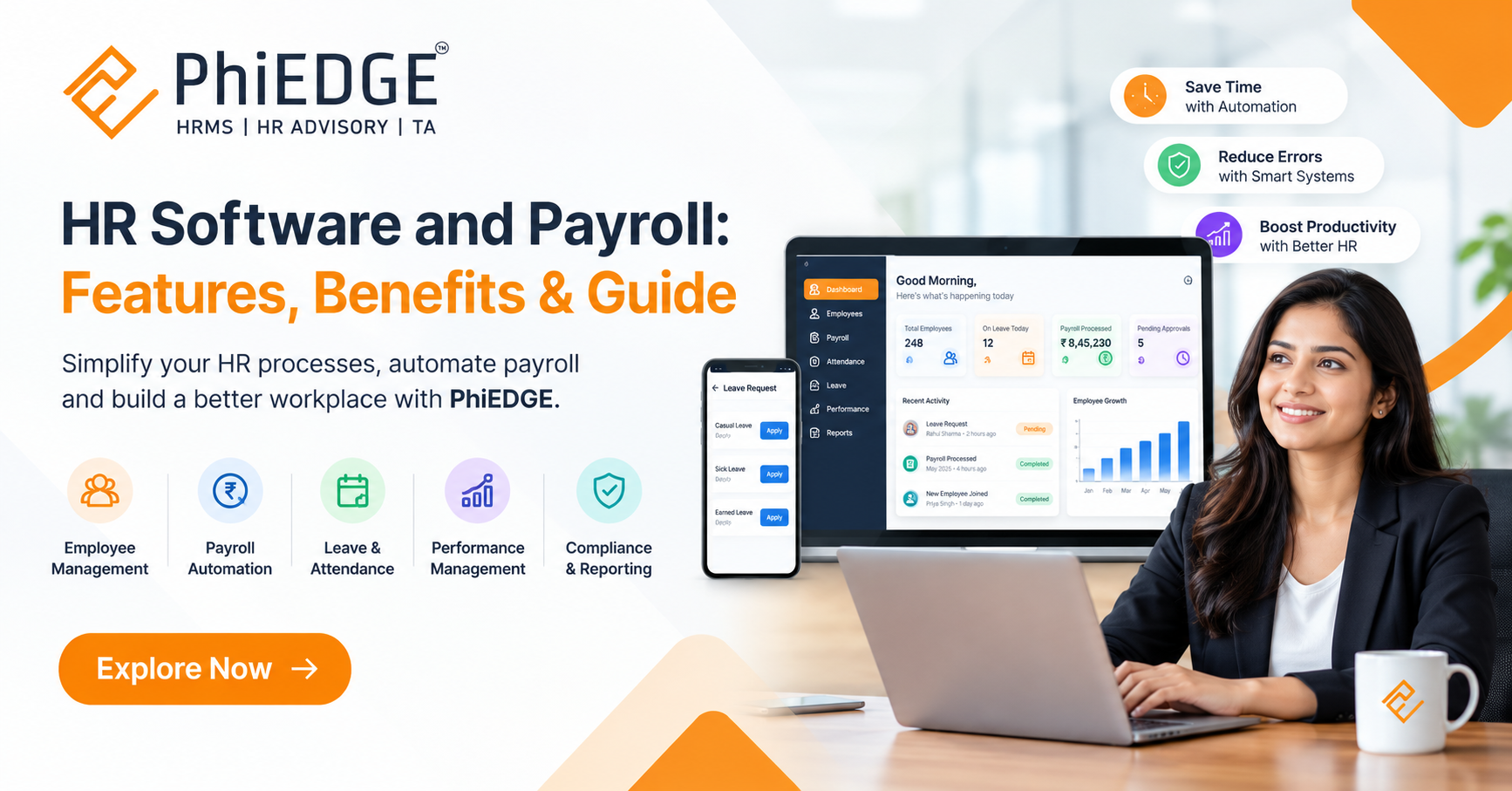
    HR software and payroll solutions help organizations bring employee information and salary-related processes into a more structured digital workflow. By connecting HR operations with payroll management, businesses can improve data consistency, reduce repetitive work, and make more informed workforce decisions.

    In this guide, we explain how HR and payroll software works, which features matter most, and how businesses can evaluate a solution such as Phi EDGE HRMS.

    What Is HR Software and Payroll?

    HR software is a digital system that helps organizations manage employee information and human resource activities. Payroll software focuses on calculating employee salaries, deductions, allowances, bonuses, and payslips.

    When these functions work together, HR teams can use employee records, attendance information, leave balances, and salary structures more consistently throughout the payroll cycle.

    For example, approved leave and attendance records may be used to calculate loss of pay, subject to the organization’s policies and configured rules. This reduces the need to enter the same information into multiple systems.

    An integrated HRMS can also connect payroll with broader processes such as performance management, employee lifecycle management, increments, and variable pay.

    Why Do Businesses Need HR and Payroll Software?

    Manual HR administration becomes more difficult as employee numbers, locations, and compensation structures increase.

    Here are some common challenges that HR software and payroll systems can help address:

    • Repeated data entry: Employee information may be maintained in multiple spreadsheets.
    • Payroll calculation errors: Incorrect attendance, leave, or salary inputs can affect payroll accuracy.
    • Time-consuming approvals: HR teams may need to follow up manually for leave, attendance corrections, and other requests.
    • Limited reporting: Managers may struggle to obtain timely workforce information.
    • Compliance-related workload: Payroll teams must maintain appropriate records and follow applicable statutory requirements.

    HR and payroll software helps organize these processes in one workflow. However, results depend on correct configuration, accurate employee data, and regular review by authorized HR or payroll professionals.

    What Are the Key Features of HR Software and Payroll Systems?

    1. Employee Information Management

    A centralized employee database helps HR teams maintain employee profiles, job details, reporting structures, and relevant employment records.

    Authorized users can access the information they need without searching through multiple files. Role-based permissions and appropriate access controls are important because employee records contain confidential information.

    2. Automated Payroll Processing

    Payroll management software supports salary calculations using configured salary components, allowances, deductions, bonuses, and approved adjustments.

    Depending on the solution and its configuration, payroll workflows may include:

    • Salary structure management
    • Monthly payroll processing
    • Payslip generation
    • Tax-related calculations
    • Payroll reports and bank transfer files
    • Full-and-final settlement support

    Automation can reduce repetitive calculations, but payroll should still be reviewed before final approval and disbursement.

    3. Leave and Attendance Integration

    Attendance and leave data can influence payroll calculations. An integrated system can help HR teams track attendance, approved leave, overtime where applicable, and loss-of-pay adjustments.

    Before payroll is processed, organizations should validate attendance records, leave approvals, shift rules, and exceptions to avoid incorrect salary outcomes.

    4. Statutory Payroll Support

    Indian employers may need to manage applicable obligations relating to provident fund, employee state insurance, professional tax, tax deduction at source, and other statutory requirements.

    The exact obligations depend on factors such as the establishment, employee eligibility, applicable law, and current regulations.

    HR software can support calculations, records, and reporting. Employers should verify legal requirements through official sources such as the Employees’ Provident Fund Organisation and the Income Tax Department.

    5. Performance and Compensation Management

    Payroll does not operate independently of other HR functions. Increment decisions, variable pay, bonuses, and approved compensation changes can affect employee salary records.

    Connecting compensation workflows with performance management can help organizations maintain a more consistent process for reviewing and implementing approved changes.

    6. Reports and Workforce Insights

    HR dashboards and reports help authorized decision-makers review workforce information, payroll summaries, employee trends, and other available metrics.

    Useful reports may include employee headcount, payroll cost, attendance exceptions, compensation changes, and attrition trends. These insights can support workforce planning when the underlying data is accurate and interpreted in context.

    How Does Integrated HR and Payroll Software Improve Efficiency?

    Consider an organization that collects attendance data separately, calculates salaries in spreadsheets, and sends payslips manually.

    Every additional step creates an opportunity for duplicated work or inconsistent information.

    With an integrated HRMS, the workflow can be more structured:

    1. Employee information is maintained in a centralized system.
    2. Attendance and leave records are updated and approved.
    3. Payroll uses the relevant employee and attendance data.
    4. HR or payroll professionals review exceptions and calculations.
    5. Approved payroll outputs and payslips are generated.
    6. Reports support reconciliation and management review.

    The benefit is not simply faster processing. It is a clearer workflow, better visibility, and more consistent handling of employee information.

    How Can You Choose the Right HR Software and Payroll Solution?

    Before selecting a platform, assess your organization’s requirements rather than choosing software based on feature lists alone.

    Evaluate these factors:

    • Business requirements: Identify your current HR and payroll challenges.
    • Integration capabilities: Check whether the software supports the attendance, accounting, or other systems you use.
    • Compliance configuration: Confirm how applicable payroll rules, updates, and reports are managed.
    • Data security: Review access controls, data protection, backups, and vendor security practices.
    • Reporting: Ensure that HR teams can access relevant operational and management reports.
    • Scalability: Consider future employee growth and additional HR requirements.
    • Implementation and support: Understand onboarding, configuration, training, and ongoing assistance.
    • Total cost: Compare licensing, implementation, integrations, maintenance, and support costs.

    Request a demonstration using realistic business scenarios. Ask the vendor to explain how employee data flows into payroll, how exceptions are handled, and which tasks still require manual review.

    How Does Phi EDGE HRMS Support HR and Payroll Management?

    Phi EDGE offers HRMS and payroll capabilities designed to support connected human resource processes.

    Its payroll solution describes features including salary structure management, payroll processing, payslip generation, tax calculations, and integration with attendance and leave information. The broader HRMS offering includes performance management, increments, variable pay, learning and development, employee lifecycle management, and talent management.

    Organizations evaluating an integrated solution can explore the Phi EDGE Payroll Management Software page to understand the available capabilities.

    The appropriate configuration will depend on an organization’s workforce, existing systems, payroll requirements, and implementation needs. Businesses should confirm specific integrations, compliance workflows, and features directly with the Phi EDGE team before making a purchasing decision.

    What Results Should Businesses Expect From HR and Payroll Software?

    The expected benefits depend on the organization’s existing processes and how effectively the software is implemented.

    Businesses may aim to reduce repetitive data entry, improve payroll review processes, make employee information easier to access, and create more consistent HR workflows.

    A useful way to measure progress is to establish a baseline before implementation. Track payroll processing time, correction frequency, approval turnaround time, and the number of manual steps involved in routine HR activities.

    Comparing these measures after implementation can help determine whether the solution is delivering practical value.

    Frequently Asked Questions About HR Software and Payroll

    What is the difference between HR software and payroll software?

    HR software supports employee records, HR administration, performance, leave, and other workforce processes. Payroll software focuses on salary calculations, deductions, payslips, and payroll-related records. An integrated HRMS may combine both.

    Can HR software automate salary calculations?

    Yes. Depending on the system and configuration, it can calculate salaries using defined salary components, approved attendance data, deductions, and other payroll inputs. Human review remains important for exceptions and final approval.

    Is HR and payroll software suitable for growing businesses?

    It can be useful for growing businesses that need consistent employee records and repeatable payroll processes. The right solution depends on employee numbers, business complexity, budget, and integration requirements.

    Does payroll software help with statutory compliance in India?

    It can support relevant calculations, reports, and recordkeeping. However, software alone does not guarantee compliance. Employers must verify applicable rules, maintain accurate data, and review statutory obligations.

    How do I evaluate Phi EDGE HRMS?

    Review the Phi EDGE website, explore its payroll solution, and request a demonstration. Discuss your workforce structure, payroll workflow, integrations, reporting requirements, and implementation expectations.

    Client Testimonials and Customer Experience

    Customer feedback can help businesses understand how an HRMS performs in real working environments. For a useful testimonial, include the customer’s name and designation only with permission, along with their organization and the specific workflow they evaluated.

    Recommended testimonial format:

    “[Insert an approved customer statement describing their experience with Phi EDGE HRMS, the HR or payroll challenge addressed, and the outcome they can substantiate.]”

    Customer name: [Verified customer name]

    Designation and organization: [Verified designation and company]

    Publish this section only after obtaining an authentic customer statement and approval to use it. Do not present illustrative text as a genuine testimonial.

    Conclusion: Build More Consistent HR and Payroll Processes

    HR software and payroll systems can help organizations manage employee information, salary processing, attendance, and HR workflows more consistently. The strongest results come from choosing software that fits business requirements, maintaining accurate records, and combining automation with appropriate review.

    For businesses exploring integrated HR management, Phi EDGE HRMS offers a starting point for evaluating payroll and connected workforce capabilities.

    Explore Phi EDGE Payroll Management Software or visit Phi EDGE to learn more and request a product demonstration.

  • Payroll HRMS Software: Features, Benefits and How to Choose the Right Solution

    Payroll HRMS Software: Features, Benefits and How to Choose the Right Solution

    Managing employee salaries involves much more than transferring money at the end of the month. HR teams must coordinate employee records, attendance, leave, salary structures, deductions, approvals and payroll reports. As a business grows, managing these activities through disconnected spreadsheets and manual calculations can become increasingly difficult.

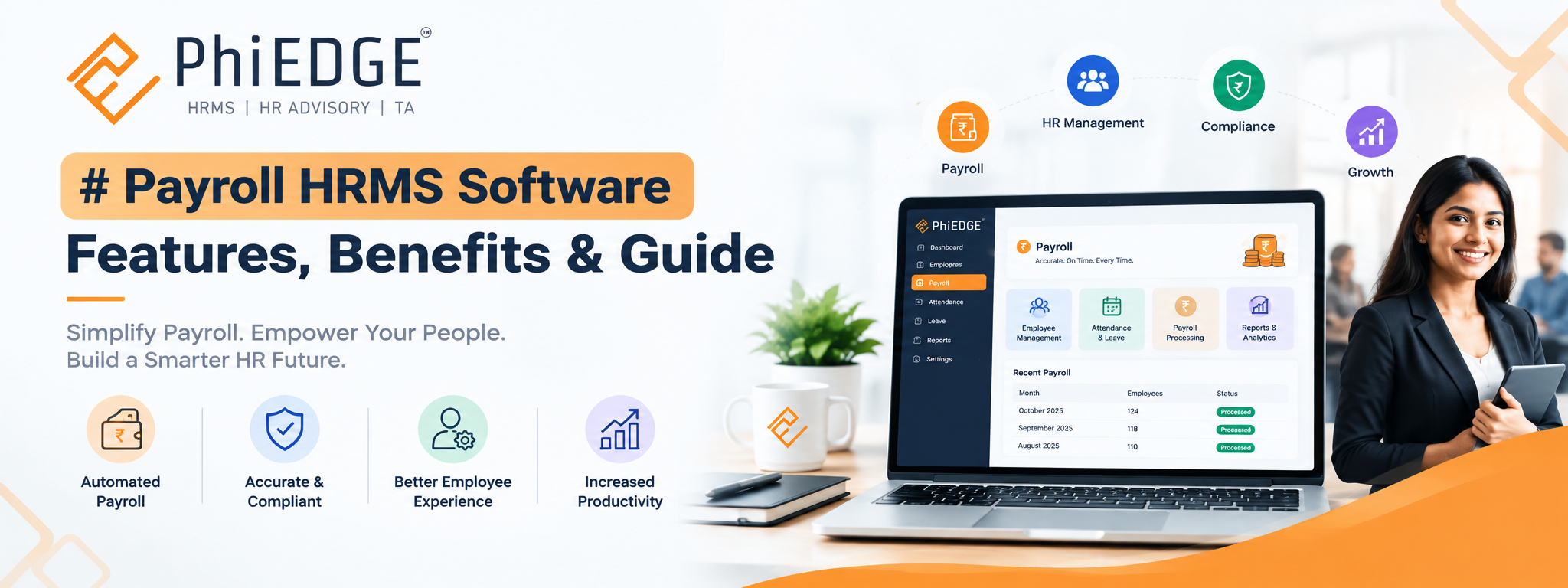
    Payroll HRMS software helps organizations bring payroll-related information and HR processes into a more organized digital workflow. When payroll is integrated with attendance, leave management and employee records, HR teams can work with consistent information and reduce repetitive administrative tasks.

    In this guide, we explain how payroll HRMS software works, its essential features, its benefits for Indian businesses and what organizations should consider before choosing a solution such as Phi EDGE HRMS.

    What Is Payroll HRMS Software?

    Payroll HRMS software is a digital system that helps businesses manage employee salary processing alongside other human resource activities. HRMS stands for Human Resource Management System.

    A payroll management system can support salary calculations, earnings and deductions, payslip preparation and payroll reporting. When integrated with a broader HRMS platform, payroll processes can use relevant employee, attendance and leave information from a centralized system.

    For example, an HR team can maintain employee records, review attendance data, process approved salary changes and prepare payroll reports through connected workflows instead of relying on multiple disconnected files.

    The exact features available depend on the software and its configuration.

    Why Do Businesses Need Payroll HRMS Software?

    Manual payroll management can become complicated when an organization has multiple departments, different salary structures, shift-based employees or several office locations.

    Common challenges include inconsistent employee records, missing attendance information, repeated data entry, delayed approvals and difficulty reviewing payroll reports.

    Payroll HRMS software can help address these challenges by organizing payroll information, supporting repeatable processes and improving visibility into payroll-related activities.

    Businesses should still establish appropriate approval controls, review calculations and verify statutory requirements. Automation supports payroll operations, but it does not eliminate the need for human oversight.

    What Are the Key Features of Payroll HRMS Software?

    1. Employee Information Management

    Payroll processing depends on accurate employee information. A connected HRMS can help maintain employee details, employment records, salary structures and other relevant information in a centralized system.

    Authorized HR personnel can review and update records according to established company procedures.

    2. Attendance and Leave Integration

    Attendance and leave information can affect payable days, approved leave adjustments and other salary components, depending on company policy.

    Integrating these records with payroll can reduce duplicate data entry and help HR teams identify discrepancies before payroll is finalized.

    3. Salary Processing and Payslips

    Payroll software can support the calculation and organization of salary components, approved deductions, incentives and other applicable payments.

    It can also help generate employee payslips and payroll reports. Organizations should verify the software’s support for their specific salary structures, approval workflows and reporting requirements before implementation.

    4. Payroll Compliance Support

    Businesses operating in India may need to account for applicable provident fund, employee state insurance, professional tax, tax deductions and other statutory obligations, depending on employee eligibility and the organization’s circumstances.

    Payroll HRMS software can support relevant calculations, records and reports where those capabilities are available. Employers remain responsible for verifying current rules, eligibility conditions, filing obligations and payment deadlines.

    Useful official references include the Employees’ Provident Fund Organisation, the Employees’ State Insurance Corporation and the Income Tax Department.

    5. Payroll Reports and Analytics

    Payroll reports help HR teams review salary costs, deductions, employee-level records and other payroll information.

    Depending on the platform, reporting tools can help management review workforce costs and identify inconsistencies that require investigation. Access to sensitive payroll information should be restricted to authorized users.

    How Does Payroll HRMS Software Improve HR Efficiency?

    Payroll HRMS software can improve efficiency by connecting information that HR teams otherwise manage separately.

    For example, an organization may use attendance records to prepare payroll inputs, route salary changes through an approval process and generate reports after payroll review. These workflows can reduce repetitive tasks and make responsibilities easier to track.

    The benefits depend on data quality, software configuration, employee adoption and the effectiveness of the organization’s existing processes. Businesses should measure improvements through relevant indicators, such as payroll processing time, correction rates and the number of manual steps required each month.

    How Should You Choose the Right Payroll HRMS Software in India?

    Before selecting a payroll management system, businesses should evaluate their operational requirements rather than choosing software based on feature lists alone.

    Consider the following questions:

    • Does the software support your employee strength and salary structures?
    • Can attendance, leave and employee information connect with payroll?
    • Does it support the statutory calculations and reports your organization requires?
    • Can payroll data be reviewed and approved before finalization?
    • What access controls and security measures protect sensitive employee information?
    • Can the system integrate with your existing HR or finance applications?
    • What implementation, training and ongoing support are available?
    • Can the solution accommodate future workforce growth?

    Request a demonstration using representative business scenarios. Ask the provider to explain how the system handles exceptions, corrections, approvals, data migration and compliance updates.

    How Can Phi EDGE HRMS Support Payroll and HR Management?

    Phi EDGE HRMS offers a broader human resource management platform with a listed Payroll module and other HR capabilities, including performance management, employee records, leave and attendance management, and related workforce processes.

    For organizations evaluating payroll HRMS software, an integrated approach can help connect payroll with relevant employee information and HR workflows.

    The suitability of Phi EDGE HRMS for a particular organization depends on its payroll requirements, configuration and the specific capabilities confirmed during a product demonstration. Businesses should discuss their statutory reporting needs, integrations, data security requirements and implementation process with the Phi EDGE team before making a decision.

    Explore the Phi EDGE official website to learn more about its HRMS solutions.

    Frequently Asked Questions About Payroll HRMS Software

    What is the difference between payroll software and HRMS software?

    Payroll software focuses primarily on salary processing, deductions, payslips and payroll reports. HRMS software covers a broader range of HR activities, which may include employee records, attendance, leave management and performance processes. An integrated HRMS may include payroll as one of its modules.

    Is payroll HRMS software suitable for small and medium-sized businesses?

    It can be suitable for small and medium-sized businesses that need more structured payroll processes. The right solution depends on employee strength, salary complexity, compliance requirements, budget and the level of support needed.

    Can payroll HRMS software automate salary calculations?

    Many payroll systems support automated calculations based on configured salary structures, approved payroll inputs and applicable rules. HR teams should validate the calculations, review exceptions and approve payroll before payments are processed.

    Does payroll HRMS software support statutory compliance in India?

    Some solutions support relevant statutory calculations, records and reports. Businesses must confirm which requirements are supported and independently ensure that their processes meet applicable laws and deadlines.

    How can a company evaluate Phi EDGE HRMS?

    A business can review the official product information and request a demonstration. During the demo, it should assess payroll workflows, attendance integration, reporting, access controls, implementation support and compatibility with its specific requirements.

    Conclusion

    Payroll HRMS software can help businesses organize salary processing, connect payroll with employee information and establish more consistent HR workflows. The most appropriate solution is one that fits the organization’s operational requirements, supports accurate processing and provides suitable controls for sensitive employee data.

    Phi EDGE HRMS is an option for businesses exploring integrated HR management capabilities. Before selecting a platform, review its relevant features, verify compliance requirements and request a demonstration based on your actual payroll scenarios.

    Interested in exploring HRMS solutions for your organization? Visit the Phi EDGE website to learn more and enquire about a product demonstration.

  • HRMS Software in India: Features, Benefits & Guide | Phi EDGE

    HRMS Software in India: Features, Benefits & Guide | Phi EDGE

    Managing employees efficiently is essential for businesses that want to improve productivity, maintain accurate HR records and make informed workforce decisions. As organisations grow, manual spreadsheets and disconnected HR tools can make employee management increasingly complicated.

    HRMS software in India helps organisations centralise HR processes such as employee information, leave and attendance, performance management, payroll coordination and talent development. The right system can reduce repetitive administrative work and help HR teams focus on employee experience and business growth.

    Phi EDGE HRMS provides an integrated approach to workforce management, with modules supporting employee performance, increments, payroll, learning and development, succession planning and other HR functions.

    What Is HRMS Software?

    A Human Resource Management System (HRMS) is software that helps organizations manage employee-related information and HR workflows through a centralized digital platform.

    Depending on the solution, an HRMS can support employee onboarding, attendance, leave management, performance reviews, compensation processes, employee self-service, and workforce reporting.

    Instead of maintaining separate spreadsheets for different HR activities, businesses can use connected workflows to improve visibility, consistency and coordination across departments.

    Why Do Businesses in India Need HRMS Software?

    Businesses in India may have to manage distributed teams, multiple locations, employee records, payroll inputs, leave policies and changing workforce requirements. Manual processes can make these activities difficult to coordinate.

    HRMS software can help organisations:

    • Centralise employee records: Maintain employee information in a structured system with appropriate access controls.
    • Improve HR efficiency: Reduce repetitive data entry and manual follow-ups.
    • Streamline leave and attendance: Standardize leave requests, approvals, and attendance records.
    • Support performance management: Organise goals, reviews, feedback and performance tracking.
    • Improve workforce visibility: Use relevant reports to understand employee and organizational trends.
    • Support informed decisions: Make workforce information easier to access for authorised decision-makers.

    Actual results depend on implementation quality, data accuracy, employee adoption and the features available in the selected software.

    What Features Should You Look for in HRMS Software in India?

    Choosing an HRMS requires more than comparing the number of features. Businesses should evaluate whether the software addresses their specific operational requirements.

    1. Employee Information Management

    An HRMS should help maintain structured employee records, job details, reporting relationships and relevant employment information. Access permissions and data protection measures are essential when handling sensitive employee data.

    2. Leave and Attendance Management

    Look for configurable leave policies, approval workflows, attendance records and reporting capabilities. Organisations with multiple offices or shift-based teams should evaluate how well the software supports their working arrangements.

    3. Payroll and Compensation Workflows

    Payroll-related features can help organise salary information, payroll inputs, deductions and approval processes. Before selecting a system, confirm which calculations and statutory requirements it supports and whether additional configuration or integration is needed.

    4. Performance Management Software

    Performance management features can support goal setting, periodic reviews, KPI tracking and feedback. These tools help managers create more structured review processes and connect employee objectives with organisational priorities.

    5. Learning and Development

    Learning and development tools can help HR teams organise employee development activities, identify skill gaps and support career progression.

    6. Succession and Career Planning

    Succession planning helps organisations identify critical roles, assess talent readiness and plan future leadership requirements. Career planning tools can help structure employee development pathways.

    7. Analytics and Reporting

    Useful reports should help authorised users understand workforce trends, performance indicators and operational requirements. Data quality, clear definitions and appropriate access permissions are important for meaningful reporting.

    How Can AI HRMS Software Improve HR Operations?

    AI-enabled HRMS capabilities can assist with selected HR workflows, depending on how the product is designed and implemented.

    Potential applications include generating interview questions, supporting KPI creation, organising workforce information and assisting with analytical tasks. Phi EDGE’s published content describes capabilities including AI Interview, AI Requirements and AI KPI Generator.

    Businesses should evaluate these features through a product demonstration and ask how the system validates outputs, protects employee information and keeps human decision-makers involved.

    AI-generated recommendations should not automatically replace professional judgement, especially in recruitment, performance evaluation or other decisions affecting employees.

    How Do You Choose the Right HRMS Software Company in India?

    Before selecting a vendor, follow a structured evaluation process.

    Step 1: Define your requirements. List the HR processes that need improvement and identify essential versus optional features.

    Step 2: Assess integration needs. Check compatibility with existing payroll, accounting, attendance and business systems.

    Step 3: Review data security. Ask about access controls, data handling, security practices, backups and incident management.

    Step 4: Understand implementation. Discuss migration, configuration, employee training, support and expected timelines.

    Step 5: Compare total costs. Evaluate licensing, implementation, integrations, support and any additional charges.

    Step 6: Request a demonstration. Test important workflows using realistic business scenarios and assess whether the software meets your requirements.

    Step 7: Measure success. Establish baseline metrics such as HR processing time, data correction rates, employee adoption and review completion rates.

    Why Consider Phi EDGE HRMS?

    Phi EDGE HR Tech Pvt. Ltd. offers HRMS software alongside HR advisory and talent acquisition services. Its published platform information describes modules for performance management, increments, variable pay, learning and development, employee self-service, payroll, leave and attendance, succession planning and other workforce processes.

    Organisations evaluating Phi EDGE can review the available modules, discuss their specific requirements and request a demonstration to understand product suitability.

    The right solution will depend on company size, workforce structure, existing systems, implementation requirements and business priorities.

    What Should You Check Before Implementing HRMS Software?

    Successful implementation requires preparation beyond installing software.

    • Clean and validate existing employee data before migration.
    • Assign responsibilities for configuration and approvals.
    • Establish clear employee access permissions.
    • Train HR teams, managers and employees.
    • Test workflows before organisation-wide deployment.
    • Review reports and resolve data inconsistencies.
    • Monitor adoption and collect feedback after launch.

    A phased implementation can help organisations identify issues early and improve the employee experience.

    Frequently Asked Questions About HRMS Software in India

    What is the best HRMS software in India?

    The best HRMS depends on your organisation’s size, required modules, integrations, security expectations, budget and support needs. Compare relevant solutions through feature assessments and product demonstrations rather than relying only on rankings.

    What is the difference between HRMS and HRIS?

    HRIS commonly refers to systems focused on employee information and core HR administration. HRMS may cover a broader range of HR workflows, including performance, compensation and talent management. The exact scope varies by vendor.

    Can HRMS software help automate payroll?

    Some HRMS platforms provide payroll functionality or integrations that support payroll workflows. Confirm the specific calculations, integrations, statutory requirements and approval controls available in the chosen solution.

    Is AI HRMS software suitable for every company?

    Not necessarily. AI-enabled features are most useful when they solve a defined business problem and can be implemented with appropriate privacy, security, oversight and quality controls.

    How can a business evaluate Phi EDGE HRMS?

    Review the available modules, explain your HR requirements to the team and request a demonstration. Ask about integrations, implementation, support, security and the functionality included in the proposed solution.

    Conclusion

    Selecting the right HRMS software in India can help organisations build more consistent HR processes, improve workforce visibility and support employee development. A careful evaluation of features, implementation requirements, data security and long-term business needs is essential.

    Phi EDGE HRMS is one option businesses can explore when evaluating integrated workforce management and talent-related solutions.

    Ready to evaluate your HR requirements? Visit the official Phi EDGE website or contact its team to discuss your needs and request a product demonstration.

    Explore Phi EDGE HRMS

    Contact the Phi EDGE team

  • Performance Appraisal System: Benefits & Best Practices | Phi EDGE

    Performance Appraisal System: Benefits & Best Practices | Phi EDGE

    Choosing the right performance appraisal system is essential to building a transparent, accountable, and growth-oriented workplace. As organizations expand, managing employee goals, performance reviews, feedback, and development through spreadsheets can become difficult. A structured performance appraisal system helps HR teams and managers organize these activities and make more informed people-management decisions.

    For businesses looking to improve their performance review process, the right software should do more than assign employee ratings. It should connect individual goals with business objectives, support constructive feedback, and help employees identify opportunities for professional development.

    What Is a Performance Appraisal System?

    A performance appraisal system is a structured process used to evaluate employee performance against defined goals, responsibilities, competencies, and organizational expectations. When supported by performance appraisal software, it can help automate review cycles, record feedback, track KPIs, and maintain performance records in one place.

    A modern employee performance management system may include goal setting, self-appraisals, manager evaluations, 360-degree feedback, performance reports, and employee development plans.

    The purpose is not simply to rate employees. It is to understand their contributions, recognize achievements, identify skill gaps, and establish clear improvement goals.

    Why Does a Company Need a Performance Appraisal System?

    Manual appraisal processes can create challenges for growing organizations. HR teams may spend considerable time collecting spreadsheets, sending reminders, consolidating ratings, and preparing reports.

    A digital performance appraisal system can help organizations address these challenges through:

    • Structured evaluations: Apply clearly defined criteria across roles and departments.
    • Goal alignment: Connect employee objectives with organizational priorities.
    • Timely feedback: Encourage regular discussions between managers and employees.
    • Performance visibility: Maintain organized records of goals, reviews, and development areas.
    • Better talent decisions: Support evidence-based discussions about training, recognition, and career progression.
    • Reduced administration: Automate repetitive review-cycle tasks where supported by the software.

    The Chartered Institute of Personnel and Development (CIPD) emphasizes that effective performance management combines objectives, feedback, development, and performance reviews rather than treating appraisal as an isolated annual activity.

    Reference: CIPD Performance Management Guide.

    What Features Should You Look for in Performance Appraisal Software?

    Before selecting a performance appraisal system for your company, assess whether its features match your workforce, review policies, and reporting requirements.

    1. Goal Setting and KPI Tracking

    The software should support measurable employee goals, Key Performance Indicators (KPIs), and Key Result Areas (KRAs), where appropriate. Clear objectives help employees understand expectations and give managers a consistent basis for evaluating progress.

    2. Employee Self-Appraisal

    Self-appraisal allows employees to document achievements, challenges, and development needs before a formal review. It can encourage more balanced conversations between employees and managers.

    3. Manager Reviews and 360-Degree Feedback

    Manager evaluations provide role-specific feedback, while 360-degree feedback can gather perspectives from relevant colleagues, team members, or other stakeholders. Organizations should choose the approach that fits their culture and job responsibilities.

    4. Flexible Appraisal Cycles

    Different businesses need different review schedules. Depending on company policy, software may support monthly check-ins, quarterly reviews, half-yearly assessments, or annual appraisals.

    5. Performance Reports and Analytics

    Reports can help HR teams review goal completion, performance ratings, departmental trends, and development needs. Access controls and clear evaluation criteria are important when handling sensitive employee information.

    6. Integration with HRMS Modules

    An integrated HRMS platform may connect performance management with employee records, learning and development, increments, succession planning, and other HR processes. Confirm which integrations are available and whether they meet your technical requirements.

    How Can a Company Implement a Performance Appraisal System Successfully?

    Buying software is only one part of successful performance management. Companies also need a consistent process and trained managers.

    Step 1: Define appraisal objectives. Decide whether the priority is goal tracking, employee development, feedback, career progression, or a combination of these outcomes.

    Step 2: Establish measurable criteria. Define role-specific KPIs, KRAs, competencies, and evaluation guidelines.

    Step 3: Communicate expectations. Explain the review process, timelines, rating criteria, and employee responsibilities.

    Step 4: Train managers. Help managers provide specific, constructive, evidence-based feedback rather than relying on personal impressions.

    Step 5: Conduct reviews and document outcomes. Record achievements, challenges, feedback, and agreed development actions.

    Step 6: Monitor and improve. Review completion rates, employee feedback, process delays, and the usefulness of performance reports.

    A successful system should encourage continuous improvement, not just produce an annual rating.

    Why Consider Phi EDGE for Performance Management?

    Phi EDGE offers a performance management system as part of its broader HRMS platform. Its published solution information describes capabilities including goal tracking, performance reviews, and 360-degree feedback.

    Organizations evaluating a performance appraisal system can explore how these capabilities may fit their existing HR workflows, employee structure, and review policies.

    Before making a decision, businesses should assess the available modules, configuration options, integrations, security controls, reporting capabilities, implementation support, and overall cost.

    Explore the Phi EDGE Performance Management System to learn more about its offering.

    What Do Phi EDGE’s Published Client Testimonials Say?

    Phi EDGE publishes client feedback on its Clients & Testimonials page.

    For example, Nicky Sujan, CEO of Mega Rubber Technologies Pvt. Ltd., describes the company’s KPI monitoring system as helping provide “clarity to the team” and building accountability and ownership.

    This published feedback concerns KPI monitoring and should not be interpreted as a quantified result from a performance appraisal implementation. Organizations should review the original testimonial and discuss relevant requirements with Phi EDGE before assessing suitability.

    Frequently Asked Questions

    What is the best performance appraisal system for a company?

    The best system is one that matches the organization’s workforce size, evaluation process, reporting needs, integrations, security requirements, and budget. Companies should compare solutions against defined requirements rather than relying on rankings alone.

    How does performance appraisal software help HR teams?

    It can centralize employee reviews, automate reminders, organize performance records, track goals, and simplify reporting, depending on the available features.

    What is the difference between performance appraisal and performance management?

    Performance appraisal generally refers to evaluating employee performance during a review period. Performance management is broader and includes goal setting, regular feedback, development, performance tracking, and formal appraisals.

    How often should companies conduct performance reviews?

    There is no single schedule for every organization. Quarterly or half-yearly check-ins can complement annual appraisals, depending on business needs and company policy.

    Can a performance appraisal system support employee development?

    Yes. When reviews identify specific skill gaps and lead to actionable learning plans, the system can help managers and employees track development priorities over time.

    Conclusion

    A well-designed performance appraisal system helps companies set clear expectations, document employee contributions, support meaningful feedback, and link individual development to organizational goals.

    The right solution combines suitable technology with transparent evaluation criteria, trained managers, and regular performance conversations. Before selecting software, identify your priorities, compare available features, and assess how the system fits your existing HRMS processes.

    Looking to improve your employee performance management process? Explore the Phi EDGE Performance Management System and request a demo to discuss your organization’s requirements.

  • Connecting PMS Competency and L&D

    Connecting PMS Competency and L&D

    1. Executive Summary

    Most organizations run three critical people processes side by side: performance management, competency assessment, and learning and development (L&D). Yet in practice these three systems rarely speak to one another. Ratings are finalized in one cycle, competency frameworks sit unused in HR repositories, and training calendars are built around generic, popular courses rather than actual capability gaps.

    This white paper examines why the disconnect between PMS, competency, and L&D has become a costly blind spot for Indian organizations, and what leading HR teams are doing to close it.

    Key themes explored in this paper:

    • Why performance ratings alone fail to drive real employee growth
    • The missing link between competency frameworks and training investment
    • What integrated organizations are doing differently
    • Key outcomes: precision development, measurable L&D ROI, and stronger retention
    1. The State of Employee Development Today

    Despite growing investment in HR technology, the link between assessing performance and actually developing people remains broken in most organizations. The gap between what reviews reveal and what training delivers has never been wider.

    • Performance reviews in most companies remain a once- or twice-a-year compliance exercise
    • Competency frameworks are built once, then rarely referenced in day-to-day reviews
    • L&D calendars are shaped by budget cycles and trends, not verified skill gaps
    • Managers spend review time rating employees, not coaching them
    • Training ROI is measured in hours consumed, not competencies closed


    1. What Is the PMS–Competency–L&D Link?

    Connecting PMS, competency, and L&D is not simply about buying new software. It is a fundamental shift in how evaluation, definition, and development work together to drive one continuous employee growth cycle.

    Three Pillars of the Connected Model

    • PMS — evaluates outcomes and behaviours against goals, surfacing where gaps exist
    • Competency Framework — defines the skills and behaviours required for a role, giving gaps a name
    • L&D — builds capability through targeted interventions mapped to that same name

    It is also important to distinguish between related but distinct practices:

    • Rating — recording how an employee performed against a goal
    • Defining — describing what “good” looks like for a competency or role
    • Developing — closing the specific, named gap between the two

    A shared competency taxonomy is the technological and conceptual foundation on which any meaningful integration between PMS and L&D must be built.

    1. Why HR and Business Leaders Must Own This Agenda

    Connecting PMS, competency, and L&D cannot succeed as a siloes HR project. It requires executive sponsorship, a shared taxonomy, and cross-functional commitment from performance, talent, and learning teams alike.

    • This integration is a business capability issue, not just an HR process fix
    • Direct impact on productivity, succession readiness, and employer brand
    • Cost of inaction, repeated skill gaps, disengaged managers, and wasted training spend
    • Leadership metric: competency closure rate is becoming a board-level talent indicator
    • CHROs and CFOs are increasingly measured on L&D ROI, not just L&D spend
    1. Key Drivers Pushing Organizations to Integrate
    • Rising Skill Complexity roles evolving faster than static job descriptions can track
    • Hybrid and Distributed Teams — fewer informal coaching moments, more need for structured development
    • Employee Expectations — talent expecting a visible, credible path from feedback to growth
    • Data-Driven People Decisions — leadership demanding proof that training changes performance
    • Competitive Talent Markets — organizations differentiating on how well they grow people, not just hire them


    1. Core Areas of Integration

    A comprehensive PMS–competency–L&D connection covers the full development lifecycle. Key functional areas include:

    • Competency-mapped performance review templates
    • A shared competency taxonomy across HR systems
    • Auto-generated Individual Development Plans (IDPs)
    • Competency-tagged L&D catalogues and course libraries
    • Manager coaching workflows tied to review outcomes
    • Progress tracking across successive review cycles
    • Organization-wide competency heat maps for workforce planning
    1. The Role of Competency-Based Analytics

    Data is now the most underutilized asset in most performance and learning functions. Competency-based analytics bridges the gap between subjective ratings and strategic workforce decisions.

    • Moving from generic training calendars to data-backed development plans
    • Identifying organization-wide competency gaps before they affect delivery
    • Workforce and succession planning using real-time competency dashboards
    • Linking L&D investment directly to subsequent performance movement
    • Giving both HR heads and business leaders a single view of organizational readiness
    1. Challenges Organizations Face in Integration

    Recognizing the need to connect these systems is one thing. Executing it successfully is another. The most common barriers include:

    • Ownership Silos — PMS, competency, and L&D often sit with different teams and timelines
    • Disconnected Systems — performance, talent, and learning platforms that don’t share data
    • Outdated Frameworks — competency models that no longer reflect current role requirements
    • Manager Adoption — reviews treated as form-filling rather than coaching conversations
    • Unclear ROI — L&D spend that can’t be tied back to measurable competency improvement
    • Change Fatigue — employees sceptical after past “transformation” efforts stalled


    1. How to Choose the Right Platform

    Selecting a system to connect PMS, competency, and L&D is one of the most consequential HR technology decisions an organization will make. Key evaluation criteria:

    • Unified vs. best-of-breed — whether one platform or integrated point solutions fit your scale
    • Configurable competency frameworks — mapped to your roles, not a generic template
    • Native linkage — review outcomes that auto-populate development plans, not manual exports
    • Scalability — able to grow from a single business unit to enterprise-wide rollout
    • Integration capability — HRIS, LMS, and performance data working from one taxonomy
    • Vendor credibility — implementation depth, HR domain expertise, and post-sales support
    1. The Phi EDGE Approach

    Phi EDGE is built differently. Where most HR technology vendors start with software and add HR context later, Phi EDGE starts with deep HR practitioner expertise and builds the Phi EDGE HRMS platform around it.

    • Built by HR practitioners not just technology developers
    • Three verticals working in sync: HR Advisory, Talent Acquisition, and HRMS
    • Phi EDGE HRMS connects performance reviews, competency frameworks, and L&D in a single data model
    • Auto-generated development plans, every competency gap flagged in a review maps directly to relevant learning content
    • Modular and scalable – fits start-ups, SMEs, and large enterprises equally
    • Real implementation support — not just a software license
    1. ROI of Connecting PMS, Competency, and L&D

    The return on investment from a well-connected performance-to-learning cycle is measurable, significant, and fast-acting:

    • 30–45% reduction in irrelevant or duplicate training spend
    • 20–30% faster closure of critical skill gaps identified in reviews
    • Higher manager engagement — reviews shift from rating exercises to coaching conversations
    • Stronger succession pipelines built on real, aggregated competency data
    • Measurable L&D ROI — course impact tracked against next-cycle performance movement
    • CHRO perspective: L&D shifting from a cost centre to a proven capability engine


    1. Implementation Roadmap

    Successful integration follows a structured, phased approach. Phi EDGE recommends a phased model for mid-size and large organizations:

    Phase 1 — Framework Audit: Review and refresh existing competency models against current role requirements

    Phase 2 — Review Redesign: Map every performance review criterion to a named competency

    Phase 3 — catalogue Tagging: Align the L&D catalogue to the same competency taxonomy and pilot auto-generated IDPs

    Phase 4 — System Integration: Connect PMS, competency records, and L&D assignments via Phi EDGE HRMS or existing HRIS/LMS APIs

    Phase 5 — Track and Scale: Monitor competency movement across cycles and feed insights into workforce planning

    1. Case for Action — Key Statistics
    • Organizations with competency-linked L&D report significantly higher training ROI than those without
    • Companies with structured development plans see materially lower voluntary attrition
    • Cost of replacing one employee equals 6 to 9 months of their salary
    • Businesses with auto-generated IDPs report faster time-to-productivity after role changes
    • Integrated performance-to-learning organizations report higher employee engagement scores
    1. Conclusion and Call to Action

    Connecting PMS, competency, and L&D is no longer a future aspiration, it is a present capability necessity. Every review cycle that closes without a linked development plan compounds the cost: in repeated skill gaps, in wasted training spend, and in employees who don’t see a credible path to growth.

    The organizations that will lead the next decade of workforce development are those investing today in the systems, taxonomy, and processes that turn every performance conversation into the start of a development plan is not the end of a rating cycle.

    Phi EDGE offers a proven pathway to this integration combining deep HR domain expertise with the Phi EDGE HRMS platform and end-to-end implementation support.


    1. About Phi EDGE HRMS

    Phi EDGE HRMS is a Pune-based HR Technology company helping Indian businesses transform their people management through a powerful combination of advisory expertise and cutting-edge technology.

    • Three verticals: HR Advisory | Talent Acquisition Management | HRMS
    • Phi EDGE HRMS — built to connect performance, competency, and learning in one platform
    • Trusted by HR leaders and business owners across industries
    • End-to-end support: from strategy and implementation to ongoing optimization


    www.phiedge.com

    Systems • Scale • Performance

    Built by HR expertise. Not just tech.