Managing employees efficiently is essential for businesses that want to improve productivity, maintain accurate HR records and make informed workforce decisions. As organisations grow, manual spreadsheets and disconnected HR tools can make employee management increasingly complicated.
HRMS software in India helps organisations centralise HR processes such as employee information, leave and attendance, performance management, payroll coordination and talent development. The right system can reduce repetitive administrative work and help HR teams focus on employee experience and business growth.
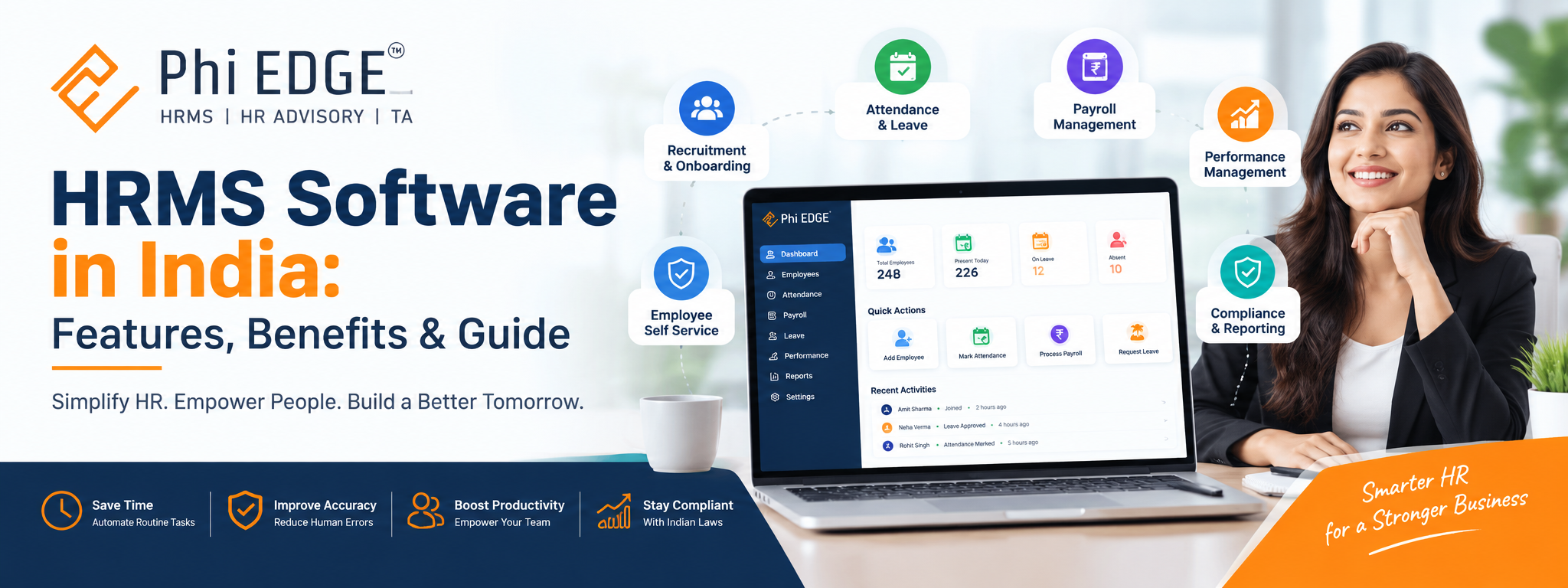
Phi EDGE HRMS provides an integrated approach to workforce management, with modules supporting employee performance, increments, payroll, learning and development, succession planning and other HR functions.
What Is HRMS Software?
A Human Resource Management System (HRMS) is software that helps organizations manage employee-related information and HR workflows through a centralized digital platform.
Depending on the solution, an HRMS can support employee onboarding, attendance, leave management, performance reviews, compensation processes, employee self-service, and workforce reporting.
Instead of maintaining separate spreadsheets for different HR activities, businesses can use connected workflows to improve visibility, consistency and coordination across departments.
Why Do Businesses in India Need HRMS Software?
Businesses in India may have to manage distributed teams, multiple locations, employee records, payroll inputs, leave policies and changing workforce requirements. Manual processes can make these activities difficult to coordinate.
HRMS software can help organisations:
- Centralise employee records: Maintain employee information in a structured system with appropriate access controls.
- Improve HR efficiency: Reduce repetitive data entry and manual follow-ups.
- Streamline leave and attendance: Standardize leave requests, approvals, and attendance records.
- Support performance management: Organise goals, reviews, feedback and performance tracking.
- Improve workforce visibility: Use relevant reports to understand employee and organizational trends.
- Support informed decisions: Make workforce information easier to access for authorised decision-makers.
Actual results depend on implementation quality, data accuracy, employee adoption and the features available in the selected software.
What Features Should You Look for in HRMS Software in India?
Choosing an HRMS requires more than comparing the number of features. Businesses should evaluate whether the software addresses their specific operational requirements.
1. Employee Information Management
An HRMS should help maintain structured employee records, job details, reporting relationships and relevant employment information. Access permissions and data protection measures are essential when handling sensitive employee data.
2. Leave and Attendance Management
Look for configurable leave policies, approval workflows, attendance records and reporting capabilities. Organisations with multiple offices or shift-based teams should evaluate how well the software supports their working arrangements.
3. Payroll and Compensation Workflows
Payroll-related features can help organise salary information, payroll inputs, deductions and approval processes. Before selecting a system, confirm which calculations and statutory requirements it supports and whether additional configuration or integration is needed.
4. Performance Management Software
Performance management features can support goal setting, periodic reviews, KPI tracking and feedback. These tools help managers create more structured review processes and connect employee objectives with organisational priorities.
5. Learning and Development
Learning and development tools can help HR teams organise employee development activities, identify skill gaps and support career progression.
6. Succession and Career Planning
Succession planning helps organisations identify critical roles, assess talent readiness and plan future leadership requirements. Career planning tools can help structure employee development pathways.
7. Analytics and Reporting
Useful reports should help authorised users understand workforce trends, performance indicators and operational requirements. Data quality, clear definitions and appropriate access permissions are important for meaningful reporting.
How Can AI HRMS Software Improve HR Operations?
AI-enabled HRMS capabilities can assist with selected HR workflows, depending on how the product is designed and implemented.
Potential applications include generating interview questions, supporting KPI creation, organising workforce information and assisting with analytical tasks. Phi EDGE’s published content describes capabilities including AI Interview, AI Requirements and AI KPI Generator.
Businesses should evaluate these features through a product demonstration and ask how the system validates outputs, protects employee information and keeps human decision-makers involved.
AI-generated recommendations should not automatically replace professional judgement, especially in recruitment, performance evaluation or other decisions affecting employees.
How Do You Choose the Right HRMS Software Company in India?
Before selecting a vendor, follow a structured evaluation process.
Step 1: Define your requirements. List the HR processes that need improvement and identify essential versus optional features.
Step 2: Assess integration needs. Check compatibility with existing payroll, accounting, attendance and business systems.
Step 3: Review data security. Ask about access controls, data handling, security practices, backups and incident management.
Step 4: Understand implementation. Discuss migration, configuration, employee training, support and expected timelines.
Step 5: Compare total costs. Evaluate licensing, implementation, integrations, support and any additional charges.
Step 6: Request a demonstration. Test important workflows using realistic business scenarios and assess whether the software meets your requirements.
Step 7: Measure success. Establish baseline metrics such as HR processing time, data correction rates, employee adoption and review completion rates.
Why Consider Phi EDGE HRMS?
Phi EDGE HR Tech Pvt. Ltd. offers HRMS software alongside HR advisory and talent acquisition services. Its published platform information describes modules for performance management, increments, variable pay, learning and development, employee self-service, payroll, leave and attendance, succession planning and other workforce processes.
Organisations evaluating Phi EDGE can review the available modules, discuss their specific requirements and request a demonstration to understand product suitability.
The right solution will depend on company size, workforce structure, existing systems, implementation requirements and business priorities.
What Should You Check Before Implementing HRMS Software?
Successful implementation requires preparation beyond installing software.
- Clean and validate existing employee data before migration.
- Assign responsibilities for configuration and approvals.
- Establish clear employee access permissions.
- Train HR teams, managers and employees.
- Test workflows before organisation-wide deployment.
- Review reports and resolve data inconsistencies.
- Monitor adoption and collect feedback after launch.
A phased implementation can help organisations identify issues early and improve the employee experience.
Frequently Asked Questions About HRMS Software in India
What is the best HRMS software in India?
The best HRMS depends on your organisation’s size, required modules, integrations, security expectations, budget and support needs. Compare relevant solutions through feature assessments and product demonstrations rather than relying only on rankings.
What is the difference between HRMS and HRIS?
HRIS commonly refers to systems focused on employee information and core HR administration. HRMS may cover a broader range of HR workflows, including performance, compensation and talent management. The exact scope varies by vendor.
Can HRMS software help automate payroll?
Some HRMS platforms provide payroll functionality or integrations that support payroll workflows. Confirm the specific calculations, integrations, statutory requirements and approval controls available in the chosen solution.
Is AI HRMS software suitable for every company?
Not necessarily. AI-enabled features are most useful when they solve a defined business problem and can be implemented with appropriate privacy, security, oversight and quality controls.
How can a business evaluate Phi EDGE HRMS?
Review the available modules, explain your HR requirements to the team and request a demonstration. Ask about integrations, implementation, support, security and the functionality included in the proposed solution.
Conclusion
Selecting the right HRMS software in India can help organisations build more consistent HR processes, improve workforce visibility and support employee development. A careful evaluation of features, implementation requirements, data security and long-term business needs is essential.
Phi EDGE HRMS is one option businesses can explore when evaluating integrated workforce management and talent-related solutions.
Ready to evaluate your HR requirements? Visit the official Phi EDGE website or contact its team to discuss your needs and request a product demonstration.