- Executive Summary
Most organizations run three critical people processes side by side: performance management, competency assessment, and learning and development (L&D). Yet in practice these three systems rarely speak to one another. Ratings are finalized in one cycle, competency frameworks sit unused in HR repositories, and training calendars are built around generic, popular courses rather than actual capability gaps.
This white paper examines why the disconnect between PMS, competency, and L&D has become a costly blind spot for Indian organizations, and what leading HR teams are doing to close it.
Key themes explored in this paper:
- Why performance ratings alone fail to drive real employee growth
- The missing link between competency frameworks and training investment
- What integrated organizations are doing differently
- Key outcomes: precision development, measurable L&D ROI, and stronger retention
- The State of Employee Development Today
Despite growing investment in HR technology, the link between assessing performance and actually developing people remains broken in most organizations. The gap between what reviews reveal and what training delivers has never been wider.
- Performance reviews in most companies remain a once- or twice-a-year compliance exercise
- Competency frameworks are built once, then rarely referenced in day-to-day reviews
- L&D calendars are shaped by budget cycles and trends, not verified skill gaps
- Managers spend review time rating employees, not coaching them
- Training ROI is measured in hours consumed, not competencies closed
- What Is the PMS–Competency–L&D Link?
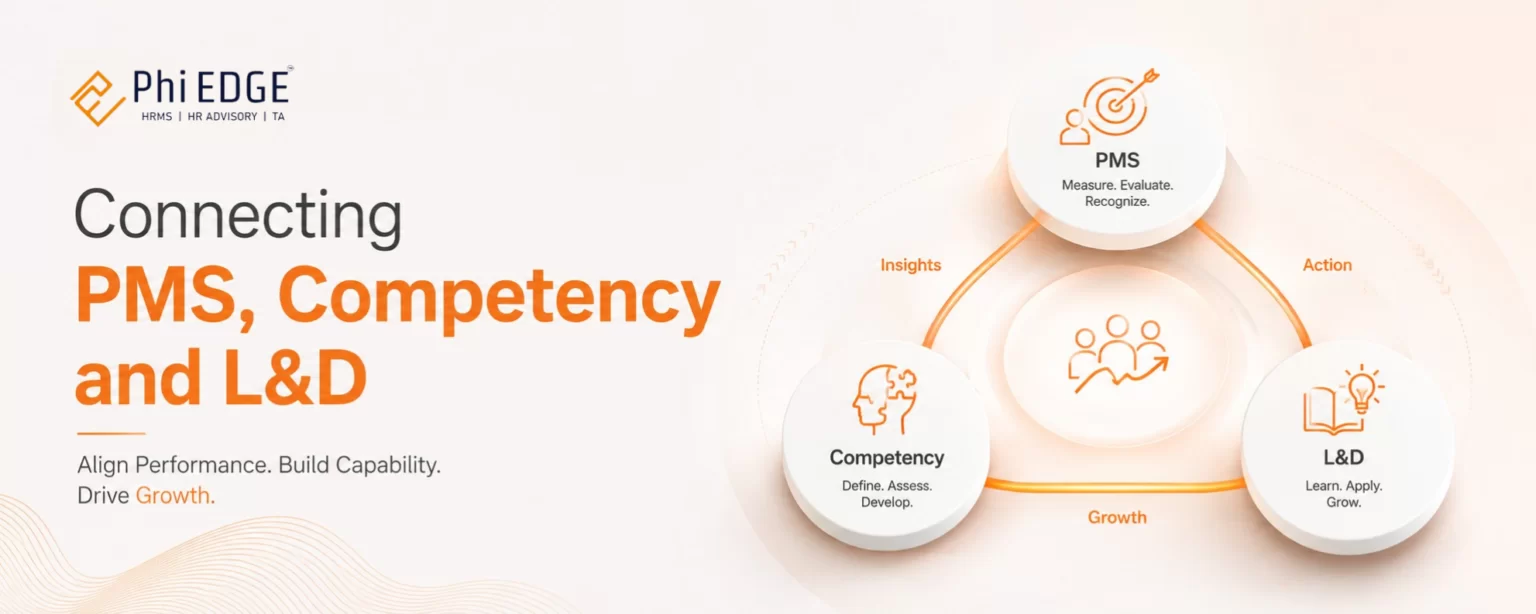
Connecting PMS, competency, and L&D is not simply about buying new software. It is a fundamental shift in how evaluation, definition, and development work together to drive one continuous employee growth cycle.
Three Pillars of the Connected Model
- PMS — evaluates outcomes and behaviours against goals, surfacing where gaps exist
- Competency Framework — defines the skills and behaviours required for a role, giving gaps a name
- L&D — builds capability through targeted interventions mapped to that same name
It is also important to distinguish between related but distinct practices:
- Rating — recording how an employee performed against a goal
- Defining — describing what “good” looks like for a competency or role
- Developing — closing the specific, named gap between the two
A shared competency taxonomy is the technological and conceptual foundation on which any meaningful integration between PMS and L&D must be built.
- Why HR and Business Leaders Must Own This Agenda
Connecting PMS, competency, and L&D cannot succeed as a siloes HR project. It requires executive sponsorship, a shared taxonomy, and cross-functional commitment from performance, talent, and learning teams alike.
- This integration is a business capability issue, not just an HR process fix
- Direct impact on productivity, succession readiness, and employer brand
- Cost of inaction, repeated skill gaps, disengaged managers, and wasted training spend
- Leadership metric: competency closure rate is becoming a board-level talent indicator
- CHROs and CFOs are increasingly measured on L&D ROI, not just L&D spend
- Key Drivers Pushing Organizations to Integrate
- Rising Skill Complexity roles evolving faster than static job descriptions can track
- Hybrid and Distributed Teams — fewer informal coaching moments, more need for structured development
- Employee Expectations — talent expecting a visible, credible path from feedback to growth
- Data-Driven People Decisions — leadership demanding proof that training changes performance
- Competitive Talent Markets — organizations differentiating on how well they grow people, not just hire them
- Core Areas of Integration
A comprehensive PMS–competency–L&D connection covers the full development lifecycle. Key functional areas include:
- Competency-mapped performance review templates
- A shared competency taxonomy across HR systems
- Auto-generated Individual Development Plans (IDPs)
- Competency-tagged L&D catalogues and course libraries
- Manager coaching workflows tied to review outcomes
- Progress tracking across successive review cycles
- Organization-wide competency heat maps for workforce planning
- The Role of Competency-Based Analytics
Data is now the most underutilized asset in most performance and learning functions. Competency-based analytics bridges the gap between subjective ratings and strategic workforce decisions.
- Moving from generic training calendars to data-backed development plans
- Identifying organization-wide competency gaps before they affect delivery
- Workforce and succession planning using real-time competency dashboards
- Linking L&D investment directly to subsequent performance movement
- Giving both HR heads and business leaders a single view of organizational readiness
- Challenges Organizations Face in Integration
Recognizing the need to connect these systems is one thing. Executing it successfully is another. The most common barriers include:
- Ownership Silos — PMS, competency, and L&D often sit with different teams and timelines
- Disconnected Systems — performance, talent, and learning platforms that don’t share data
- Outdated Frameworks — competency models that no longer reflect current role requirements
- Manager Adoption — reviews treated as form-filling rather than coaching conversations
- Unclear ROI — L&D spend that can’t be tied back to measurable competency improvement
- Change Fatigue — employees sceptical after past “transformation” efforts stalled
- How to Choose the Right Platform
Selecting a system to connect PMS, competency, and L&D is one of the most consequential HR technology decisions an organization will make. Key evaluation criteria:
- Unified vs. best-of-breed — whether one platform or integrated point solutions fit your scale
- Configurable competency frameworks — mapped to your roles, not a generic template
- Native linkage — review outcomes that auto-populate development plans, not manual exports
- Scalability — able to grow from a single business unit to enterprise-wide rollout
- Integration capability — HRIS, LMS, and performance data working from one taxonomy
- Vendor credibility — implementation depth, HR domain expertise, and post-sales support
- The Phi EDGE Approach
Phi EDGE is built differently. Where most HR technology vendors start with software and add HR context later, Phi EDGE starts with deep HR practitioner expertise and builds the Phi EDGE HRMS platform around it.
- Built by HR practitioners not just technology developers
- Three verticals working in sync: HR Advisory, Talent Acquisition, and HRMS
- Phi EDGE HRMS connects performance reviews, competency frameworks, and L&D in a single data model
- Auto-generated development plans, every competency gap flagged in a review maps directly to relevant learning content
- Modular and scalable – fits start-ups, SMEs, and large enterprises equally
- Real implementation support — not just a software license
- ROI of Connecting PMS, Competency, and L&D
The return on investment from a well-connected performance-to-learning cycle is measurable, significant, and fast-acting:
- 30–45% reduction in irrelevant or duplicate training spend
- 20–30% faster closure of critical skill gaps identified in reviews
- Higher manager engagement — reviews shift from rating exercises to coaching conversations
- Stronger succession pipelines built on real, aggregated competency data
- Measurable L&D ROI — course impact tracked against next-cycle performance movement
- CHRO perspective: L&D shifting from a cost centre to a proven capability engine
- Implementation Roadmap
Successful integration follows a structured, phased approach. Phi EDGE recommends a phased model for mid-size and large organizations:
Phase 1 — Framework Audit: Review and refresh existing competency models against current role requirements
Phase 2 — Review Redesign: Map every performance review criterion to a named competency
Phase 3 — catalogue Tagging: Align the L&D catalogue to the same competency taxonomy and pilot auto-generated IDPs
Phase 4 — System Integration: Connect PMS, competency records, and L&D assignments via Phi EDGE HRMS or existing HRIS/LMS APIs
Phase 5 — Track and Scale: Monitor competency movement across cycles and feed insights into workforce planning
- Case for Action — Key Statistics
- Organizations with competency-linked L&D report significantly higher training ROI than those without
- Companies with structured development plans see materially lower voluntary attrition
- Cost of replacing one employee equals 6 to 9 months of their salary
- Businesses with auto-generated IDPs report faster time-to-productivity after role changes
- Integrated performance-to-learning organizations report higher employee engagement scores
- Conclusion and Call to Action
Connecting PMS, competency, and L&D is no longer a future aspiration, it is a present capability necessity. Every review cycle that closes without a linked development plan compounds the cost: in repeated skill gaps, in wasted training spend, and in employees who don’t see a credible path to growth.
The organizations that will lead the next decade of workforce development are those investing today in the systems, taxonomy, and processes that turn every performance conversation into the start of a development plan is not the end of a rating cycle.
Phi EDGE offers a proven pathway to this integration combining deep HR domain expertise with the Phi EDGE HRMS platform and end-to-end implementation support.
- About Phi EDGE HRMS
Phi EDGE HRMS is a Pune-based HR Technology company helping Indian businesses transform their people management through a powerful combination of advisory expertise and cutting-edge technology.
- Three verticals: HR Advisory | Talent Acquisition Management | HRMS
- Phi EDGE HRMS — built to connect performance, competency, and learning in one platform
- Trusted by HR leaders and business owners across industries
- End-to-end support: from strategy and implementation to ongoing optimization
www.phiedge.com
Systems • Scale • Performance
Built by HR expertise. Not just tech.