An effective performance management process helps organizations align employee performance with business objectives, identify skill gaps, improve productivity and support professional development. Instead of relying only on annual appraisals, modern organizations use continuous feedback, measurable goals and regular performance discussions to help employees perform at their best.
For HR leaders, managers and business owners, the challenge is not simply evaluating employees. It is creating a transparent and consistent process that connects individual contributions with organizational growth.
A structured performance management process combines goal setting, KPI tracking, performance monitoring, employee feedback, performance reviews and development planning. With the support of an appropriate HRMS or performance management system, organizations can make these activities more organized, measurable and easier to manage.
What Is the Performance Management Process?
The performance management process is a continuous framework used to plan, monitor, evaluate and improve employee performance in alignment with organizational goals.
It helps managers communicate expectations, assess progress, recognize achievements and identify opportunities for improvement. Rather than treating performance appraisal as a one-time event, this process encourages ongoing conversations between employees and managers.
For example, a sales team may establish quarterly revenue targets, monitor progress through KPIs, review performance during monthly meetings and provide coaching when an employee needs additional support.
The objective is to create clarity, accountability and opportunities for professional growth while helping the organization achieve its strategic goals.
Why Is the Performance Management Process Important?
A well-designed process provides several benefits:
- Clear expectations: Employees understand their responsibilities, targets and performance standards.
- Better productivity: Regular goal tracking helps identify delays, obstacles and areas that need improvement.
- Continuous employee development: Managers can identify skill gaps and recommend relevant training.
- Fairer evaluations: Documented objectives and consistent evaluation criteria support more transparent decisions.
- Employee engagement: Constructive feedback and recognition help employees understand the value of their contributions.
- Data-informed decisions: Performance records help HR teams identify workforce trends and development needs.
These benefits depend on how consistently the process is implemented. Software can support the workflow, but effective management also requires clear communication, appropriate metrics and responsible decision-making.
What Are the 7 Steps in the Performance Management Process?
1. Set Clear Goals and Performance Expectations
The first step is to establish measurable goals that connect individual responsibilities with departmental and organizational objectives.
Managers can use SMART goals—Specific, Measurable, Achievable, Relevant and Time-bound—to make expectations clear.
For example, a customer support employee might aim to resolve a defined percentage of eligible customer queries within the agreed service timeframe while maintaining quality standards.
Goals should be realistic, role-specific and discussed with employees before the performance cycle begins.
2. Define KPIs and Success Metrics
Key Performance Indicators (KPIs) help organizations measure progress against established objectives.
The right KPIs depend on the employee’s role. Sales teams may track revenue and conversion rates, while customer support teams may measure resolution time, customer satisfaction and quality scores.
Organizations should avoid measuring performance through numbers alone. Quality, collaboration, compliance, customer experience and other role-specific factors may also be important.
A well-defined KPI framework makes performance expectations more objective and easier to review.
3. Monitor Performance and Progress Regularly
Performance monitoring helps managers understand whether employees are progressing toward their goals.
Instead of waiting until the end of the year, managers can conduct weekly check-ins, monthly reviews or quarterly progress discussions, depending on the nature of the work.
These conversations should focus on achievements, obstacles, changing priorities and the support employees need.
A performance management system can help centralize goals, progress updates and review records, reducing dependence on disconnected spreadsheets and manual follow-ups.
4. Provide Continuous Feedback and Recognition
Feedback should be timely, specific and constructive. Employees need to understand what they are doing well, what needs improvement and how they can improve.
For example, instead of saying, “Your performance needs improvement,” a manager could explain which project milestone was missed, discuss the underlying challenge and agree on practical next steps.
Recognition is equally important. Acknowledging meaningful contributions can reinforce positive behaviours and encourage employees to maintain high standards.
Regular feedback also helps prevent misunderstandings from building up over an entire appraisal cycle.
5. Conduct Structured Performance Reviews
Performance reviews bring together goals, KPI results, feedback and relevant evidence to evaluate progress over a defined period.
Depending on the organization’s requirements, the process may include self-assessments, manager evaluations, competency assessments and 360-degree feedback.
Managers should use consistent criteria and consider the context behind the results. For example, changes in responsibilities, resource limitations or revised business priorities may influence an employee’s outcomes.
A structured review should end with a clear discussion of achievements, improvement areas and future expectations—not merely a rating.
6. Create Employee Development and Improvement Plans
Performance management should help employees develop their capabilities, not just identify shortcomings.
Based on review outcomes, managers can recommend training, mentoring, stretch assignments, competency development or an individual development plan.
When an employee is not meeting expectations, a Performance Improvement Plan (PIP) may be appropriate. It should clearly define the improvement areas, support available, measurable expectations and review timeline.
Development plans should be practical, documented and reviewed regularly so employees understand how progress will be assessed.
7. Review Outcomes and Plan the Next Performance Cycle
The final step is to evaluate the effectiveness of the performance cycle and prepare for the next one.
HR teams and managers can review goal completion, feedback quality, development progress and recurring performance gaps. They can also identify employees who may benefit from new responsibilities or additional development opportunities.
The findings should inform future goal setting, training priorities and workforce planning.
This creates a continuous cycle in which planning, monitoring, evaluation and development reinforce one another.
How Does Performance Management Software Improve the Process?
Managing goals, reviews and feedback through separate spreadsheets can become difficult as organizations grow. Performance management software helps centralize information and organize recurring workflows.
Depending on the platform and its configuration, useful capabilities may include:
- Goal setting and KPI tracking
- Performance review scheduling
- Employee self-assessments
- Continuous feedback and recognition
- 360-degree feedback
- Competency assessments
- Performance dashboards and reports
- Development planning and follow-up workflows
Phi EDGE HRMS provides performance management capabilities alongside related modules such as 360-degree feedback, competency management, learning and development, and succession and career planning.
Organizations evaluating a performance management system should assess its functionality, reporting, integration requirements, data security, ease of use and suitability for their existing HR processes.
Explore the Phi EDGE HRMS platform to learn more about its workforce management solutions.
What Are the Best Practices for an Effective Performance Management Process?
To make the process useful and consistent, organizations should:
- Align individual goals with business priorities.
- Communicate expectations before the performance cycle starts.
- Select relevant, measurable and role-specific KPIs.
- Train managers to provide constructive and unbiased feedback.
- Hold regular check-ins rather than relying exclusively on annual reviews.
- Document performance discussions and agreed actions.
- Use consistent evaluation criteria across comparable roles.
- Connect reviews with training, career development and recognition.
- Protect employee information and restrict access to authorized users.
- Review the process periodically and improve it using employee and manager feedback.
The most effective approach balances measurable outcomes with employee development, context and fairness.
How Can AI and HRMS Technology Support Performance Management?
AI-enabled HR technology can assist with selected activities such as summarizing feedback, identifying trends, organizing performance information and supporting goal development, depending on the platform’s capabilities.
However, AI-generated insights should be treated as decision support rather than unquestionable conclusions. Performance evaluations can be influenced by incomplete data, inconsistent manager inputs or historical bias.
Organizations should validate outputs, protect employee data, communicate how information is used and retain appropriate human oversight for consequential decisions.
Technology is most valuable when it makes the process more transparent, consistent and useful for both employees and managers.
Frequently Asked Questions
What are the main stages of the performance management process?
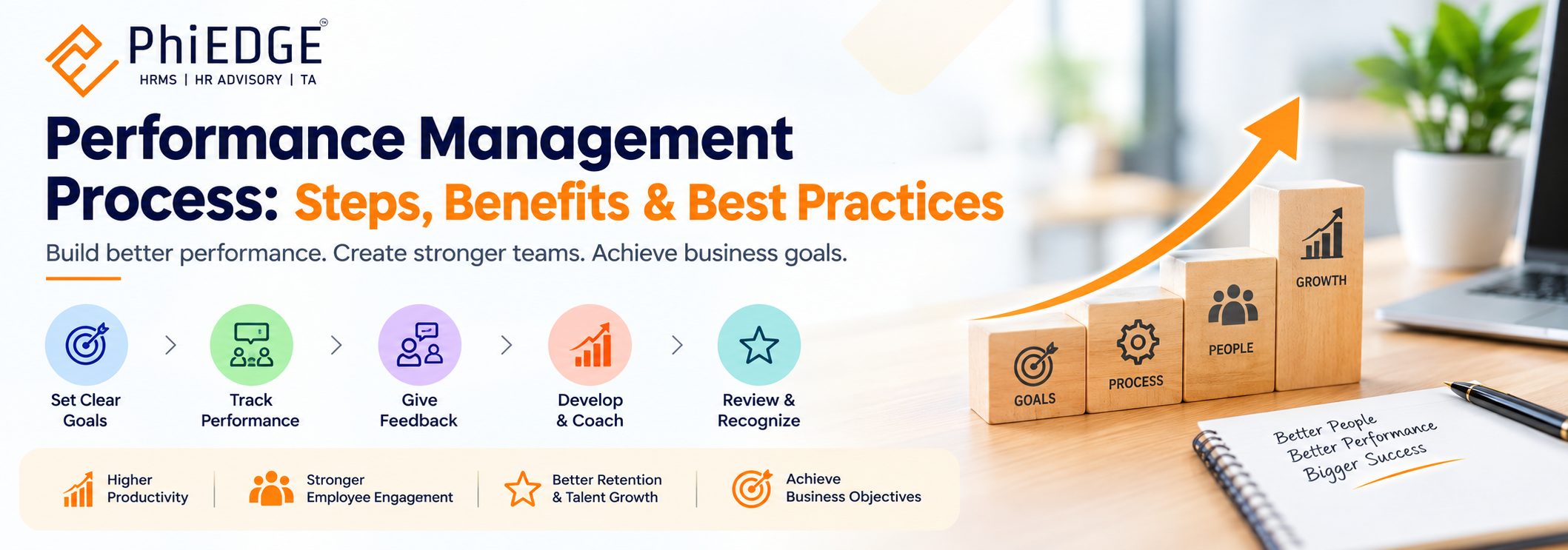
The main stages are goal setting, KPI definition, performance monitoring, continuous feedback, formal performance reviews, employee development and planning for the next performance cycle.
How often should performance management be conducted?
Performance management should be continuous. Organizations can combine regular check-ins with monthly or quarterly progress reviews and a formal annual or semi-annual appraisal, depending on their business requirements.
What is the difference between performance management and performance appraisal?
Performance management is the ongoing process of setting goals, monitoring progress, providing feedback and supporting development. Performance appraisal is a formal evaluation conducted at a specific point in that process.
Which KPIs should organizations use to measure employee performance?
KPIs should reflect each role’s responsibilities. Examples include sales conversion, project delivery, customer satisfaction, service quality and productivity. Organizations should also consider collaboration, compliance and qualitative contributions where relevant.
Can performance management software automate employee reviews?
Many platforms can automate parts of the review workflow, including reminders, review forms, feedback collection and reporting. The exact capabilities depend on the software and its configuration. Managers should still review evidence and make appropriate decisions.
How does Phi EDGE support performance management?
Phi EDGE HRMS offers performance management capabilities alongside related HR modules, including KPI-oriented processes, 360-degree feedback, competency management and employee development. Organizations should review the platform’s current features and request a demonstration to determine whether it meets their requirements.
Conclusion
An effective performance management process connects employee goals with organizational priorities through clear expectations, measurable KPIs, regular feedback, structured reviews and ongoing development.
When these activities are supported by suitable HR technology and consistent management practices, organizations can improve visibility into employee performance and make more informed workforce decisions.
Phi EDGE HRMS offers an integrated approach to workforce and performance management. Explore the official Phi EDGE website to learn more about its HRMS solutions and assess their suitability for your organization.
Looking to structure your employee performance management process? Connect with Phi EDGE to discuss your HR technology requirements.