Author: admin

  • Choosing the Right HRMS Software for Your Company

    Choosing the Right HRMS Software for Your Company

    Step-by-Step Guide to Choosing the Right HRMS Software for Your Company

    Imagine this, its payroll day
    Your HR team is struggling with spreadsheets, double checking attendance, calculating deductions, and replying to ten different “Where’s my salary?” messages at once. Sounds familiar?

    That is why many modern companies are switching to best HRMS Software (Human Resource Management Systems) that automate, centralize, and simplify everything related to HR.

    But here’s the problem: choosing the best HRMS software is harder than it sounds. Many of the companies choose HR software the wrong way.

    They start with what: “Which HRMS should we buy?”

    Then they move to how: “How fast can we implement it?”

    And at last, somewhere in between the chaos, they remember the “Why”- Actual reason why they needed it in the first place.

    Sinek, is a British American author and a motivational speaker, introduced the idea in his famous TED Talk “Start With Why.” He explained that great leaders and organizations think, act, and communicate from within the organisation starting with why (their purpose), then how (their process), and finally what (their product or service).

    He called this framework the “Golden Circle” This concept fits perfectly when choosing the right HRMS for your organization.

    Step 1: Start With WHY – Define Why you need the HRMS System.
    Best HRMS Software

    Most of the companies these days would jump straight into the mindset of “Which best HRMS software system should we buy?”

    But the real question asked should be “Why do we need one in the first place?”

    Why matters

    Every business on the path to success on the way feels the weight of doing HR work manual involving never ending spreadsheets, late payrolls and scattered data. But simply Automating these tasks isn’t enough.

    The real “why” behind best HRMS Software system adoption should be about empowering your people. Its about helping HR teams spend less time on paper work and more time building culture, engagement and growth.

    Your purpose might sound something like this:

    “We’re implementing best HRMS Software to bring transparency, accuracy, and empathy into how we manage people.”

    When you start with this purpose, you stop chasing dashboard numbers and start focusing on meaningful outcomes, smooth operations, happy employees, and stronger trust.

    An HRMS (Human Resource Management System) centralizes and automates all key HR functions whether its recruitment, onboarding, attendance, payroll, performance or analytics. It combines all these into one connected platform.

    Your purpose for adopting it should be clear:

    1. Efficiency: Reduce repetition of work so the HR can focus on making strategies for people.

    2. Accuracy: Ensure every function is error free from payroll to compliance.

    3. Transparency: Give employees and managers self-service access.

    4. Scalability: Handle future growth without operational chaos.

    5. Insight: Turn data into decisions through detailed analytics.

    When the Pian points (why) is defined every other decision becomes easier to make.

    Step 2: HOW -Plan the Right Process to Achieve That Why
    Best HRMS Software

    Once you know the reason is clear next is the roadmap that makes it real.

    The how is where strategy meets structure.

    1. Work on your HR pain points
    Start with an audit.
    Ask the common questions –
    ● Where are we losing the most time?
    ● Which HR tasks causes the most number of errors and confusion?
    ● Are the employees struggling with outdated tools?
    List every issue and classify it as Must Have
    This clarity prevents you from buying features you’ll never use.

    2. Define scope, scale, and budget
    Your budget should be calculated based on company size, required features, and deployment model.
    ● Cloud-based (SaaS):This is Pay-per-employee subscriptions, it’s easy to start, minimal IT load and is ideal for SMEs and fast growing firms.
    ● On premise: Higher upfront cost, more control, preferred by large organizations.
    Look beyond the price. There are costs like customization, integration, and training.
    A slightly costlier but scalable system usually wins in the long run of the company.

    3. Evaluate core features and modules
    Focus on what directly supports your “why”:
    ● Employee Database Management – This is a single source of truth for records.
    ● Attendance & Leave Automation- Its for accurate scheduling and approvals.
    ● Payroll & Compliance- For timely, error free payments.
    ● Recruitment & Onboarding – For faster hiring and smoother orientation.
    ● Performance & Training- To align goals, feedback, and learning.
    ● Analytics & Reporting- For actionable workforce insights.
    Make sure your platform can add modules later as you grow.

    4. Check integration and security early
    A good HRMS works within the existing system of your organisation accounting tools, ERP, biometrics, Slack / Teams, and HR chatbots. Also verify: encryption, access controls, audit trails, and compliance with GDPR, ISO 27001, EPF, ESI, TDS, etc. Security is non-negotiable as your HRMS will hold your most sensitive data.

    5. Prioritize user experience
    No matter how powerful the system, it fails if it’s hard to use. Look for:
    ● Clean, intuitive dashboards
    ● Mobile app access
    ● Self service for leave, payslips, and profiles
    ● Multi language options for distributed teams
    Always request a live demo. Let HR and a few employees test it if they like using it, everyone will.

    6. Select a vendor who supports your “why”
    An HRMS should be a partnership, not a purchase. Research about each vendor’s reputation, response times, and client success stories.
    Ask for ongoing support plans and product update schedules.
    The best providers stay involved long even after going live.

    Step 3: WHAT – Implement, Measure, and Optimize

    WHAT - Implement, Measure, and Optimize

    Now you know why you need HRMS and how to select it — the final step is what you actually do: implementation, measurement, and continuous improvement.

    1. Plan an easy launch
    Create a structured implementation roadmap:
    ● Define what should be user roles and their permissions.
    ● Clean existing data.
    ● Integrate payroll, ERP, or biometric systems.
    ● Train HR teams first, then managers and employees.
    ● Communicate with everyone so everybody knows the benefits.
    Implementation isn’t just about installing a software , it’s about transforming how HR works.

    2. Request custom demos and run pilots
    Shortlist three to five vendors and request tailored demos.
    Rate each on:
    ● Ease of use
    ● Feature coverage
    ● Integration capability
    ● Scalability
    ● Customer support
    ● Pricing flexibility
    A short pilot with real employee data will show how well the system fits daily operations.

    3. Request custom demos and run pilots
    Shortlist three to five vendors and request demos.
    Rate Demos on KPIs such as:
    ● Are they easy to use?
    ● Do they have all Feature coverage?
    ● How is the Integration capability?
    ● Scalability?
    ● Is Customer support available?
    ● Pricing flexibility?
    A short demo with real employee data will show how well the system works in daily operations.

    Conclusion: Think Not like a Buyer but a Leader

    Simon Sinek’s Golden Circle reminds us that if purpose is clear every action will be effective.

    This when applied to HRMS selection:
    ● WHY gives you focus it clears the business case for structure, efficiency, and data control.
    ● HOW builds the bridge your method for studying needs, vendors, and adoption methods.
    ● WHAT delivers results a system that transforms HR from paperwork to performance.

    Most organizations usually shop outside-in, starting with the software specifications.

    But the companies that truly succeed think inside-out: they begin with why they need this particular change and how they are going to achieve it, and then only they decide what to buy.

    So before you sign a contract or schedule a demo, stop and ask:

    “Why do we really need an best HRMS software right now, and what will success look like when it’s working perfectly?”

    Once the answer to this question is clear, the rest of the circle completes itself and your HR department moves from busy to brilliant.

    Frequently Asked Questions (FAQ)

    1. What is HRMS software and why do I need it?

    HRMS (Human Resource Management System) software is a platform that helps automate, manage, and streamline various HR functions—such as employee data, payroll, attendance, recruitment, performance, benefits, etc. You need it to reduce manual administrative work, improve data accuracy, ensure compliance, and provide better employee experiences.

    2. How is HRMS different from HRIS or HCM?
    • HRIS (Human Resource Information System) focuses primarily on data management and record keeping (personnel files, basic HR processes).

    • HRMS extends HRIS by including operational and transactional HR functions (payroll, time & attendance, performance).

    • HCM (Human Capital Management) is broader still—it includes strategic talent management, learning, development, analytics, and aligning HR with business goals.
      (Depending on your blog, you might clarify how you use these terms.)

    3. What are the key features I should look for in an HRMS?

    Some essential features include: Employee data & document management, Payroll and benefits administration, Time and attendance / leave management, Recruitment / applicant tracking, Performance management

    4. What role does integration play in choosing HRMS software?

    Integration is critical. Your HRMS should work seamlessly with payroll systems, accounting, ERP, CRM, and other tools you use. Poor integration leads to data silos, duplicate entry, and errors. A well-integrated system ensures unified, real-time data flow across departments.

    5. How do cost and pricing models work for HRMS software?

    HRMS software is typically priced on a subscription basis (SaaS model) or through a one-time license fee for on-premise solutions. The total cost depends on factors like the number of users, modules selected, implementation charges, and support services. While upfront costs matter, it’s important to consider the total cost of ownership over time — including training, maintenance, and updates. A transparent pricing model ensures there are no hidden costs and helps you plan your HR budget effectively.

  • What is a Performance Management System in HRM?

    What is a Performance Management System in HRM?

    What is a Performance Management System in HRM? A Complete Guide

    At Phi EDGE, we’ve always believed that people are the core of every successful business. Over the years, our services have expanded from HR Advisory to Talent Acquisition and advanced HRMS solutions, helping organizations across industries like Manufacturing, Financial Services, Real Estate, Hospitality, Construction, Academics, and IT achieve more.

    One of the most important tools for businesses today is a Performance Management System in HRM. It’s not just about evaluating employees—it’s about building a culture of growth, accountability, and transparency. This blog explores what a Performance Management System in HRM is, why it matters, its benefits, and how Phi EDGE helps organizations implement it effectively.

    What is a Performance Management System in HRM?

    performance management system in hrm

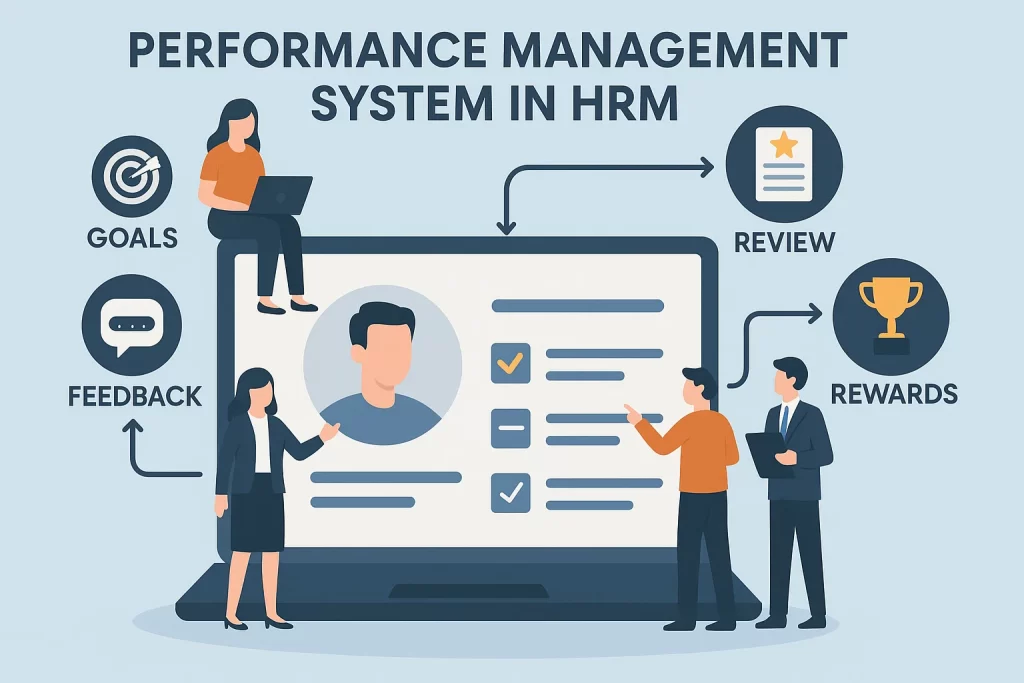
    A Performance Management System in HRM is a structured framework designed to monitor, evaluate, and improve employee performance in alignment with organizational goals.

    Unlike the traditional performance appraisal system that happens once a year, modern performance appraisal performance management is continuous. It involves setting goals, providing feedback, tracking progress, and rewarding achievements throughout the employee lifecycle.

    At Phi EDGE, we see performance management as more than just numbers—it’s about engaging employees, driving productivity, and fostering leadership.

    Key Components of a Performance Management System

    1. Goal Setting and Alignment
    Clear, measurable goals are defined for employees that align with business objectives.
    2. Continuous Feedback
    Instead of annual reviews, managers provide ongoing feedback, helping employees stay on track.
    3. Performance Reviews
    Structured appraisals using a performance appraisal system to measure individual contributions.
    4. Training and Development
    Identifying gaps and providing learning opportunities through integrated HRMS tools.
    5. Recognition and Rewards
    Motivating employees by recognizing achievements and linking rewards to performance.
    6. Analytics and Reporting
    Using data-driven insights to identify trends, top performers, and areas of improvement.

    Why Performance Management is Crucial in HRM

    performance management system in hrm

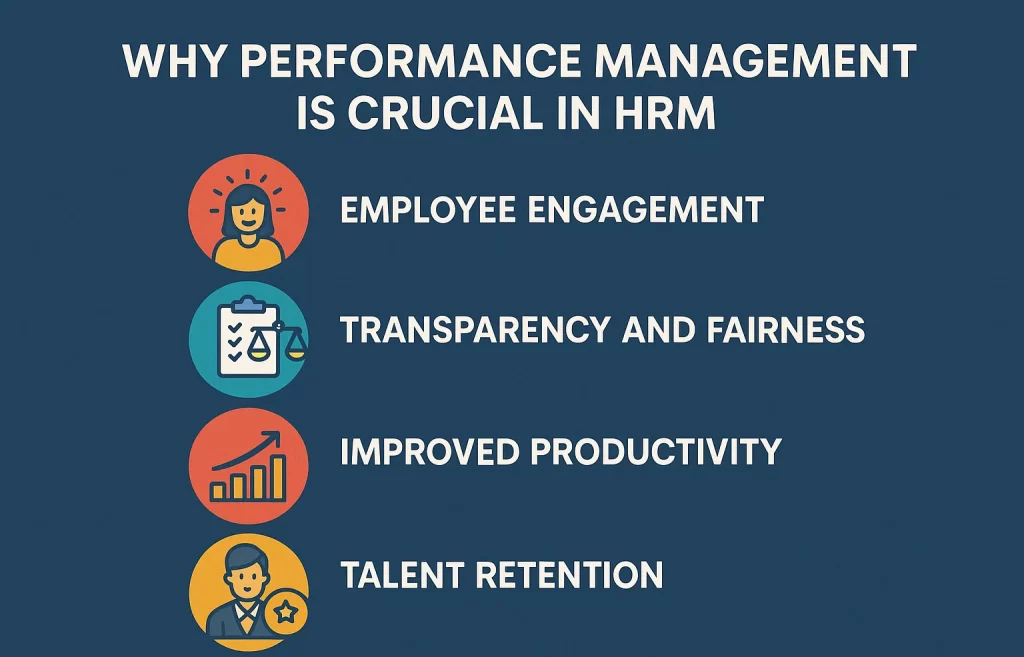
    1. Employee Engagement
    Employees who receive regular feedback and recognition are more motivated and engaged.
    2. Transparency and Fairness
    A well-structured performance appraisal system ensures fair evaluations based on
    measurable outcomes.
    3. Improved Productivity
    Employees perform better when they have clear goals and real-time feedback.
    4. Talent Retention
    Employees feel valued when their contributions are recognized, reducing attrition rates.
    5. Business Growth
    Performance management aligns employee efforts with organizational strategy, driving growth.

    Traditional Appraisal vs Modern Performance Management

    ● Traditional Appraisals: Annual, subjective, often one-sided.
    ● Modern Performance Management: Continuous, data-driven, collaborative.

    At Phi EDGE, our performance management systems in HRM integrate advanced HRMS technology with advisory expertise, ensuring organizations shift from outdated annual reviews to dynamic, ongoing performance practices.

    How HRMS Software Enhances Performance Management

    Modern HRMS systems make performance management seamless by integrating data and automation.
    Key Features in Phi EDGE HRMS:
    ● Automated Goal Tracking: Employees and managers can track progress in real-time.
    ● 360-Degree Feedback: Feedback from peers, managers, and clients ensures holistic evaluations.
    ● Customizable Performance Appraisal System: Tailored to industry-specific needs.
    ● Analytics Dashboard: Visual reports for data-driven decisions.
    ● Integration with Training: Links performance gaps to learning modules.

    By embedding performance appraisal performance management directly into HRMS, businesses gain accuracy, efficiency, and transparency

    Benefits of Implementing a Performance Management System in HRM

    1. Objective Evaluations
    Eliminates bias by using structured metrics and continuous data.
    2. Improved Communication
    Facilitates open conversations between employees and managers.
    3. Scalable for All Sizes
    Whether you’re a startup or a multinational, performance appraisal systems can scale with your workforce.
    4. Better Workforce Planning
    Helps HR teams identify future leaders and succession planning opportunities.
    5. Cost Savings
    By retaining talent and improving productivity, companies save on recruitment and training costs.

    Why Choose Phi EDGE for Performance Management?

    At Phi EDGE, we don’t just deliver HRMS software—we combine it with HR advisory expertise. That means we help businesses:

    ● Build tailored performance appraisal systems.
    ● Design competency-driven evaluations.
    ● Provide advisory support for goal-setting and employee engagement.
    ● Implement continuous feedback culture.

    Our clients across industries trust Phi EDGE to not only automate HR processes but also create people-centric growth strategies.

    Real-Life Example

    A large IT services company was facing challenges with outdated annual reviews. By implementing Phi EDGE’s Performance Management System in HRM, they achieved:
    ● 40% faster appraisal cycles.
    ● Improved employee satisfaction scores by 25%.
    ● Identified and developed 15% more high-potential employees for leadership roles.

    FAQs on Performance Management System in HRM

    What is a Performance Management System in HRM?

    It’s a structured framework to evaluate, improve, and align employee performance with organizational goals.

    How is a performance appraisal system different from performance management?

    A performance appraisal system is a part of the broader performance management system in HRM, which includes continuous feedback, training, and goal alignment.

    Why is performance management important?

    It boosts engagement, ensures fairness, improves productivity, and drives business growth.

    Can small businesses use performance management systems?

    Yes. At Phi EDGE, we design scalable systems suitable for SMEs as well as large enterprises.

    How does HRMS software improve performance management?

    By automating goal tracking, integrating feedback, and linking appraisals to payroll and training.

    What industries benefit most from performance management systems?

    All industries benefit, but fast-changing sectors like IT, finance, and manufacturing see the highest ROI.

    Is performance management only for employees?

    No, it also helps managers and leadership align strategies, making it an organization-wide growth tool.

    Conclusion

    A Performance Management System in HRM is more than just an appraisal—it’s a culture shift. By moving away from traditional reviews to continuous, data-driven, and people-focused evaluations, businesses unlock their true potential.

    At Phi EDGE, we bring together HRMS technology, advisory expertise, and talent solutions to deliver end-to-end performance appraisal performance management systems. Whether you want to improve employee engagement, enhance transparency, or build future leaders, our performance appraisal systems help you achieve it all.

    Ready to transform your organization’s performance journey? Partner with Phi EDGE and explore the power of integrated Performance Management System in HRM.

  • Pros and Cons of Employee Monitoring

    Pros and Cons of Employee Monitoring

    Pros and Cons of Employee Monitoring: Insights by Phi EDGE

    In today’s digital-first workplace, organizations are under increasing pressure to balance productivity, security, and employee well-being. One practice that has gained attention is employee monitoring—the use of tools and systems to track work-related activities. From time-tracking software and project management dashboards to monitoring emails and internet usage, companies are leveraging technology to keep an eye on how employees work.

    At Phi EDGE, we specialize in HRMS, HR Advisory, and Talent Acquisition, and we often see organizations debating whether employee monitoring is truly beneficial. While it can increase accountability and data-driven insights, it also raises ethical and privacy concerns. In this blog, we’ll explore the pros and cons of employee monitoring, helping businesses make informed
    decisions.

    What is Employee Monitoring?

    Employee Monitoring

    Employee monitoring refers to practices where organizations track employee activities to measure productivity, ensure compliance, and protect company resources. Monitoring can take many forms, including:
    ● Time and attendance tracking.
    ● Project progress monitoring via HRMS systems.
    ● Email and internet usage tracking.
    ● Screen recording or keystroke logging (more common in highly regulated industries).
    ● GPS tracking for field employees.

    When implemented responsibly, monitoring supports efficiency. However, without transparency,
    it can lead to mistrust.

    The Pros of Employee Monitoring

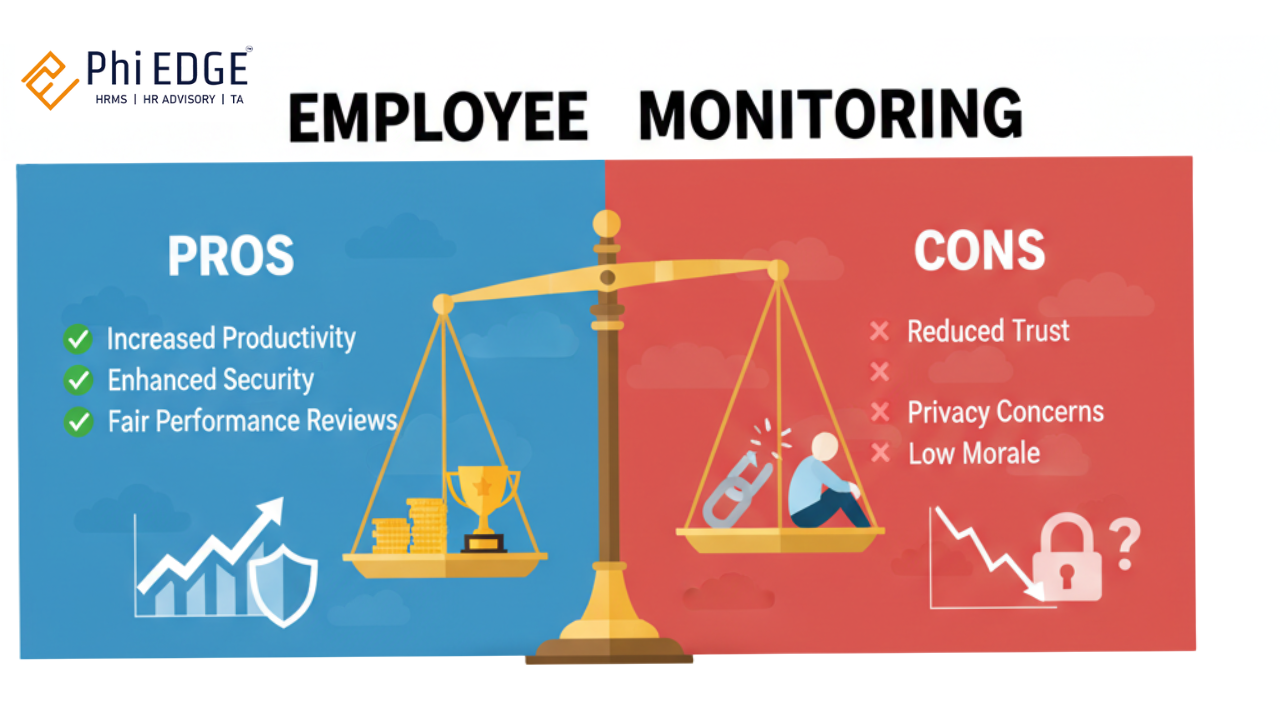
    1. Improved Productivity
    Monitoring ensures employees stay focused on tasks. With HRMS management systems, managers can see project progress in real time, identify bottlenecks, and optimize workflows.
    2. Better Time Management
    Time-tracking features in HRMS software in India help employees and employers alike. Workers can understand how they spend their time, while leaders can allocate resources effectively.
    3. Enhanced Security
    Employee monitoring protects sensitive data by preventing misuse of company resources or unauthorized sharing of information.
    4. Accurate Performance Measurement
    By integrating monitoring into an HRMS system, businesses get data-driven insights into employee contributions, making appraisals fairer and more objective.
    5. Compliance with Regulations
    In industries like finance or healthcare, monitoring ensures employees follow protocols, reducing risks of non-compliance.
    6. Supports Remote Work
    With hybrid and remote work models, monitoring tools assure managers that employees remain productive while working from home.

    The Cons of Employee Monitoring

    1. Privacy Concerns
    Employees may feel their privacy is being invaded, especially with invasive tools like screen recording. This can damage trust.
    2. Employee Morale Issues
    Excessive monitoring creates a culture of micromanagement. Instead of boosting productivity, it may lead to disengagement.
    3. Risk of Misuse
    If monitoring data is mishandled, it could be used unfairly against employees or lead to legal consequences.
    4. High Costs
    Advanced monitoring software and integrations with HRMS systems can be costly, especially for SMEs.
    5. False Sense of Productivity
    Monitoring time spent doesn’t always reflect quality of work. Overemphasis on hours can discourage creativity and innovation.
    6. Potential Legal Challenges
    Without clear consent, companies may violate labor or privacy laws, especially in international contexts.

    Finding the Right Balance

    Employee Monitoring

    At Phi EDGE, we encourage businesses to use HRMS systems for constructive monitoring rather than invasive practices. Here’s how organizations can strike the right balance:
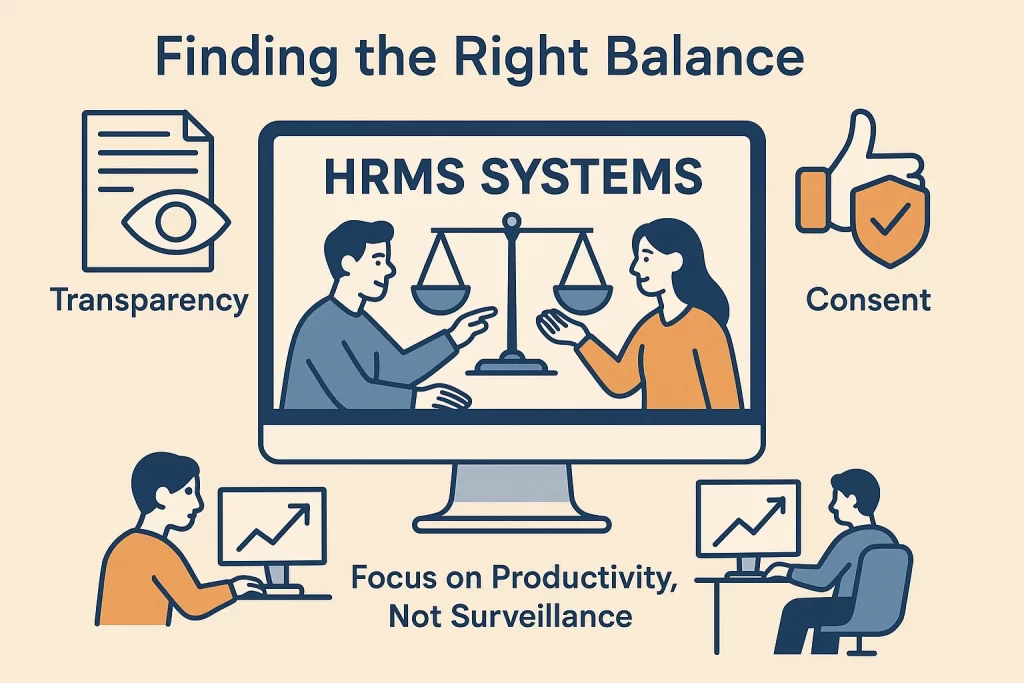
    ● Transparency: Inform employees about what is being monitored and why.
    ● Consent: Obtain clear consent through contracts or policies.
    ● Focus on Productivity, Not Surveillance: Use monitoring to improve workflows, not to police employees.
    ● Leverage Data for Growth: Integrate monitoring insights into training, resource allocation, and performance management.
    ● Set Boundaries: Avoid tracking personal data or activities outside working hours.

    How HRMS Software in India Supports Ethical Monitoring

    Unlike standalone monitoring tools, HRMS software in India focuses on employee engagement and organizational efficiency. At Phi EDGE, our HRMS systems offer features like:
    ● Attendance and Leave Tracking: Transparent and automated.
    ● Project & Task Monitoring: Visibility into progress without micromanagement.
    ● Performance Management Integration: Data-driven appraisals, reducing bias.
    ● Employee Self-Service Portals: Employees can view their own data, ensuring fairness. This approach ensures monitoring enhances productivity without compromising trust.

    Pros and Cons of Employee Monitoring in Different Industries

    ● IT & Software: Useful for project tracking, but risks employee burnout if overused.
    ● Manufacturing: Critical for attendance and safety compliance.
    ● Financial Services: Essential for data security and regulatory compliance.
    ● Hospitality: Helpful for scheduling and managing seasonal staff.
    ● Construction: GPS and project tracking support on-site accountability.

    Each industry needs a tailored approach—something Phi EDGE HRMS management solutions deliver through customization.

    FAQs on Employee Monitoring

    Yes, as long as it’s done transparently, with employee consent, and without violating privacy rights.

    How can HRMS systems help in employee monitoring?

    HRMS systems track attendance, leave, and performance data fairly, without invasive surveillance.

    Does monitoring improve productivity?

    Yes, when used ethically. Monitoring highlights inefficiencies and helps employees stay accountable.

    Can monitoring damage trust?

    Yes. Over-monitoring may create fear or dissatisfaction. Transparency is key.

    Is employee monitoring suitable for small businesses?

    SMEs can benefit from simple monitoring features in HRMS software in India, but should avoid expensive or invasive tools.

    What’s the best way to balance pros and cons?

    Use monitoring as a tool for growth, not punishment. Communicate openly and respect employee boundaries.

    Conclusion

    The debate around pros and cons of employee monitoring isn’t going away anytime soon. While it offers undeniable benefits like productivity, compliance, and data-driven insights, it also risks employee morale and trust if overused.

    At Phi EDGE, we recommend a balanced approach. By using HRMS management tools designed for fairness, transparency, and engagement, businesses can enjoy the benefits of monitoring without compromising their culture.

    Looking to integrate ethical employee monitoring into your HR processes? Explore Phi EDGE HRMS software in India and discover how our tailored HRMS systems support productivity, compliance, and employee trust—all in one platform.

  • Top Benefits of Using HRMS Payroll Integration

    Top Benefits of Using HRMS Payroll Integration

    Top Benefits of Using HRMS Payroll Integration: A Complete Guide by Phi EDGE

    At Phi EDGE, we believe that businesses thrive when their people are empowered by the right systems. Over the years, we have evolved from offering HR Advisory services to delivering advanced HRMS systems, Talent Acquisition solutions, and integrated HRIS software. Our mission is clear: to simplify human resource processes across industries like Manufacturing, Financial Services, Real Estate, Hospitality, Construction, Academics, and Information Technology.

    One of the most valuable features modern organizations seek is HRMS Payroll Integration. Payroll isn’t just about cutting checks—it’s about compliance, accuracy, and employee trust. In this blog, we’ll explore the top benefits of using HRMS payroll integration, why it matters today, and how Phi EDGE HRMS software in India can transform the way you manage your workforce.

    What is HRMS Payroll Integration?

    HRMS payroll integration

    Payroll integration within an HRMS system connects employee data with payroll processing. It eliminates the need for duplicate entries, ensures compliance with local tax laws, and provides employees with accurate and timely pay.

    Instead of managing attendance, leave, performance, and payroll on separate platforms, integrated HRMS software brings everything into one place. At Phi EDGE, our HRMS management solutions ensure payroll is seamlessly connected with workforce data—reducing errors, saving time, and building employee confidence.

    Why HRMS Payroll Integration Matters Today ?

    Businesses in India face unique challenges—frequent regulatory updates, diverse employee needs, and increasing competition. A disjointed payroll process leads to errors, penalties, and unhappy employees. With HRMS payroll integration, companies gain transparency, efficiency, and compliance in one unified system.

    At Phi EDGE, we design HRMS systems that go beyond automation—they create a foundation for long-term business growth.

    Top Benefits of Using HRMS Payroll Integration

    Top Benefits of Using HRMS Payroll Integration

    1. Accuracy and Error Reduction
    Manual payroll processing often leads to errors in salary calculation, deductions, or tax
    compliance. Integrated HRMS software in India ensures that leave, attendance, and overtime data flow directly into payroll—eliminating duplication and mistakes.

    2. Time and Cost Savings
    HR teams no longer need to cross-check multiple systems. With HRMS payroll integration, businesses save hours of manual effort every month. At Phi EDGE, we’ve seen companies cut payroll processing time by nearly 50%.

    3. Compliance Made Easy
    India’s statutory requirements (PF, ESIC, TDS, gratuity, etc.) change frequently. HRMS management automates compliance, ensures accurate filings, and reduces risks of penalties.

    4. Employee Transparency
    Employees can log in to self-service portals, download payslips, track deductions, and view tax calculations in real-time. Transparency builds trust and boosts employee satisfaction.

    5. Seamless Data Flow
    Integrated systems ensure smooth data flow between HR functions. Leave approvals, performance reviews, or attendance records instantly update payroll, creating a single source of truth.

    6. Improved Employee Retention
    Employees value timely, accurate salary payments. A robust HRMS system ensures reliability, which contributes to higher retention and morale.

    7. Advanced Analytics
    Integrated payroll provides actionable insights—salary trends, overtime costs, tax liabilities, and attrition analysis. Leaders can make smarter decisions with real-time data from HRMS systems.

    8. Scalability for Growing Businesses
    As organizations expand, payroll complexities grow. Phi EDGE HRMS software in India scales effortlessly, supporting businesses from 20 employees to 20,000 without losing efficiency.

    Why Choose Phi EDGE for HRMS Payroll Integration?

    At Phi EDGE, we don’t just offer technology—we offer expertise. Our HRMS management solutions combine advisory services with advanced tools to meet industry-specific needs. Whether you’re in manufacturing, IT, or hospitality, our HRMS systems are designed to handle your unique workforce challenges.
    Key reasons businesses choose Phi EDGE:
    ● Industry-specific customization.
    ● Integration with existing ERP and accounting systems.
    ● User-friendly design for HR teams and employees.
    ● Continuous updates to stay compliant with Indian laws.
    ● Advisory-driven support beyond software.

    FAQs on HRMS Payroll Integration

    What is the difference between payroll software and HRMS payroll integration?

    Payroll software focuses only on salary processing, while HRMS payroll integration connects payroll with attendance, leave, and compliance—providing a complete solution.

    Yes. Phi EDGE HRMS software in India is scalable and affordable, making it ideal for startups and SMEs as well as large enterprises.

    It automates statutory deductions (PF, ESIC, TDS), updates regulations automatically, and reduces risks of non-compliance.

    Absolutely. Employees can download payslips, check leave balances, and track deductions using self-service portals in our HRMS systems.

    Yes. By reducing manual errors, avoiding penalties, and saving HR time, companies achieve significant cost savings.

    Yes. At Phi EDGE, we use encryption, secure access, and compliance standards to protect sensitive employee data.

    Conclusion

    Payroll is the heartbeat of employee satisfaction and compliance. With HRMS payroll integration, businesses streamline processes, reduce errors, and empower employees with transparency. At Phi EDGE, our HRMS systems are built to deliver more than payroll—they create efficiency, compliance, and engagement across the employee lifecycle.

    If you’re still managing payroll separately, it’s time to switch to an integrated HRMS system that grows with your business.

    Book a demo with Phi EDGE today and discover the true potential of HRMS payroll integration for your organisation.

  • What is HRMS software

    What is HRMS software

    What is HRMS Software? A Complete Guide by Phi EDGE

    HRMS software

    At Phi EDGE, we believe that people are the heart of every business. Managing them effectively requires more than just spreadsheets or manual processes—it requires modern technology. That’s why we’ve built our expertise across three verticals: HRMS, HR Advisory, and Talent Acquisition. Over the years, we’ve expanded from HR Advisory to advanced HRMS systems and HRIS solutions, supporting industries like Manufacturing, Financial Services, Real Estate, Hospitality, Construction, Academics, and Information Technology.

    One of the most common questions we hear is: “What is HRMS software, and why is it important?” Let’s dive into what makes HRMS a game-changer for businesses in India and worldwide.

    What is HRMS Software?

    HRMS software

    HRMS (Human Resource Management System) software is a digital platform that integrates core HR functions such as recruitment, payroll, attendance, leave management, performance tracking, and employee engagement.

    Instead of juggling multiple systems, an HRMS system centralizes everything into one platform. For businesses in India, where compliance, scalability, and efficiency are critical, HRMS software in India provides automation, transparency, and real-time insights.

    Simply put: HRMS is the backbone of modern workforce management.

    History of Human Resource Management Systems

    The idea of managing human resources isn’t new—it has evolved over centuries, shaped by industrial growth, workplace complexity, and technological progress. Understanding the history of Human Resource Management Systems (HRMS) helps us appreciate how far we’ve come and why businesses like those supported by Phi EDGE need modern HRMS software today.

    Early Stages: The Industrial Revolution

    In the late 19th and early 20th centuries, businesses began formalizing labor management. Large factories needed ways to record working hours, calculate wages, and enforce labor laws. During this time, “personnel departments” emerged, focusing mainly on administrative tasks like payroll and compliance. There were no digital HRMS systems yet—everything was manual.

    Mid-20th Century: Personnel Management Evolves

    By the 1950s and 60s, organizations realized employees were more than just resources—they were assets who needed training, engagement, and development. This was the beginning of performance reviews and structured training programs. Still, most records were paper-based, creating inefficiencies that highlighted the need for automation.

    1970s–1980s: The First HR Software

    With the rise of mainframe computers, businesses started using software to automate payroll and attendance. This marked the birth of the earliest HRMS systems. However, they were expensive, complex, and accessible only to large corporations.

    1990s: HRMS Gains Momentum

    By the 1990s, with personal computers and enterprise software becoming more affordable, HRMS software in India and worldwide started integrating core HR functions—payroll, leave, and employee records—into one system. This era marked the transition from personnel management to modern HR management.

    2000s: The Rise of Cloud HRMS

    The 2000s brought web-based and cloud technologies. HRMS management moved from on-premise servers to cloud-based platforms, making them accessible to businesses of all sizes. Features like recruitment, onboarding, performance appraisals, and employee self-service portals became standard.

    Today: Intelligent HRMS Software

    Modern HRMS software in India goes beyond automation. With AI, analytics, and mobile-first design, today’s systems empower HR leaders to make data-driven decisions, improve employee engagement, and align workforce strategies with business goals. Companies like Phi EDGE now provide integrated HRMS solutions that combine payroll, compliance, performance management, and employee engagement into a single, user-friendly platform.

    Who Uses HRMS Software?

    An HRMS system is not limited to one type of organization—it is versatile and beneficial across industries and business sizes. At Phi EDGE, we’ve seen how companies in different sectors adopt HRMS software in India to simplify workforce management and improve efficiency.

    1. Small and Medium Enterprises (SMEs)
    For growing businesses, managing payroll, attendance, and compliance manually can quickly become overwhelming. An HRMS system helps SMEs reduce errors, save time, and focus on scaling their operations.

    2. Large Enterprises
    Big organizations with multiple branches, departments, or even global operations rely on HRMS systems for centralized employee data, seamless compliance, and effective workforce planning.

    3. Industry-Specific Use Cases
    ● Manufacturing: Tracks shift workers, overtime, and attendance.
    ● Financial Services: Ensures payroll and compliance accuracy.
    ● Hospitality & Retail: Manages seasonal staff and high attrition rates.
    ● Construction: Coordinates project-based workforce scheduling.
    ● Academics: Simplifies faculty leave, attendance, and performance.
    ● IT & Startups: Supports agile teams with performance and payroll integration.

    4. HR Teams and Managers
    HR professionals use HRMS management to automate repetitive tasks, improve accuracy, and get access to real-time analytics. Managers benefit by easily approving leave requests, tracking performance, and engaging employees.

    5. Employees
    It’s not just HR—employees themselves use HRMS software via self-service portals. They can download payslips, apply for leave, check attendance, and update their information without HR intervention.

    Why Do Businesses Need HRMS Management?

    Manual HR processes lead to inefficiencies, errors, and employee dissatisfaction. HRMS management automates repetitive tasks, saves time, and ensures accuracy. At Phi EDGE, we design solutions that:
    ● Reduce administrative workload.
    ● Ensure compliance with Indian labor laws.
    ● Provide real-time employee data.
    ● Improve employee satisfaction through transparency.

    Why is HRMS Software So Important Today?

    In today’s digital-first, fast-moving business environment, organizations can’t afford to rely on manual HR processes. Employees expect transparency, speed, and convenience, while leaders need data-driven insights to make strategic decisions. This is why HRMS software has become a critical part of modern business operations. At Phi EDGE, we’ve seen how companies that adopt HRMS systems gain a strong competitive advantage.

    1. Managing a Hybrid and Remote Workforce
    With the rise of remote and hybrid work models, tracking attendance, managing leave, and monitoring productivity has become more complex. An HRMS system centralizes these functions, making it easier to manage employees no matter where they are located.

    2. Ensuring Compliance
    In India, labor laws, tax regulations, and statutory requirements are constantly evolving. HRMS software in India ensures automatic updates, accurate payroll processing, and error-free compliance—saving businesses from penalties.

    3. Boosting Employee Engagement
    Modern employees want self-service options, transparent performance reviews, and timely recognition. With features like employee self-service portals, performance tracking, and recognition tools, HRMS management helps improve engagement and retention.

    4. Data-Driven Decision Making
    HR leaders need insights into workforce productivity, attrition, and skill gaps. Modern HRMS systems offer advanced analytics and reporting, enabling organizations to make smarter, data-backed decisions.

    5. Scaling with Business Growth
    As businesses expand, managing HR processes manually becomes impossible. A robust
    HRMS system grows with your business—supporting everything from 20 employees to 20,000.

    6. Saving Time and Reducing Costs
    By automating repetitive tasks like payroll, leave tracking, and compliance, companies save time, reduce administrative costs, and allow HR teams to focus on strategic growth initiatives.

    Key Features of Phi EDGE HRMS System

    1. Payroll & Compliance
    Our HRMS software in India automates salary processing, tax deductions, and statutory compliance like PF, ESIC, and TDS.

    2. Leave & Attendance Management
    Employees can apply for leave online, managers approve instantly, and the system tracks attendance accurately.

    3. Performance Management
    Our HRMS includes appraisal cycles, continuous feedback, and KPI alignment—creating a fair performance appraisal system.

    4. Recruitment & Onboarding
    Hire faster with applicant tracking, digital documentation, and smooth onboarding experiences.

    5. Employee Self-Service
    From payslips to leave requests, employees can access everything themselves, reducing HR dependency.

    6. Analytics & Reporting
    Real-time dashboards provide insights into workforce trends, attrition, and productivity.

    Benefits of HRMS Software

    1. Efficiency – Automates HR tasks, saving time.
    2. Accuracy – Reduces human errors in payroll and leave calculations.
    3. Transparency – Employees have visibility into their records.
    4. Scalability – Works for startups, SMEs, and large enterprises.
    5. Engagement – Improves employee morale with self-service and recognition.

    At Phi EDGE, our HRMS systems are built to adapt to businesses across industries and growth stages.

    HRMS Software in India: Why It’s Different

    India’s diverse workforce, complex compliance requirements, and rapidly growing businesses demand a specialized approach. HRMS software in India must:

    ● Support multilingual and multi-location needs.
    ● Handle compliance with local labor laws.
    ● Scale with fast-growing organizations.
    ● Provide affordability without compromising features.

    That’s why Phi EDGE HRMS management solutions are designed specifically for Indian businesses, with flexibility for global scalability.

    How Phi EDGE HRMS Stands Apart

    ● Human-Centric Design: Built for employees, not just HR departments.
    ● Industry-Specific Customization: Whether you’re in IT, Construction, or Hospitality, our HRMS adapts.
    ● Integration: Works seamlessly with payroll, performance management, and talent acquisition.
    ● Advisory + Technology Advantage: Unlike vendors who only provide software, Phi EDGE also provides HR Advisory expertise.

    Industries Using Phi EDGE HRMS Systems

    ● Manufacturing: Automates attendance for shift workers.
    ● Finance: Ensures compliance with regulations.
    ● Hospitality: Manages high attrition and seasonal staff.
    ● Construction: Tracks project-based workforce.
    ● Academics: Simplifies leave, attendance, and faculty management.
    ● IT: Aligns agile teams with performance and payroll.

    FAQs on HRMS Software

    What is HRMS software used for?

    HRMS software manages employee data, payroll, attendance, leave, performance, and compliance in one centralized system.

    Yes. At Phi EDGE, we offer scalable solutions that work for startups, SMEs, and large organizations.

    HRIS focuses on storing employee information, while HRMS systems combine data management with payroll, performance, and engagement tools.

    Absolutely. Our HRMS is built to meet Indian labor laws like PF, ESIC, TDS, and GST.

    Yes. Phi EDGE HRMS integrates with payroll, finance, and ERP systems.

    We use encryption, role-based access, and audit logs to protect sensitive HR data.

    By offering transparency, self-service access, and fair performance management, employees feel valued and empowered.

    Conclusion

    So, what is HRMS software? It’s the modern backbone of workforce management. For businesses in India and across industries, HRMS systems bring automation, compliance, and transparency into daily operations. At Phi EDGE, we combine HR Advisory expertise, talent acquisition support, and innovative HRMS technology to deliver solutions that are not just tools—but enablers of growth.

    If you’re ready to transform your HR processes, explore Phi EDGE HRMS software in India and discover how it can empower your workforce and scale with your business.

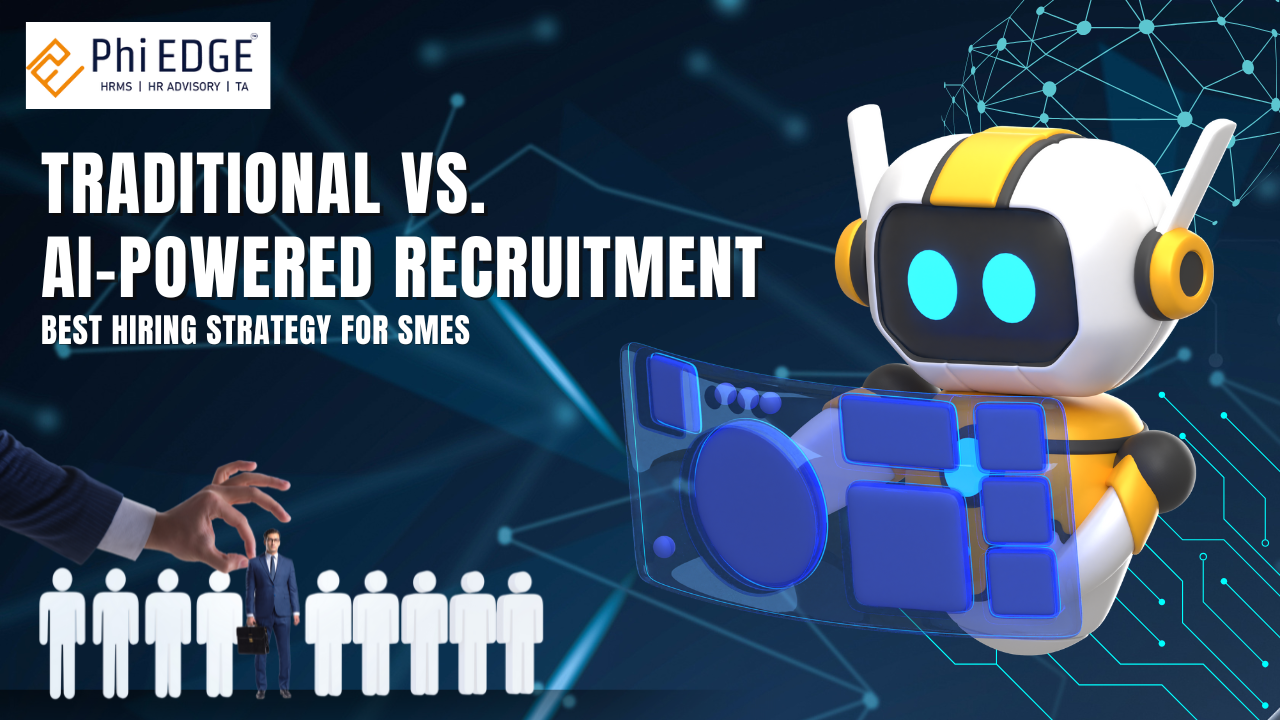
  • Traditional vs. AI-Powered Recruitment: What’s Best for SMEs

    Traditional vs. AI-Powered Recruitment: What’s Best for SMEs

    Hiring the right people has always been a challenge, but for Small and Medium Enterprises (SMEs), it can feel like walking a tightrope. One wrong decision, and the impact is immediate—projects slow down, productivity drops, and costs rise. Unlike large corporations with big HR teams and hefty budgets, SMEs often need to find the perfect balance between efficiency and cost.

    That brings us to the big question many SMEs are asking in 2025: Should we stick to traditional recruitment methods or switch to AI-powered hiring?

    At Phi EDGE, we’ve worked closely with SMEs across India and seen both sides of the story. Traditional methods still hold value, but modern tools like HRMS Software and talent acquisition automation are transforming how businesses hire. Let’s dive deeper and see what works best for growing organizations. Traditional vs AI-Powered Recruitment.

    Traditional Recruitment: A Familiar Path

    Traditional vs AI-Powered Recruitment

    For years, hiring looked the same: post a job ad, wait for resumes, manually screen them, and conduct rounds of interviews. This is what we call traditional recruitment.

    Why SMEs still use it:
    ● It feels personal. Recruiters get to interact directly with candidates.
    ● The process is straightforward, no need for fancy technology.
    ● Cultural fit is easier to gauge in face-to-face interactions.

    But there are drawbacks too:
    ● It’s slow. Sorting through hundreds of resumes manually takes weeks.
    ● It’s subjective. Decisions often depend on gut feeling rather than data.
    ● It can be expensive. The longer the hiring cycle, the more it costs.

    For a small business trying to move fast, these limitations can create roadblocks.

    AI-Powered Recruitment: A Smarter Approach

    Traditional vs AI-Powered Recruitment

    Now imagine this: you post a job, and within hours an AI tool screens thousands of resumes, highlights the top 10 candidates, and even schedules interviews. That’s what AI-powered recruitment brings to the table.

    Using HRMS Software with talent acquisition automation, SMEs can:

    ● Save time: Automated resume screening cuts shortlisting time drastically.
    ● Improve accuracy: AI matches candidate skills against job requirements and KPI HR
    benchmarks.
    ● Reduce bias: Decisions are based more on data than personal preference.
    ● Expand reach: AI searches across job boards, social media, and databases
    simultaneously.

    Of course, AI recruitment isn’t flawless. Some SMEs worry about losing the “human touch.” Others hesitate because of the initial learning curve. But the benefits—especially for growing businesses—are hard to ignore.

    Traditional vs. AI Recruitment: Head-to-Head

    Let’s compare both approaches across a few key areas:

    1. Speed

    ● Traditional: Screening resumes manually can take weeks.
    ● AI-powered: Automation cuts this time by half, sometimes more.

    With Phi EDGE talent acquisition automation, SMEs can reduce hiring delays and fill roles faster.

    2. Quality of Hire

    ● Traditional: Relies on recruiter judgment and instinct.
    ● AI-powered: Uses data and KPI HR insights to ensure skills align with job needs.

    Phi EDGE HRMS Software gives SMEs a balanced view—data-driven analysis plus human evaluation.

    3. Cost

    ● Traditional: Longer processes mean higher recruitment expenses.
    ● AI-powered: Faster, streamlined hiring lowers overall cost-per-hire.

    SMEs using Phi EDGE save money while improving efficiency.

    4. Bias & Diversity

    ● Traditional: Subjective decisions may unintentionally favor certain candidates.
    ● AI-powered: Algorithms focus on skills, qualifications, and job fit.

    At Phi EDGE, we combine AI with human oversight so businesses can maintain fairness while ensuring cultural alignment.

    5. Scalability 

    ● Traditional: Works fine when hiring occasionally but struggles as businesses expand.
    ● AI-powered: Can easily handle high-volume recruitment.

    Our HRMS Software scales with your business, so whether you’re hiring 5 people or 50, the system adapts.

    Why SMEs Need to Think Ahead

    Traditional vs AI-Powered Recruitment

    The hiring landscape in India is changing rapidly. Younger job seekers expect faster processes, digital interactions, and clear communication. SMEs sticking only to traditional methods may fall behind competitors already using AI tools.

    Here’s why a shift makes sense:
    ● Faster decision-making: No more losing candidates because the process dragged on.
    ● Smarter choices: Candidates are assessed against data-backed KPIs.
    ● Better retention: Right hires stay longer, reducing turnover costs.
    ● All-in-one management: Recruitment connects seamlessly with payroll, performance reviews, and training inside HRMS Software.

    At Phi EDGE, we’ve seen SMEs transform their hiring by combining technology with the human touch.

    The Phi EDGE Approach

    We don’t believe it’s about choosing between traditional or AI recruitment—it’s about blending both. Technology handles the repetitive, time-consuming parts, while HR managers focus on
    engaging with candidates personally.

    Our solutions include:
    ● Automated job postings across multiple platforms.
    ● Resume screening powered by AI.
    ● Integrated talent acquisition automation features.
    ● Recruitment KPIs linked directly to KPI HR dashboards.
    ● End-to-end management through our HRMS Software.

    The result? SMEs hire faster, smarter, and with greater confidence.

    Conclusion

    So, what’s best for SMEs: traditional recruitment or AI-powered hiring? The truth is, both have their place. Traditional recruitment is personal and trusted, while AI-powered tools bring speed, accuracy, and scalability.

    For SMEs in 2025, the winning formula lies in combining both. Use AI to handle the heavy lifting—resume screening, shortlisting, scheduling—and let your HR team focus on conversations, cultural fit, and final decisions.

    At Phi EDGE, we help SMEs strike this balance. With our advanced HRMS Software and talent acquisition automation, you can track KPI HR, improve hiring outcomes, and build strong teams that support long-term growth.

    Ready to make recruitment smarter for your SME? Get in touch with Phi EDGE today and discover how we can help you hire faster and better.

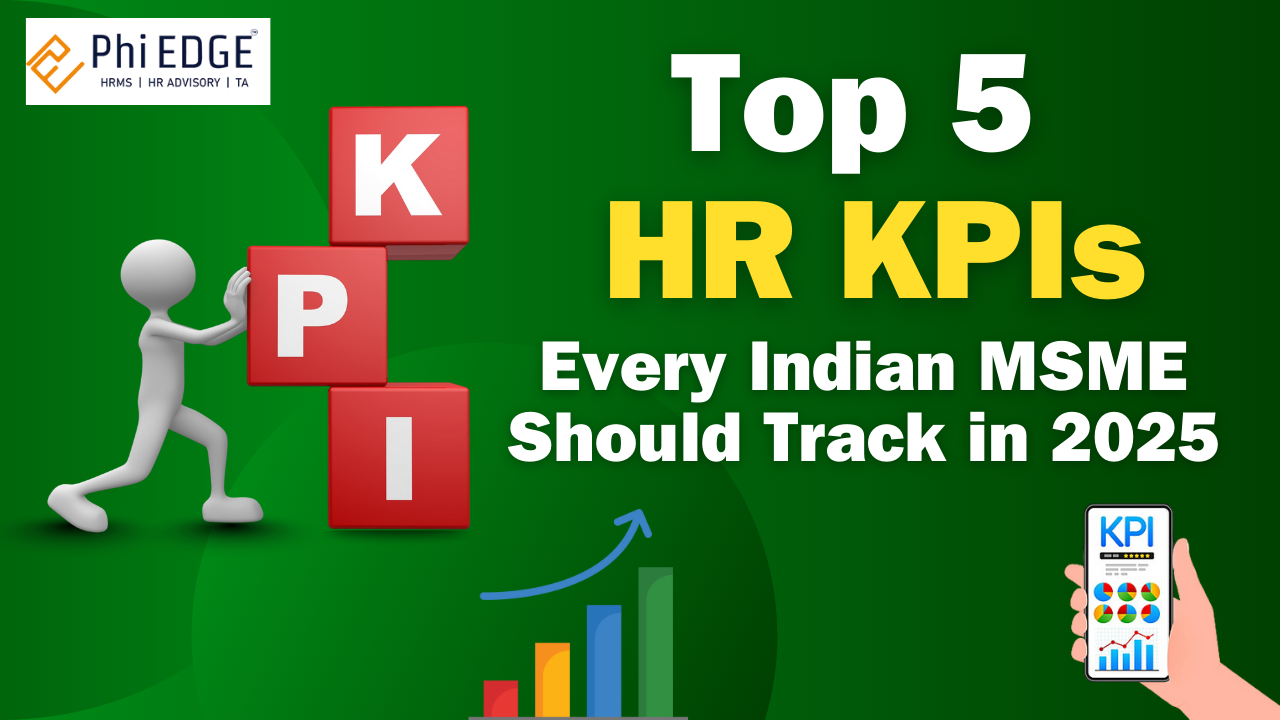
  • Top 5 HR KPIs Every Indian MSME Should Track in 2025

    Top 5 HR KPIs Every Indian MSME Should Track in 2025

    In today’s competitive landscape, Micro, Small, and Medium Enterprises (MSMEs) in India are under constant pressure to improve productivity, retain talent, and stay compliant with changing labor regulations. in 2025 these HR KPIs Every Indian MSME Should Track. For 2025, one of the most effective ways MSMEs can gain an edge is by tracking the right HR Key Performance Indicators (KPIs). These metrics not only measure employee efficiency but also help business leaders take data-driven decisions.

    At Phi EDGE, we understand that every MSME requires smart HR strategies to scale
    successfully. With the help of modern tools like HRMS Software India 2025 and talent
    acquisition automation India, companies can track KPIs with ease, gain insights, and build a more engaged workforce.

    In this blog, we’ll explore the top 5 HR KPIs every Indian MSME should track in 2025—and
    how Phi EDGE helps businesses achieve measurable results.

    Why HR KPIs Matter for MSMEs in India

    HR KPIs Every Indian MSME Should Track

    Unlike large corporations, MSMEs often operate with limited resources. That means each hiring decision, every employee’s contribution, and every training investment directly impacts the bottom line. By measuring the right KPI HR India, MSMEs can:

    ● Reduce employee turnover.
    ● Increase workforce productivity.
    ● Streamline recruitment with automation.
    ● Optimize training budgets.
    ● Improve employee satisfaction and retention.

    Without tracking KPIs, MSMEs risk making decisions based on guesswork rather than insights. With Phi EDGE HRMS Software India 2025, MSMEs can automate KPI tracking, generate reports instantly, and take action before problems escalate.

    1. Employee Turnover Rate

    Definition: The percentage of employees leaving the organization during a given period.

    High turnover is one of the biggest challenges for MSMEs in India. Replacing an employee often costs 1.5 to 2 times their salary, which is a heavy burden for smaller businesses.

    Why it matters:
    ● High turnover disrupts operations.
    ● Hiring new talent consumes time and money.
    ● Knowledge loss impacts productivity.

    Formula:
    Employee Turnover Rate = (Number of Exits ÷ Average Number of Employees) × 100

    With Phi EDGE HRMS Software India 2025, MSMEs can track turnover trends, identify
    departments with higher attrition, and take proactive steps such as employee engagement programs and rewards.

    2. Time-to-Hire

    Definition: The average number of days it takes to fill a job vacancy.

    For MSMEs, every day a role stays vacant means lost productivity and slower growth. Delayed hiring can also cause project bottlenecks.

    Why it matters:
    ● Shorter hiring cycles reduce business disruption.
    ● Attracting top talent quickly increases competitiveness.

    How to improve:
    ● Use talent acquisition automation India to screen resumes faster.
    ● Build a talent pipeline to reduce delays.
    ● Streamline interview processes.

    With Phi EDGE’s recruitment solutions, MSMEs can reduce time-to-hire significantly. Our platform automates candidate sourcing, shortlisting, and interview scheduling, giving HR teams more time to focus on quality rather than paperwork.

    3. Employee Productivity

    Definition: The output delivered by employees within a specific timeframe.

    Employee productivity is a direct measure of how efficiently resources are utilized. For MSMEs, even a slight improvement in productivity can have a significant impact on revenue and profitability.

    Why it matters:
    ● High productivity means faster project delivery.
    ● Better output ensures business scalability.
    ● Helps identify top performers and areas for training.

    How to track:
    ● Project completion rates.
    ● Sales per employee.
    ● Work quality and customer feedback.

    Phi EDGE HRMS Software India 2025 provides managers with productivity dashboards, performance appraisal tools, and 360-degree feedback systems. These insights empower MSMEs to recognize achievers, motivate teams, and ensure continuous improvement.

    4. Absenteeism Rate

    Definition: The frequency of unplanned employee absences within a defined period.

    Why it matters for MSMEs:
    ● Frequent absenteeism disrupts team collaboration.
    ● In smaller teams, one absent employee can delay projects.
    ● High absenteeism often signals poor engagement or workplace dissatisfaction.

    Formula:
    Absenteeism Rate = (Total Days Lost to Absence ÷ Total Available Workdays) × 100

    With Phi EDGE HRMS Software, attendance tracking is automated using biometric systems and mobile apps. MSMEs can quickly identify patterns of absenteeism and implement wellness initiatives, flexible schedules, or engagement programs to address the root causes.

    5. Training & Development ROI

    Definition: The return on investment from employee training and development programs.

    For MSMEs, training budgets are usually tight. It’s essential to ensure every rupee spent ontraining delivers measurable benefits.

    Why it matters:
    ● Skilled employees are more productive.
    ● Training improves retention and reduces hiring costs.
    ● Continuous learning prepares businesses for digital transformation in 2025.

    How to measure:
    Training ROI = (Benefits from Training − Cost of Training) ÷ Cost of Training × 100

    With Phi EDGE HRMS Software India 2025, MSMEs can track training attendance, monitor skill improvements, and link learning outcomes with performance reviews. Whether it’s leadership coaching or digital upskilling, MSMEs can ensure they are investing in the right training programs.

    Trends to Watch in 2025

    HR KPIs Every Indian MSME Should Track

    The future of HR in India is data-driven. For MSMEs to thrive, they need to embrace technology and modernize their HR practices. Some key 2025 HR trends include:

    ● AI-powered HR analytics for better decision-making.
    ● Talent acquisition automation India to simplify hiring.
    ● Mobile-first HRMS platforms for remote and hybrid teams.
    ● Employee engagement apps that foster communication and collaboration.

    By leveraging these trends, MSMEs can gain a competitive edge. Phi EDGE is at the forefront of these innovations, offering comprehensive HR solutions designed specifically for Indian businesses.

    How Phi EDGE Helps MSMEs Track HR KPIs

    At Phi EDGE, our mission is to simplify HR management for MSMEs. Our HRMS Software India 2025 offers:

    ● Automated payroll, attendance, and leave management.
    ● KPI tracking dashboards tailored for MSMEs.
    ● Performance appraisal and 360-degree feedback tools.
    ● Seamless integration of recruitment with talent acquisition automation India.
    ● Training and development tracking for ROI measurement.

    By consolidating all HR processes into one platform, Phi EDGE helps MSMEs save time, reduce costs, and focus on business growth.

    Conclusion

    In 2025, HR KPIs are no longer optional—they are business essentials. in these days these HR KPIs Every Indian MSME Should Track. By tracking the top 5 HR KPIs—Employee Turnover Rate, Time-to-Hire, Employee Productivity, Absenteeism Rate, and Training ROI—Indian MSMEs can boost efficiency, retain top talent, and stay competitive.

    With Phi EDGE HRMS Software India 2025, MSMEs gain a powerful tool to automate KPI
    measurement, generate actionable insights, and future-proof their HR strategy.

    👉 Ready to take your MSME HR to the next level? Contact Phi EDGE today and discover how our advanced HRMS and talent acquisition automation India solutions can transform your workforce management in 2025.

  • Performance Feedback Nightmares: A Comedy of Corporate Errors in the Age of AI

    Performance Feedback Nightmares: A Comedy of Corporate Errors in the Age of AI

    In today’s rapidly evolving corporate landscape, performance feedback is both a Phi EDGE for growth and—when mishandled—a source of untold frustration. At Phi EDGE, we’ve seen how even the best-intentioned performance cycles can descend into chaos, especially when old habits meet cutting-edge AI tools. This white paper shares a wry, insightful look at classic and modern performance pitfalls and guides organizations toward genuine talent transformation using data, empathy, and technology.

    Error: Contact form not found.

  • How AI HRMS Drives Business Growth with Phi EDGE

    How AI HRMS Drives Business Growth with Phi EDGE

    How AI HRMS Drives Business Growth with Phi EDGE

    In today’s fast-changing business environment, Human Resources (HR) is no longer limited to hiring employees and managing payroll. Modern HR teams are expected to improve employee productivity, reduce operational costs, enhance workforce engagement, and support strategic business decisions. To meet these expectations, organizations are increasingly adopting AI HRMS (Artificial Intelligence Human Resource Management Systems) that automate repetitive tasks and provide actionable insights.

    Businesses across industries are embracing AI-powered HR solutions because they simplify workforce management while enabling HR professionals to focus on people rather than paperwork. From recruitment and onboarding to payroll, attendance, performance management, and employee engagement, AI has transformed how organizations manage their workforce.

    Phi EDGE AI HRMS is designed to help businesses streamline HR operations through intelligent automation, data-driven decision-making, and employee-centric workflows. Instead of relying on manual processes and disconnected tools, organizations can manage their entire employee lifecycle from a single, secure platform.

    Whether you’re a startup with a growing team or a large enterprise managing thousands of employees, AI-powered HR technology can significantly improve operational efficiency, compliance, and business performance.

    In this guide, we’ll explore how AI HRMS drives business growth, the key features that make it indispensable, and why organizations are choosing Phi EDGE to modernize their HR processes.


    What Is AI HRMS?

    An AI HRMS (Artificial Intelligence Human Resource Management System) is an advanced software platform that combines traditional HR management with artificial intelligence, machine learning, and data analytics to automate routine tasks, improve decision-making, and deliver personalised employee experiences.

    Unlike conventional HR software that mainly stores employee records, an AI HRMS actively analyses workforce data, predicts trends, identifies potential issues, and recommends actions that help HR teams and business leaders make smarter decisions.

    For example, AI can:

    • Screen resumes within seconds.
    • Match candidates based on skills and experience.
    • Predict employee attrition risks.
    • Automate payroll calculations.
    • Detect attendance anomalies.
    • Recommend personalised learning paths.
    • Generate real-time HR reports and dashboards.
    • Forecast future workforce requirements.

    This intelligent approach reduces administrative workload while improving productivity, accuracy, and employee satisfaction.

    With Phi EDGE AI HRMS, organizations gain access to a unified platform that integrates essential HR functions, including:

    • Employee Database Management
    • Recruitment & Applicant Tracking
    • Attendance & Leave Management
    • Payroll Processing
    • Performance Management
    • Learning & Development
    • Employee Self-Service Portal
    • HR Analytics & Reporting
    • Compliance Management
    • Workforce Planning

    Instead of switching between multiple applications, HR teams can manage every process from one centralized dashboard, saving valuable time and reducing operational complexity.


    Why Businesses Are Investing in AI HRMS in 2026

    The workplace has changed dramatically over the last few years. Hybrid work models, remote teams, rising employee expectations, and increasing compliance requirements have made manual HR management inefficient and difficult to scale.

    Organizations now require intelligent HR platforms that can automate repetitive work while providing real-time insights into workforce performance.

    Here are some of the biggest reasons businesses are investing in AI HRMS:

    1. Increased Operational Efficiency

    AI automates repetitive HR tasks such as attendance tracking, payroll processing, leave approvals, document management, and onboarding workflows. This allows HR teams to focus on strategic initiatives like employee engagement, talent development, and organizational growth.

    2. Better Hiring Decisions

    AI-powered recruitment tools analyze candidate profiles, rank applicants based on job requirements, and reduce hiring bias. This helps organizations identify the most qualified candidates faster while improving the overall recruitment experience.

    3. Data-Driven Workforce Planning

    AI HRMS platforms provide real-time dashboards and predictive analytics that help HR leaders monitor workforce trends, identify skill gaps, forecast hiring needs, and optimize staffing levels.

    4. Improved Employee Experience

    Employees expect quick access to HR services. Self-service portals, AI chatbots, automated workflows, and personalized recommendations enable employees to manage leave requests, payroll information, performance reviews, and learning opportunities without unnecessary delays.

    5. Enhanced Compliance

    Labour laws and payroll regulations continue to evolve. AI HRMS solutions automate compliance tracking, maintain audit trails, generate statutory reports, and reduce the risk of costly compliance errors.

    6. Business Growth Through Better People Management

    Employees are the foundation of every successful business. By improving recruitment, engagement, productivity, and retention, AI HRMS directly contributes to higher profitability, stronger organizational performance, and sustainable business growth.

    In today’s rapidly evolving digital economy, businesses are constantly searching for smarter ways to improve workforce productivity, streamline operations, and drive sustainable growth. Traditional HR systems are no longer enough to handle the complexities of modern workforce management. This is where the powerful combination of Artificial Intelligence (AI) and Human Resource Management Systems (HRMS) becomes a game-changing solution.

    Phi EDGE is transforming the future of workforce management by combining advanced AI technologies with intelligent HRMS solutions to help businesses automate processes, improve employee experiences, and make smarter organizational decisions.

    AI-powered HRMS platforms are no longer just administrative tools — they have become strategic business partners that help organizations scale efficiently while improving operational performance.

    Key Features of Phi EDGE AI HRMS That Drive Business Growth

    A modern business cannot rely on spreadsheets, emails, and disconnected HR tools to manage its workforce effectively. As organizations grow, HR operations become more complex, increasing the chances of errors, compliance issues, and employee dissatisfaction.

    Phi EDGE AI HRMS brings all HR functions into a single intelligent platform, helping organizations automate processes, improve decision-making, and create a better employee experience. Every feature is designed not only to simplify HR tasks but also to contribute directly to business growth.


    H3: 1. AI-Powered Recruitment and Applicant Tracking System (ATS)

    Hiring the right talent quickly is one of the biggest competitive advantages for any organization. Traditional recruitment processes often involve manually reviewing hundreds of resumes, coordinating interviews, and maintaining candidate records.

    Phi EDGE’s AI-powered Applicant Tracking System (ATS) simplifies recruitment by:

    • Automatically screening resumes
    • Ranking candidates based on job requirements
    • Tracking applicants through every hiring stage
    • Scheduling interviews efficiently
    • Building a centralized talent database
    • Reducing manual recruitment efforts

    Business Benefits

    • Faster hiring cycles
    • Improved candidate quality
    • Reduced recruitment costs
    • Better candidate experience
    • Higher recruiter productivity

    Internal Linking Opportunity: AI Recruitment Software | Applicant Tracking System (ATS) | Talent Acquisition Software


    H3: 2. Smart Employee Onboarding

    Employee experience begins on the first day. A smooth onboarding process helps new hires become productive faster while improving engagement and retention.

    Phi EDGE automates onboarding through:

    • Digital document collection
    • Offer letter management
    • Employee profile creation
    • Welcome workflows
    • Task assignments
    • Policy acknowledgements
    • Department-specific onboarding checklists

    Business Benefits

    • Reduced paperwork
    • Faster employee activation
    • Consistent onboarding experience
    • Better compliance
    • Higher employee satisfaction

    H3: 3. Attendance and Leave Management

    Manual attendance systems often result in payroll errors, inaccurate records, and administrative delays.

    Phi EDGE automates attendance tracking using:

    • Biometric integrations
    • GPS attendance
    • Mobile check-in/check-out
    • Shift scheduling
    • Holiday calendars
    • Leave approval workflows
    • Overtime tracking

    Employees can apply for leave through the self-service portal, while managers receive instant notifications for approvals.

    Business Benefits

    • Accurate attendance records
    • Reduced payroll discrepancies
    • Improved workforce visibility
    • Less manual HR work
    • Better workforce planning

    Internal Linking Opportunity: Attendance Management System | Leave Management Software


    H3: 4. AI-Powered Payroll Management

    Payroll processing is one of the most critical HR functions. Even small calculation errors can affect employee trust and compliance.

    Phi EDGE automates payroll by handling:

    • Salary calculations
    • Tax deductions
    • Provident Fund (PF)
    • Employee State Insurance (ESI)
    • Professional Tax (PT)
    • Bonus processing
    • Incentives
    • Reimbursements
    • Payslip generation
    • Statutory compliance

    AI minimizes human errors while ensuring employees receive accurate and timely payments.

    Business Benefits

    • Faster payroll processing
    • Reduced payroll errors
    • Improved compliance
    • Increased employee trust
    • Lower administrative costs

    Internal Linking Opportunity: Payroll Management Software


    H3: 5. Performance Management System

    Employee performance directly impacts business growth. Traditional annual reviews often fail to provide continuous feedback and actionable insights.

    Phi EDGE enables organizations to:

    • Set SMART goals
    • Track Key Performance Indicators (KPIs)
    • Conduct 360-degree feedback
    • Perform continuous performance reviews
    • Measure productivity
    • Monitor team objectives
    • Identify high performers

    Managers gain access to real-time dashboards that help evaluate employee performance objectively.

    Business Benefits

    • Increased employee productivity
    • Better goal alignment
    • Higher employee engagement
    • Improved performance visibility
    • Data-driven promotions and rewards

    Internal Linking Opportunity: Performance Management System


    H3: 6. Employee Self-Service (ESS) Portal

    Employees expect quick and convenient access to HR services without relying on HR personnel for every request.

    The Phi EDGE Employee Self-Service Portal allows employees to:

    • Download payslips
    • Apply for leave
    • Update personal information
    • Track attendance
    • Submit reimbursement claims
    • Access company policies
    • View holiday calendars
    • Complete performance reviews

    Business Benefits

    • Reduced HR workload
    • Faster employee support
    • Improved employee satisfaction
    • Greater transparency
    • Higher operational efficiency

    H3: 7. AI-Driven HR Analytics and Dashboards

    Data is one of the most valuable assets for modern HR teams. However, raw data alone doesn’t help unless it can generate actionable insights.

    Phi EDGE provides interactive dashboards with real-time analytics for:

    • Employee turnover
    • Recruitment performance
    • Attendance trends
    • Payroll reports
    • Leave utilization
    • Department performance
    • Hiring costs
    • Employee engagement
    • Productivity metrics

    AI identifies patterns and predicts workforce trends, enabling proactive HR decisions.

    Business Benefits

    • Better workforce planning
    • Faster decision-making
    • Reduced employee attrition
    • Improved productivity
    • Strategic HR management

    Internal Linking Opportunity: HR Analytics Software | Workforce Analytics Dashboard


    H3: 8. Learning and Development (LMS Integration)

    Continuous learning is essential for employee growth and business success.

    Phi EDGE helps organizations manage learning through:

    • Online training programs
    • Skill assessments
    • Course assignments
    • Certification tracking
    • Learning progress reports
    • AI-based learning recommendations

    Employees receive personalized learning paths based on their roles, performance, and career aspirations.

    Business Benefits

    • Improved employee skills
    • Higher productivity
    • Better internal promotions
    • Increased employee retention
    • Future-ready workforce

    Internal Linking Opportunity: Learning Management System (LMS)


    H3: 9. Workforce Planning and Predictive Analytics

    One of the biggest advantages of AI HRMS is its ability to predict future workforce needs.

    Phi EDGE uses AI to analyze:

    • Hiring trends
    • Employee turnover risks
    • Workforce demand
    • Department performance
    • Skill shortages
    • Succession planning
    • Future recruitment requirements

    These predictive insights allow organizations to plan hiring, allocate resources efficiently, and reduce unexpected talent gaps.

    Business Benefits

    • Better workforce forecasting
    • Reduced hiring delays
    • Lower attrition
    • Improved succession planning
    • Sustainable business growth

    How Phi EDGE AI HRMS Supports Different Industries

    Every industry has unique HR challenges. Phi EDGE offers flexible workflows and automation to support diverse business needs.

    Manufacturing

    • Shift and workforce scheduling
    • Overtime management
    • Attendance automation
    • Compliance tracking

    IT & Software

    • Remote workforce management
    • Performance tracking
    • Learning management
    • Recruitment automation

    Healthcare

    • Shift planning
    • Staff compliance
    • Credential management
    • Payroll automation

    Retail & E-commerce

    • Multi-location employee management
    • Seasonal workforce planning
    • Attendance and payroll integration
    • Employee engagement

    Education

    • Faculty attendance
    • Performance reviews
    • Leave management
    • Digital document management

    BFSI

    • Compliance-driven HR workflows
    • Secure employee data management
    • Performance analytics
    • Employee lifecycle management

    Expert Insight

    Organizations that treat HR as a strategic function rather than an administrative department are more likely to attract top talent, improve employee retention, and achieve sustainable business growth. By combining automation, predictive analytics, and employee-centric workflows, Phi EDGE AI HRMS empowers HR teams to become strategic partners in driving organizational success—not just managing routine operations.

    What Is an HRMS?

    A Human Resource Management System (HRMS) is a software platform designed to manage and automate core HR functions such as:

    • Employee records
    • Attendance tracking
    • Payroll processing
    • Recruitment
    • Leave management
    • Performance evaluation
    • Compliance management

    Modern HRMS platforms centralize workforce data and simplify HR operations for businesses of all sizes.


    The Role of Artificial Intelligence in HRMS

    Artificial Intelligence enhances traditional HRMS systems by introducing automation, predictive analytics, intelligent recommendations, and real-time decision-making capabilities.

    AI-powered HRMS systems can:

    • Analyze employee performance patterns
    • Automate repetitive HR tasks
    • Predict workforce trends
    • Improve recruitment processes
    • Enhance employee engagement
    • Reduce human errors

    With AI integration, HR departments can focus more on strategic business growth rather than administrative tasks.


    Why Businesses Need AI + HRMS Solutions

    The Shift Toward Digital Workforce Management

    As organizations grow, managing employees manually becomes increasingly difficult. Businesses face challenges such as:

    • Increasing operational complexity
    • Employee retention issues
    • Payroll errors
    • Compliance management
    • Performance tracking difficulties
    • Recruitment inefficiencies

    AI-powered HRMS solutions solve these problems by creating a centralized and intelligent workforce management ecosystem.

    Phi EDGE helps organizations adopt digital HR transformation strategies that improve efficiency and scalability.


    Key Benefits of AI-Powered HRMS with Phi EDGE

    Smart Recruitment and Talent Acquisition

    Hiring the right employees is one of the most critical factors for business success. Traditional recruitment processes are time-consuming and often inefficient.

    AI-powered HRMS platforms streamline recruitment by:

    • Automatically screening resumes
    • Matching candidate profiles
    • Scheduling interviews
    • Analyzing hiring trends
    • Reducing recruitment time

    Phi EDGE intelligent HRMS solutions help businesses attract top talent faster while improving hiring accuracy.


    Automated Attendance and Payroll Management

    Manual attendance tracking and payroll processing often lead to:

    • Human errors
    • Delayed salary payments
    • Compliance risks
    • Administrative overload

    AI-powered HRMS systems automate:

    • Attendance tracking
    • Shift scheduling
    • Payroll calculations
    • Tax deductions
    • Leave management

    This automation saves time, improves accuracy, and reduces operational costs for businesses.


    Performance Management and Employee Analytics

    Modern organizations require data-driven insights to improve employee productivity and organizational performance.

    AI-integrated HRMS platforms provide:

    • Real-time performance tracking
    • Productivity analytics
    • Goal management
    • Employee engagement analysis
    • Automated feedback systems

    Managers can make informed decisions based on accurate workforce data rather than assumptions.

    Phi EDGE helps organizations transform employee performance management into a strategic growth engine.


    AI Improves Employee Experience

    Personalized Employee Engagement

    Employee satisfaction directly impacts productivity and retention. AI-powered HRMS systems create personalized employee experiences by:

    • Recommending training programs
    • Automating onboarding
    • Providing self-service portals
    • Delivering instant HR support through AI chatbots

    Employees gain faster access to HR information, improving workplace transparency and communication.


    AI Chatbots for HR Support

    AI chatbots simplify internal communication by answering common HR-related queries such as:

    • Leave balance
    • Payroll details
    • Attendance records
    • Company policies
    • Holiday schedules

    This reduces HR workload while improving employee satisfaction and response times.


    Business Growth Through Intelligent HR Automation

    Data-Driven Decision Making

    One of the biggest advantages of AI-powered HRMS is access to workforce intelligence.

    Businesses can analyse:

    • Employee productivity trends
    • Attrition rates
    • Recruitment effectiveness
    • Department performance
    • Workforce planning

    This data helps organisations optimise operations and improve strategic planning.

    Phi EDGE enables businesses to make smarter decisions using advanced workforce analytics and AI-driven insights.


    Scalability for Growing Businesses

    As companies expand, managing larger teams becomes more challenging. AI-based HRMS platforms scale effortlessly with organizational growth.

    Whether a company has:

    • 20 employees
    • 200 employees
    • 2000 employees

    AI-powered HRMS systems maintain operational efficiency without increasing administrative complexity.


    Security and Compliance Management

    Reducing Compliance Risks

    Businesses must comply with labour laws, tax regulations, and employee policies. Manual HR processes often create compliance challenges.

    AI-powered HRMS solutions help organisations:

    • Maintain accurate records
    • Automate compliance reporting
    • Monitor attendance regulations
    • Secure employee data

    Phi EDGE ensures businesses stay compliant while minimizing legal and operational risks.


    Enhanced Data Security

    Employee information is highly sensitive. Modern HRMS platforms use:

    • Cloud security
    • Access control systems
    • Encrypted databases
    • AI-driven threat monitoring

    These security features protect critical workforce data from unauthorized access and cyber threats.


    The Future of AI in HR Management

    Predictive Workforce Analytics

    The future of HR technology lies in predictive analytics. AI systems can forecast:

    • Employee turnover risks
    • Hiring requirements
    • Skill gaps
    • Workforce productivity trends

    This allows businesses to proactively address organizational challenges before they become major issues.


    AI-Driven Workforce Optimization

    Future AI HRMS platforms will continue evolving with:

    • Advanced automation
    • Behavioral analysis
    • Smart scheduling
    • AI-based employee wellness monitoring
    • Intelligent workforce planning

    Businesses adopting AI HR technologies today will gain a significant competitive advantage in the future.


    Why Choose Phi EDGE for AI-Powered HRMS Solutions?

    Industry-Focused HR Technology

    Phi EDGE delivers intelligent HRMS solutions designed to meet the needs of modern businesses across various industries.

    The platform focuses on:

    • Automation
    • Scalability
    • Workforce intelligence
    • Business growth
    • Employee experience
    • Operational efficiency

    Customized HRMS Solutions

    Every business has unique HR requirements. Phi EDGE provides customizable HRMS systems that adapt to:

    • Startups
    • SMEs
    • Enterprises
    • Remote teams
    • Multi-location organizations

    This flexibility ensures businesses can optimise workforce management according to their operational goals.


    Final Thoughts

    The combination of AI and HRMS is transforming workforce management into a strategic driver of business growth. Organisations that adopt AI-powered HRMS solutions achieve operational efficiency, enhanced decision-making capabilities, improved employee engagement, and scalable workforce management systems.

    Phi EDGE is helping businesses move beyond traditional HR processes by delivering intelligent, automated, and future-ready HRMS solutions.

    As the digital workplace continues evolving, AI-powered HRMS platforms will become essential tools for organizations seeking long-term growth, innovation, and competitive success.

  • Can AI Replace HR? Myths vs. Reality

    Can AI Replace HR? Myths vs. Reality

    Artificial Intelligence is transforming industries across the world, from healthcare and finance to marketing and customer service. Human Resources (HR) is no exception. Modern businesses are increasingly adopting AI-powered HR technologies to automate recruitment, improve workforce management, analyze employee performance, and streamline administrative operations.

    As AI continues evolving, a common question arises in the corporate world:

    Can AI completely replace HR professionals?

    While some believe AI will eventually take over human resource management, others argue that human empathy, leadership, and workplace relationships can never be replaced by machines.

    The reality lies somewhere in between.

    AI is undoubtedly reshaping HR operations, but it is not eliminating the need for human resource professionals. Instead, AI is transforming HR into a more strategic, data-driven, and employee-focused function.

    This article explores the myths and realities surrounding AI in HR and explains how artificial intelligence is changing the future of workforce management.


    Understanding AI in Human Resources

    What Is AI-Powered HR?

    AI-powered HR refers to the use of artificial intelligence technologies in human resource management processes.

    These technologies help organizations automate and optimize HR functions such as:

    • Recruitment
    • Employee onboarding
    • Attendance tracking
    • Payroll management
    • Performance evaluations
    • Employee engagement
    • Workforce analytics

    AI systems use machine learning, automation, and predictive analytics to improve efficiency and decision-making.


    Why Businesses Are Adopting AI in HR

    The Shift Toward Digital Workforce Management

    Modern organizations manage larger, more diverse, and increasingly remote workforces. Traditional HR methods often struggle to handle growing operational complexity.

    Businesses adopt AI-driven HR systems to:

    • Save time
    • Reduce manual workload
    • Improve employee experiences
    • Enhance hiring accuracy
    • Support business growth

    AI technologies help HR departments focus more on strategic initiatives rather than repetitive administrative tasks.


    Common Myths About AI Replacing HR

    Myth 1: AI Will Completely Replace HR Professionals

    One of the biggest misconceptions is that AI will eliminate HR jobs entirely.

    Reality

    AI can automate repetitive tasks, but it cannot fully replace:

    • Human empathy
    • Emotional intelligence
    • Leadership
    • Conflict resolution
    • Workplace culture management

    HR professionals play a critical role in building relationships, managing employee well-being, and supporting organizational growth.

    AI works best as a support system rather than a complete replacement for human HR expertise.


    Myth 2: AI Can Make Perfect Hiring Decisions

    Many businesses believe AI recruitment tools can always identify the best candidates accurately.

    Reality

    AI can improve recruitment efficiency by:

    • Screening resumes
    • Matching candidate profiles
    • Automating interview scheduling

    However, AI systems still rely on data and algorithms that may contain biases or limitations.

    Hiring decisions require human judgment, cultural understanding, and communication skills that AI cannot fully replicate.

    Organizations must combine AI insights with human evaluation to make fair hiring decisions.


    Myth 3: Employees Prefer AI Over Human Interaction

    Some companies assume employees are comfortable replacing human HR communication with AI chatbots and automated systems.

    Reality

    While employees appreciate faster support and digital convenience, they still value human interaction during:

    • Workplace conflicts
    • Career discussions
    • Emotional challenges
    • Performance feedback
    • Leadership guidance

    Employees want to feel understood, supported, and respected — something AI alone cannot provide.


    The Real Role of AI in HR

    Automating Repetitive HR Tasks

    AI is highly effective at handling repetitive and time-consuming administrative functions.

    These include:

    • Attendance management
    • Payroll calculations
    • Leave approvals
    • Employee data processing
    • Compliance reporting

    Automation reduces manual workload and improves operational efficiency.

    This allows HR professionals to spend more time on strategic workforce planning and employee development.


    Improving Recruitment Efficiency

    AI-powered recruitment tools help businesses hire faster and more efficiently.

    AI systems can:

    • Analyze resumes quickly
    • Identify qualified candidates
    • Reduce recruitment time
    • Improve candidate matching

    This helps organizations manage high-volume hiring processes more effectively.

    However, final hiring decisions still require human assessment and interpersonal evaluation.


    Enhancing Employee Experience

    AI technologies are improving employee experiences through:

    • HR chatbots
    • Personalized learning recommendations
    • Self-service HR portals
    • Automated onboarding systems

    Employees can access HR information instantly without waiting for manual support.

    This improves workplace convenience and communication efficiency.


    Where Human HR Professionals Remain Essential

    Emotional Intelligence and Workplace Relationships

    Human Resources is not only about processes and data. It also involves:

    • Understanding emotions
    • Managing workplace conflicts
    • Supporting employee well-being
    • Encouraging collaboration
    • Building organizational culture

    AI lacks emotional understanding and human empathy.

    Employees facing workplace stress, personal challenges, or career concerns often need compassionate human support rather than automated responses.


    Leadership and Organizational Culture

    Strong workplace culture depends on leadership, trust, communication, and shared values.

    HR professionals help organizations:

    • Develop leadership strategies
    • Improve employee morale
    • Promote diversity and inclusion
    • Strengthen workplace relationships

    AI can provide insights and analytics, but culture-building remains a deeply human responsibility.


    Risks of Over-Reliance on AI in HR

    Bias in AI Systems

    AI systems learn from historical data. If the data contains bias, AI recommendations may also become biased.

    This can affect:

    • Recruitment decisions
    • Performance evaluations
    • Promotion opportunities

    Businesses must regularly monitor AI systems to ensure fairness and transparency.


    Loss of Human Connection

    Excessive automation can make workplaces feel impersonal and disconnected.

    Employees may feel:

    • Reduced emotional support
    • Lack of recognition
    • Poor communication
    • Decreased trust in management

    Organizations must balance technology with human-centered leadership.


    The Future of AI and HR Collaboration

    AI as a Strategic HR Partner

    The future of HR is not about replacing humans with machines. Instead, it involves collaboration between AI technologies and HR professionals.

    AI supports HR by:

    • Providing workforce insights
    • Automating routine tasks
    • Improving decision-making
    • Enhancing operational efficiency

    Meanwhile, HR professionals focus on:

    • Employee engagement
    • Leadership development
    • Workplace relationships
    • Organizational growth

    This partnership creates more efficient and people-focused workplaces.


    The Rise of Data-Driven HR

    Modern organizations increasingly rely on workforce analytics to improve business decisions.

    AI-powered HR systems can analyze:

    • Employee productivity
    • Retention risks
    • Skill gaps
    • Recruitment trends
    • Engagement levels

    These insights help businesses make smarter workforce management decisions.


    Benefits of AI-Powered HR Systems

    Increased Operational Efficiency

    AI reduces administrative workload and improves process automation, allowing organizations to operate more efficiently.

    Benefits include:

    • Faster recruitment
    • Accurate payroll processing
    • Improved compliance management
    • Better workforce planning

    Improved Employee Productivity

    AI-powered tools help employees:

    • Access HR services faster
    • Receive personalized training
    • Improve communication
    • Manage tasks efficiently

    This contributes to higher workplace productivity and employee satisfaction.


    Preparing for the Future of HR

    Building Human-Centered AI Strategies

    Businesses should implement AI in ways that support employees rather than replace human interaction completely.

    Successful organizations:

    • Combine AI with human leadership
    • Maintain transparent communication
    • Prioritize employee well-being
    • Use technology ethically

    This balanced approach creates healthier workplace environments.


    Upskilling HR Professionals

    As the use of AI grows, HR professionals need to acquire new competencies like:

    Analysis of data
    Management of the digital workforce
    Knowledge of AI technology
    Leadership in strategy

    From administrative management to strategic business cooperation, HR’s function is changing.


    Final Thoughts

    AI is revolutionizing the HR sector by enhancing workforce analytics, automation, and efficiency. But it’s mostly untrue to say that AI will totally replace HR specialists.

    Technology cannot completely replace human skills in human resources, which includes emotional intelligence, leadership, workplace culture, and interpersonal interactions.

    AI technology and HR specialists working together is the key to the future of HR. Stronger, smarter, and more productive workplaces will be produced by companies that successfully integrate intelligent automation with people-focused leadership.