Author: admin

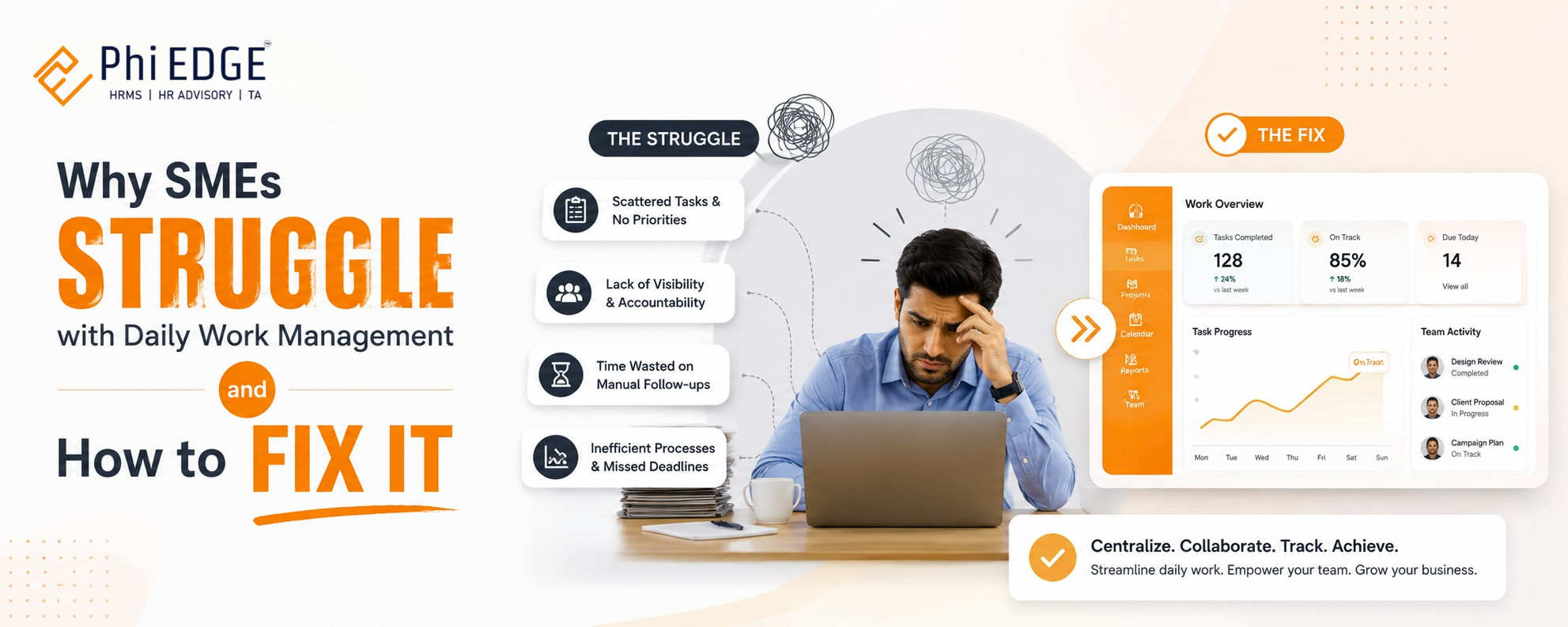
  • Why SMEs Struggle with Daily Work Management and How to Fix It

    Why SMEs Struggle with Daily Work Management and How to Fix It

    SMEs face daily work management

    In the fast-moving world of small and medium enterprises (SMEs), every decision, deadline, and deliverable matters. Yet while strategy and vision draw senior leadership’s focus, what happens every single day—the tasks, handoffs, follow-ups, and assignments that shape outcomes—often gets overlooked.

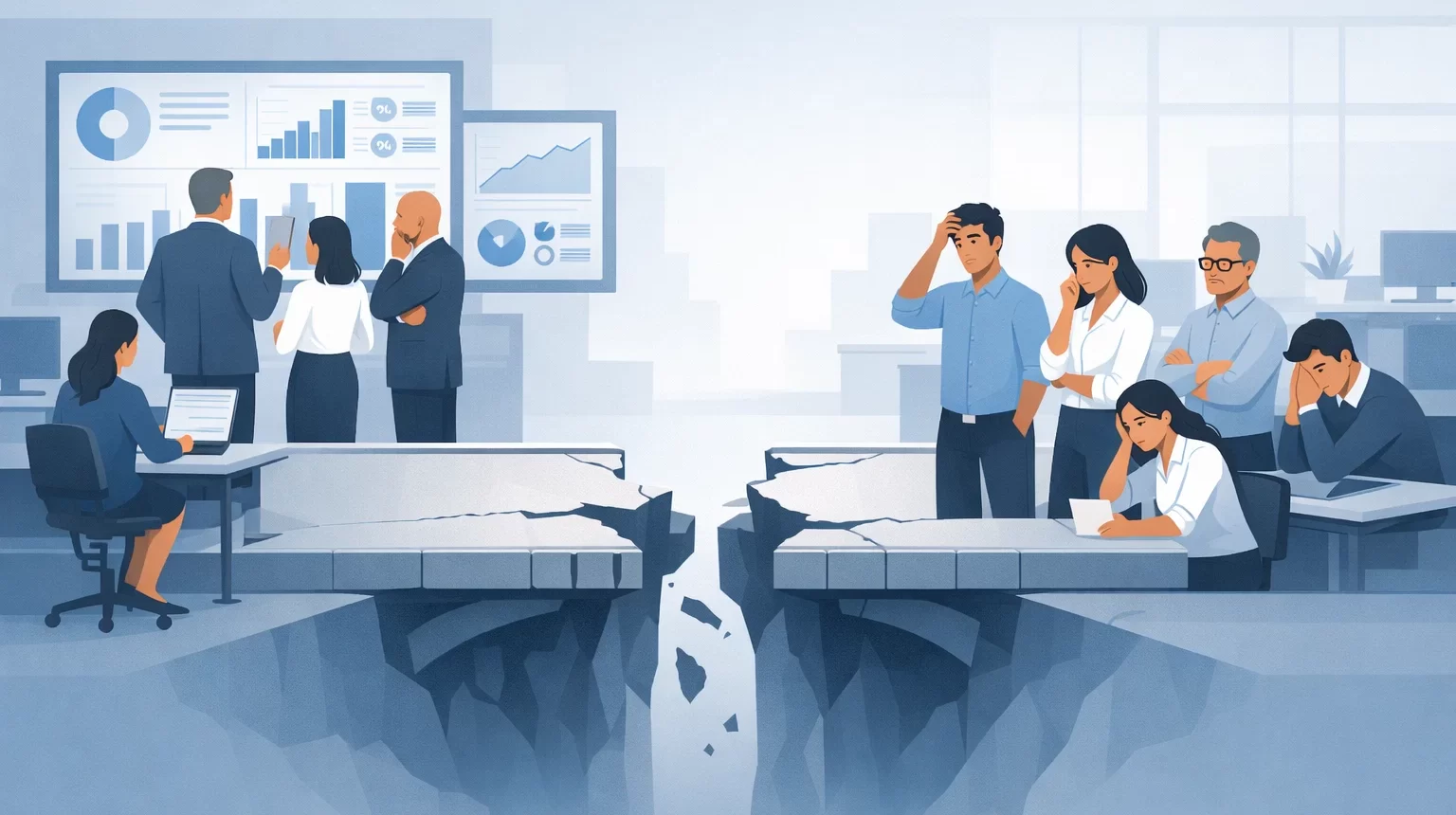
    Ask almost any SME leader what keeps them up at night, and you’ll find that Daily work management consistently ranks high on the list of operational challenges. Teams juggle responsibilities, individual work habits differ, and priorities shift like sand under pressure. When workflows aren’t structured, productivity doesn’t just slow down—it becomes unpredictable.

    At Phi EDGE, we have a front-row view of these challenges. With our integrated experience across HRMS, HR Advisory, and Talent Acquisition, and through our HRMS software and HRIS talent management solutions deployed across industries such as Manufacturing, Financial Services, Real Estate, Hospitality, Construction, Academics, and Information Technology, we have seen how effective work management—or the lack of it—can make or break performance.

    In this blog, we’ll explore why SMEs struggle with daily work management, and more importantly, how they can fix it using structured systems like a Daily Work Management System and practical tools like a daily task management app. This isn’t theoretical. These are strategies you can implement now to transform productivity, accountability, and team morale in your business.

    The Heart of the Problem: Why Daily Work Management Is Hard for SMEs
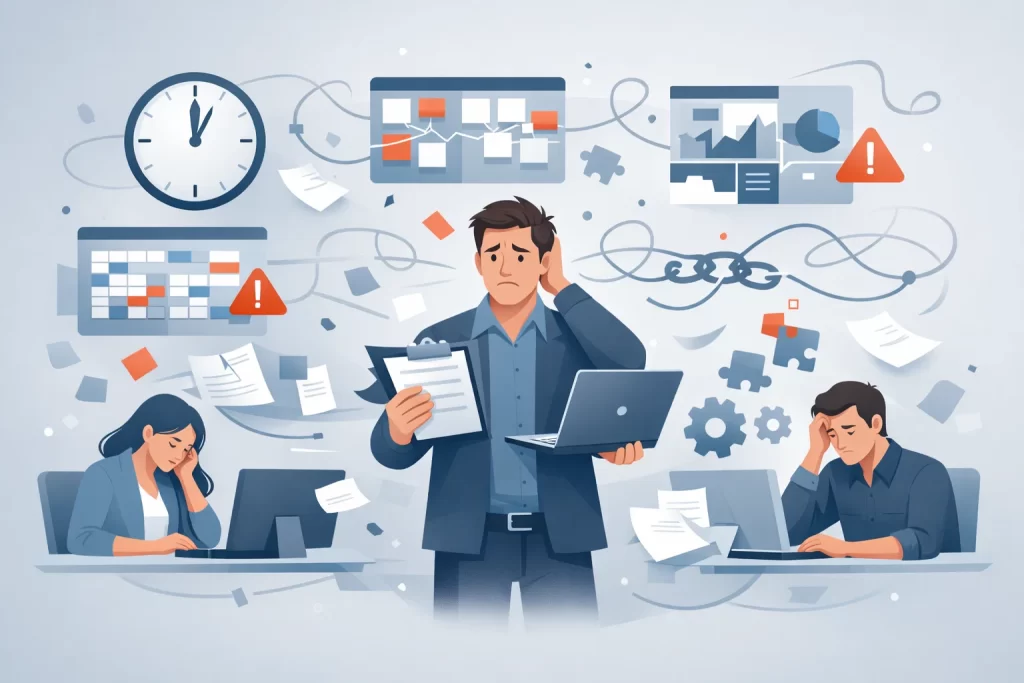
    1. Lack of Clear Visibility and Consistency
    Many SMEs function on informal communication—teams follow their own rhythms and methods. In one corner of the company, tasks might be tracked through group chats. In another, spreadsheets collect dust in forgotten folders. Without a central system, it’s impossible to know what work is being done, by whom, and by when. This lack of visibility is a root cause of confusion and missed commitments.

    This problem gets amplified as businesses scale. When SMEs reach 20, 50, or 200 employees, individual habits, inconsistent workflows, and siloed task tracking create chaos rather than clarity.

    A Daily Work Management System solves this by creating one source of truth—where all tasks, timelines, and responsibilities live in a single platform accessible to everyone who needs them. At Phi EDGE, we’ve seen how this clarity directly improves performance and prevents tasks from falling through the cracks.

    2. Reliance on Manual or Fragmented Tools
    Word documents, spreadsheets, sticky notes, email threads, and chat apps have their place—but they are not designed for structured task tracking. These tools were never built to answer the critical question: What should each employee be working on TODAY?

    For SMEs without an integrated daily task management app, processes become fragmented. Even if a team wants to stay organized, the tools they use don’t scale with complexity. What works for two people quickly collapses when there are ten, and even faster when dependencies multiply.

    A dedicated Daily Work Management System replaces this patchwork of tools with a unified workflow where tasks are created, assigned, tracked, and measured—all in a single place. This not only reduces the time wasted switching between apps but also brings disciplined process to daily execution.

    3. Lack of Defined Accountability
    In many SMEs, accountability happens informally. Managers assume someone is responsible because the work exists. Employees assume someone else is handling it because no one has clearly been assigned. The result? Work gets delayed, misaligned, and ultimately disconnected from business priorities.

    When accountability isn’t formally embedded in daily processes, performance suffers. Deadlines blur, quality drops, and team frustration increases.

    A Daily Work Management System assigns clear ownership of every task. A good daily task management app shows who is doing what and by when, preventing confusion. This clarity in accountability ensures that tasks are not just expected—but owned.

    4. Unclear Priorities and Overload
    In growing SMEs, priorities change rapidly—often without clear communication. Team members can find themselves pulled in multiple directions, unsure whether a task on their board is a top priority or a secondary request. This ambiguity worsens with remote or hybrid teams.

    Without a system that clarifies urgency and impact, employees resort to guessing, multitasking inefficiently, and experiencing burnout. This directly harms performance and engagement.

    The right Daily Work Management solution helps teams rank tasks based on urgency and business value. Managers and employees align on what truly matters today, this week, and this quarter. This prioritization is the backbone of focused work environments.

    5. Poor Integration with Broader HR Systems
    Daily task tracking on its own can help with task completion—but true performance improvement happens when daily work is connected to bigger HR functions: performance reviews, goal setting, learning, and workforce planning.

    Many SMEs use one system for payroll, another for performance reviews, and still others for task tracking. This disconnection creates data silos and prevents leaders from understanding how daily execution impacts performance outcomes.

    With an integrated HRMS solution, like the one offered by Phi EDGE, daily work data becomes part of a larger performance ecosystem. This connectivity generates insights that help with personalized reviews, promotions, training plans, and resource allocation—grounded in real work patterns, not guesswork.

    How Daily Work Management Impacts Employee Performance
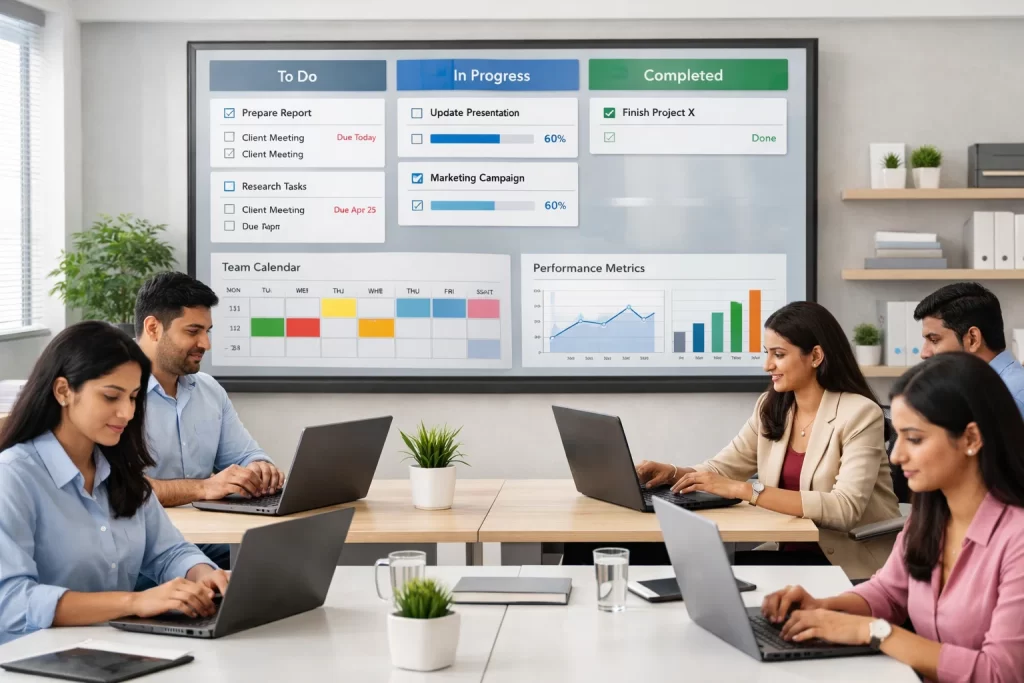
    Understanding why SMEs struggle is the first step. The next is recognizing how a structured approach can improve employee performance and, by extension, business outcomes

    1. Daily Clarity Boosts Focus

    When employees know exactly what they are expected to accomplish each day, they can focus their energy accordingly. A daily task management app provides this clarity by delivering personalized task lists, reminders, and progress indicators.

    Researchers consistently show that clarity of expectations directly correlates with performance quality. Employees who know their targets—and see how their work connects to business goals—are more engaged, productive, and motivated.

    2. Accountability Improves Completion Rates

    As tasks are logged and assigned in a structured Daily Work Management System, accountability becomes measurable. Teams stop guessing who should do what. When tasks are visible, with real deadlines and ownership, employees are more likely to complete work on time.

    At Phi EDGE, we’ve seen teams significantly improve task completion rates when they adopt centralized task tracking. It’s not just about seeing tasks—it’s about knowing they are being held accountable every step of the way.

    3. Transparency Enhances Collaboration

    Teams that use a daily system communicate better. Instead of fragmented updates across emails and chats, task details, comments, attachments, and progress are all in one place. This creates a shared understanding of priorities, removes barriers to collaboration, and eliminates redundant communication.

    With team members having shared visibility into tasks and progress, collaboration becomes smoother, less friction-filled, and more efficient—leading to better performance outcomes.

    4. Reduced Stress, Better Well-Being

    Disorganization creates stress. Unclear responsibilities and shifting priorities leave employees anxious and depleted. A Daily Work Management System reduces this stress by providing clarity of purpose.

    When work is structured, predictable, and transparent, employees experience less cognitive overload. This improves both well-being and performance, as individuals can focus their mental energy on execution rather than uncertainty.

    5. Real-Time Feedback Leads to Continuous Improvement

    When a daily system is integrated with broader HRMS analytics, managers can offer feedback based on real work data—not memory or assumptions. Instead of waiting weeks for periodic reviews, employees receive timely feedback tied to actual task outcomes.

    This accelerates performance improvement, fosters a culture of growth, and builds stronger manager-employee relationships.

    How to Fix Daily Work Management Challenges in SMEs

    Knowing the problem is only half the battle. The next step is implementing solutions that are practical, scalable, and sustainable. Here’s how SMEs can fix their daily work management struggles:

    1. Adopt a Unified Daily Work Management Tool

    The first step for any SME should be moving away from informal tools and toward a structured Daily Work Management System. A good system provides:

    ● Centralized task tracking
    ● Clear assignments and timelines
    ● Real-time updates
    ● Reporting and analytics
    ● Integration with larger HR systems

    A daily task management app is central to this transformation—it becomes the engine that drives clarity and execution.

    2. Align Tasks with Organizational Goals

    Daily tasks should not be isolated checkboxes. They should map back to strategic goals. Employees perform better when they understand how their day-to-day work contributes to broader outcomes.

    Using an integrated HRMS platform like Phi EDGE, organizations can ensure that daily work is not just managed—but aligned with performance objectives, learning goals, and long-term growth.

    3. Train Teams on Structured Task Habits

    Technology is only effective if people use it well. SMEs should invest in training employees on how to use daily work systems effectively—not just how to enter tasks, but how to prioritize, update progress, collaborate, and interpret analytics.

    A well-trained team performs better because they use the system to support clarity and execution—not treat it as a filing cabinet.

    4. Integrate with Performance Reviews

    Daily work data should inform performance evaluations, not be separate from them. When managers use real task outcomes in conversations, the feedback becomes fairer, evidence-based, and actionable.

    This integration between a Daily Work Management System and performance appraisal builds a stronger culture of accountability and continuous improvement.

    5. Provide Continuous Visibility and Feedback

    A daily system is most impactful when it encourages ongoing communication and feedback. Encourage teams to update task progress frequently and share insights within the system—not only at weekly meetings.

    This practice fosters transparency, elevates performance discussions, and prevents small issues from becoming major roadblocks.

    Case Study: How SMEs Benefit When Daily Work
    Management Is Done Right

    Consider a mid-sized IT consulting firm struggling with missed deadlines and team burnout. Tasks were scattered across email threads and spreadsheets, and managers had little visibility into individual workloads. Performance reviews became stressful because managers relied on memory rather than real data.

    After implementing a Daily Work Management System with a daily task management app integrated into their HRMS, things changed. Tasks were centralized, progress was visible in real time, and priorities were clear. Managers could redistribute work when someone was overloaded, and employees could view what was expected of them each day.

    As a result, task completion rates improved by 35%, team collaboration increased, and performance reviews became more constructive because they were backed by daily execution data. This transformation was powered by the clarity, accountability, and transparency provided by a well-implemented system like the one offered by Phi EDGE.

    Common Mistakes SMEs Make in Work Management (and How to Avoid Them)

    Relying on informal tools – Spreadsheets and chats create silos.
    Fix: Use a centralized daily work system for visibility.

    Not setting priorities – Employees juggle work without knowing what matters most.
    Fix: Use structured task lists with priorities and deadlines.

    Disconnect from performance goals – Tasks become disconnected from outcomes.
    Fix: Link daily tasks to broader HRMS goals and KPIs.

    Lack of real-time updates – Work tracking is stale.
    Fix: A daily task management app ensures live updates and accountability.

    Frequently Asked Questions (FAQs)

    Q1: What is daily work management?
    Daily work management refers to organizing, assigning, tracking, and completing daily work tasks in a structured manner that improves clarity, accountability, and performance.

    Q2: How does a daily task management app help SMEs?
    It provides a centralized platform where teams can view, update, and track tasks in real time—breaking free from scattered spreadsheets and informal communication.

    Q3: What is a Daily Work Management System?
    A Daily Work Management System is a structured process, supported by software, that ensures tasks are properly assigned, visible, and measurable, helping teams stay aligned and accountable.

    Q4: Can daily work management improve performance reviews?
    Yes. By connecting daily task execution with performance analytics, SMEs can base reviews on real data rather than impressions.

    Q5: Is integrating with HRMS important for task management?
    Absolutely. Integration ensures that task outcomes feed into broader HR functions such as performance evaluation, training plans, and workforce planning.

    Q6: What challenges do SMEs face with daily work management?
    Common challenges include lack of visibility, fragmented tools, unclear ownership, and disconnected reviews—all of which can be fixed with a structured system.

    Q7: How quickly can SMEs implement a Daily Work Management System?
    With cloud-based solutions like the ones offered by Phi EDGE, implementation can happen quickly—often within weeks, depending on business complexity.

    Conclusion: Daily Work Management Is the Foundation of SME Success

    In the competitive landscape where SMEs operate, efficiency and accountability can make all the difference. When daily work is structured, visible, and aligned with larger goals, employees perform better, managers lead more effectively, and organizations grow more predictably.

    A Daily Work Management System supported by a strong daily task management app transforms how work gets done. It brings clarity, reduces friction, enhances collaboration, and aligns daily effort with strategic performance outcomes.

    At Phi EDGE, we help SMEs implement systems that drive sustainable productivity—ensuring that daily execution becomes a competitive advantage rather than a daily struggle.

    Today’s daily work becomes tomorrow’s performance. Make it count with the right system in place.
  • Why Traditional Performance Appraisals Fail — and How AI Fixes Them

    Why Traditional Performance Appraisals Fail — and How AI Fixes Them

    Why Traditional Performance Appraisals Fail — and How AI Fixes Them

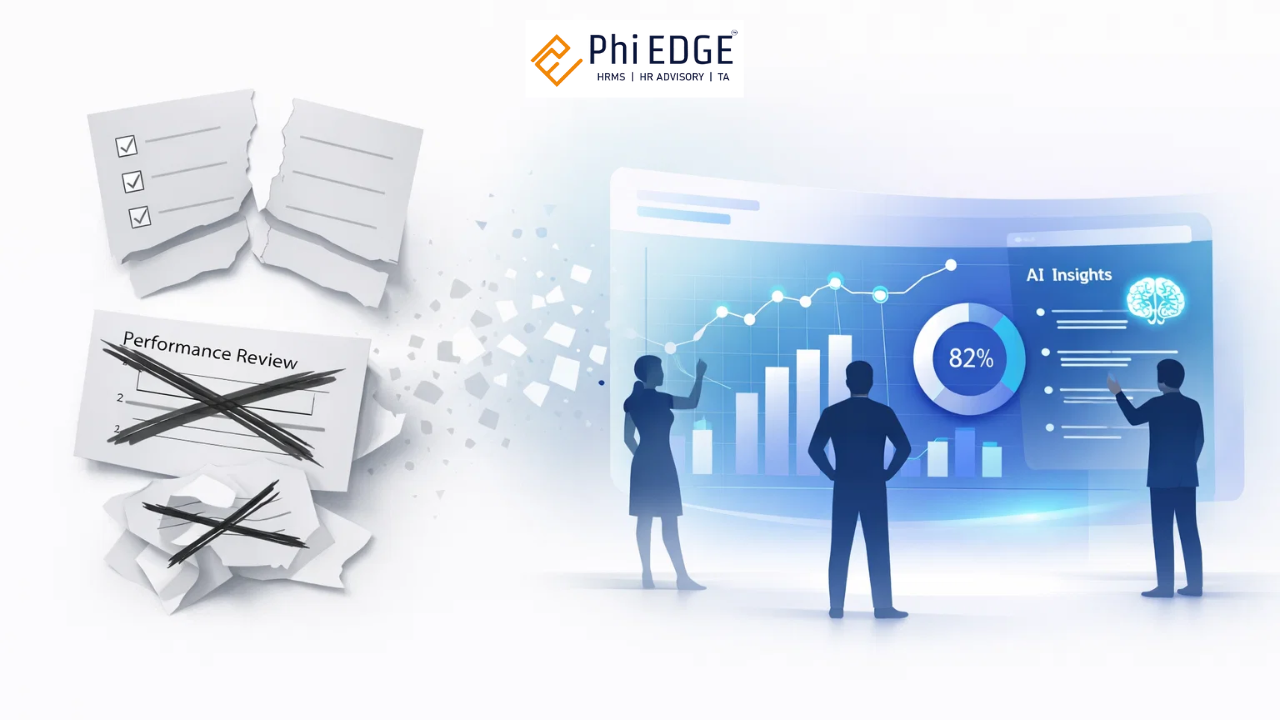
    Performance appraisal has always been one of the most sensitive and impactful HR processes in any organization. Done well, it motivates employees, improves productivity, and builds trust. Done poorly, it creates frustration, disengagement, and attrition. Yet, despite decades of experience and countless frameworks, many organizations still struggle to get performance appraisals right.

    At Phi EDGE, operating across three core business verticals—HRMS, HR Advisory, and Talent Acquisition—we have worked closely with organizations across Manufacturing, Financial Services, Real Estate, Hospitality, Construction, Academics, and Information Technology. One insight consistently emerges across industries: traditional performance appraisal systems no longer work in today’s dynamic, data-driven workplace.

    As organizations evolve, the gap between old appraisal methods and modern workforce expectations continues to widen. This is where AI-powered performance management is not just helpful—but essential.

    The Reality of Traditional Performance Appraisal Systems

    Most traditional performance appraisals system were designed for a different era—an era of stable roles, predictable workflows, and hierarchical reporting structures. Annual or biannual reviews, paper-based forms, manager-only feedback, and static rating scales once served their purpose.

    However, today’s workplace looks very different. Employees collaborate across teams, work remotely or in hybrid models, and contribute in ways that are not always visible to a single manager. Unfortunately, many organizations still rely on outdated HR appraisal systems that cannot capture this complexity.

    Traditional appraisal cycles often focus on past performance rather than continuous improvement. By the time feedback is delivered, the opportunity for course correction is long gone. Employees feel judged rather than supported, and managers feel burdened by a process that adds little value.

    At Phi EDGE, we frequently see organizations struggling with employee dissatisfaction not because of performance issues—but because their employee appraisal system fails to recognize real effort, growth, and contribution.

    Why Traditional Performance Appraisals Fail

    The failure of traditional performance appraisals is not due to poor intent but due to structural limitations that no longer align with modern work environments.

    One of the most common issues is manager bias. In a conventional staff appraisal system, performance ratings depend heavily on a single manager’s perception. Conscious or unconscious bias, recent events, or personal relationships often influence outcomes. This leads to perceptions of unfairness, even when managers try to be objective.

    Another major flaw is the lack of real-time feedback. Traditional performance appraisal systems rely on memory—what happened months ago—rather than data. Employees may have improved, learned new skills, or contributed significantly since the last review, but these efforts are often overlooked.

    There is also the problem of static goals. Many HR appraisal systems set goals at the beginning of the year and revisit them at the end, ignoring the fact that priorities change rapidly. Employees end up being evaluated against goals that are no longer relevant.

    Manual processes further complicate the situation. HR teams spend weeks collecting forms, following up with managers, consolidating data, and resolving disputes. This administrative burden turns the appraisal process into a compliance exercise rather than a development opportunity.

    From our HR advisory experience at Phi EDGE, we know that these shortcomings not only reduce the effectiveness of appraisals but also directly impact employee engagement, retention, and organizational culture.

    The Growing Disconnect Between Appraisals and Employee Expectations

    Traditional Performance Appraisals

    Today’s employees expect transparency, fairness, and continuous development. They want feedback that helps them grow—not a once-a-year verdict on their worth. Unfortunately, traditional performance appraisal systems often feel disconnected from daily work and real contributions.

    Employees increasingly question the credibility of appraisal outcomes when feedback does not reflect their actual efforts. This disconnect erodes trust in the HR appraisal system and reduces the perceived value of performance reviews.

    For organizations, this results in disengaged teams, lower productivity, and higher attrition—especially among high performers who feel undervalued.

    How AI Is Transforming Performance Appraisal Systems

    Artificial Intelligence is redefining how organizations approach performance management. Instead of relying on subjective opinions and infrequent reviews, AI introduces continuous, data-driven, and unbiased evaluation mechanisms.

    An AI-enabled performance appraisal system does not replace human judgment—it enhances it. By analyzing real-time data from multiple sources, AI provides a more accurate and holistic view of employee performance.

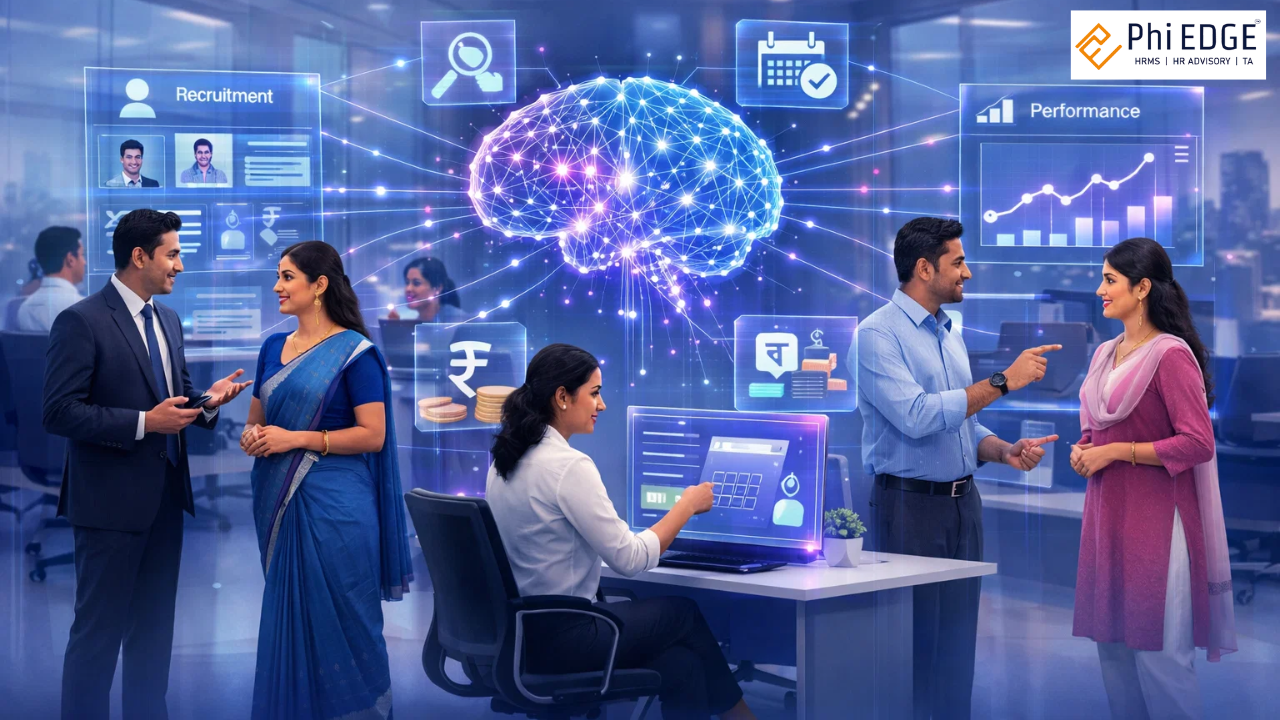
    At Phi EDGE, our AI-powered HRMS solutions integrate performance data across goals, tasks, attendance, feedback, collaboration patterns, and skill development. This allows organizations to move from reactive appraisal processes to proactive performance management.

    Eliminating Bias Through AI-Powered Appraisals

    One of the biggest advantages of AI in performance management is its ability to reduce bias. Traditional employee appraisal systems are vulnerable to favoritism, recency bias, and inconsistent scoring standards.

    AI analyzes performance based on predefined metrics and patterns rather than personal impressions. It considers long-term trends instead of isolated incidents, ensuring that evaluations are fair and consistent.

    For organizations using Phi EDGE’s AI-driven HR appraisal system, this means greater trust in appraisal outcomes and improved employee confidence in the process.

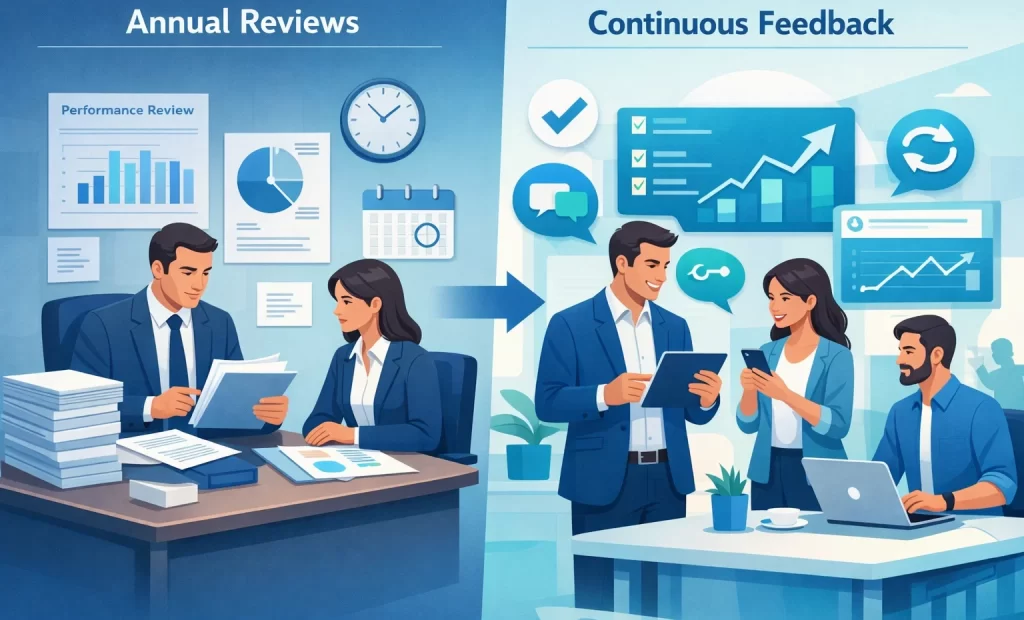
    From Annual Reviews to Continuous Performance Management

    Traditional Performance Appraisals

    AI enables a shift from annual appraisals to continuous performance conversations. Instead of waiting for year-end reviews, employees and managers receive ongoing insights into performance trends.

    This continuous approach allows for timely feedback, immediate recognition, and faster course correction. Employees feel supported rather than judged, and managers become coaches instead of evaluators.

    At Phi EDGE, we believe that a modern staff appraisal system should empower growth, not create anxiety. AI helps achieve this by making performance management an ongoing, constructive process.

    Smarter Goal Alignment with AI

    Traditional appraisal systems often fail because goals become outdated. AI solves this by enabling dynamic goal tracking and alignment.

    An AI-powered performance appraisal system can monitor progress in real time, flag misalignment, and suggest goal adjustments as business priorities change. This ensures that employees are always evaluated based on relevant and achievable objectives.

    For growing organizations, this adaptability is crucial. Phi EDGE has seen how AI-driven goal management improves clarity, focus, and accountability across teams.

    Actionable Insights for Employee Development

    Performance appraisals should lead to development, not just ratings. Unfortunately, many traditional HR appraisal systems stop at scoring employees without offering guidance on improvement.

    AI changes this by identifying skill gaps, learning needs, and development opportunities based on actual performance data. It can recommend training programs, mentoring initiatives, or role changes that align with employee strengths and organizational goals.

    This transforms the employee appraisal system into a powerful tool for talent development and career progression.

    Improved Manager Effectiveness Through AI Support

    Managers often struggle with appraisals because they lack data, time, or structured frameworks. AI supports managers by providing clear insights, performance summaries, and data-backed recommendations.

    With AI-driven tools from Phi EDGE, managers spend less time compiling reports and more time having meaningful performance discussions. This improves the quality of feedback and strengthens manager-employee relationships.

    Organizational Benefits of AI-Based Performance Appraisal Systems

    Organizations that adopt AI-powered appraisal systems experience significant improvements across multiple dimensions. Productivity increases as employees receive clear expectations and timely feedback. Engagement improves because employees feel recognized and treated fairly.

    Attrition reduces as high performers see clear growth paths and feel valued. Leadership pipelines strengthen as AI identifies potential leaders early and supports succession planning.

    From our experience at Phi EDGE, organizations that modernize their performance appraisal systems are better equipped to navigate change and sustain growth.

    Why Phi EDGE Is the Right Partner for Modern Performance Management

    What sets Phi EDGE apart is not just technology, but understanding. With deep expertise in HR advisory and talent acquisition, Phi EDGE designs performance appraisal solutions that align with real organizational challenges.

    Our AI-powered HR appraisal system is built to adapt to different industries, workforce sizes, and maturity levels. Whether you are a manufacturing firm managing shift workers or an IT company managing hybrid teams, Phi EDGE offers a flexible, scalable, and intelligent solution.

    By combining technology with advisory insights, Phi EDGE ensures that performance appraisals are meaningful, fair, and growth-oriented.

    The Future of Performance Appraisals Is Intelligent

    As organizations move forward, it is clear that traditional appraisal methods will continue to lose relevance. The future belongs to systems that are adaptive, data-driven, and employee-centric.

    AI is not about replacing human judgment—it is about enhancing it with clarity, consistency, and insight. For organizations ready to evolve, AI-powered performance appraisals offer a path to stronger engagement, better leadership, and sustainable success.

    FAQs

    Why do traditional performance appraisal systems fail?
    They fail due to bias, lack of real-time feedback, outdated goals, and heavy reliance on manual processes that do not reflect modern work realities.

    How does AI improve performance appraisal systems?
    AI provides continuous, data-driven insights, reduces bias, enables real-time feedback, and supports employee development through predictive analytics.

    Is an AI-based HR appraisal system suitable for all organizations?
    Yes. Organizations of all sizes and industries can benefit from AI-driven appraisal systems, especially those with growing or hybrid workforces.

    Can AI replace managers in performance appraisals?
    No. AI supports managers by providing insights and recommendations, allowing them to focus on coaching and development rather than administration.

    Why choose Phi EDGE for performance appraisal solutions?
    Phi EDGE combines HRMS technology with HR advisory expertise, ensuring that appraisal systems are practical, fair, and aligned with business goals.

    Conclusion: Fixing What Traditional Appraisals Broke

    Traditional performance appraisals fail not because people don’t care—but because the systems were built for a world that no longer exists. In today’s fast-moving, data-rich environment, organizations need smarter tools to manage performance effectively.

    AI offers that solution.

    With its experience across HRMS, HR advisory, and talent acquisition, Phi EDGE helps organizations replace outdated performance appraisal systems with intelligent, transparent, and development-focused solutions.

    The question is no longer whether traditional appraisals fail—it’s whether your organization is ready to fix them.

    With Phi EDGE, the future of performance management is already here

  • How Phi EDGE AI-Based HRMS is Redefining Human Resource Management in India

    How Phi EDGE AI-Based HRMS is Redefining Human Resource Management in India

    How Phi EDGE’s AI-Based HRMS is Redefining Human Resource Management in India

    In today’s fast-paced digital era, Human Resource Management is no longer confined to paperwork, manual processes, or isolated systems. The workplace has evolved, becoming more dynamic, diverse, and data-driven. Keeping up with this rapid transformation requires HR systems that are smart, intuitive, integrated, and capable of predicting trends rather than merely recording data. This is precisely where AI-Based HRMS solutions emerge as the next frontier.

    Among India’s leading innovators in this space, Phi EDGE has been at the forefront of redefining how organizations manage their human capital. With deep experience across HRMS, HR Advisory, and Talent Acquisition, Phi EDGE has grown from a consulting partner to an end-to-end HR technology provider, helping businesses of all sizes and industries—from Manufacturing to Financial Services, Real Estate to Information Technology—navigate the complexities of modern HR.

    In this blog, we explore how Phi EDGE’s AI-Based HRMS is revolutionizing Human Resource Management across India, enabling organizations to unlock unprecedented levels of efficiency, employee experience, and strategic decision-making.

    The Evolution of HR: From Manual Processes to AI-Based HRMS Software

    AI-Based HRMS

    To understand the impact of AI-powered HR systems, it’s essential to look back at where HR began. Traditional HR functions were largely administrative. Employee records were maintained on spreadsheets or filing cabinets. Payroll was calculated manually. Leave, attendance, and performance reviews required endless paperwork, approvals, and coordination across departments.

    The introduction of HRMS Software transformed these processes by centralizing data and automating routine tasks. However, even early HRMS systems were limited in their ability to provide real-time insights or support strategic workforce decisions.

    Enter AI-Based HRMS. This next generation of HR technology doesn’t just automate processes—it interprets data, predicts outcomes, and provides intelligent recommendations. For the first time, HR leaders are equipped not just with reports from the past, but predictive insights about the future.

    At Phi EDGE, we believe HR should be more than operational. It should be strategic, insightful, and continuously aligned with business goals. Our AI-based HRMS platform bridges the gap between technology and people strategy, empowering HR professionals with tools that elevate the workforce and business performance alike.

    Why the Indian Market Needs AI-Based HRMS Now More Than Ever

    India’s workforce landscape is uniquely diverse. Companies navigate multiple languages, cultures, compliance regimes, and labor laws. Add to this the rapid digitization of industries, the rise of hybrid work, and the expectations of a young, digital-native workforce—and it becomes clear that traditional HR systems are no longer enough.

    Organizations today face challenges that include:
    ● Efficiently managing remote and hybrid teams
    ● Ensuring compliance with complex labor regulations
    ● Tracking performance and productivity in real time
    ● Reducing bias in hiring and evaluations
    ● Supporting employee development and retention

    These challenges cannot be addressed with static spreadsheets or legacy HRMS solutions. They demand AI-based intelligence, continuous analysis, and automated insights—exactly what Phi EDGE’s AI-Based HRMS delivers.

    How Phi EDGE’s AI-Based HRMS Software Is Transforming HR

    AI-Based HRMS

    1. Intelligent Automation of Core HR Functions
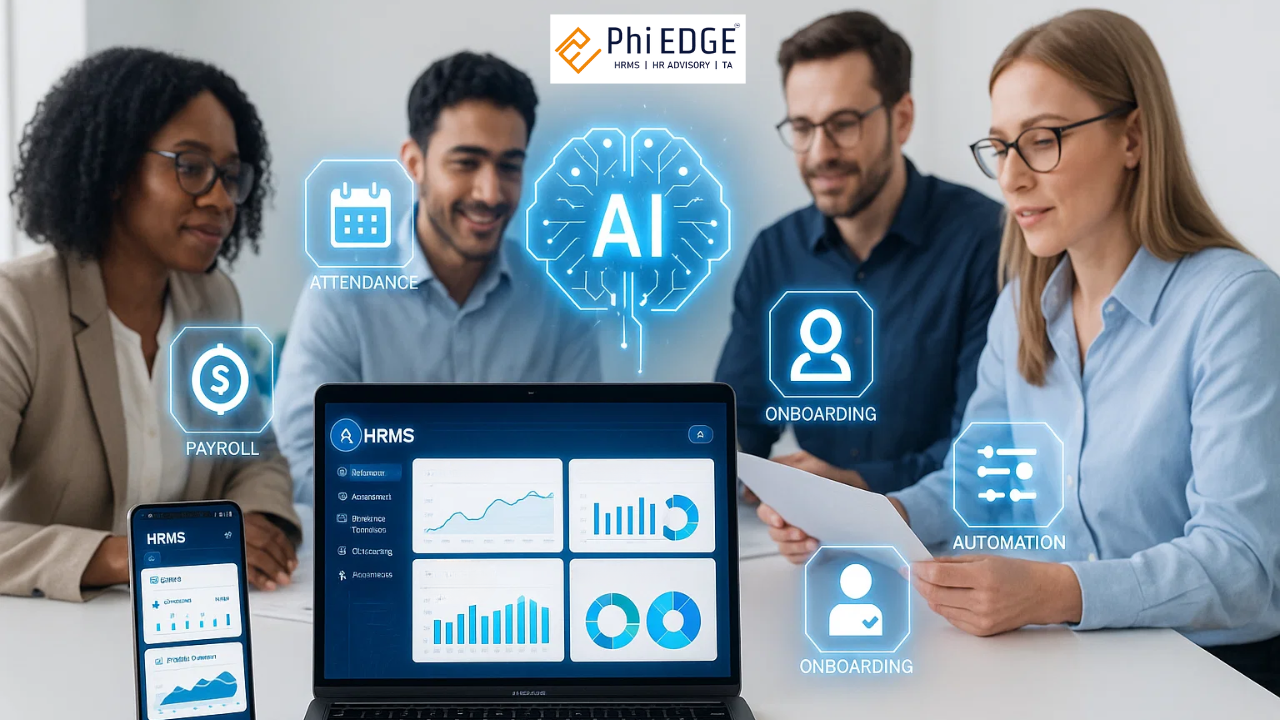
    One of the most immediate benefits of adopting an AI-powered HRMS platform is automation. Phi EDGE’s solution automates repetitive tasks such as attendance tracking, leave management, payroll processing, onboarding workflows, and compliance updates. What used to take hours of manual work now happens automatically, with minimal human intervention. This saves valuable time for HR teams, allowing them to focus on strategic initiatives like talent development, employee engagement, and culture building.

    2. Smarter Recruitment and Talent Acquisition
    Talent acquisition is a critical business priority, and Phi EDGE’s AI-Based HRMS integrates seamlessly with its Talent Acquisition vertical to deliver superior hiring outcomes. Instead of sifting through piles of resumes, recruiters can leverage AI-enhanced tools for:

    ● Resume screening based on skill matching
    ● Predictive analysis of candidate success
    ● Bias-reduced shortlisting
    ● Automated interview scheduling

    This intelligent process not only shortens hiring cycles but also improves the quality of hires, making recruitment more efficient and effective.

    3. Enhanced Employee Engagement and Experience
    A modern HRMS Software should serve not just HR teams but every employee. Phi EDGE’s AI-based system delivers personalized experiences for staff, enabling self-service access to:

    ● Leave balances and requests
    ● Attendance and shift schedules
    ● Payslips and compensation details
    ● Performance feedback and goal tracking
    ● Learning and development opportunities

    By providing employees direct access to their HR data through an intuitive interface, Phi EDGE enhances transparency, boosts engagement, and empowers individuals to take ownership of their growth.

    4. Dynamic Performance Management with AI Insights
    Traditional performance reviews are often annual or biannual, leaving employees waiting long periods for feedback. This approach no longer aligns with the demand for continuous improvement and real-time performance insights.

    Phi EDGE’s AI-Based HRMS integrates a dynamic performance management framework that tracks performance continuously. The AI engine analyzes performance trends, identifies skill gaps, and highlights patterns that may not be immediately obvious to managers. This enables:

    ● Personalized feedback
    ● Real-time goal tracking
    ● AI-generated suggestions for improvement
    ● Data-driven performance reviews

    In this way, the system shifts performance management from a retrospective appraisal to a future-focused development journey.

    5. Predictive Analytics for Strategic HR Decisions
    One of the most powerful aspects of an AI-Based HRMS is predictive analytics. Rather than
    passively storing employee data, the system interprets it to help leaders answer critical questions such as:

    ● Which employees are most likely to engage long term?
    ● Who shows potential for leadership development?
    ● What factors contribute to attrition?
    ● How can training be optimized to fill skill gaps?

    These insights allow HR leaders to make strategic decisions that impact business outcomes directly. At Phi EDGE, we help organizations use these predictive analytics to build workforce strategies that are proactive rather than reactive.

    6. Bias Reduction and Fair Evaluations
    Human subjectivity has long been a concern in HR—particularly in hiring and performance appraisals. AI can help level the playing field by analyzing patterns and highlighting potential disparities in decision making.

    Phi EDGE’s AI-Based HRMS can identify inconsistencies and recommend actions to promote fairness in talent evaluations. Whether in hiring or performance reviews, AI ensures that decisions are anchored in data, reducing the influence of unconscious bias and promoting equity across the organization.

    7. Seamless Compliance and Risk Management
    Compliance with labor laws, data protection regulations, and industry standards can be a complex task for any business, especially in a diverse environment like India. Different states, industries, and job categories often have unique requirements.

    An AI-based HRMS System like Phi EDGE’s simplifies compliance by automatically updating rules, capturing audit trails, and alerting HR teams to irregularities. This not only reduces legal risk but ensures that organizations are always up to date with evolving regulatory standards.

    What Sets Phi EDGE’s AI-Based HRMS Apart

    Many HRMS solutions exist in the market, but not all deliver the depth, intelligence, and contextual understanding that modern organizations require. What makes Phi EDGE’s AI-Based HRMS truly transformational is its combination of:

    ● Integrated HR ecosystem: From recruitment to retirement, the system connects all HR functions seamlessly.
    ● AI-driven intelligence: Insights, trends, and forecasts based on real workforce data.
    ● User-centric design: Both employees and managers find the system intuitive and empowering.
    ● Scalability: It supports small teams to large enterprise workforce models.
    ● Domain expertise: Built with insights from HR Advisory and Talent Acquisition practices.

    This holistic approach enables organizations to do much more than manage administrative tasks—they can now optimize human potential.

    Real Transformation Stories: AI-Based HRMS in Action

    Across industries, companies that have implemented Phi EDGE’s AI-Based HRMS Software are reporting measurable impacts.

    In the Manufacturing sector, for example, automatic attendance tracking and performance analytics have reduced administrative workload while improving shift optimization. In IT firms, AI-powered performance tracking and learning suggestions have accelerated talent growth and lowered attrition rates. Financial services and real estate organizations have leveraged predictive insights to identify leadership potential early in careers.

    These success stories reflect how AI is not just enhancing HR processes—it’s redefining organizational capability.

    AI-Based HRMS and the Future of Work

    The future of HR is intelligent, empathic, and strategic. Employees no longer want generic processes or annual check-ins. They want guidance, clarity, real-time feedback, and opportunities for growth. Leaders want data, predictive insights, and the ability to build teams that are not only functioning—but thriving.

    AI-Based HRMS Software is the technology that brings all of this together.

    With Phi EDGE, organizations in India are already stepping into that future—where HR is not just a function, but a competitive advantage.

    Frequently Asked Questions

    What is an AI-Based HRMS?
    An AI-Based HRMS refers to a Human Resource Management System that uses artificial intelligence to automate HR tasks, interpret workforce data, provide insights, and support strategic decisions. It goes beyond traditional HRMS by incorporating predictive analytics, bias reduction, and intelligent recommendations.

    How does Phi EDGE’s AI-Based HRMS differ from regular HRMS Software?
    While traditional HRMS Software automates basic HR tasks (like attendance and payroll), Phi EDGE’s AI-Based HRMS adds data intelligence, predictive insights, continuous performance tracking, and bias-aware decision support. It transforms HR from reactive to proactive.

    Can small and mid-size businesses benefit from AI-Based HRMS?
    Absolutely. SMEs, startups, and mid-sized enterprises benefit greatly from AI-driven HRMS because it reduces manual workload, improves accuracy, enhances employee experience, and provides insights previously only available to large enterprises.

    Does the AI-based system replace HR teams?
    No. AI supports HR teams by automating repetitive tasks and providing intelligent insights. Human involvement remains essential for culture building, leadership decisions, and employee care.

    Is AI-Based HRMS compliant with Indian labor laws?
    Yes. Phi EDGE’s HRMS platform is designed with compliance in mind, ensuring that statutory standards, payroll rules, and labor regulations are consistently followed.

    Conclusion: Redefining HR with Intelligence, Empathy, and Insight

    Human Resource Management is no longer about filling out forms or processing payrolls. Today, HR is strategic, data-informed, and people-centric. To meet this new reality, organizations need AI-Based HRMS Software that supports every stage of the employee lifecycle.

    Phi EDGE is leading this transformation in India—helping organizations automate processes, gain deep workforce insights, support employee growth, and make smart decisions based on real data.

    Whether your organization is in Manufacturing, Financial Services, Hospitality, Real Estate, Construction, Academics, or Information Technology, AI-based HRMS is the key to building a resilient, engaged, and future-ready workforce.

    With Phi EDGE’s AI-Based HRMS, the future of HR is already here—intelligent, inclusive, and incredibly impactful.

  • Why Every Growing SME Needs AI-Driven HRMS Software in 2025

    Why Every Growing SME Needs AI-Driven HRMS Software in 2025

    Why Every Growing SME Needs AI-Driven HRMS Software in 2025

    Small and medium enterprises (SMEs) are experiencing a major shift in how they operate, manage people, and scale their businesses. In India especially, SMEs are no longer confined to local markets or traditional working models. They are adopting digital tools, hiring diverse talent, enabling hybrid work, and competing with larger enterprises for skilled professionals. In this changing landscape, managing people efficiently has become one of the most critical success factors.

    This is exactly where AI-Driven HRMS Software becomes indispensable.

    Phi EDGE, operating through its three strong business verticals—HRMS, HR Advisory, and Talent Acquisition—has closely observed how HR challenges for SMEs have evolved over the years. What started as basic HR advisory and consulting services has now expanded into advanced HRMS Software and HRIS systems that support complete talent management solutions. Serving industries such as Manufacturing, Financial Services, Real Estate, Hospitality, Construction, Academics, and Information Technology, Phi EDGE understands the unique workforce challenges SMEs face today.

    As we move into 2025, traditional HR practices are proving inadequate. SMEs that want to grow sustainably, retain talent, and remain compliant must transition to intelligent, automated, and data-driven HR systems. An AI-Driven HRMS System is no longer a luxury—it is a necessity.

    The Changing Reality of HR for SMEs in 2025

    Key Features of Phi EDGE AI-Driven HRMS Software

    The HR function in SMEs has transformed dramatically. Earlier, HR teams focused mainly on attendance tracking, salary processing, and maintaining employee records. Today, HR is expected to play a strategic role in employee engagement, performance improvement, compliance, workforce planning, and leadership development.

    SMEs now deal with hybrid workforces, remote teams, contractual staff, gig workers, and multi-location operations. Managing such complexity manually or through disconnected tools often leads to inefficiencies, errors, employee dissatisfaction, and compliance risks. This is where a modern HRMS System powered by artificial intelligence provides a competitive advantage.

    Phi EDGE HRMS Software is designed to address these evolving needs by automating routine HR tasks while offering deep insights into employee behavior, productivity, and engagement. AI allows SMEs to manage their workforce proactively rather than reactively.

    Understanding AI-Driven HRMS Software

    To truly appreciate why SMEs need AI-Driven HRMS Software in 2025, it’s important to understand what makes it different from traditional HR software.

    A conventional HRMS Software primarily digitizes HR processes. It stores employee data, manages attendance, processes payroll, and tracks leave. While this is helpful, it still relies heavily on manual intervention and human judgment.

    An AI-Driven HRMS System, on the other hand, goes beyond automation. It uses artificial intelligence, machine learning, and analytics to study patterns, predict outcomes, and recommend actions. Instead of simply recording data, the system interprets it and helps HR teams and business leaders make informed decisions.

    At Phi EDGE, AI is embedded into the HRMS to enable smarter performance evaluations, predictive attrition analysis, intelligent workforce planning, bias-free appraisals, and personalized employee development journeys.

    Why 2025 Is the Right Time for SMEs to Switch to AI-Driven HRMS Software

    AI-Driven HRMS Software

    By 2025, SMEs will face stronger competition, tighter margins, and higher expectations from employees. The businesses that succeed will be those that operate efficiently while keeping their workforce engaged and motivated.

    One of the biggest challenges SMEs face is limited HR bandwidth. HR teams are often small, and leaders are involved in day-to-day operations. AI-Driven HRMS Software helps SMEs automate repetitive tasks such as attendance processing, leave approvals, payroll calculations, and compliance reporting. This frees up HR teams to focus on people strategy rather than paperwork.

    Another reason 2025 is the turning point is the shift toward hybrid and remote work. Monitoring productivity and engagement in such environments is difficult without intelligent systems. Phi EDGE’s AI-powered HRMS System provides real-time visibility into attendance trends, performance metrics, and engagement levels without micromanaging employees. This balance between flexibility and accountability is crucial for modern SMEs.

    Additionally, SMEs are under increasing pressure to comply with changing labor laws and statutory requirements. Manual compliance tracking often leads to errors and penalties. An AI-Driven HRMS Software automatically updates rules, flags discrepancies, and ensures compliance, reducing legal and financial risks.

    How AI Transforms Performance Management for SMEs

    Performance management is one of the areas where AI creates the most impact. Traditional appraisal systems are often subjective, inconsistent, and infrequent. Employees receive feedback once or twice a year, which limits growth and engagement.

    With AI-Driven Performance Management integrated into the HRMS Software, SMEs can track performance continuously. Phi EDGE’s HRMS System analyzes goal progress, work patterns, feedback data, and productivity metrics to generate real-time performance insights. This allows managers to provide timely feedback, recognize achievements, and address performance gaps early.

    AI also reduces bias in appraisals by using data-driven evaluations rather than personal opinions. This builds trust among employees and creates a culture of fairness and transparency—something SMEs often struggle to achieve with manual systems.

    Enhancing Employee Experience Through AI-Driven HRMS

    Employee experience has become a key differentiator for SMEs competing with large organizations for talent. Today’s employees expect transparency, quick responses, and easy access to HR services.

    An AI-Driven HRMS Software improves employee experience by offering self-service portals, mobile access, automated approvals, and real-time updates. Employees can apply for leave, check attendance, view payslips, track goals, and receive feedback without depending on HR for every request.

    Phi EDGE focuses on making HRMS Software intuitive and employee-friendly, ensuring high adoption and satisfaction. AI-powered notifications, reminders, and recommendations further enhance engagement by keeping employees informed and supported.

    AI-Powered Workforce Planning and Talent Retention

    One of the biggest risks for SMEs is unexpected attrition. Losing a key employee can disrupt operations and slow growth. AI helps SMEs move from reactive retention strategies to predictive workforce planning.

    Phi EDGE’s AI-Driven HRMS System analyzes trends such as absenteeism, declining performance, engagement scores, and workload stress to identify employees who may be at risk of leaving. This allows managers and HR teams to intervene early through discussions, role changes, training, or support.

    AI also helps identify high-potential employees and future leaders, enabling SMEs to plan succession and career development more effectively. This strategic approach to talent management is critical for long-term stability and growth.

    Why Phi EDGE Is the Right AI-Driven HRMS Partner for SMEs

    SMEs choose Phi EDGE not just for software, but for expertise. With a strong foundation in HR Advisory and Talent Acquisition, Phi EDGE understands the real challenges businesses face—not just from a technology perspective, but from a people and process standpoint.

    Phi EDGE’s HRMS Software is designed specifically for Indian SMEs, taking into account local compliance requirements, industry variations, and workforce diversity. The AI-Driven HRMS System is flexible, scalable, and customizable, making it suitable for both growing startups and established mid-sized organizations.

    Unlike generic HR tools, Phi EDGE combines technology with advisory support, ensuring smooth implementation, adoption, and continuous improvement.

    The Industries Benefiting from AI-Driven HRMS Software

    AI-Driven HRMS Software from Phi EDGE supports a wide range of industries. Manufacturing companies benefit from shift management, attendance automation, and productivity tracking. Financial services organizations gain from compliance management and performance analytics. Real estate and construction firms use the system to manage on-site and remote staff effectively. Educational institutions streamline faculty management and performance tracking. IT and technology companies rely on AI insights for productivity, engagement, and retention.

    Across industries, the common factor is the need for efficiency, transparency, and scalability—qualities that AI-Driven HRMS Software delivers consistently.

    The Business Impact of Adopting AI-Driven HRMS Software

    SMEs that adopt AI-Driven HRMS Software experience measurable improvements in operational efficiency, employee satisfaction, and decision-making. HR teams spend significantly less time on administrative tasks and more time on strategic initiatives. Employees feel more engaged due to fair evaluations, faster processes, and better communication. Leadership teams gain access to accurate, real-time data that supports smarter business decisions.

    In 2025, these advantages will separate high-performing SMEs from those struggling to keep up.

    FAQs

    What is AI-Driven HRMS Software?
    AI-Driven HRMS Software is an advanced HR management system that uses artificial intelligence to automate HR processes, analyze employee data, and provide predictive insights for better decision-making.

    How is AI-Driven HRMS Software different from traditional HRMS Software?
    Traditional HRMS Software focuses on record-keeping and automation, while AI-Driven HRMS Software interprets data, predicts trends, reduces bias, and supports strategic HR decisions.

    Is AI-Driven HRMS Software suitable for small businesses?
    Yes. SMEs benefit greatly from AI-Driven HRMS Systems because they reduce manual work, improve accuracy, and enable growth without increasing HR headcount.

    How does Phi EDGE support SMEs during implementation?
    Phi EDGE provides end-to-end support, including configuration, training, HR advisory, and ongoing assistance to ensure successful adoption.

    Will AI replace HR roles in SMEs?
    No. AI enhances HR roles by eliminating repetitive tasks and enabling HR teams to focus on people development, culture, and strategy.

    Conclusion: 2025 Is the Turning Point for SMEs

    The future of HR is intelligent, predictive, and people-centric. As SMEs prepare for growth in 2025, adopting an AI-Driven HRMS Software is no longer optional—it is essential.

    With its deep expertise across HRMS, HR Advisory, and Talent Acquisition, Phi EDGE empowers SMEs to manage their workforce with confidence, clarity, and control. By switching to an AI-enabled HRMS System, SMEs can improve efficiency, enhance employee experience, reduce risk, and build a strong foundation for sustainable growth.

    2025 is the year to transform HR from an administrative function into a strategic powerhouse—with Phi EDGE as your trusted partner.

  • We are honoured to be featured in People Matters

    We are honoured to be featured in People Matters

    Phi EDGE has been proudly featured in People Matters for its innovative approach to HR technology. The article showcases how Phi EDGE is empowering MSMEs with intelligent HR solutions that enhance productivity, engagement, and workforce growth.

  • How AI-Backed 360-Degree Feedback Helps Identify and Nurture Future Leaders

    How AI-Backed 360-Degree Feedback Helps Identify and Nurture Future Leaders

    How AI-Backed 360-Degree Feedback Helps Identify and Nurture Future Leaders

    In today’s rapidly evolving business world, leadership isn’t defined by job titles — it’s defined by potential, adaptability, and emotional intelligence. The challenge for most organizations isn’t finding talent, but identifying who among that talent can become tomorrow’s leaders.

    That’s where AI-backed 360-degree feedback system are transforming leadership development. By combining the human power of feedback with the analytical precision of artificial intelligence, companies can now uncover hidden leaders, design targeted growth plans, and build resilient leadership pipelines.

    At Phi EDGE, we’ve integrated AI-driven insights into our 360 degree feedback system to help organizations evaluate leadership readiness scientifically — reducing bias, improving accuracy, and ensuring that every rising star gets the visibility they deserve.

    The Evolution from Traditional Reviews to AI-Enhanced 360-Degree Feedback

    360 Degree Feedback System

    For decades, performance reviews followed a top-down format: a manager’s single-perspective evaluation that often left employees feeling misunderstood or overlooked. These traditional reviews lacked context, feedback diversity, and actionable insights.

    The 360 degree feedback system changed that by introducing multi-source evaluation. Instead of one opinion, employees receive feedback from managers, peers, subordinates, and even clients — providing a well-rounded view of both performance and behavior.

    Now, with AI entering the equation, this system is more powerful than ever. AI-backed 360 feedback automates feedback collection, detects bias, interprets sentiment, and predicts leadership potential. The result? Smarter decisions, faster development, and a stronger leadership bench.

    What Makes 360-Degree Feedback Ideal for Leadership Development

    Leadership isn’t just about delivering results — it’s about communication, influence, and alignment with organizational values. A 360 degree feedback system captures these nuanced traits better than any traditional appraisal can.

    Here’s how it supports leadership growth:
    1. Holistic Perspective: By gathering feedback from all directions, the system reveals how a potential leader is perceived across teams.

    2. Behavioral Insights: Feedback covers soft skills like empathy, collaboration, and decision-making — critical for leadership success.

    3. Actionable Development Plans: Insights feed directly into learning paths and coaching programs.

    4. Transparency and Trust: When employees know feedback is fair and data-driven, they’re more motivated to improve.

    At Phi EDGE, our AI-enabled HRMS platform integrates 360 feedback results into talent and performance modules, allowing HR to monitor leadership readiness over time.

    How AI Strengthens the 360-Degree Feedback Process

    360 Degree Feedback System

    Artificial Intelligence doesn’t replace human judgment — it refines it. Here’s how AI elevates traditional 360 feedback to a predictive, insight-driven model:
     1. Sentiment and Emotion Analysis
    AI scans open-ended feedback responses to identify tone and sentiment — highlighting whether comments reflect encouragement, concern, or conflict. This provides a deeper understanding of team morale and leadership influence.

    2. Bias Detection and Normalization
    AI algorithms flag patterns of rating bias (e.g., consistently high or low ratings from a particular group). Phi EDGE’s system adjusts scores statistically, ensuring fairness and credibility in results.

    3. Predictive Leadership Indexing
    By analyzing feedback data, engagement levels, and performance history, AI generates a “Leadership Potential Index” — pinpointing employees most likely to succeed in managerial roles.

    4. Automated Development Recommendations
    AI maps feedback outcomes to personalized learning plans, suggesting specific training or mentorships based on an employee’s competencies.

    5. Real-Time Dashboards and Insights
    Instead of static reports, HR and management get real-time analytics dashboards with trend graphs, engagement scores, and sentiment summaries.

    Together, these capabilities make Phi EDGE’s AI-driven 360 feedback software a vital leadership accelerator for modern organizations.

    The Role of 360 Feedback in Employee Satisfaction and Engagement

    360 Degree Feedback System

    Effective leaders inspire engaged, satisfied teams — and the feedback process itself can be a catalyst for that engagement.

    A transparent, continuous 360 degree feedback system process gives employees a sense of ownership over their growth. When coupled with employee satisfaction surveys and employee engagement surveys, it offers a complete picture of organizational health.

    How the Synergy Works:
    360 Feedback → Identifies leadership behaviors that affect morale and collaboration.

    Employee Satisfaction Survey → Measures how employees feel about management and culture.

    Employee Engagement Survey → Evaluates emotional commitment and alignment with company goals.

    By integrating these insights, Phi EDGE helps organizations link leadership behavior directly to engagement outcomes — ensuring that leadership development translates into real-world team success.

    Identifying Future Leaders Through AI-Driven 360 Feedback

    Traditional performance reviews often recognize only those who deliver results. However, AI-powered 360 feedback can identify potential leaders — those who may not yet hold senior titles but consistently display empathy, initiative, and collaboration.

    Here’s how Phi EDGE helps uncover tomorrow’s leaders:
    1. Performance vs. Potential Mapping
    AI cross-analyzes feedback data to highlight employees who demonstrate leadership potential even if they’re not in formal leadership roles.

    2. Behavioral Predictors of Leadership
    Natural-language processing identifies recurring patterns in peer feedback — such as “mentors others” or “handles conflict well.” These qualitative signals are strong predictors of leadership readiness.

    3. Engagement Correlation
    AI examines how an individual’s behavior influences team engagement and satisfaction levels — a hallmark of great leaders.

    4. Continuous Tracking
    Over time, Phi EDGE’s platform tracks progress and growth metrics, ensuring that leadership pipelines stay dynamic and data-driven.

    Nurturing Leadership Potential with Actionable Insights

    Identifying talent is just the beginning — nurturing it is what sustains growth.

    Phi EDGE’s AI-powered 360 degree feedback system not only identifies high-potential individuals but also helps HR teams craft personalized development journeys.

    These include:
    Tailored coaching programs
    Learning path recommendations based on competency gaps
    Regular progress check-ins through feedback cycles
    Correlation tracking with employee engagement survey results

    By closing the feedback-to-development loop, organizations build stronger, more confident leaders — and higher employee satisfaction across teams.

    The Impact of AI-Backed 360 Feedback on Leadership Culture

    The introduction of AI into 360 degree feedback systems has transformed leadership development from a once-a-year event into a continuous, culture-driven practice.

    Key Organizational Benefits:
    Faster Leadership Identification: AI analytics surface potential leaders in real time.
    Reduced Bias: Objective evaluation builds fairness and trust.
    Higher Retention: Employees see growth opportunities, reducing attrition.
    Better Team Dynamics: Feedback-driven leaders foster open communication and accountability.
    Increased Employee Engagement: Regular feedback loops keep employees connected to their goals.

    At Phi EDGE, we’ve seen organizations achieve up to 30% improvement in leadership readiness and a 20% boost in engagement scores after implementing our AI-driven 360 feedback solution.

    How to Implement an AI-Powered 360 Feedback System Effectively

    1. Define Leadership Competencies: Identify the skills and values you want leaders to embody.
    2. Integrate with HRMS: Use a unified platform like Phi EDGE HRMS to combine performance, learning, and engagement modules.
    3. Communicate Purpose: Ensure employees understand that 360 degree feedback system is for growth, not evaluation.
    4. Ensure Confidentiality: Use AI-enabled anonymity to encourage honest participation.
    5. Track Progress: Review analytics regularly to measure development and engagement improvements.

    Case Study: Building a Leadership Pipeline with Phi EDGE

    A mid-sized IT services company partnered with Phi EDGE to modernize its performance review system. Using our AI-backed 360 feedback model:

    • 420 employees participated in the first cycle.
    • AI identified 32 high-potential individuals across departments.
    • Personalized development plans were implemented for each.
    • Within one year, 11 of those individuals advanced into leadership positions.

    Additionally, the company’s employee satisfaction survey showed a 22% increase in trust toward management — a direct result of transparent, data-driven feedback processes.

    The Future: Continuous AI-Driven Leadership Intelligence

    The next stage of leadership development is continuous intelligence — ongoing analysis of behavior, engagement, and performance through integrated AI systems.

    Phi EDGE is pioneering this future by connecting:

    • 360 degree feedback cycles

    • Employee engagement surveys

    • Performance management data

    • AI predictive analytics

    This integration provides leadership dashboards that reveal who’s thriving, who needs support, and where the next generation of leaders will come from.

    Frequently Asked Questions (FAQs)

    Q1. What is AI-backed 360-degree feedback?

    It’s a technology-driven version of the traditional feedback process that uses artificial intelligence to analyze sentiment, detect bias, and predict leadership potential.

    Q2. How does it help identify future leaders?

    AI interprets feedback patterns, engagement data, and behavioral indicators to identify employees who display strong leadership traits.

    Q3. Can 360 feedback improve employee satisfaction?

    Yes. When employees feel that feedback is fair, transparent, and data-driven, overall satisfaction and trust increase significantly.

    Q4. Is Phi EDGE’s 360 feedback system customizable?

    Absolutely. Organizations can customize competencies, rating scales, and survey designs to align with their leadership models.

    Q5. How is employee engagement tracked?

    Phi EDGE integrates employee engagement surveys with 360 feedback analytics to measure the impact of leadership behavior on team morale.

    Q6. Does AI replace human feedback?

    No — it enhances it. AI ensures feedback is analyzed objectively and delivers meaningful insights faster.

    Q7. Is the system suitable for SMEs?

    Yes, Phi EDGE’s 360 feedback platform scales effortlessly for organizations of all sizes.

    Conclusion

    As organizations navigate constant change, one thing remains certain — future success depends on today’s leaders and tomorrow’s potential.

    By merging human feedback with artificial intelligence, Phi EDGE’s AI-backed 360 degree feedback system helps businesses identify, nurture, and empower future leaders with precision and purpose.

    Through intelligent analytics, employee satisfaction surveys, and employee engagement surveys, companies gain more than data — they gain clarity, confidence, and a culture of continuous development.

    Discover the future of leadership intelligence with Phi EDGE — where AI meets 360 degree feedback system  to shape tomorrow’s leaders today.

  • How AI Is Revolutionizing 360-Degree Feedback in Modern Organizations

    How AI Is Revolutionizing 360-Degree Feedback in Modern Organizations

    How AI Is Revolutionizing 360-Degree Feedback in Modern Organizations

    In an era where data drives every business decision, traditional performance reviews are rapidly being replaced by intelligent, employee-centered solutions. One of the most transformative of these is the 360-degree feedback system — a holistic performance evaluation framework that gathers input from peers, managers, subordinates, and even external stakeholders.

    At Phi EDGE, we believe that when paired with Artificial Intelligence (AI), 360 feedback evolves from a simple performance review tool into a strategic engine for employee growth, engagement, and organizational excellence. Our advanced AI-powered HRMS platform integrates 360-degree feedback with analytics, predictive insights, and sentiment detection — helping leaders make smarter, fairer, and faster decisions about their people.

    The Shift from Traditional Appraisals to 360-Degree Feedback

    360-Degree Feedback in Modern Organizations

    Traditional performance reviews have long been plagued by limitations — subjective opinions, annual-only evaluations, and a lack of actionable insights. Employees often feel their performance is judged by a single perspective, leading to dissatisfaction and disengagement.

    In contrast, the 360 degree feedback process collects perspectives from multiple stakeholders, ensuring a more complete, balanced, and fair evaluation. It not only highlights what employees do well but also uncovers blind spots — areas that may not be visible to direct supervisors.

    When combined with AI and automation, this system becomes even more powerful, delivering real-time insights, reducing human bias, and providing personalized development recommendations.

    What Is 360-Degree Feedback?

    A 360-degree feedback system (or simply 360 feedback) is a performance evaluation process that gathers feedback from various sources around an employee — including managers, peers, direct reports, and sometimes clients.

    This multi-dimensional feedback offers employees a broader understanding of their performance, interpersonal behavior, and leadership capabilities. It is particularly effective for leadership development, team alignment, and culture transformation.

    At Phi EDGE, our 360-degree feedback software integrates seamlessly with other HRMS modules like performance management, learning and development, and employee engagement surveys, creating a unified ecosystem for employee growth.

    The Role of AI in Transforming 360 Feedback

    360-Degree Feedback in Modern Organizations

    AI is not replacing human feedback — it’s enhancing its accuracy and value. Here’s how AI technology is transforming how modern organizations conduct and benefit from 360-degree feedback:

    1. Intelligent Sentiment Analysis
    AI algorithms analyze written comments in 360 feedback responses to determine sentiment — positive, neutral, or negative. This helps HR teams understand not just what is being said but also how it’s being said.

    At Phi EDGE, our AI-driven sentiment mapping ensures that feedback isn’t just numeric but emotionally intelligent, giving leaders deeper insights into employee relationships and culture.

    2. Bias Detection and Fairness
    Human evaluations are prone to bias — unconscious favoritism, leniency, or recency effects. AI tools identify patterns that suggest bias, alerting HR managers before these distort results. The system ensures fairness by normalizing feedback data across departments or hierarchies.

    3. Automated Report Generation
    AI automatically compiles and visualizes feedback results into dashboards and competency reports. Instead of spending hours analyzing spreadsheets, HR teams get ready-to-use insights within seconds.

    4. Predictive Performance Analytics
    AI models in the Phi EDGE HRMS platform can forecast employee potential and engagement levels. This predictive intelligence helps organizations identify emerging leaders or those at risk of disengagement.

    5. Personalized Learning Recommendations
    Based on the feedback insights, AI recommends specific learning and development modules, helping employees close skill gaps efficiently. This integration of 360 feedback with employee development makes the process truly actionable.

    360 Feedback and Its Connection with Employee Satisfaction

    A well-executed 360-degree feedback program directly influences employee satisfaction and engagement. When employees know their voices matter — and that evaluations are holistic and transparent — trust grows.

    An employee satisfaction survey can complement the 360 feedback process by gauging how employees feel about leadership, communication, and career growth opportunities. Together, these tools form the foundation of a feedback-driven culture where continuous improvement becomes second nature. Explore the concept of 360-Degree Feedback in Modern Organizations, its benefits, and how it empowers employees

    Benefits of Combining 360 Feedback and Employee Satisfaction Surveys:

    ● Identifies cultural or communication issues before they impact performance.
    ● Enhances leadership credibility by showing commitment to fairness.
    ● Strengthens employee retention through greater transparency and inclusion.
    ● Helps HR correlate satisfaction data with actual behavioral feedback.

    At Phi EDGE, our integrated HRMS platform allows organizations to run both employee satisfaction surveys and 360 feedback reviews within a single ecosystem — ensuring every voice contributes to organizational growth.

    The Link Between 360 Feedback and Employee Engagement

    A thriving workplace depends on employee engagement — the emotional and psychological connection employees have with their work and company. AI-enabled 360 degree feedback systems fuel engagement by promoting open communication, recognition, and growth.

    Here’s how:
    ● Employees feel valued when their input is sought from multiple directions.
    ● Constructive, balanced feedback boosts morale and accountability.
    ● Managers gain insights into hidden talent and underutilized skills.
    ● Engagement scores improve as employees see their feedback lead to real action.

    Phi EDGE’s AI-powered employee engagement survey tools complement 360-degree reviews by providing HR teams with real-time engagement metrics — identifying departments or individuals that need attention before productivity dips.

    How Phi EDGE’s AI-Driven 360-Degree Feedback System Works

    1. Setup & Customization
    HR teams configure competencies, rating scales, and question templates specific to departments or leadership levels.

    2. Stakeholder Selection
    Employees, managers, and peers are automatically mapped through organizational hierarchies in the HRMS.

    3. AI-Assisted Feedback Distribution
    The system automates invitations and reminders to ensure high participation rates.

    4. Data Analysis & Reporting
    AI compiles feedback, detects sentiment trends, and eliminates duplicate or biased data.

    5. Actionable Insights
    Employees and managers receive reports highlighting top strengths, development areas, and training suggestions.

    This smart automation allows organizations using Phi EDGE to focus more on outcomes and less on administrative work.

    Advantages of Using AI-Powered 360 Feedback Software

    Enhanced Accuracy
    AI minimizes bias and misinterpretation, producing data-backed insights.

    Time Efficiency
    Automated surveys and reports save HR teams significant time and effort.

    Personalized Growth
    AI aligns feedback outcomes with learning paths and competency development.

    Higher Engagement
    Employees trust a transparent, tech-driven process more than traditional reviews.

    Real-Time Decision Making
    Instant dashboards allow leaders to take immediate actions on employee growth, morale, or performance challenges.

    Case Example: AI in Action with Phi EDGE

    A technology client using Phi EDGE’s AI-enabled 360 feedback platform replaced its manual performance review system with an automated model. Within the first cycle:

    ● Feedback participation increased by 45%.
    ● Engagement scores (measured via employee engagement survey) rose by 27%.
    ● Leadership development programs became data-driven.
    ● Attrition among high-potential employees dropped significantly.

    This showcases how AI-powered 360 feedback not only improves evaluation accuracy but also drives measurable business outcomes.

    Future of 360 Feedback: Predictive Insights & Continuous Listening

    The future of 360-degree feedback lies in continuous, AI-assisted evaluation — not just annual reviews. Phi EDGE is leading this transformation through:

    ● Continuous feedback loops that capture performance snapshots monthly or quarterly.
    ● AI-driven engagement tracking to detect early signs of burnout or dissatisfaction.
    ● Integrated sentiment dashboards combining results from employee satisfaction and
    engagement surveys.
    ● Predictive modeling to forecast leadership readiness or turnover risks.

    This proactive approach transforms feedback from a reactive process into a predictive one — shaping smarter, more agile organizations.

    FAQs

    Q1. What is AI-powered 360-degree feedback?

    AI-powered 360 feedback combines multi-source evaluations with artificial intelligence to enhance data accuracy, sentiment analysis, and fairness in employee reviews.

    Q2. How does 360-degree feedback improve employee satisfaction?

    By collecting diverse, unbiased feedback and translating it into actionable development plans, employees feel recognized and valued, which boosts satisfaction.

    Q3. Can Phi EDGE’s system integrate with employee engagement surveys?

    Yes, the Phi EDGE HRMS platform allows organizations to conduct 360 feedback, satisfaction, and engagement surveys in one integrated dashboard.

    Q4. How does AI reduce bias in performance feedback?

    AI detects inconsistencies, identifies bias patterns, and standardizes evaluation data across departments, ensuring fair results.

    Q5. Is the feedback process confidential?

    Absolutely. Phi EDGE ensures complete data security and anonymous feedback channels to encourage honesty

    Q6. How often should organizations conduct 360 feedback?

    Quarterly or semi-annual reviews work best for ongoing development and engagement tracking.

    Conclusion

    The convergence of AI and 360-degree feedback marks a new era in employee development. What was once a static review process is now a dynamic, data-driven system that fuels satisfaction, engagement, and leadership growth.

    At Phi EDGE, we’re pioneering this transformation through our integrated HRMS platform — combining 360 feedback, employee satisfaction surveys, and employee engagement analytics into one intelligent ecosystem.

    With AI guiding insights, organizations can finally achieve what every HR leader strives for:
    ● A culture of transparency
    ● Fair evaluations
    ● Data-backed decisions
    ● And continuous employee growth

    Empower your organization with Phi EDGE’s AI-driven 360 Degree Feedback System — the smarter way to measure, manage, and maximize talent potential. Learn how 360-Degree Feedback in Modern Organizations enhances employee performance, strengthens leadership, and fosters a culture of continuous growth.

  • How SMEs Can Use AI to Build Transparent and Fair Appraisal Systems

    How SMEs Can Use AI to Build Transparent and Fair Appraisal Systems

    How SMEs Can Use AI to Build Transparent and Fair Appraisal Systems

    At Phi EDGE, we believe that performance management is more than a yearly ritual—it’s the foundation for employee growth, engagement, and organizational success. Over the years, Phi EDGE has evolved from a trusted HR Advisory firm into a comprehensive HR technology partner offering HRMS software, HRIS talent management solutions, and HR advisory expertise across industries like Manufacturing, Financial Services, Real Estate, Hospitality, Construction, Academics, and IT.

    In 2026, small and medium-sized enterprises (SMEs) are embracing digital transformation like never before. Among the most impactful innovations is the rise of AI-powered performance appraisal systems that make evaluations more transparent, unbiased, and fair.

    This blog explores how SMEs can leverage AI-driven appraisal systems—such as those offered by Phi EDGE—to transform the way they measure, manage, and motivate their people.

    Understanding the Performance Appraisal System

    Understanding the Performance Appraisal System

    A performance appraisal system is a structured process used to evaluate employee performance based on predefined goals, competencies, and behaviors. It’s not just about ratings—it’s about recognizing effort, identifying strengths, and creating opportunities for growth.

    For SMEs, this system can make or break employee morale. In smaller organizations, where every team member contributes directly to success, an efficient hr appraisal system ensures that recognition, rewards, and career growth are consistent and data-driven.

    At Phi EDGE, our intelligent employee appraisal system helps businesses go beyond spreadsheets and gut feelings. By integrating automation and analytics, we bring clarity, fairness, and engagement to the appraisal process.

    Why SMEs Struggle with Traditional Appraisal Systems

    Most SMEs rely on manual or outdated appraisal processes that create several challenges:

    ● Bias and subjectivity: Managers often rate employees based on personal impressions.
    ● Lack of transparency: Employees rarely know how ratings are determined.
    ● Time-consuming process: Gathering and reviewing data manually takes weeks.
    ● One-time feedback: Annual reviews don’t reflect ongoing contributions.
    ● Limited growth insights: Appraisals focus more on judgment than development.

    That’s where AI-driven staff appraisal systems come in—bringing speed, structure, and objectivity to an otherwise tedious process.

    The Rise of AI in Performance Appraisals

    Artificial Intelligence has completely reimagined how HR evaluates performance. Instead of relying on manual scoring, AI uses data to generate insights about productivity, collaboration, and improvement areas.

    At Phi EDGE, our AI-powered performance appraisal system uses intelligent algorithms to analyze employee data—attendance, project performance, peer feedback, and behavioral indicators—so decisions are based on facts, not opinions.

    1. Objective Evaluations Using Data Analytics
    AI collects and analyzes data from multiple sources (attendance, project timelines, peer reviews) to provide a holistic view of employee performance. This eliminates bias and ensures fair scoring across teams.

    For example, the Phi EDGE hr appraisal system can highlight employees who consistently meet KPIs even if they don’t self-promote their achievements—giving equal recognition to quiet performers.

    2. Real-Time Feedback and Continuous Improvement
    Traditional appraisals happen once a year; AI makes feedback continuous. Our employee appraisal system integrates with task management tools to deliver real-time progress reports, helping managers guide employees before problems escalate.

    This “always-on” feedback loop improves performance, engagement, and accountability throughout the year.

    3. Predictive Insights for Career Growth
    AI doesn’t just evaluate—it predicts. By analyzing historical data, Phi EDGE systems can identify future leaders, skill gaps, and learning opportunities.

    Imagine knowing who’s ready for a promotion or which skill sets your team needs next quarter—before anyone even asks. That’s the power of predictive analytics built into the Phi EDGE performance appraisal system.

    4. Bias Reduction Through Algorithmic Consistency
    Bias is one of the biggest barriers to fair appraisals. AI minimizes it by ensuring evaluations are based on consistent metrics.

    With Phi EDGE’s hr appraisal system, all employees are measured using standardized data points like goal completion rate, collaboration score, and innovation index—making every review transparent and equitable.

    5. Automated Goal Setting and Tracking
    AI streamlines goal setting by aligning individual objectives with company KPIs. Employees can track their own progress through self-service dashboards within the staff appraisal system, ensuring they always know where they stand.

    This alignment ensures both managers and employees are on the same page, leading to better performance and reduced friction during evaluations.

    Key Benefits of AI-Powered Performance Appraisal Systems for SMEs

    1. Transparency at Every Level
    AI-backed systems like Phi EDGE’s performance appraisal software create a culture of openness. Employees can see what metrics matter and how their performance is assessed—building trust across the organization.

    2. Time Efficiency
    Automation reduces paperwork and manual calculations, allowing HR and managers to focus on strategy and growth.

    3. Data-Driven Decision Making
    With visual dashboards and analytics, HR leaders can identify top performers, training needs, and succession gaps effortlessly.

    4. Enhanced Employee Engagement
    Real-time feedback and recognition keep employees motivated. Engaged employees perform better, stay longer, and contribute more to business growth.

    5. Scalability for Growing Teams
    As SMEs grow, managing appraisals manually becomes unsustainable. AI-driven employee appraisal systems scale effortlessly with expanding teams.

    Key Benefits of AI-Powered Performance Appraisal Systems

    How Phi EDGE Helps SMEs Transform Their Appraisal Systems

    At Phi EDGE, we go beyond software—we deliver strategic HR transformation. Our performance appraisal system integrates seamlessly with our HRMS suite, helping SMEs automate, align, and accelerate their HR processes.

    Our Approach Includes:
    ● Tailored performance metrics for each role and industry.
    ● Integration with payroll, attendance, and training modules.
    ● AI-based reporting for unbiased appraisals.
    ● 360-degree feedback collection.
    ● Secure, cloud-based dashboards for easy access.

    Whether you’re a 50-employee startup or a 500-member enterprise, Phi EDGE customizes its hr appraisal system to fit your organizational DNA.

    The Role of Managers and HR in AI-Driven Appraisals

    AI may power the system, but people drive the culture. Managers and HR professionals must ensure that technology enhances—not replaces—human connection.

    At Phi EDGE, we train HR teams to use AI insights for constructive discussions. Rather than replacing personal feedback, our system amplifies it by providing context, trends, and objective data that make conversations more meaningful.

    Real-Life Impact: A Success Story

    A fast-growing real estate firm with 200 employees struggled with inconsistent appraisals. By implementing the Phi EDGE performance appraisal system, they achieved:

    ● 70% faster appraisal cycles
    ● 40% improvement in employee satisfaction scores
    ● 25% reduction in attrition within one year

    Their HR manager said, “Phi EDGE helped us turn appraisals from a stressful process into a celebration of growth.”

    The Future of Appraisals: AI Meets Human Insight

    By 2026, appraisal systems will evolve into intelligent ecosystems where AI and human judgment work hand-in-hand.

    AI will continue to handle data collection and analysis, while managers focus on empathy, coaching, and personal growth conversations.

    At Phi EDGE, we believe this hybrid model—data plus empathy—is the future of HR. Our mission is to help SMEs harness this power to build fair, transparent, and people-first workplaces.

    FAQs on Performance Appraisal Systems

    Q1: What is a performance appraisal system?

    A performance appraisal system is a structured process that evaluates employee performance, identifies strengths and weaknesses, and helps organizations plan training, promotions, and rewards.

    Q2: How does AI improve the hr appraisal system?

    AI automates data collection, reduces bias, and ensures fair and consistent evaluations across all employees.

    Q3: Can SMEs afford AI-powered appraisal systems?

    Yes! Phi EDGE offers scalable, cost-effective solutions tailored for small and medium-sized enterprises.

    Q4: What makes an employee appraisal system fair?

    Transparency, clear metrics, and continuous feedback. With Phi EDGE’s AI-driven systems, every appraisal is backed by data, not opinion.

    Q5: How often should performance appraisals be conducted?

    Modern systems encourage continuous feedback rather than annual reviews. Our staff appraisal system supports ongoing evaluations throughout the year.

    Q6: Can Phi EDGE integrate the appraisal system with existing HRMS?

    Absolutely. Phi EDGE solutions integrate seamlessly with payroll, attendance, and learning systems for unified HR operations.

    Q7: What industries benefit most from appraisal automation?

    All industries—from manufacturing and real estate to IT and academics—benefit from automated appraisals that enhance performance visibility.

    Q8: Does AI completely remove human involvement?

    No. AI supports decision-making, but human judgment and empathy remain central to meaningful performance reviews.

    Conclusion

    For SMEs, fair and transparent performance evaluations are the foundation of a motivated workforce. As businesses grow, managing this manually becomes impossible. AI-powered performance appraisal systems—like those from Phi EDGE—offer the perfect solution by automating evaluations, reducing bias, and empowering both employees and managers with real-time insights.

    With Phi EDGE, you can move beyond outdated appraisals and embrace a culture of continuous improvement. Our intelligent hr appraisal systems, employee appraisal systems, and staff appraisal systems are designed to help SMEs unlock human potential while maintaining fairness and transparency at every level.

    Ready to modernize your appraisals?
    Let Phi EDGE help you implement a smarter, AI-enabled performance appraisal system that drives performance, engagement, and growth in 2026 and beyond.

  • How AI is Revolutionizing Performance Management Systems in 2025

    How AI is Revolutionizing Performance Management Systems in 2025

    How AI is Revolutionizing Performance Management Systems in 2025

    At Phi EDGE, we’ve always believed that technology should empower people—not replace them. As a company operating across HRMS, HR Advisory, and Talent Acquisition, we’ve seen how artificial intelligence (AI) is transforming the workplace. One area experiencing the most dramatic change is performance management.

    In 2025, the rise of AI-powered performance management software is redefining how organizations evaluate, support, and develop their employees. Instead of annual reviews and subjective feedback, companies are now embracing real-time, data-driven insights that lead to continuous growth.

    This blog explores how AI is revolutionizing the performance management system, the benefits it offers, and how Phi EDGE helps organizations harness this technology effectively.

    Understanding Performance Management Systems

    performance management software

    A performance management system is a structured process that helps organizations align employee performance with business goals. Traditionally, it involved goal-setting, annual appraisals, and rating scales. However, these systems often failed to capture the complete picture—focusing more on evaluation than development.

    The modern performance management system, especially when powered by AI, transforms this process. It emphasizes continuous feedback, real-time insights, and personalized growth paths. At Phi EDGE, we’ve seen how integrating AI into performance management software creates a culture of improvement, accountability, and engagement.

    The Evolution: From Manual Reviews to AI-Driven Insights

    performance management system software

    The old performance management appraisal process was reactive—conducted once or twice a year. Managers relied on memory or biased observations, and employees often felt disengaged.

    AI changes this narrative. It enables:
    ● Real-time tracking of performance metrics.
    ● Data-driven appraisals that reduce subjectivity.
    ● Predictive analytics to identify potential leaders or areas for training.

    At Phi EDGE, our performance management systems combine human expertise with AI-powered automation, making performance management proactive and personalized.

    How AI is Transforming the Performance Management Process

    1. Automated Goal Setting and Alignment
    AI tools analyze historical data, business KPIs, and role expectations to suggest measurable goals. This ensures every employee’s targets align directly with the company’s strategy.

    At Phi EDGE, our performance management software uses smart algorithms to recommend goals that are challenging yet realistic—keeping employees motivated and accountable.

    2. Continuous Feedback and Sentiment Analysis
    Gone are the days of one-way feedback. AI tools analyze communication patterns, performance data, and peer reviews to gauge engagement and morale.

    For example, an AI-enabled performance management system can detect early signs of burnout or dissatisfaction, allowing HR to take preventive action.

    3. Predictive Analytics for Performance Trends
    AI doesn’t just report what happened—it predicts what’s likely to happen next. Through pattern recognition, AI identifies high-potential employees and flags underperformance early.

    This helps managers at Phi EDGE clients make informed decisions about promotions, training, and succession planning.

    4. Enhanced Employee Experience
    AI-powered chatbots and self-service portals enable employees to access performance data, request feedback, and plan career development independently.

    When integrated into Phi EDGE HRMS systems, this automation improves transparency and engagement.

    5. Personalized Learning and Development
    AI links performance gaps with tailored training modules. For example, if an employee struggles with leadership skills, the system automatically recommends a relevant learning path.

    This turns performance management into a continuous development process rather than a yearly event.

    Key Benefits of AI-Driven Performance Management Software

    1. Eliminates Bias
    AI evaluates performance based on data—not personal opinions. This ensures fair and objective reviews, strengthening employee trust.

    2. Improves Productivity
    Real-time feedback keeps employees aligned with organizational goals. They can correct mistakes immediately instead of waiting for annual appraisals.

    3. Supports Remote and Hybrid Work
    In 2025, many organizations operate with flexible teams. AI-enabled performance management systems track results based on output, not presence—making performance measurable anywhere.

    4. Enables Agile Decision-Making
    With AI dashboards, leaders can identify performance trends and make faster, more accurate business decisions.

    5. Integrates with HRMS and Payroll
    When combined with Phi EDGE HRMS software, performance insights directly influence compensation, bonuses, and training decisions.

    The Role of Phi EDGE in AI-Enhanced Performance Management

    At Phi EDGE, we go beyond providing performance management software—we create holistic ecosystems where data, technology, and people work together.

    Our Approach:
    ● Advisory Expertise – We help companies design competency-driven performance models.
    ● Smart HRMS Integration – Our systems unify performance, payroll, and talent management.
    ● Customization for Industries – From manufacturing to IT, our solutions adapt to each
    sector’s needs.
    ● Employee-Centric Focus – AI enhances human connection by empowering both managers and employees with clarity and insight.

    Whether you’re managing 50 employees or 5,000, Phi EDGE performance management systems help you automate appraisals while retaining the human touch.

    How AI Improves the Performance Management Appraisal Process

    AI brings structure, precision, and transparency to the performance management appraisal process. Here’s how:

    ● Data Collection: AI automatically gathers inputs from multiple sources—attendance, projects, client feedback, and peer reviews.
    ● Analysis: The software compares performance trends and identifies strengths and improvement areas.
    ● Recommendations: AI provides insights into training needs and potential career paths.
    ● Reporting: Generates unbiased performance summaries for both HR and employees.

    At Phi EDGE, we design systems that empower managers to make informed, evidence-based decisions rather than relying on intuition alone.

    AI and the Future of Performance Management

    The next generation of performance management software goes beyond automation—it
    learns and evolves. In 2025 and beyond, AI will enable:

    ● Emotion recognition through voice and writing analysis to measure engagement.
    ● Predictive career mapping to identify future leaders.
    ● Integration with wearable devices for wellness and productivity tracking.
    ● Generative AI assistants that guide managers through complex appraisal conversations.

    At Phi EDGE, we’re already embedding these capabilities into our HRMS ecosystem—creating intelligent performance solutions that adapt to tomorrow’s workplace.

    Performance management with AI

    Best Practices for Implementing AI in Performance Management

    1. Start with Clear Objectives – Define what success looks like for your organization.
    2. Ensure Transparency – Communicate how AI will be used and what data it collects.
    3. Train Managers and Employees – Help teams interpret AI-driven insights effectively.
    4. Integrate with Existing HRMS – Seamless data flow enhances system efficiency.
    5. Monitor and Improve Continuously – AI systems get smarter over time, but they need consistent evaluation.

    Phi EDGE provides end-to-end guidance—from planning and deployment to change management—so your transition to AI-powered performance management is smooth and effective.

    Challenges of AI in Performance Management (and How to Overcome Them)

    1. Data Privacy Concerns
    Employees may worry about being constantly tracked.
    Phi EDGE Solution: We ensure compliance with global privacy standards and give users control over their data visibility.

    2. Over-Reliance on Technology
    AI provides data, but human judgment remains essential.
    Phi EDGE Philosophy: Balance automation with empathy—AI should assist, not replace, human evaluation.

    3. Integration Complexity
    Merging AI tools with legacy systems can be challenging.
    Phi EDGE Expertise: Our HRMS is designed for modular integration, allowing smooth deployment without disrupting workflows.

    FAQs on Performance Management Software

    Q1: What is performance management software?

    It’s a digital platform that helps organizations evaluate, manage, and improve employee performance through goal-setting, feedback, and analytics.

    Q2: How is AI changing the performance management process?

    AI automates goal tracking, predicts performance trends, removes bias, and delivers continuous feedback for real-time improvement.

    Q3: Can small businesses use AI-based performance management systems?

    Yes. At Phi EDGE, our scalable performance management software suits startups and enterprises alike.

    Q4: How does performance management software integrate with HRMS?

    Integrated systems connect performance data with payroll, training, and career development for a 360° HR view.

    Q5: What makes AI-driven performance management different from traditional systems?

    Traditional systems rely on manual input and yearly reviews, while AI-driven systems offer real-time data, insights, and automation.

    Q6: How secure is employee data in AI-enabled systems?

    At Phi EDGE, data is encrypted, access-controlled, and compliant with GDPR and Indian IT laws.

    Q7: Will AI replace managers in appraisals?

    No. AI enhances decision-making by providing data insights, but human empathy and judgment remain central.

    Q8: What industries benefit most from AI-driven performance management?

    All sectors—from IT to manufacturing—gain from automation, transparency, and improved employee engagement.

    Conclusion

    AI isn’t here to replace HR—it’s here to empower it. The shift from manual reviews to intelligent automation is redefining the performance management process, making it more efficient, fair, and growth-oriented.

    At Phi EDGE, we help businesses embrace this transformation. Our AI-powered performance management software combines human insight with intelligent automation, helping companies streamline their performance management appraisal process, boost engagement, and drive
    long-term success.

    Whether you’re building your first performance mgmt system or upgrading to a smarter AI-powered solution, Phi EDGE ensures your organization stays future-ready in 2025 and beyond.

    Ready to revolutionize your performance management system?
    Contact Phi EDGE today and experience how AI-driven HRMS solutions can transform your workforce performance, one intelligent insight at a time.

  • The Difference Between HRIS, HRMS, and HCM.

    The Difference Between HRIS, HRMS, and HCM.

    The Difference Between HRIS, HRMS, and HCM.

    Running a business needs more than just hiring people; it’s about managing their information, processes and strategy effectively.

    Now imagine an organisation that does not keep attendance, doesn’t maintain employee records, and does not plan for future need for growth and workforce . Sounds like chaos, right?

    That’s what HR looks like without proper structure.

    Thankfully, today’s HR structure comes in three stages:

    HRIS, HRMS, and HCM.
    They almost sound almost similar, but they are not, each one of them represents a different stage in how an organization or business understands its people.

    Each of them represents a new level of maturity from storing data to shaping the future of an organisation.

    Let’s walk through this Evolution of HR together.

    1. HRIS: Managing Employee Data and Information

    Human Resource Information System is basically your company’s attendance book, but online and automatic. Every company starts by placing a digital structure in place like maintaining accurate employee information, their attendance, and their salary payroll records.

    Without HRIS, HR departments have to maintain endless spreadsheets, employee details and the risk of human errors grows every day. But with HRIS, every piece of data from attendance to payroll is under one digital system which is automated and easily accessible giving HR teams the freedom to focus on strategy instead of paperwork.

    HRIS doesn’t make people-related decisions, it is only to provide information it simply records people and answers questions like:

    ● Who’s working here?
    ● What’s their role?
    ● How much leave have they taken?
    ● What’s their salary structure?

    It’s the first step toward building an organized structured HR ecosystem, one that replaces confusion with clarity

    2.HRMS: The System that Connects People with Processes

    HRMS

    Once data is collected, the next step is running the actual organization. That’s where HRMS (Human Resource Management System) comes in.

    HRMS uses data from HRIS to coordinate workflows from assigning tasks to monitoring employee performance and managing new job recruitments. Managers can assign roles, schedule shifts, track KPIs, and manage employees everything from one digital
    dashboard.

    If HRIS here is to tell you what is happening through data, HRMS shows you how things are going to get done i.e. managing the actions that keep the organization running smoothly.

    3.HCM:Converting Strategy into Future Growth

    HCM

    A truly successful organisation doesn’t stop at managing daily functions.It thinks ahead and plans for growth introducing better training, new programs, and long-term success for employees. That’s what HCM (Human Capital Management) does for your company. It’s the kind of place where strategy, planning, and people come together. Where data from HRIS and HRMS is used to make decisions about promotions, training,success, and culture.

    Where HRIS and HRMS focus on what’s happening now, HCM focuses on what’s next.

    It’s where strategy, leadership, and culture meet. The system doesn’t just record or manage it helps develop the employees of an organisation. HCM uses all the data collected by HRIS and HRMS to make smarter, long-term decisions. It focuses on talent acquisition, employee engagement, leadership development, and future success planning.

    In an organization, HCM helps identify future managers, create growth opportunities, and build a culture that inspires people to perform really well.

    It answers crucial questions like:
    ● Who are our top performers, and how do we hold onto them?
    ● What skills our company needs in the coming five years?
    ● How do we create a workplace where people are not just working but growing?

    How the Three Systems Work Together

    Each of these Stages are Built upon the last one without HRIS we cannot perform HRMS and without HRMS we cannot run HCM While each one of these systems have a unique purpose, their real power lies in when they are used together. When HRIS, HRMS, and HCM are connected, your Organization runs like a coordinated school where each and every department knows its role and shares information smoothly.

    For example:
    When a new employee joins, their details are stored in HRIS. After that HRMS uses that data to schedule onboarding tasks, assign mentors, and track the early performance of the new employee.

    Then HCM steps in to identify learning paths, career development opportunities, and leadership potential of that employee.

    This will create a smooth flow of information from info collection to performance tracking to making strategic decisions. No manual transfers or human errors , no missing details, no confusion. Everything runs like a school where teachers, students, and the principal are all aligned toward one goal that is growth.

    When these three systems are unified:
    ● HRIS makes sure that data is accurate.
    ● HRMS ensures that everything runs on a schedule.
    ● HCM makes Future planning for the organization for its growth.

    Together, they transform HR from just a function of organization into the heartbeat of the organization.

    How the HR Technology has Evolved over the Years.

    The journey of going from HRIS to HCM is also the story of how this HR system has progressed over the time.
    ● In the past, HR’s role was fully administrative like maintaining records, calculating payroll, and ensuring compliance. That was the HRIS era.
    ● Then came automation. HRMS emerged in this , helping organizations move faster and manage everyday functions easily such as scheduling, recruiting, and performance
    tracking. All of these functions were done digitally.
    ● Now, the focus is on people. HCM represents a shift from common workings of above like managing employees to nurturing talent. It brings in analytics, employee engagement tools, Use of AI to have valuable insights on things and strategic planning for Future Growth.

    This transition shows how organisations themselves have changed from process driven to more people-driven. Today, the businesses that invest in modern HR systems are not just keeping records, they are creating environments where people can learn and grow.

    The Future of HR: Connecting People and Integrating the HR system in an Intelligent way.

    The Future stage of HR is not about having to choose between HRIS, HRMS, or HCM. It’s about smartly combining all three andusing them in sync basically Intelligence and Integration

    Current modern day platforms now combine all three under one system also using in depth and predictive analysis, cloud based systems and Artificial intelligence. These platforms together don’t just store and manage data they actually learn from it predicting risks, suggesting possible promotions, and identifying skill gaps.

    This is where HR becomes a business partner helping managers make informed decisions while keeping employees engaged and growing their future.

    The future of HR does not just function on digital advancements; it actually has human imprint at its core. Technology sure will handle the repetitive everyday work, but empathy, leadership, and culture will continue to define success from within the organisation.

    Conclusion: Making Your Organisation’s Own People First HR System

    Every successful organization needs to have its own HR system, A successful organisation is built on empowered people. Using HRIS, HRMS, and HCM helps create such system.

    HRIS is the first step by laying the foundation with structure and accuracy.

    HRMS brings order and efficiency to everyday working of an organisation.

    HCM drives strategy, leadership, and future growth.

    Together, they make a complete journey from information to inspiration and growth.

    So, if your organisation is managing HR manually, it’s time for a much needed upgrade where data makes crucial decisions, and employees evolve into learners, managers, and future builders. Because in the end, great companies should not be defined by system alone, but by through the people who grow, innovate, and succeed within them.