Author: admin

  • Best HRMS Payroll Software in India

    Best HRMS Payroll Software in India

    Payroll is one of the most sensitive business processes. Employees expect accurate salaries, HR teams need reliable attendance and leave data, and management requires clear payroll reports for better workforce decisions.

    Yet many growing businesses still ask the same question: Should we manage payroll in Excel or switch to payroll software?

    For a small team with a simple salary structure, Excel may appear convenient. It is familiar, flexible, and easy to start with.  However, as employee numbers increase, payroll becomes more complex. Attendance, leave, overtime, salary revisions, deductions, reimbursements, approvals, and statutory requirements create multiple data points that HR teams must reconcile every month.

    This is where the Excel vs payroll software debate becomes important.

    The right choice is not simply about replacing spreadsheets with technology. It is about choosing a payroll process that supports accuracy, efficiency, employee trust, data visibility, and business growth.

    In this guide, Phi EDGE explains the practical differences between Excel payroll and automated payroll software to help businesses make an informed decision.

    What Is Excel-Based Payroll Management?

    Excel-based payroll management means using spreadsheets to maintain employee salary information and calculate monthly payroll.

    HR or accounts teams may create formulas for basic salary, allowances, deductions, overtime, leave without pay, incentives, and net salary. Attendance information may be collected from another spreadsheet, biometric report, or manual attendance register.

    For example, an HR team may maintain separate files for:

    • Employee master data
    • Monthly attendance
    • Leave records
    • Salary structures
    • Overtime
    • Reimbursements
    • Payroll calculations
    • Final salary reports

    The payroll team then combines this information before processing salaries.

    Excel can be useful when the workforce is small and payroll rules are relatively simple. The challenge begins when multiple spreadsheets, departments, locations, shifts, and approval workflows become part of the payroll process.

    What Is Payroll Software?

    Payroll software is a digital system designed to automate salary processing and connect payroll-related employee data in a structured workflow.

    Instead of manually copying attendance or leave information into a salary sheet, an integrated HRMS can allow approved data to flow into the payroll process.

    A modern HRMS payroll software may help businesses manage salary structures, attendance inputs, leave deductions, payroll calculations, employee records, reports, and payslip access through a centralized system.

    When payroll is integrated with a Leave & Attendance Management System, approved attendance and leave data can support accurate salary calculations without repeated manual data entry.

    This creates a more connected payroll workflow.

    Attendance data is recorded. Leave requests are approved. Payroll inputs are reviewed. Salaries are processed. Employees can access relevant information through an employee self-service system.

    The objective is simple: reduce repetitive HR work and improve payroll accuracy.

    Excel vs Payroll Software: Quick Comparison

    Payroll Factor Excel Payroll Software
    Payroll Calculation Formula-based Automated workflows
    Attendance Integration Mostly manual Can be integrated
    Leave Data Separate sheets Centralized
    Payroll Errors Higher manual dependency Reduced manual intervention
    Employee Self-Service Not available Available in integrated HRMS
    Data Access File-based Role-based system access
    Payroll Reports Manually prepared System-generated reports
    Scalability Difficult with complex payroll Designed for growing teams
    Audit Visibility Depends on file management Better process visibility
    Multi-location Management Complex Centralized management
    HR Productivity Repetitive tasks Automation-focused
    Employee Experience HR-dependent Self-service enabled

    Why Do Businesses Continue Using Excel for Payroll?

    Excel remains popular because most HR and finance professionals already know how to use spreadsheets.

    There is no major learning curve for basic calculations. Businesses can customize columns, create formulas, and change salary structures based on internal requirements.

    For a company with a limited number of employees, a simple salary structure, and one business location, Excel may initially meet payroll requirements.

    However, the real question is:

    Can the same spreadsheet-based payroll process support the business when the workforce grows?

    A payroll process that works for 10 employees may become difficult when HR needs to manage 100, 500, or more employees across departments, shifts, and locations.

    What Are the Limitations of Using Excel for Payroll?

    1. Manual Payroll Errors Can Be Difficult to Detect

    Excel payroll depends heavily on formulas and manual inputs.

    A wrong cell reference, copied formula, missed attendance update, or incorrect deduction can affect salary calculations. Research into spreadsheet risk has consistently highlighted that errors in larger spreadsheets can be difficult to detect.

    In payroll, even a small mistake matters because salary directly affects employees.

    Payroll accuracy is therefore not only an HR efficiency issue. It is also an employee trust issue.

    2. Attendance and Payroll Data May Remain Disconnected

    One of the biggest payroll challenges is collecting the correct inputs before salary processing.

    Attendance may come from a biometric device. Leave information may be maintained separately. Overtime may require manager approval. Salary revisions may arrive through email.

    The HR team must reconcile all these inputs.

    An integrated attendance management software can centralize attendance information and connect approved data with payroll workflows.

    This reduces repeated data movement between multiple spreadsheets.

    3. Multiple Excel Versions Create Confusion

    “Payroll_Final.xlsx”

    “Payroll_Final_New.xlsx”

    “Payroll_Final_Approved.xlsx”

    “Payroll_Final_Updated.xlsx”

    This situation is familiar to many HR teams.

    When payroll files are shared through email or stored across different systems, identifying the latest approved version can become difficult.

    A centralized payroll system provides structured access to payroll data and workflows.

    4. Excel Does Not Provide Employee Self-Service

    Employees frequently contact HR for payslips, leave balances, attendance corrections, and payroll-related information.

    Excel cannot provide an employee-facing self-service experience.

    An Employee Self-Service Portal allows employees to access relevant HR information through a web or mobile interface, depending on the HRMS configuration.

    This can reduce repetitive HR queries and improve transparency.

    5. Payroll Becomes Harder to Scale

    Business growth increases payroll complexity.

    New employees, departments, branches, salary structures, shifts, and approval hierarchies add more data to the payroll process.

    Excel is flexible, but flexibility can become difficult to control when payroll operations become large.

    A scalable HRMS software creates a centralized employee data environment and supports connected HR workflows.

    Question: Is Excel Good Enough for a Small Business?

    Answer: Excel can be suitable for a very small business when the employee count is limited and payroll calculations are straightforward.

    However, businesses should evaluate process complexity rather than employee count alone.

    Ask these questions:

    • How much time does HR spend preparing payroll every month?
    • Is attendance copied manually into payroll sheets?
    • Are leave deductions calculated manually?
    • Do payroll corrections happen frequently?
    • Are multiple salary sheet versions created?
    • Do employees repeatedly ask HR for payslips or leave information?
    • Is the business planning to hire more employees?
    • Are multiple locations or shifts being managed?

    If several answers indicate manual dependency, the business may have outgrown spreadsheet-based payroll.

    Question: How Does Payroll Software Reduce Manual Work?

    Answer: Payroll software reduces manual work by connecting payroll inputs through automated and centralized workflows.

    For example, Phi EDGE’s leave and attendance workflow supports attendance capture through biometric, RFID, GPS, or online login methods. Employees can apply for leave, managers can review requests, and approved attendance and leave information can flow into payroll processing.

    Instead of HR teams repeatedly collecting information from different sources, data is maintained through connected HR processes.

    This can create a more efficient payroll cycle:

    Attendance → Leave Approval → Payroll Input → Salary Processing → Reports → Employee Access

    The result is less repetitive data entry and improved process visibility.

    Excel vs Payroll Software: Which Is More Accurate?

    Payroll software has a clear advantage when businesses want to reduce manual calculation dependency.

    Excel accuracy depends on the quality of formulas, data inputs, and manual review.

    Payroll software uses configured payroll rules and structured workflows. However, software implementation and payroll configuration must also be managed correctly.

    No technology should replace responsible payroll review.

    The strongest payroll process combines:

    Automation + Accurate Data + Configured Policies + Human Review

    At Phi EDGE, the focus is on helping organizations create connected HR processes rather than simply digitizing isolated spreadsheets.

    Can Payroll Software Improve Employee Experience?

    Yes.

    Employees may not see the complete payroll process, but they immediately notice payroll errors, missing information, or delayed responses.

    An integrated HRMS can improve employee experience by providing greater transparency.

    Employees may be able to:

    • View relevant payroll information
    • Access payslips
    • Check leave balances
    • Apply for leave
    • Request attendance regularization
    • Receive workflow updates

    This reduces dependency on HR for routine information.

    For HR teams, an Employee Self-Service Portal creates more time to focus on workforce planning, engagement, and strategic HR activities.

    Why Payroll Integration With Attendance and Leave Matters

    Payroll does not operate independently.

    Salary calculations can depend on employee attendance, leave without pay, overtime, shifts, and approved employee information.

    When these processes are maintained in separate systems, HR teams spend more time reconciling data.

    Phi EDGE’s Leave & Attendance Management System supports biometric integration, automated leave tracking, customizable leave policies, shift scheduling, attendance regularization, and payroll integration.

    The value of integration is data continuity.

    Instead of repeatedly entering the same employee information, businesses can create a connected HR ecosystem.

    This is an important difference between basic payroll calculation and modern HRMS payroll software.

    When Should You Move From Excel to Payroll Software?

    There may not be one universal employee-count threshold for every company.

    A manufacturing organization with multiple shifts may experience payroll complexity earlier than a small consulting company with a uniform salary structure.

    Businesses should consider switching when:

    1. Payroll preparation consumes several HR working hours or days.
    2. Attendance reconciliation is mostly manual.
    3. Payroll errors or corrections are increasing.
    4. Multiple spreadsheets are required every month.
    5. Employees depend on HR for basic payroll information.
    6. The company operates across multiple locations.
    7. Salary structures and approval workflows are becoming complex.
    8. Management needs real-time HR reports.
    9. The business is rapidly hiring employees.
    10. HR wants a centralized employee lifecycle system.

    These are signs that payroll is becoming a business process challenge rather than a spreadsheet task.

    Why Choose Phi EDGE for Payroll and HRMS Automation?

    Phi EDGE combines HR technology with HR advisory expertise.

    This is important because HR transformation is not only about software implementation. Businesses need systems that align with their workforce policies, operational structure, and growth requirements.

    Phi EDGE provides an integrated HRMS ecosystem designed to connect important employee lifecycle processes.

    Key capabilities include:

    • Payroll and HRMS integration
    • Leave and attendance management
    • Biometric attendance integration
    • Configurable leave policies
    • Shift management and scheduling
    • Employee and manager self-service
    • Mobile and web access
    • Attendance regularization workflows
    • Payroll data synchronization
    • HR reports and analytics
    • Talent management integration

    Phi EDGE works with organizations across industries including Manufacturing, Financial Services, Real Estate, Hospitality, Construction, Academics, and Information Technology.

    The objective is to help HR teams move from repetitive administrative work towards smarter and more connected workforce management.

    Excel or Payroll Software: What Is Best for Your Business?

    The answer depends on the current complexity and future growth of your business.

    Excel may still work for businesses with a small workforce and simple payroll requirements.

    However, if your HR team spends significant time collecting attendance, checking leave records, updating salary sheets, correcting formulas, and responding to repetitive employee queries, payroll software may provide greater long-term value.

    Modern payroll management is moving towards connected HR systems.

    Attendance should communicate with payroll. Leave approvals should update employee records. Employees should have access to relevant HR information. Management should have better workforce visibility.

    This is where an integrated HRMS software becomes more valuable than a collection of spreadsheets.

    The goal is not to stop using Excel everywhere.

    The goal is to use the right technology for the right business process.

    Frequently Asked Questions About Excel vs Payroll Software

    1. Is payroll software better than Excel?

    Payroll software is generally more suitable for growing businesses that need automation, centralized employee data, attendance integration, structured payroll workflows, and employee self-service. Excel may still work for simple payroll processes in very small teams.

    2. Can Excel be used for payroll?

    Yes. Businesses can use Excel for payroll calculations. However, the process may become difficult to manage as employee numbers, salary structures, shifts, locations, and payroll inputs increase.

    3. What is the main disadvantage of Excel payroll?

    The main disadvantage is high manual dependency. Payroll teams may need to manually collect, update, reconcile, and verify information across multiple spreadsheets.

    4. How does HRMS payroll software work?

    HRMS payroll software centralizes employee information and can connect attendance, leave, salary structures, and payroll workflows. Configured payroll data is processed through structured system workflows.

    5. Does attendance software integrate with payroll?

    Yes. An integrated attendance management system can sync approved attendance and leave information with payroll for salary calculations. Phi EDGE supports attendance and payroll integration.

    6. Is payroll software suitable for SMEs?

    Yes. Growing SMEs can use payroll and HRMS software to reduce repetitive HR tasks, improve process visibility, and build scalable employee management workflows.

    7. When should a company stop using Excel for payroll?

    A company should evaluate payroll software when manual reconciliation takes too much time, payroll corrections increase, multiple files are used, or employee and workforce complexity becomes difficult to manage.

    8. Can employees access payroll information through HRMS software?

    An HRMS with employee self-service capabilities can provide employees access to relevant HR and payroll information, including payslips and leave data, based on system configuration and permissions.

    Move Beyond Manual Payroll With Phi EDGE

    Payroll should not become a monthly spreadsheet challenge.

    With connected attendance, leave, employee self-service, payroll integration, and HR analytics, businesses can create a more efficient and scalable HR operation.

    Phi EDGE helps growing organizations transform manual HR processes into connected, technology-enabled workforce workflows.

    Explore Phi EDGE HRMS and payroll solutions to discover how your business can simplify HR operations, improve payroll accuracy, and build a future-ready employee management system.

    Excel for Payroll Processing

    For decades, Microsoft Excel has been a staple in business operations, particularly for managing payroll. Its functionalities allow users to create spreadsheets that can calculate employee wages, track hours worked and manage deductions. With features like formulas, pivot tables, and customizable templates, Excel provides a flexible platform for businesses to handle payroll tasks manually. Small organizations often rely on Excel due to its low cost and ease of access. However, as businesses expand and payroll needs become more complex, the limitations of Excel start to surface.

    What is Payroll?

    Payroll is a critical function within any organization that involves the process of compensating employees for their work. This process not only includes calculating wages based on hours worked or salaries but also encompasses various deductions such as taxes, retirement contributions, and health insurance premiums. Furthermore, payroll management ensures compliance with labor laws and regulations, which can vary significantly by location. A well-managed HR payroll system in India is essential for maintaining employee satisfaction, ensuring timely payments, and avoiding legal repercussions.

    Key Components of HRMS Payroll System

    Understanding the key components of payroll is vital for effective management. These components include:

    • Employee Salary: The gross pay calculated based on hourly rates or salaries.
    • Overtime Pay: Compensation for hours worked beyond the standard workweek.
    • Bonuses and Benefits: Additional payments or perks provided to employees as incentives or rewards.
    • Tax Deductions: Mandatory deductions such as income tax, social security contributions, and Medicare taxes.
    • Expense Reimbursements: Payments made to employees for out-of-pocket expenses incurred while performing job-related duties.
    • Paid Time Off (PTO): Compensation for vacation days, sick leave, and other forms of leave.
    • Compliance: Adherence to local labor laws and tax regulations to avoid penalties.

    Why Using Excel for Payroll is Risky

    While Excel can be a useful tool for basic payroll functions, relying on it for comprehensive payroll processing poses several risks:

    1. Human Error: Manual data entry increases the likelihood of mistakes in calculations or formulas. A simple miscalculation can lead to significant discrepancies in employee paychecks or tax filings.
    2. Time-Consuming: Setting up complex formulas and maintaining spreadsheets can be incredibly time-consuming. As your workforce grows, managing payroll in Excel can become overwhelming.
    3. Lack of Scalability: As your business expands, handling large datasets in Excel can lead to confusion and errors.
    4. Compliance Challenges: Keeping up with changing tax laws manually is difficult. Non-compliance can result in hefty fines and legal issues that could have been avoided with an HRMS payroll software.
    5. Data Security Risks: Excel lacks robust security features such as encryption and access controls. Sensitive payroll data stored in spreadsheets is vulnerable to unauthorized access or data breaches.
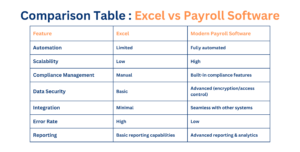
    Comparison Table Excel vs Payroll

    Why Modern HRMS Payroll Software in India is Superior

    Modern HR and payroll software is transforming the way businesses handle employee compensation by automating tedious tasks, ensuring compliance, and boosting overall efficiency. Here are some key advantages:

    1. Centralized Data Management

    HRMS payroll software centralizes all employee-related information within a single, secure platform, eliminating manual data transfers and reducing errors.

    2. Automated Calculations

    A key benefit of HRMS payroll software in India is its ability to automate calculations for wages, taxes, and deductions, ensuring accuracy and timely payments.

    3. Real-Time Updates

    Keeping up with fluctuating tax laws and labor regulations is simplified as the best HRMS and payroll software in India provides automatic updates for compliance.

    4. Employee Self-Service Portals

    Payroll solutions empower employees through self-service portals, allowing them to access payslips, update personal information, and track leave balances.

    5. Enhanced Security and Transparency

    Advanced security features such as encryption, role-based access controls, and audit logs protect sensitive payroll data.

    6. Error Reduction

    Automation eliminates common payroll mistakes, ensuring accuracy in every payroll cycle.

    7. Seamless Integration

    Modern payroll solutions integrate with HRMS payroll systems, accounting software, and time-tracking applications for enhanced efficiency.

    8. Cost Efficiency

    Investing in HRMS payroll software leads to long-term savings by reducing errors and administrative workload.

    9. Scalability

    As organizations grow, HRMS payroll software can easily accommodate more employees without sacrificing performance or accuracy.

    10. Improved Record-Keeping

    Payroll systems maintain thorough records of employee payments, tax filings, and compliance documents, simplifying audits and regulatory inspections.

    Upgrade Your Payroll Processing with Phi EDGE HRMS Payroll Software in India

    At Phi EDGE, we understand the challenges businesses face when managing payroll through traditional methods like Excel. Our comprehensive HRMS payroll software is designed to simplify payroll processes while ensuring accuracy, compliance, and security. With features such as real-time reporting, automated tax calculations, and customizable employee profiles, Phi EDGE Payroll Software empowers you to focus on what truly matters—growing your business.

    Frequently Asked Questions (FAQs)

     1. Is it cost-effective to use a payroll system for small organizations?
    Yes! Many HRMS payroll software in India offer tiered pricing plans for small businesses, making them a cost-effective solution.

    2. Can payroll software handle compliance with local tax laws?
    Absolutely! The best HRMS and payroll software in India ensures compliance by automatically updating tax rates and regulations.

    3. How secure is payroll software compared to Excel?
    Payroll software offers advanced security features such as encryption and access controls, protecting sensitive payroll data far better than Excel.

     4. Does switching to payroll software require technical expertise?
    Not at all! Most HRMS payroll systems are user-friendly and require minimal training.

    5. Can I integrate payroll software with my existing tools?
    Yes! Modern HR and payroll software seamlessly integrates with HRMS and accounting tools, streamlining your business processes.

    By upgrading to Phi EDGE Payroll Software, you can transform your payroll management into a streamlined process that enhances accuracy, ensures compliance, and strengthens security—allowing you more time to focus on what truly matters—growing your business!

     

  • Best HRMS Software for Large Corporations: Features & Benefits

    Best HRMS Software for Large Corporations: Features & Benefits

    Managing human resources in large and medium enterprises is a complex task that requires efficient processes, transparency, and automation. A robust HRMS (Human Resource Management System) enables organizations to streamline operations, improve employee experience, and enhance productivity. In this blog, we will explore the key features of an ideal HRMS Systems in India and how a holistic HRMS suite helps mid and large organizations implement an effective HR strategy that aligns with their business goals.

    Key Features of an HRMS  Software in India

    1. Employee Life Cycle Management (ELCM)

    The ELCM module facilitates smooth employee transitions across different career phases within the organization. It streamlines onboarding, automating documentation and approvals for a hassle-free experience. It also manages employment documents such as offer letters, appointment letters, and confirmations while simplifying the resignation process, allowing employees to submit, withdraw, or accept resignation requests seamlessly.

    2. Organizational Structure

    A well-structured HRMS Software provides a comprehensive view of the company’s hierarchy, allowing HR professionals and managers to access detailed insights into organizational departments, teams, and reporting structures. With a clear representation of employees across various departments, businesses can visualize their hierarchy efficiently. It simplifies locating employees based on roles, teams, and reporting managers, aiding in better workforce planning and decision-making.

    3.. Payroll Management

    Payroll management is a critical function that ensures employees receive timely and accurate compensation while complying with tax regulations. A robust payroll system streamlines salary processing by calculating earnings based on leave, attendance, and tax deductions. It automates compliance tasks such as generating challans, Form 16, and investment declarations, reducing manual errors and administrative workload. Employees benefit from easy access to their pay slips, the ability to submit investment declarations with supporting documents, and instant updates on salary changes, deductions, and tax computations, fostering financial transparency.

    4. Task & Daily Work Management

    A well-organized task management system allows managers to assign, monitor, and track progress on tasks efficiently. Employees can allocate responsibilities among team members, ensuring accountability and smooth workflow management. Real-time tracking keeps employees informed about their daily work schedules and deadlines.

    5. Performance Management System (PMS)

    A performance management system ensures structured evaluation and continuous improvement of employees. It enables companies to set up performance evaluation structures in line with corporate policies, monitor employee performance through dashboards, and encourage self-assessments. Employees can set goals, submit supporting documents, and receive feedback, creating a dynamic performance-driven culture.

    6. Increment & Variable Pay

    Handling salary increments and performance-based bonuses becomes effortless with an automated HRMS. It allocates budgets based on employee CTC and department guidelines, generating increment letters within the system. Employees can transparently track promotions, and performance-based incentives, ensuring fairness in compensation management.

    7. Learning & Development

    A structured learning and development module enhance employee skills by assigning relevant training programs. Organizations can schedule training sessions, track attendance, and assess effectiveness through feedback tools. This system ensures employees remain up-to-date with evolving industry trends and organizational needs.

    8. Competency Management

    Competency management features help organizations define essential skills for various roles and ensure fair evaluation of employees. Managers can assess employees against predefined competency parameters, helping individuals identify areas for improvement and fostering a competency-driven culture within the organization.

    9. 360-Degree Feedback

    A multi-perspective feedback system ensures holistic evaluations by incorporating input from peers, managers, and subordinates. It provides employees with insights into their strengths and areas for development while ensuring balanced appraisals. This method promotes a culture of continuous learning and collaboration.

    10. 9-Box Model

    The 9-box model categorizes employees based on performance and potential, helping HR teams set clear performance benchmarks. Real-time analytics support workforce planning by identifying high-potential employees for leadership development and training opportunities.

    11. Career Planning

    Career planning features map employee potential to suitable career paths, identifying skill gaps and recommending learning opportunities. Organizations can implement structured succession plans, ensuring leadership continuity and employee growth within the company.

    12. Performance Improvement Plan (PIP)

    A structured PIP module aids underperforming employees by setting clear improvement goals and timelines. Real-time dashboards help managers track progress while fostering continuous communication between employees and managers. This ensures that employees receive the necessary support for improvement.

    13. Employee Self-Service (ESS)

    A self-service portal empowers employees by providing access to personal data, documents, and HR policies. They can participate in surveys, track feedback history, and communicate their concerns efficiently. This autonomy enhances engagement and reduces dependency on HR teams for routine queries.

    14. Rewards & Recognition

    An automated rewards and recognition system encourage employee motivation and engagement. HR teams can define and manage recognition programs, automatically generate appreciation certificates, and track recognition trends to promote a positive workplace culture.

    15. Asset Management

    Asset management ensures proper tracking and allocation of company resources such as laptops, ID cards, and other equipment. It maintains an inventory to prevent losses and ensures employees return assets upon resignation, promoting accountability.

    16. Expense Management

    A centralized expense management system simplifies reimbursement processes. Employees can submit expenses with supporting documents, and managers can approve claims based on predefined approval limits. This automation enhances efficiency and financial accuracy.

    17. Attrition Analysis

    Data-driven attrition analysis helps HR teams monitor turnover trends, identify causes, and implement retention strategies. Understanding employee departure patterns allows organizations to address workplace concerns and improve employee satisfaction.

    18. Help Desk and Grievance Management

    An integrated help desk system ensures employee concerns and queries are efficiently addressed. Employees can raise tickets for HR-related concerns, technical issues, or payroll inquiries and track their resolution status in real time. The availability of self-help resources such as manuals, FAQ guides, and knowledge-based videos empowers employees to resolve queries independently, reducing dependency on HR teams.

    How Comprehensive HRMS Helps Large Organizations

    A holistic HRMS integrates all these features into a single, seamless platform, enabling businesses to optimize their HR operations. From payroll management to performance tracking, learning & development, and talent retention.
    Phi EDGE HRMS Software in India provides organizations with a centralized solution to streamline their HR processes. By fostering efficiency, transparency, and employee engagement, businesses can drive sustainable growth, create performance Culture and workforce satisfaction.

    Revolutionaries Workforce Management with Phi EDGE. To know more, book a free consultation with us.

    With all these capabilities, Phi EDGE empowers enterprises to enhance workforce management, automate HR functions, and align HR strategies with business goals. Explore Phi EDGE today and transform the way your HR functions!

    Frequently Asked Questions (FAQ)

    1. What makes Phi EDGE one of the Best HRMS companies in India for large corporations?

    Phi EDGE stands out as one of the Best HRMS companies in India because of its comprehensive, AI-driven, and fully integrated HR platform. It simplifies complex HR processes like onboarding, payroll, leave, attendance, and performance management under one unified dashboard. Large enterprises prefer Phi EDGE for its scalability, customization, real-time analytics, and unmatched support, ensuring smooth HR operations across thousands of employees.

    2. Why do large organizations need HRMS software like Phi EDGE?

    For large enterprises managing diverse teams across locations, manual HR processes often cause inefficiency and compliance errors. Implementing Phi EDGE HRMS allows centralization of all HR functions — from employee data to payroll, appraisals, and compliance — in a single, secure system. With automation and data-driven insights, HR teams can focus more on strategic growth and employee engagement rather than repetitive admin tasks.

    3. What key features make Phi EDGE the Best HRMS company in India?

    Phi EDGE provides a robust suite of enterprise-grade features including:

    ● Automated payroll with real-time compliance updates
    ● Performance appraisal system and AI-based analytics
    ● Employee self-service portals for leave, claims, and documents
    ● Advanced attendance tracking and biometric integration
    ● Data-driven dashboards for leadership decisions
    ● Cloud-based scalability for multi-location management

    These features make Phi EDGE the preferred choice for organizations seeking the Best HRMS software in India.

    4. How does Phi EDGE help improve HR efficiency and business performance?

    By digitizing every HR workflow, Phi EDGE HRMS eliminates duplication, errors, and delays. The platform’s analytics empower leaders with actionable insights into workforce trends, attrition, and productivity. Automation of payroll, leave, and appraisals ensures faster operations and enhanced employee satisfaction — a key factor that drives long-term business success.

    5. What should enterprises look for when selecting the Best HRMS company in India?

    When choosing an HRMS partner, enterprises should evaluate:

    ● Scalability: Can it grow with your organization?
    ● Integration: Does it connect with ERP, accounting, and CRM tools?
    ● User-experience: Is it simple and intuitive for employees and HR teams?
    ● Support: Does the vendor offer training and 24×7 support?
    Phi EDGE meets all these benchmarks, making it the ideal HRMS partner for large organizations across industries.

    6. Is investing in Phi EDGE HRMS a long-term value decision?

    Absolutely. Though initial implementation involves cost and planning, the long-term ROI is substantial. Phi EDGE, recognized as one of the Best HRMS companies in India, helps reduce payroll errors, improve compliance, enhance transparency, and elevate employee engagement — leading to measurable cost savings and improved organizational efficiency.

    7. How long does it take to implement Phi EDGE HRMS in large corporations?

    Implementation timelines depend on organization size, data migration, and customization needs. However, Phi EDGE offers a well-structured deployment process with expert onboarding teams, ensuring a seamless go-live within weeks. Its modular design allows phased implementation — starting with core HR modules and scaling up gradually.

    8. What post-implementation support does Phi EDGE provide?

    Phi EDGE provides continuous support through dedicated account managers, training sessions, helpdesk access, and system upgrades. Regular compliance updates and AI enhancements ensure that clients always stay future-ready. This ongoing partnership approach makes Phi EDGE a trusted name among the Best HRMS companies in India.

  • Step-by-Step Guide to Career Development Planning

    Step-by-Step Guide to Career Development Planning

    Introduction: Why Career Development Matters

    In today’s competitive job market, retaining top talent is just as critical as recruiting the right candidates. Organizations often struggle with employee retention, as many professionals leave their roles citing “better career prospects.” This phrase is not just a generic response—it reflects a genuine concern among employees about their career growth and future opportunities within the company. While it is widely acknowledged that employees leave managers, the second most significant reason for attrition remains the better prospects for career advancement.

    Error: Contact form not found.

  • HRIS vs. HRMS: Choosing the Right System for Large Businesses

    HRIS vs. HRMS: Choosing the Right System for Large Businesses

    Human resource management has evolved from paper-based processes to streamlined, data-driven digital solutions. Two popular solutions are HRIS (Human Resource Information System) and HRMS (Human Resource Management System). Both platforms promise to simplify HR operations, but understanding the differences is key to choosing the right system for your organization. In this guide, we explore what each system offers, compare their features and benefits, and provide a framework for selecting the best solution for your unique needs—all while highlighting important of HRIS software, HRMS software, performance management system, and talent management software.

    Understanding the Basics

    What is HRIS?

    An HRIS is primarily an employee data management system that focuses on:

    • Employee Data Management: Storing and maintaining detailed employee records, including personal information, employment history, and benefits.
    • Policy and Compliance: Ensuring that your organization adheres to internal policies and employment laws.
    • Basic HR Functions: Managing routine HR tasks such as attendance tracking, leave management, and payroll administration.

    When selecting HRMS software in India, organizations—especially smaller companies—benefit from centralized data and streamlined administrative processes. Many of the HRMS in India available today have evolved to offer not only basic HR functionalities but also integration capabilities with more comprehensive systems.

    When selecting HRIS software in India, organizations—especially smaller companies—benefit from centralized data and streamlined administrative processes. Most of the top HRIS systems in India available today have evolved to offer not only basic HR functionalities but also integration capabilities with more comprehensive systems.

    What is HRMS?

    An HRMS (Human Resource Management System) extends beyond the capabilities of traditional HRIS by integrating a broader range of functionalities:

    An HRMS (Human Resource Management System) in India extends beyond the capabilities of traditional HRIS by integrating a broader range of functionalities:

    • Comprehensive Employee Management: Beyond basic data management, HRMS platforms include advanced tools for tracking employee performance, managing compensation, and administering benefits.
    • Talent Management Solutions: Often bundled with robust talent management software, HRMS systems facilitate recruitment, onboarding, and continuous employee development.
    • Self-Service Portal: These platforms empower employees to access their own information with Employee life cycle management wherein it automates the flow Hire to Retire.
    • Performance Management System: Integrated performance management systems within HRMS allow for regular performance reviews and goal tracking, ensuring that employees are aligned with company objectives.
    • Real time reports/ Dashboards: Many modern HR Management Software India now offer cloud-based performance management software, providing remote accessibility and real-time reports and Dashboards that enhance operational flexibility.

    HRMS is particularly needed for larger organizations or growing companies that require a holistic approach to HR management.

    This table clearly illustrates that while both systems share core functions, an HRMS Software in India offers a broader range of features designed to support complex HR processes and strategic planning.

    Benefits of HRIS

    Implementing an HRIS can bring several key benefits, including:

    • Centralized Employee Information: Consolidate employee data in one place to improve accessibility and reduce errors.
    • Streamlined Compliance: Automated tracking of policies and legal requirements ensures that your organization remains compliant, mitigating risk.
    • Cost-Effectiveness: Top HRMS Software in India provides essential HR functionalities at a lower cost, making it a viable option for smaller companies.
    • Improved Decision Making: Ready access to accurate employee data enables better reporting and analytics, supporting informed HR strategies.

    Benefits of HRMS

    For organizations with more complex needs, an Best HRMS Software in India offers additional advantages:

    • Enhanced Talent Management: With integrated talent management software, HRMS supports the entire employee lifecycle—from onboarding to development.
    • Empowered Employees: Self-service portals allow employees to manage HR-related tasks independently, which can increase engagement and reduce administrative workload.
    • Advanced Performance Management: Built-in performance management systems facilitate regular reviews and feedback, helping align individual performance with organizational goals.
    • Scalability and Flexibility: HRMS platforms are designed to grow with your business, making them suitable for large enterprises and rapidly expanding companies.
    • Cloud-Enabled Accessibility: With cloud-based performance management software, HRMS systems provide remote access to critical HR functions, ensuring that your team remains connected and efficient regardless of location.

    Use Cases of HRIS vs. HRMS

    • HRIS: Typically, HRIS platforms are favored by small to medium-sized companies that need efficient employee data management and basic HR functions. When considering HRMS software in India, these organizations appreciate the simplicity and cost-effectiveness.
    • HRMS: Large organizations and fast-growing companies often opt for HRMS due to its comprehensive suite of features. However, many small companies are also recognizing the benefits of advanced HR functionalities such as integrated talent management software and cloud-based performance management software as they scale.
    • HRMS: Large organizations and fast-growing companies in India often opt for HRMS due to its comprehensive suite of features. However, many small companies are also recognizing the benefits of advanced HR functionalities such as integrated talent management software in India and cloud-based performance management software as they scale.

    Each company experiences the value of these platforms differently based on its unique processes, technology infrastructure, and specific HR needs.

    Factors to Consider When Choosing Between HRIS and HRMS

    When deciding which system is right for your organization, consider the following factors:

    1. Identify the Need: Assess whether your primary challenge is managing employee data or if you require a full spectrum of HR functionalities including a performance management system.
    2. Size of the Company: Determine whether your organization’s size and growth trajectory call for the simplicity of Human Resource Management System or the more advance features of HRMS.
    3. Current Tech Stack: Evaluate how a new system will integrate with your existing technology. Smooth integration can lead to enhanced overall efficiency.
    4. Accessibility: Choose systems with user-friendly interfaces and self-service options that empower employees.
    5. Integrations: Ensure the platform can work seamlessly with other critical software, including payroll, CRM, and performance management systems.
    6. Scalability: Opt for a solution that can adapt to your growing business, whether it’s a robust or scalable HRMS Software in India.

    Taking the time to evaluate these factors will help you invest in a system that not only meets your current needs but also supports long-term growth and success.

    Conclusion: HRMS for Large Enterprises and Growing Organizations

    For large enterprises and companies poised for growth, an HRMS stands out as the ideal solution. With integrated talent management software, advanced performance management system features, and cloud-based performance management software, HRMS platforms drive strategic decision-making that positively impacts ROI. While both HRIS and HRMS offer significant benefits, choosing the right system depends on aligning your selection with your organization’s requirements.

    By carefully weighing your needs against the features offered by each system—from Best HRMS software in India to comprehensive HRMS platforms—you can ensure a smooth transition from traditional HR processes to a modern, efficient digital workspace that enhances overall business success.

    This comprehensive guide is designed to assist you in navigating the HR technology landscape, ensuring you select the optimal solution for your organization. Whether you opt for a straightforward HRIS or a full-scale HRMS with integrated talent management software and advanced performance management capabilities, the key is to choose a system that supports your organization’s current and future HR needs.

    1. What is the difference between HRIS and HRMS?

    HRMS Software focuses on managing employee data and basic HR functions, while HRMS extends these features with modules like a performance management system in India and talent management software in India. HRMS software in India offers comprehensive, scalable solutions for larger organizations.

    1. Which system is best for small businesses?

    For small businesses, HRMS software in India provides cost-effective, centralized employee data management. However, if future growth is expected, upgrading to HRMS software in India—which includes integrated talent management software in India—might be more beneficial.

    1. What benefits do top HRMS Software in India offer?

    Top HRMS Solutions in India streamline HR operations by centralizing data and ensuring compliance with policies. They provide a reliable foundation for managing payroll, leave, and attendance efficiently.

    1. How does a performance management system in India enhance HRMS functionality?

    A performance management system in India within an HRMS platform enables regular reviews, real-time feedback, and goal tracking. This integration ensures employees stay aligned with company objectives while boosting overall performance.

    1. What advantages does cloud based performance management software in India offer?

    Cloud based performance management software in India allows remote access, real-time updates, and flexible scalability. It supports agile performance reviews and decision-making from any location, enhancing operational efficiency.

    1. How does talent management software in India integrate with HRMS solutions?

    Talent management software in India, integrated within HRMS, streamlines recruitment, onboarding, and employee development. It creates a seamless employee lifecycle experience, making HR processes more efficient and strategic.

    1. What factors should be considered when choosing between HRIS and HRMS?

    Consider factors like the size of your company, integration needs, and future growth plans. HRMS suits companies needing basic functionalities, while HRMS software in India—with features like a performance management system in India and talent management software in India—supports a comprehensive HR strategy.


  • The Ultimate Guide to Talent Management Software for Enterprises

    The Ultimate Guide to Talent Management Software for Enterprises

    In today’s fast-paced business environment, enterprises must stay ahead by optimizing their workforce strategies. If you want the best people working at your company, then you need a properly thought-out talent management strategy. With this in place, you’ll have everything you need to ensure you attract the best talent in your industry, while also ensuring you can keep them happy and engaged.

    Talent management software plays a crucial role in attracting, developing, and retaining top talent while aligning employee performance with business goals. With the right talent management system, organizations can streamline HR functions, enhance employee engagement, Boost productivity and ensure continuous workforce development.

    This guide explores the essentials of talent management software, how to implement it effectively, and why enterprises need to invest in an integrated HRMS system.

    What is Talent Management Software?

    Talent management software in India is an advanced HR technology solution designed to support various HR functions, including Employee life cycle management, performance management, learning and development, and succession planning. It helps enterprises ensure that the right people are in the right roles, optimizing productivity and workforce efficiency.

    Key features of Talent management systems include

    • ELCM –Automated workflows, and real-time insights, helping organizations enhance employee experiences 
    • Performance Management – Continuous feedback, goal setting, and employee development.
    • Competency Mapping– Helps assess employee proficiency and identify skill gaps.
    • Learning & Development – Personalized training programs and skill enhancement.
    • 360° feedback -Comprehensive feedbacks for employee Growth.
    • Succession Planning – Identifying high-potential employees for leadership roles.

    Why Enterprises Need Talent Management Software?

    Large enterprises deal with complex workforce structures and high employee turnover. Choosing the right HRMS system/Talent Management Solution in India transforms HR from an administrative function into a strategic business enabler, driving growth, retention, and performance.

    1. Attract the Top Talent

    The success of any organization depends on acquiring and retaining the right talent. With an HRMS system, enterprises can attract, and onboard high-performing candidates efficiently.

    2. Boost Employee Performance

    A performance management software helps businesses track employee progress, set clear expectations, and provide continuous feedback. Features like goal setting, OKRs (Objectives and Key Results), and 360° feedback drive a culture of high performance and accountability.

    3. Real-Time, Data-Driven Decision-Making

    Enterprises generate massive amounts of workforce data, but without the right tools, it’s difficult to extract valuable insights. A talent management system integrates real-time analytics, enabling data-driven decision-making for workforce planning and Performance insights.

    4. Enhancing Employee Engagement

    Engaged employees are more productive, loyal, and committed to the organization’s success. Talent management software fosters employee engagement through self-service portals, recognition programs, and collaboration tools.

    5. Encouraging Learning & Development

    With rapid technological advancements, employees must continuously upskill and reskill. An HRMS software in India with built-in learning & development (L&D) features ensures that employees stay updated with industry-relevant skills. Personalized learning paths, online training modules, help create a future-ready workforce.

    6. Supporting Strategic Workforce Planning

    A top HRMS software and Talent Management Solution enables enterprises to align their talent strategy with long-term business goals. From workforce forecasting to succession planning, an HRMS for large organizations ensures the right people are in the right roles at the right time.

    7. Scalability & Future-Readiness

    As enterprises expand, their workforce grows, and managing talent at scale becomes complex. A cloud-based performance management software ensures scalability, flexibility, and future-readiness by automating HR workflows and enabling seamless integrations with other enterprise tools and HRIS.

    How to Implement a Talent Management System in Enterprises?

    1. Define Your Business Objectives

    Before selecting a talent management system, enterprises must align HR strategies with business goals. Identify key challenges such as high attrition rates, skill gaps, or inefficient performance tracking.

    2. Choose the Right Talent Management Software

    Selecting the right software depends on factors such as scalability, integration capabilities, and ease of use. Consider top HRMS software or Online Talent Management System in India best suitable to your needs.

    3. Integrate with Existing HR Systems

    Seamless integration with existing HRIS software is critical. Ensure your chosen platform integrates with payroll, attendance, and employee management tools for a unified HR experience.

    4. Train Employees & HR Teams

    A successful implementation requires training HR professionals and employees on how to use the new system effectively. Invest in ongoing support and learning resources.

    5. Monitor & Optimize Performance

    Regularly assess system performance through analytics and employee feedback. HRMS for large organizations to streamline HR workflows provides insights that help HR teams refine strategies over time.

    Key Benefits of Talent Management Software for Enterprises

    1. Enhanced Employee Performance

    Cloud-based performance management ensures real-time tracking of employee achievements and skill development.

    2. Data-Driven Decision Making

    With real-time analytics, organizations can make informed HR decisions, such as identifying top-performing employees and addressing skill gaps proactively.

    3. Improved Talent Retention

    A well-structured talent management system fosters employee growth and satisfaction, reducing turnover and ensuring long-term workforce stability.

    4. Automated HR Processes

    Automation minimizes manual tasks, allowing HR teams to focus on strategic initiatives that drive business growth.

    5. Scalable HR Solutions

    The best talent management software for large corporations’ scales with organizational growth, ensuring continuous workforce optimization.

    Why Choose Phi EDGE Talent Management Software?

    Phi EDGE Talent Management Software is a powerful, future-ready talent management system designed to streamline HR operations for enterprises. Built by HR experts with over 70+ years of experience, it seamlessly integrates with existing workflows to optimize performance management, employee engagement, and retention. As a comprehensive HRMS system, Phi EDGE provides real-time analytics, HRIS software capabilities, and automated processes, ensuring data-driven decision-making. With a proven track record across industries, Phi EDGE is the ideal choice for enterprises looking for a cloud-based talent management software that enhances workforce productivity while supporting business growth.

    Conclusion

    HR Talent management software in India is a game-changer for enterprises looking to optimize workforce performance and improve employee engagement. Investing in the right talent management system enhances organizational agility, productivity, and long-term success.

    With Phi EDGE HRMS, businesses can streamline HR operations, foster a culture of continuous growth, and build a future-ready workforce.

    Discover how Phi EDGE HRMS to transform your HR strategy today!

  • Task Management Systems: How to Improve Employee Accountability and Efficiency

    Task Management Systems: How to Improve Employee Accountability and Efficiency

     Task management directly affects employee productivity and  business growth.
    In today’s fast-paced business world, employee accountability and efficiency is very crucial for organizational success. With teams often spread across different locations, managing tasks and meeting deadlines can become increasingly complex. This is where Task Management Software in India (TMS) come into play. By providing organizations with a centralized platform to plan, assign, and track tasks, TMS help streamline workflows and ensure employees remain accountable for their responsibilities.

    This blog explores how Task Management Systems can significantly improve employee accountability and efficiency, ultimately driving organizational performance.

    What is a Task Management System?

    A Task & Project Management Software in India is a digital tool that helps organize, track, and manage tasks in an organization. These systems let managers create, assign, and prioritize tasks, set deadlines, and keep an eye on progress as it happens. TMS integrates with other business tools like project management software, communication platforms, and HR systems offering a holistic approach to task management.

    How TMS Have an Impact on Employee Accountability

    1. Clear Task Assignment and Ownership

    One of the best ways to build accountability is to assign tasks and define ownership. A Task Management System makes sure every employee knows which tasks they need to do along with their deadlines and what’s expected of them. This clarity helps avoid confusion and stops tasks from being forgotten.

    • Outcome: Employees are less likely to forget tasks when managers give clear assignments and set deadlines. This creates a feeling of responsibility for their work.

    2. Real-Time Progress Tracking

    With a TMS, managers can track the progress of tasks in real-time. This constant visibility into task completion enables supervisors to identify potential delays early on and take corrective action before they affect project timelines. When employees know their progress is being monitored, it creates a natural sense of accountability.

    ·         Outcome: Regular updates and progress reports encourage employees to stay on track, knowing their performance is being monitored and assessed.

    3. Transparency and Collaboration

    Task Management Systems include collaborative features like shared task lists, comments, and notifications. This transparency ensures that team members are aware of each other’s progress and can offer support when needed. Additionally, this level of visibility increases accountability amongst the employees.

    Outcome: When employees know their work impacts the success of the team and is visible to others, they are more likely to take ownership of their tasks and deliver results.

    4. Automated Reminders and Notifications

    TMS come with built-in reminders and automated notifications. This feature ensure that employees are consistently reminded of upcoming deadlines and pending tasks. This reduces the chances of missed deadlines and ensures employees are always aware of their responsibilities. Automated alerts help employees stay organized and manage their workload.

    ·         Outcome: Regular reminders help employees stay focused avoid putting things off, and stick to deadlines.

    How TMS Boost Worker Productivity

    How TMS Enhance Employee Efficiency

    1.    Prioritization of Tasks

    Efficiency thrives when employees are able to prioritize their tasks effectively. A good Task Management System allows users to categorize tasks based on urgency and importance. By visually organizing tasks, employees can easily focus on high-priority items and ensure that their time is spent productively.

    ·         Outcome: Improved prioritization leads to a reduction in time wasted on non-essential tasks and ensures that critical work is completed first.

    2. Less Time on Paperwork

    Old-school ways to handle tasks, like spreadsheets or emails often need manual updates and follow-ups. These take time and can lead to mistakes. Task Management Tools do a lot of this work . This means less need for manual tracking and updates. As a result, workers have more time to focus on their main jobs.

    • Outcome: When paperwork is automated, employees can spend more time doing actual tasks. This boosts overall output and makes things run smoother.

    3. Reduced Time Spent on Administrative Tasks

    Traditional methods of task management, such as spreadsheets or emails, often involve manual updates and follow-ups, which can be time-consuming and prone to errors. Task Management Systems automate much of this process, reducing the need for manual tracking and updates. This leaves employees with more time to focus on their core responsibilities.

    Outcome: By automating administrative work, employees can dedicate more time to executing tasks, improving overall productivity and efficiency.

    4. Smarter Use of Resources


    Task Management Systems provide managers with a clear view of the workloads and availability of employees. This enables them to allocate tasks based on the strengths, skills, and capacity of each team member. By ensuring that tasks are assigned to the right people, businesses can maximize their resource utilization and improve efficiency.

    • Outcome: When tasks are assigned in the best way possible, it ensures employees are neither overburdened nor underutilized, helping maintain productivity without burnout

    5. Time Tracking and Analytics


    Many Task Management Systems have built-in time tracking tools. These tools let employees log the time they spend on different tasks. Managers can then look at these numbers to find areas where they can boost productivity. By looking at time tracking data, businesses can streamline processes, eliminate bottlenecks, and optimize workflows.

    Outcome: Time tracking gives useful insights into how people spend their time. This helps managers to make processes better and increase productivity.

    6. Centralized Communication


    Effective communication is essential for maintaining productivity. TMS centralize all task-related communications in one place, allowing team members to collaborate, share files, and provide updates without leaving the platform. This reduces time spent on emails or meetings and ensures that all communication is task-focused and easily accessible.

    ·         Outcome: Centralized communication minimizes miscommunication and keeps teams aligned, ensuring efficient collaboration and timely task completion.

    Conclusion

    Task Management Systems are powerful tools for improving employee accountability and efficiency. By providing clear task assignments, real-time progress tracking, enhanced collaboration, and automated reminders, TMS foster a sense of ownership and responsibility among employees. Furthermore, these systems optimize task prioritization, resource allocation, and time tracking, enabling organizations to maximize productivity and meet deadlines consistently.

    For companies looking to boost performance, adopting a Task Management System can be the key to unlocking improved accountability, efficiency, and overall success. At Phi EDGE, we understand the importance of technology in driving business outcomes, and our expertise in performance management solutions can help organizations implement the right tools for enhanced results.

  • Task Management System for EPC Companies | Improve Employee Efficiency | Phi EDGE

    Task Management System for EPC Companies | Improve Employee Efficiency | Phi EDGE

    Task Management System Implementation: Driving Employee Efficiency in an EPC Company

    Engineering, Procurement, and Construction (EPC) companies manage some of the most complex projects across industries such as infrastructure, energy, manufacturing, oil & gas, renewable energy, and commercial construction. Every project involves multiple teams, strict deadlines, compliance requirements, vendor coordination, procurement tracking, and real-time reporting. As projects grow in scale, manual task tracking through spreadsheets, emails, or messaging apps often creates delays, communication gaps, and missed deadlines.

    A Task Management System (TMS) provides a centralized platform where organizations can assign tasks, monitor progress, automate workflows, and measure employee performance in real time. By integrating task management with an advanced HRMS platform such as Phi EDGE, EPC companies can improve operational efficiency, reduce project delays, and increase workforce productivity.

    This comprehensive guide explains how implementing a task management system transforms employee efficiency, strengthens project governance, and supports sustainable business growth for EPC organizations.


    Why Task Management is Critical for EPC Companies

    Unlike traditional businesses, EPC organizations operate across multiple project sites with cross-functional teams. Task Management System for EPC Companies | Improve Employee Efficiency Engineers, procurement specialists, project managers, finance departments, HR teams, and contractors must work together while meeting strict project timelines.

    Without a structured task management process, organizations commonly face:

    • Delayed project execution
    • Poor communication between departments
    • Duplicate work assignments
    • Missed approvals
    • Inefficient resource allocation
    • Lack of accountability
    • Limited visibility into employee productivity
    • Difficulty monitoring project milestones
    • Increased operational costs

    A modern Task Management System eliminates these challenges by providing a single source of truth for all project-related activities.


    What is a Task Management System?

    A Task Management System is a digital platform that enables organizations to create, assign, prioritize, track, and complete tasks throughout the project lifecycle. It helps managers monitor workloads, allocate resources efficiently, and ensure every activity is completed within the planned schedule.

    Modern task management software goes beyond simple task lists by incorporating:

    • Workflow automation
    • Real-time dashboards
    • Employee collaboration
    • Document management
    • Notifications and reminders
    • Performance analytics
    • Mobile accessibility
    • Integration with HRMS and ERP systems

    For EPC companies, these capabilities provide greater visibility into engineering workflows, procurement activities, construction progress, inspections, and project documentation.


    Key Components of a Modern Task Management System

    1. Task Creation and Assignment

    Managers can create tasks with detailed descriptions, assign ownership, define priorities, attach project documents, and set expected completion dates.

    Example:

    • Prepare Structural Design Drawings
    • Vendor Material Inspection
    • Site Safety Audit
    • Procurement Approval
    • Quality Assurance Review

    Every employee clearly understands their responsibilities.


    2. Priority-Based Work Management

    Not every task has the same business impact.

    A task management platform categorizes work based on:

    • High Priority
    • Medium Priority
    • Low Priority
    • Critical Tasks
    • Project Milestones

    This helps project managers allocate resources more effectively.


    3. Deadline Monitoring

    Automated reminders reduce the risk of missed deadlines by notifying employees before due dates.

    Managers receive alerts for:

    • Overdue tasks
    • Pending approvals
    • Escalated issues
    • Delayed activities

    4. Workflow Automation

    Instead of manually assigning every activity, organizations can automate repetitive workflows.

    Examples include:

    • Purchase approval workflows
    • Design approval processes
    • Leave approval linked to project schedules
    • Daily work reporting
    • Incident reporting
    • Client approval notifications

    Automation minimizes manual effort while improving operational consistency.


    5. Real-Time Progress Tracking

    Project managers gain instant visibility into project performance through dashboards displaying:

    • Completed tasks
    • Pending tasks
    • Overdue activities
    • Department-wise progress
    • Employee workload
    • Resource utilization

    Real-time monitoring enables proactive decision-making and faster issue resolution.


    Why Traditional Task Management Fails in EPC Companies

    Many EPC companies continue to rely on spreadsheets, email chains, phone calls, and messaging applications to manage projects. While these methods may work for small teams, they become inefficient as projects increase in size and complexity.

    Common Challenges of Manual Task Management

    Traditional Process Business Impact
    Excel-based task tracking Frequent data inconsistencies and version conflicts
    Email approvals Delayed decision-making and missed responses
    WhatsApp communication No centralized audit trail or reporting
    Manual follow-ups Significant time spent chasing updates
    Paper-based documentation Higher risk of document loss and compliance issues
    Independent departmental tracking Poor collaboration and information silos

    These inefficiencies often lead to increased project costs, reduced productivity, and delayed project delivery.


    How a Task Management System Improves Employee Efficiency

    Employee efficiency is not about working longer hours—it is about enabling employees to focus on the right tasks with the right information at the right time.

    A task management system supports this by:

    Improving Accountability

    Every task has:

    • A designated owner
    • A due date
    • Defined priorities
    • Progress status
    • Performance metrics

    This creates clear ownership and responsibility.


    Increasing Productivity

    Employees spend less time searching for information or waiting for updates. Instead, they can:

    • View assigned tasks in one dashboard
    • Collaborate with team members
    • Upload documents
    • Track progress
    • Receive automated reminders

    This reduces administrative effort and allows teams to focus on value-added work.


    Enhancing Team Collaboration

    Cross-functional collaboration becomes easier through shared workspaces where engineering, procurement, finance, HR, and construction teams can communicate, exchange documents, and monitor project progress in real time.

    This minimizes communication gaps and accelerates project execution.


    Step-by-Step Task Management System Implementation for an EPC Company

    Implementing a Task Management System (TMS) is more than deploying software. It is a strategic initiative that aligns people, processes, and technology to improve project delivery, employee productivity, and operational efficiency. For EPC companies, where multiple departments and project sites operate simultaneously, a structured implementation roadmap minimizes disruption and accelerates user adoption.

    Step 1: Analyze Existing Workflows

    Before implementation, evaluate how tasks are currently managed across departments.

    Assess:

    • Engineering design approvals
    • Procurement workflows
    • Site execution activities
    • Quality inspections
    • Safety audits
    • Vendor coordination
    • Client approvals
    • HR and administrative tasks

    Identify process bottlenecks such as:

    • Manual approvals
    • Duplicate data entry
    • Delayed communication
    • Unclear task ownership
    • Missed deadlines
    • Lack of reporting

    This analysis provides the foundation for designing an efficient digital workflow.


    Step 2: Define Business Objectives

    A successful implementation begins with measurable goals.

    Examples include:

    • Reduce project delays by 30%
    • Improve employee productivity by 25%
    • Achieve 100% task visibility
    • Reduce manual reporting by 80%
    • Improve approval turnaround time
    • Increase project completion rates
    • Strengthen compliance tracking

    Clearly defined KPIs help measure implementation success.


    Step 3: Map Department-Wise Workflows

    Each department has unique responsibilities. Configure workflows accordingly.

    Engineering Department

    Typical tasks include:

    • Design preparation
    • Drawing review
    • Structural calculations
    • Technical approvals
    • Revision management

    Procurement Department

    Workflow examples:

    • Purchase requisitions
    • Vendor quotation reviews
    • Purchase order approvals
    • Material dispatch tracking
    • Inventory updates

    Construction Team

    Daily activities may include:

    • Site inspections
    • Daily progress reporting
    • Equipment allocation
    • Labor management
    • Milestone completion

    Quality Assurance (QA/QC)

    Tasks include:

    • Inspection requests
    • Quality checklists
    • Material testing
    • Non-conformance reporting
    • Corrective actions

    Health, Safety & Environment (HSE)

    Typical workflows:

    • Safety inspections
    • Incident reporting
    • Risk assessments
    • Permit approvals
    • Compliance documentation

    Digitizing these workflows ensures consistency and accountability across the organization.


    Why Phi EDGE is the Right Choice for EPC Companies

    Unlike standalone task management tools, Phi EDGE combines task management with a comprehensive HRMS platform, enabling organizations to manage both workforce operations and project execution from a single system.

    Key advantages include:

    • Integrated Employee Management
    • Attendance and Leave Management
    • Project-Based Task Assignment
    • Workflow Automation
    • Performance Management
    • Document Management
    • Real-Time Analytics
    • Mobile Access for On-Site Teams
    • Approval Workflows
    • Customizable Dashboards

    This unified approach helps EPC organizations improve productivity, strengthen governance, and support scalable growth.


    The client is a leading Engineering, Procurement, and Construction (EPC) company that specializes in delivering complex, large-scale infrastructure projects for industries such as oil & gas, energy, and utilities. With a global presence and a diverse workforce, the company faces the challenge of managing multiple projects simultaneously, each with unique requirements and stringent deadlines.

    Challenges Faced by the Client

    The EPC company was grappling with several operational inefficiencies, primarily related to task management and project delivery. These included:

    1. Fragmented Task Allocation: The company’s task management process was highly decentralized, with tasks being allocated manually through emails, spreadsheets, and informal communication channels. This led to a lack of visibility and accountability across teams.
    2. Lack of Real-Time Tracking: With multiple ongoing projects, managers struggled to keep track of task progress in real time. This resulted in delays, missed deadlines, and an inability to predict potential bottlenecks.
    3. Resource Overload and Underutilization: Without a clear system to monitor employee workloads, there were frequent instances of employees being either overburdened or underutilized, leading to inefficiencies and burnout.
    4. Poor Collaboration Across Teams: As the company operated across different time zones and departments, collaboration on tasks was disjointed, leading to communication gaps and misunderstandings that affected project timelines.
    5. Difficulty Meeting Deadlines: With no automated or centralized system to track deadlines, the company struggled to ensure that project milestones were met consistently, leading to frequent delays and client dissatisfaction.

    Implementing a Task Management System by Phi EDGE

    To address these challenges, the client decided to implement a comprehensive Task Management System (TMS) to streamline task allocation, improve tracking, enhance collaboration, and optimize resource utilization. Phi EDGE was engaged to help design and deploy the solution, leveraging our expertise in integrating technology with business processes to drive operational efficiency.

    The implementation strategy was broken down into the following phases:

    1. Needs Assessment and Customization

    Phi EDGE conducted an in-depth needs assessment, working closely with the client’s management team to understand the specific pain points and project requirements. We customized the Task Management System to meet the needs of the EPC sector, incorporating features that would address:

    • Multi-project Management: The system was configured to handle multiple projects with different deadlines, resource requirements, and client specifications.
    • Task Prioritization: The ability to prioritize tasks based on urgency and importance, ensuring that high-priority tasks were completed on time.
    • Resource Management: Integration with the company’s HR and ERP systems to monitor resource availability and workload distribution in real time.

    2. System Integration and Training

    Phi EDGE worked with the client’s IT department to ensure seamless integration of the Task Management System with existing tools such as ERP, CRM, and time tracking systems. This integration allowed for smooth data exchange and ensured that project managers had access to real-time updates across all platforms.

    Comprehensive training sessions were conducted for employees at all levels, from project managers to team members, ensuring that the system was fully understood and adopted. The training focused on:

    • Task creation, assignment, and tracking
    • Setting deadlines, milestones, and dependencies
    • Real-time collaboration and communication tools within the system

    3. Rollout and Monitoring

    The system was rolled out across multiple teams and projects, starting with a pilot phase for one of the company’s key projects. This allowed Phi EDGE to gather feedback, make necessary adjustments, and ensure that the system was fine-tuned to the specific needs of the client.

    During the rollout, Phi EDGE provided ongoing support to address any technical issues, answer user queries, and optimize system performance.

    4. Post-Implementation Support and Optimization

    Following the successful implementation, Phi EDGE provided post-launch support, including performance monitoring, system optimization, and periodic updates. This ensured that the system continued to evolve with the company’s needs and the challenges presented by ongoing projects.

    Results and Benefits

    The Task Management System implementation brought about several significant improvements for the EPC company, driving employee efficiency and improving project delivery timelines:

    1. Enhanced Task Visibility and Accountability

    With the Task Management System in place, all tasks, deadlines, and assignments were centralized in a single platform, providing both managers and employees with complete visibility. Project managers could easily track task progress, see which team members were responsible for which tasks, and identify potential delays or issues early on.

    • Outcome: There was a 30% improvement in task completion rates on time, as teams had clear visibility into their responsibilities and deadlines.

    2. Streamlined Collaboration and Communication

    The system facilitated real-time communication between teams, with integrated chat, notifications, and file-sharing capabilities. Teams working in different time zones could now collaborate more efficiently, with task dependencies and progress being clearly documented.

    • Outcome: A 60% reduction in miscommunications and delays due to improved collaboration and information sharing.

    3. Optimized Resource Allocation

    By integrating the Task Management System with the company’s HR and ERP systems, the client could track resource availability and workloads across all projects. This enabled project managers to allocate resources based on skills, availability, and project priorities, ensuring that no team member was overburdened or underutilized.

    • Outcome: A 45% improvement in resource utilization, ensuring that projects were staffed appropriately and on time.

    4. Timely Project Deliveries

    With a more organized and structured approach to task management, the company was able to track and meet project deadlines more consistently. The system’s real-time tracking and milestone management ensured that project managers could identify delays early and take corrective action before they impacted the overall timeline.

    • Outcome: A 65% reduction in project delays, with a marked improvement in client satisfaction and on-time delivery rates.

    5. Increased Employee Efficiency

    With a more streamlined task assignment process and clear deadlines, employees could focus on their core responsibilities without the distraction of manual task tracking. This led to a more efficient work environment where team members were empowered to complete their work independently and on schedule.

    • Outcome: A 60% increase in overall employee productivity, with fewer instances of task confusion and delays.

    Conclusion

    The implementation of a Task Management System at the EPC company transformed its approach to project management, driving employee efficiency and ensuring that deadlines were met consistently. By centralizing task allocation, improving real-time tracking, and fostering collaboration across teams, the company was able to enhance productivity, optimize resource utilization, and improve client satisfaction.

    This case study underscores the critical role of technology in modernizing task management processes and demonstrates how an effective Task Management System can drive operational excellence in complex industries such as EPC.

  • Task Management Systems: Enhancing Employee Productivity and Meeting Organizational Deadlines

    Task Management Systems: Enhancing Employee Productivity and Meeting Organizational Deadlines

    In today’s fast-paced business environment, organizations are increasingly turning to Task Management Systems (TMS) as essential tools to enhance employee productivity and ensure deadlines are consistently met. By streamlining task allocation, progress tracking, and collaboration, TMS not only improves operational efficiency but also fosters a culture of accountability and transparency. This white paper explores the importance of Task Management Systems, their impact on organizational productivity, and how they help businesses achieve timely project completions through optimized resource allocation and real-time communication.

    Error: Contact form not found.

  • Building a Scalable Talent Acquisition Strategy for Growth

    Building a Scalable Talent Acquisition Strategy for Growth

    In today’s fast-paced business landscape, attracting and retaining top talent is no longer just a necessity—it’s a competitive advantage. Certain industries namely IT, ITES, Banks and Financial services have a huge requirement for talent staffing and staff augmentation on contractual basis where right talent is sourced and deployed at the client site in bulk.  

    At Phi EDGE, we understand that organizations aiming for growth must ensure their talent acquisition strategies are not only effective but also scalable to meet evolving demands. Here, we outline key steps to build a scalable talent acquisition strategy that aligns with organizational growth objectives.

    1. Align with Organizational Vision and Growth Goals

    A scalable talent acquisition strategy begins with a deep understanding of your organization’s long-term goals. Collaborate with leadership teams to identify business objectives, potential growth markets, and the skills required to achieve them. This clarity ensures that hiring efforts are aligned with the company’s trajectory, a core principle of Phi EDGE strategic approach.

    2. Leverage Technology and Automation

    Technology is the backbone of scaling recruitment efforts. Invest in an Applicant Tracking System (ATS) to streamline hiring, manage candidate pipelines, and generate actionable insights. At Phi EDGE, we emphasize integrating AI-driven tools to assist in screening resumes, scheduling interviews, and assessing cultural fit, ensuring efficiency and accuracy.

    3. Strengthen Your Employer Brand

    Your employer brand is your beacon to attract top talent. Develop a compelling Employee Value Proposition (EVP) that highlights your company culture, career growth opportunities, and commitment to employee well-being. Phi EDGE advocates using social media, employee testimonials, and industry presence to amplify your brand and attract candidates organically.

    4. Build a Robust Talent Pool

    Proactive talent management is essential for scalability. There are many staffing agencies which provide skilled and shortlisted manpower in huge quantities to various organisations namely in the IT&ITES, BFSI etc . Companies can approach them for quick hiring. Also maintain relationships with passive talent, engage alumni, and collaborate with educational institutions to build a talent pool. This forward-thinking approach ensures your organization is prepared for rapid expansion.

    5. Emphasize Data-Driven Decisions

    At Phi EDGE, we believe that data is the foundation of informed decision-making. Leverage metrics like time-to-hire, cost-per-hire, and source effectiveness to optimize recruitment strategies. Predictive analytics can also forecast future hiring needs, helping you stay ahead of the curve.

    6. Foster Collaboration Between HR and Leadership

    Scalable strategies require cohesive efforts. Encourage ongoing dialogue between HR and leadership teams to anticipate workforce needs and align recruitment priorities with business objectives. This ensures timely and impactful hiring decisions.

    7. Prioritize Diversity and Inclusion

    Diversity and inclusion are integral to a scalable talent strategy. Diverse teams drive innovation and enhance performance. Phi EDGE emphasizes implementing inclusive hiring practices, eliminating biases, and cultivating an environment where everyone feels valued.

    8. Upskill Your Recruitment Team

    Recruiters are the architects of talent acquisition. Equip them with the latest skills and tools to identify and attract top talent. At Phi EDGE, we offer training on emerging trends, technology, and best practices to ensure your team’s efforts scale effectively.

    9. Enhance Onboarding Processes

    A strong onboarding program is critical for productivity and retention. Automate onboarding workflows and personalize the experience to align with individual roles. Effective onboarding reduces turnover and sets the stage for scalable growth.

    10. Continuously Innovate and Adapt

    The recruitment landscape is dynamic. At Phi EDGE, we stay ahead by monitoring industry trends, experimenting with new tools, and seeking feedback from candidates and hiring managers. A flexible approach ensures your strategy evolves with your organization’s growth.

    Conclusion

    Building a scalable talent acquisition strategy is a continuous journey that requires alignment, innovation, and foresight. By leveraging technology, fostering collaboration, and staying true to your company’s values, you can create a recruitment framework that supports sustainable growth. At Phi EDGE, we’re committed to helping organizations propel their vision forward with tailored talent acquisition solutions that ensure scalability and success.

  • Increment and Variable Pay Based on Performance: A Case Study on the IT Industry

    Increment and Variable Pay Based on Performance: A Case Study on the IT Industry

    In the competitive manufacturing industry, maintaining a motivated and engaged workforce is crucial for sustaining growth and innovation. Compensation structures, particularly increments and variable pay, are pivotal in this regard. This case study explores how Phi EDGE, a leading HR consulting and technology firm, successfully resolved increment and variable pay challenges for a mid-sized manufacturing firm. With approximately 1,000 employees, the firm struggled with issues in performance assessment, compensation fairness, and employee retention. Phi EDGE’s tailored solutions not only addressed these challenges but also significantly enhanced overall organizational performance.

    Challenges Identified

    The manufacturing company faced several persistent issues with its existing compensation system:

    Lack of Clear Performance Metrics: The absence of well-defined performance metrics led to subjective evaluations, making it difficult to assess individual contributions accurately.

    Inconsistent Increment Policies: Salary increments were not standardized, resulting in employee perceptions of favoritism and unfair treatment. This inconsistency caused dissatisfaction and eroded trust in the management.

    Variable Pay Discrepancies: The linkage between performance and variable pay was unclear. Employees were uncertain about how their performance translated into bonuses, leading to disengagement and a lack of motivation to excel.

    High Attrition Rates: Dissatisfaction with the compensation structure, particularly among high-performing employees, contributed to a high attrition rate. The loss of top talent posed a significant challenge to the company’s growth and stability.

    Solution Implementation by Phi EDGE

    Phi EDGE employed a multi-faceted approach to revamp the compensation structure, leveraging its expertise in performance management and its SaaS-based HRIS.

    Development of Clear Performance Metrics: Phi EDGE collaborated with the manufacturing company’s leadership to design clear, quantifiable performance metrics aligned with the company’s strategic goals. These metrics were role-specific, ensuring that performance evaluations were relevant, fair, and objective.

    Introduction of a Structured Increment Framework: Phi EDGE introduced a structured framework that linked salary increments directly to performance outcomes. This framework categorized employees into performance tiers, each associated with specific increment percentages:

    • Top Performers (20% of employees): Received a 15% salary increment, recognizing their exceptional contributions.
    • High Performers (30% of employees): Awarded a 10% increment, motivating them to sustain their high performance.
    • Average Performers (40% of employees): Given a 5% increment, encouraging them to strive for higher performance levels.
    • Low Performers (10% of employees): No increment was provided, with a focus on performance improvement plans.

    Revamping the Variable Pay Structure: Phi EDGE revamped the variable pay system to ensure a stronger link between individual performance, team achievements, and company profitability. The revised structure included:

    • Individual Performance Bonus: Ranging from 5% to 20% of the base salary, depending on the employee’s performance tier. This component rewarded personal achievements and contributions.
    • Company Profitability Bonus: An additional bonus ranging from 5% to 10% was awarded based on the company’s annual financial performance, fostering a collective sense of ownership and alignment with organizational goals.

    Enhanced Communication and Transparency: To address issues of transparency, Phi EDGE implemented regular performance review sessions and established clear communication channels. Employees received detailed feedback on their performance evaluations and were provided with comprehensive explanations of how their compensation adjustments were determined. This transparency helped build trust and clarity around the compensation process.

      Results and Impact

      The implementation of Phi EDGE solutions led to significant positive outcomes for the manufacturing company:

      Improved Employee Satisfaction: The clear linkage between performance and compensation improved employee morale and satisfaction. Employees felt valued and fairly rewarded for their contributions.

      Reduced Attrition Rates: The company experienced a 25% reduction in attrition rates within the first year of implementation. The improved compensation structure played a key role in retaining high-performing employees.

      Enhanced Performance: Motivated by the performance-linked incentives, employees exhibited a 15% increase in overall productivity. The structured approach encouraged them to consistently perform at their best.

      Better Financial Performance: The alignment of variable pay with company profitability contributed to a 10% improvement in the company’s financial performance. This improvement underscored the effectiveness of linking compensation with organizational success.

      Conclusion

      This case study highlights the pivotal role of structured performance management systems in addressing compensation challenges in the manufacturing industry. Phi EDGE tailored approach not only resolved the issues of increments and variable pay but also drove significant improvements in employee engagement, retention, and overall performance. Through the implementation of clear metrics, structured frameworks, and enhanced transparency, Phi EDGE successfully transformed the manufacturing company’s compensation strategy, setting a benchmark for performance-driven pay practices in the industry. This case study serves as a testament to the importance of aligning compensation structures with performance to achieve organizational excellence.