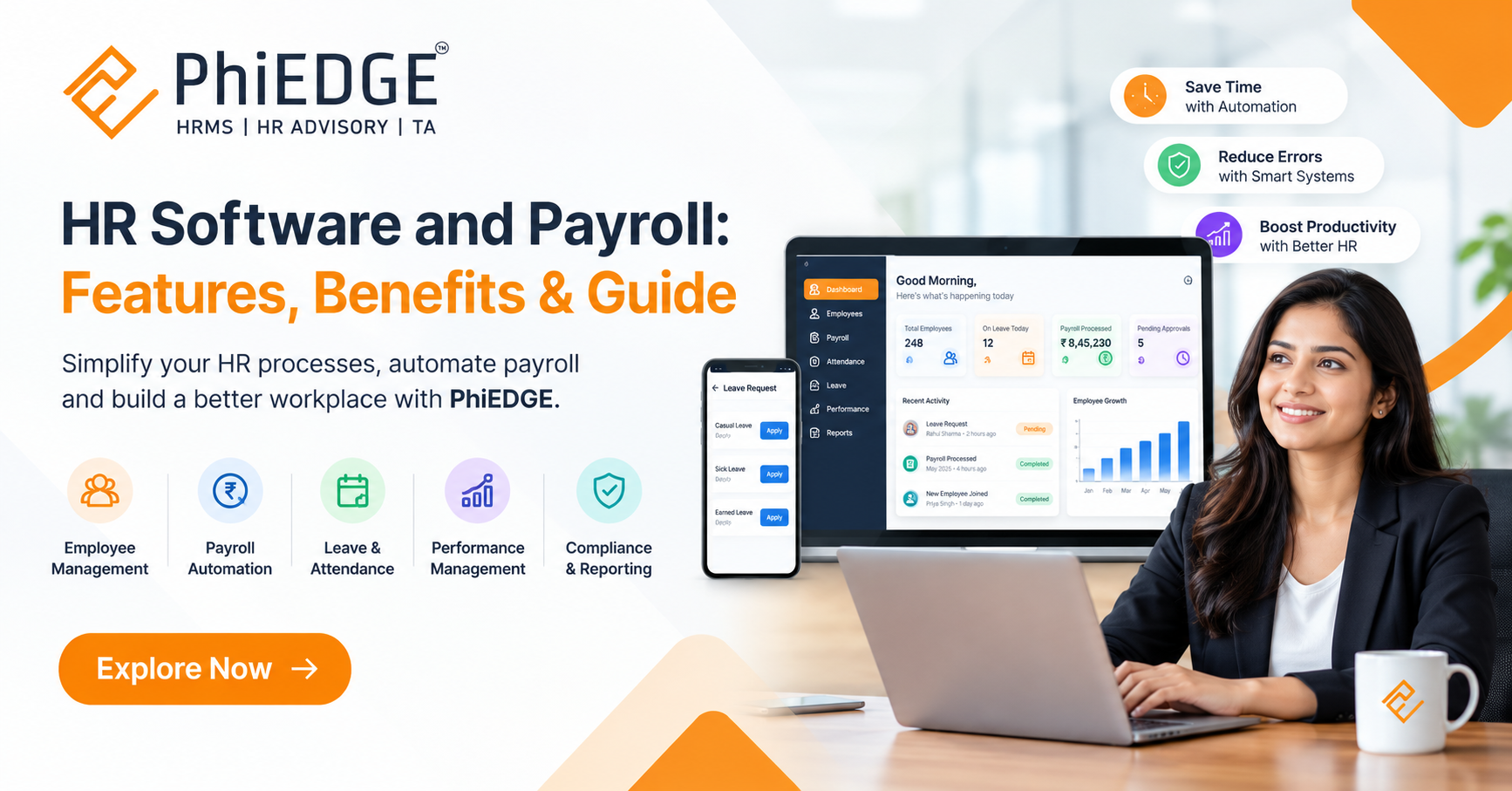
Managing employees, processing salaries, tracking attendance, and maintaining payroll records can become challenging as a business grows. When these activities depend on spreadsheets and disconnected systems, HR teams may spend more time on repetitive administration and less time supporting employees and business goals.
HR software and payroll solutions help organizations bring employee information and salary-related processes into a more structured digital workflow. By connecting HR operations with payroll management, businesses can improve data consistency, reduce repetitive work, and make more informed workforce decisions.
In this guide, we explain how HR and payroll software works, which features matter most, and how businesses can evaluate a solution such as Phi EDGE HRMS.
What Is HR Software and Payroll?
HR software is a digital system that helps organizations manage employee information and human resource activities. Payroll software focuses on calculating employee salaries, deductions, allowances, bonuses, and payslips.
When these functions work together, HR teams can use employee records, attendance information, leave balances, and salary structures more consistently throughout the payroll cycle.
For example, approved leave and attendance records may be used to calculate loss of pay, subject to the organization’s policies and configured rules. This reduces the need to enter the same information into multiple systems.
An integrated HRMS can also connect payroll with broader processes such as performance management, employee lifecycle management, increments, and variable pay.
Why Do Businesses Need HR and Payroll Software?
Manual HR administration becomes more difficult as employee numbers, locations, and compensation structures increase.
Here are some common challenges that HR software and payroll systems can help address:
- Repeated data entry: Employee information may be maintained in multiple spreadsheets.
- Payroll calculation errors: Incorrect attendance, leave, or salary inputs can affect payroll accuracy.
- Time-consuming approvals: HR teams may need to follow up manually for leave, attendance corrections, and other requests.
- Limited reporting: Managers may struggle to obtain timely workforce information.
- Compliance-related workload: Payroll teams must maintain appropriate records and follow applicable statutory requirements.
HR and payroll software helps organize these processes in one workflow. However, results depend on correct configuration, accurate employee data, and regular review by authorized HR or payroll professionals.
What Are the Key Features of HR Software and Payroll Systems?
1. Employee Information Management
A centralized employee database helps HR teams maintain employee profiles, job details, reporting structures, and relevant employment records.
Authorized users can access the information they need without searching through multiple files. Role-based permissions and appropriate access controls are important because employee records contain confidential information.
2. Automated Payroll Processing
Payroll management software supports salary calculations using configured salary components, allowances, deductions, bonuses, and approved adjustments.
Depending on the solution and its configuration, payroll workflows may include:
- Salary structure management
- Monthly payroll processing
- Payslip generation
- Tax-related calculations
- Payroll reports and bank transfer files
- Full-and-final settlement support
Automation can reduce repetitive calculations, but payroll should still be reviewed before final approval and disbursement.
3. Leave and Attendance Integration
Attendance and leave data can influence payroll calculations. An integrated system can help HR teams track attendance, approved leave, overtime where applicable, and loss-of-pay adjustments.
Before payroll is processed, organizations should validate attendance records, leave approvals, shift rules, and exceptions to avoid incorrect salary outcomes.
4. Statutory Payroll Support
Indian employers may need to manage applicable obligations relating to provident fund, employee state insurance, professional tax, tax deduction at source, and other statutory requirements.
The exact obligations depend on factors such as the establishment, employee eligibility, applicable law, and current regulations.
HR software can support calculations, records, and reporting. Employers should verify legal requirements through official sources such as the Employees’ Provident Fund Organisation and the Income Tax Department.
5. Performance and Compensation Management
Payroll does not operate independently of other HR functions. Increment decisions, variable pay, bonuses, and approved compensation changes can affect employee salary records.
Connecting compensation workflows with performance management can help organizations maintain a more consistent process for reviewing and implementing approved changes.
6. Reports and Workforce Insights
HR dashboards and reports help authorized decision-makers review workforce information, payroll summaries, employee trends, and other available metrics.
Useful reports may include employee headcount, payroll cost, attendance exceptions, compensation changes, and attrition trends. These insights can support workforce planning when the underlying data is accurate and interpreted in context.
How Does Integrated HR and Payroll Software Improve Efficiency?
Consider an organization that collects attendance data separately, calculates salaries in spreadsheets, and sends payslips manually.
Every additional step creates an opportunity for duplicated work or inconsistent information.
With an integrated HRMS, the workflow can be more structured:
- Employee information is maintained in a centralized system.
- Attendance and leave records are updated and approved.
- Payroll uses the relevant employee and attendance data.
- HR or payroll professionals review exceptions and calculations.
- Approved payroll outputs and payslips are generated.
- Reports support reconciliation and management review.
The benefit is not simply faster processing. It is a clearer workflow, better visibility, and more consistent handling of employee information.
How Can You Choose the Right HR Software and Payroll Solution?
Before selecting a platform, assess your organization’s requirements rather than choosing software based on feature lists alone.
Evaluate these factors:
- Business requirements: Identify your current HR and payroll challenges.
- Integration capabilities: Check whether the software supports the attendance, accounting, or other systems you use.
- Compliance configuration: Confirm how applicable payroll rules, updates, and reports are managed.
- Data security: Review access controls, data protection, backups, and vendor security practices.
- Reporting: Ensure that HR teams can access relevant operational and management reports.
- Scalability: Consider future employee growth and additional HR requirements.
- Implementation and support: Understand onboarding, configuration, training, and ongoing assistance.
- Total cost: Compare licensing, implementation, integrations, maintenance, and support costs.
Request a demonstration using realistic business scenarios. Ask the vendor to explain how employee data flows into payroll, how exceptions are handled, and which tasks still require manual review.
How Does Phi EDGE HRMS Support HR and Payroll Management?
Phi EDGE offers HRMS and payroll capabilities designed to support connected human resource processes.
Its payroll solution describes features including salary structure management, payroll processing, payslip generation, tax calculations, and integration with attendance and leave information. The broader HRMS offering includes performance management, increments, variable pay, learning and development, employee lifecycle management, and talent management.
Organizations evaluating an integrated solution can explore the Phi EDGE Payroll Management Software page to understand the available capabilities.
The appropriate configuration will depend on an organization’s workforce, existing systems, payroll requirements, and implementation needs. Businesses should confirm specific integrations, compliance workflows, and features directly with the Phi EDGE team before making a purchasing decision.
What Results Should Businesses Expect From HR and Payroll Software?
The expected benefits depend on the organization’s existing processes and how effectively the software is implemented.
Businesses may aim to reduce repetitive data entry, improve payroll review processes, make employee information easier to access, and create more consistent HR workflows.
A useful way to measure progress is to establish a baseline before implementation. Track payroll processing time, correction frequency, approval turnaround time, and the number of manual steps involved in routine HR activities.
Comparing these measures after implementation can help determine whether the solution is delivering practical value.
Frequently Asked Questions About HR Software and Payroll
What is the difference between HR software and payroll software?
HR software supports employee records, HR administration, performance, leave, and other workforce processes. Payroll software focuses on salary calculations, deductions, payslips, and payroll-related records. An integrated HRMS may combine both.
Can HR software automate salary calculations?
Yes. Depending on the system and configuration, it can calculate salaries using defined salary components, approved attendance data, deductions, and other payroll inputs. Human review remains important for exceptions and final approval.
Is HR and payroll software suitable for growing businesses?
It can be useful for growing businesses that need consistent employee records and repeatable payroll processes. The right solution depends on employee numbers, business complexity, budget, and integration requirements.
Does payroll software help with statutory compliance in India?
It can support relevant calculations, reports, and recordkeeping. However, software alone does not guarantee compliance. Employers must verify applicable rules, maintain accurate data, and review statutory obligations.
How do I evaluate Phi EDGE HRMS?
Review the Phi EDGE website, explore its payroll solution, and request a demonstration. Discuss your workforce structure, payroll workflow, integrations, reporting requirements, and implementation expectations.
Client Testimonials and Customer Experience
Customer feedback can help businesses understand how an HRMS performs in real working environments. For a useful testimonial, include the customer’s name and designation only with permission, along with their organization and the specific workflow they evaluated.
Recommended testimonial format:
“[Insert an approved customer statement describing their experience with Phi EDGE HRMS, the HR or payroll challenge addressed, and the outcome they can substantiate.]”
Customer name: [Verified customer name]
Designation and organization: [Verified designation and company]
Publish this section only after obtaining an authentic customer statement and approval to use it. Do not present illustrative text as a genuine testimonial.
Conclusion: Build More Consistent HR and Payroll Processes
HR software and payroll systems can help organizations manage employee information, salary processing, attendance, and HR workflows more consistently. The strongest results come from choosing software that fits business requirements, maintaining accurate records, and combining automation with appropriate review.
For businesses exploring integrated HR management, Phi EDGE HRMS offers a starting point for evaluating payroll and connected workforce capabilities.
Explore Phi EDGE Payroll Management Software or visit Phi EDGE to learn more and request a product demonstration.
Leave a Reply