Category: Blog

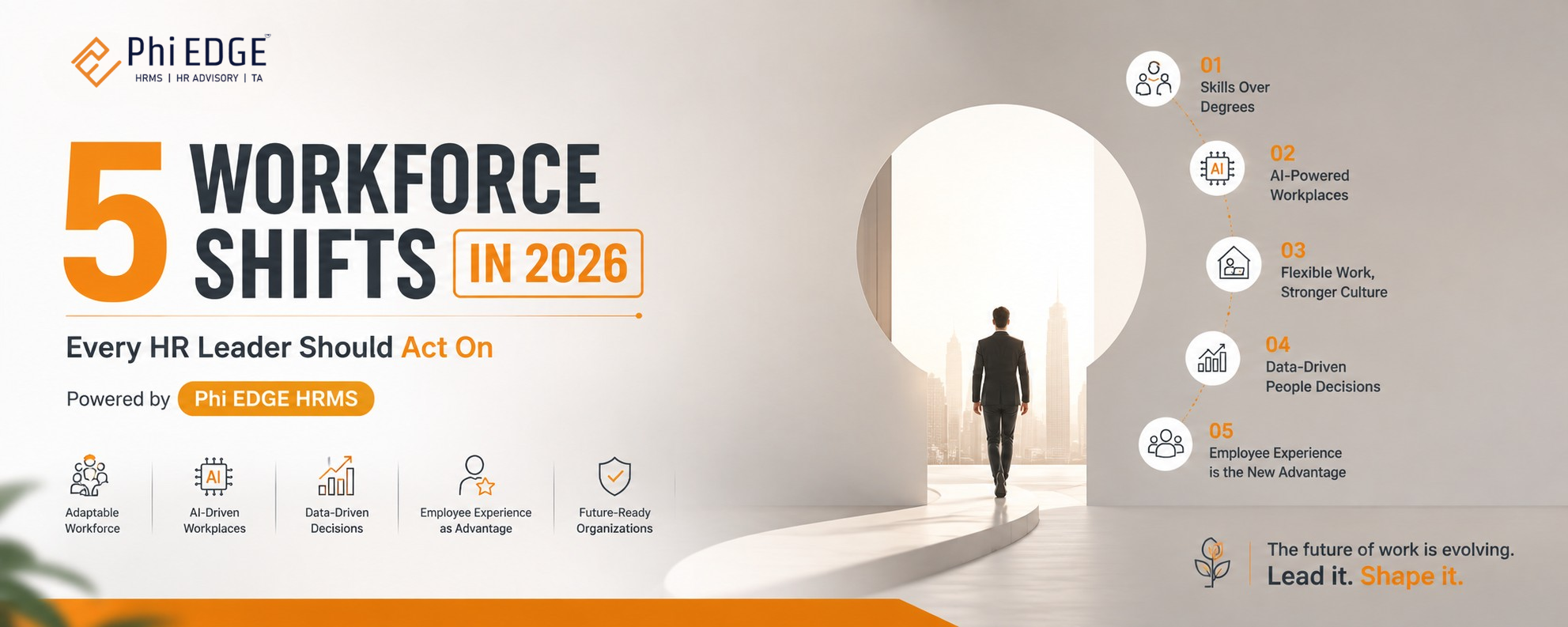
  • 5 Workforce Shifts in 2026 Every HR Leader Should Act On Powered by Phi EDGE HRMS

    5 Workforce Shifts in 2026 Every HR Leader Should Act On Powered by Phi EDGE HRMS

    The workplace of 2026 doesn’t look like the one HR leaders planned for even two years ago. Hybrid work has matured into something more complex, employees expect transparency and growth in equal measure, and AI has moved from “nice to have” to the backbone of everyday HR operations.

    For HR leaders, the question isn’t whether to adapt — it’s how fast and with what tools. 5 Workforce Shifts in 2026 Every HR Leader Should Act On Powered by Phi EDGE HRMS Below are five workforce shifts defining 2026 and how a modern, AI-powered HRMS like Phi EDGE helps you act on each one before it becomes a problem.

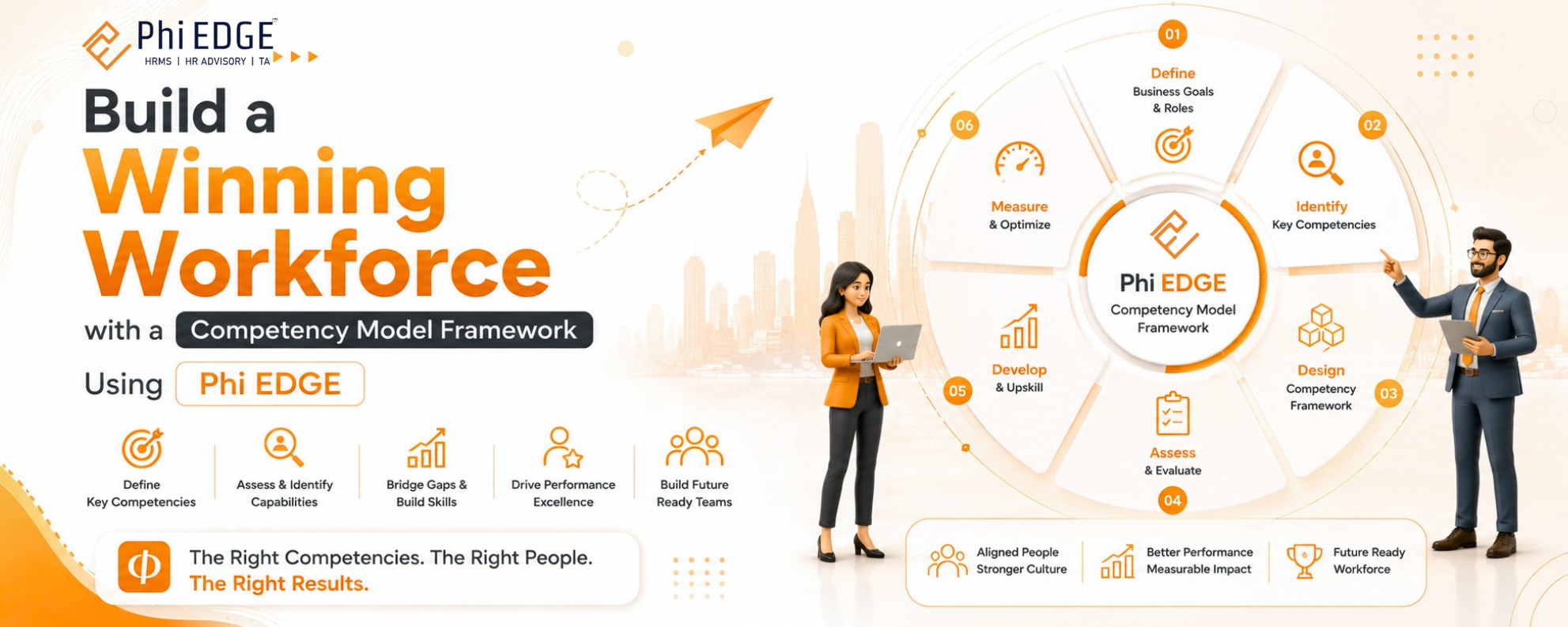
    1. Skills Are Replacing Job Titles — Build a Real Competency Model Framework

    Job descriptions are losing relevance. Companies are hiring, promoting, and rewarding based on demonstrated skills rather than static titles. This means HR teams need a structured competency model framework that maps the exact skills required for each role, tracks employee proficiency against that map, and flags gaps before they become performance issues.

    Without this framework, promotions feel arbitrary, training budgets get wasted on the wrong programs, and succession planning becomes guesswork. With Phi EDGE, HR leaders can build role-specific competency frameworks natively inside the platform, linking skills directly to appraisals, learning paths, and career progression — so every development conversation is backed by data, not opinion.

    Action item: Audit your current job architecture. If competencies aren’t formally mapped and tracked, 2026 is the year to fix that.

    1. Feedback Has to Be Continuous, Not Annual

    The once-a-year review is dead weight in 2026. Employees expect real-time, multi-source feedback that reflects how they actually work with peers, managers, and cross-functional teams. This is why 360-degree feedback software has become a core HR tech investment rather than an optional add-on.

    Good 360 feedback software does more than collect ratings — it aggregates feedback from managers, peers, direct reports, and even clients, then turns it into clear development insights. Phi EDGE’s built-in 360-feedback module lets HR teams launch feedback cycles in minutes, customize question sets by role or competency, and generate individual growth reports automatically — closing the loop between feedback and action.

    Action item: If your feedback process still runs once a year through spreadsheets or forms, it’s time to move to continuous, software-driven feedback loops.

    1. Leave and Attendance Management Needs to Be Smart, Not Manual

    Hybrid and distributed teams have made manual leave tracking unsustainable. HR leaders are under pressure to reduce administrative overhead while still maintaining accuracy, compliance, and visibility across locations. That’s where AI leave management software comes in — automating approvals, flagging patterns (like recurring Monday leaves or burnout risk), and syncing seamlessly with payroll.

    Phi EDGE combines leave and attendance tracking with AI-driven insights, so managers get real-time visibility into team availability, and HR gets predictive analytics on absenteeism trends — before they affect productivity or morale.

    Action item: Move away from manual leave approvals and spreadsheet-based attendance logs. AI-based automation isn’t a luxury anymore; it’s table stakes for a distributed workforce.

    1. AI Is Now Expected Across the Entire HR Stack

    By 2026, employees and HR teams alike expect AI to be embedded everywhere — from resume screening to performance insights to chatbot-driven employee support. Standalone tools that don’t talk to each other are becoming a liability. This is driving demand for unified AI HR software platforms that bring recruitment, performance, payroll, and engagement together under one intelligent system.

    As an HRMS company in India built for scale, Phi EDGE integrates AI across the entire employee lifecycle — smart candidate matching, predictive attrition alerts, automated payroll reconciliation, and conversational support for employee queries — all within a single dashboard, rather than a patchwork of disconnected tools.

    Action item: Evaluate whether your current HR stack is genuinely AI-enabled or just marketed that way. Look for platforms where AI improves decision-making, not just automates data entry.

    1. Payroll and Talent Management Can No Longer Sit in Silos

    In 2026, employees expect payroll accuracy and career growth conversations to feel connected, not like they belong to two different departments. HR leaders are increasingly evaluating HR & payroll management software, as well as talent management software, together, because disconnected systems create errors, delays, and a disjointed employee experience.

    Among the best HRMS tools available today, those that win the trust of HR leaders are those that unify payroll, compliance, performance, and talent development on a single platform. Phi EDGE was built on exactly this principle — payroll runs are linked to attendance and leave data automatically, while talent management modules use the same employee data to power appraisals, succession planning, and internal mobility.

    Action item: If your payroll and talent systems don’t share data in real time, you’re likely creating friction — and risk — that a unified HRMS can eliminate.

    The Conclusion

    2026 isn’t asking HR leaders to do more with less — it’s asking them to do it smarter. Competency-based growth, continuous feedback, AI-driven leave and attendance, unified AI HR software, and integrated payroll and talent management aren’t separate initiatives anymore. They’re pieces of the same connected HR strategy.

    Phi EDGE HRMS was built to bring all five of these shifts together in one platform — helping HR leaders move from reactive administra

  • The Future of HR in India: AI, Automation & Smart Decision-Making with Phi EDGE HRMS

    The Future of HR in India: AI, Automation & Smart Decision-Making with Phi EDGE HRMS

    India’s workplaces are changing faster than ever. Hybrid work, a young and mobile workforce, rising compliance complexity, and growing employee expectations have pushed HR teams to rethink how they operate. The Future of HR in India: AI, Automation & Smart Decision-Making with Phi EDGE HRMS. The days of spreadsheets, manual approvals, and disconnected HR processes are fading. In their place, a new generation of intelligent, automated, and data-driven HR platforms is taking shape — and Phi EDGE HRMS is leading that shift.

    This blog explores how AI and automation are reshaping HR in India, and how Phi EDGE HRMS is helping organizations move from routine administration to smart, strategic decision-making.

    Why HR in India Needs to Evolve

    India’s workforce is one of the youngest and most digitally native in the world. Employees today expect the same seamless, app-like experience from their HR systems that they get from consumer apps. At the same time, HR leaders are under pressure to:

    • Reduce time spent on repetitive administrative tasks
    • Ensure accurate, real-time compliance with labour laws across states
    • Improve employee retention in a competitive talent market
    • Make faster, data-backed workforce decisions
    • Scale HR operations without scaling headcount

    Traditional HRMS platforms simply weren’t built to handle this level of complexity and speed. This is exactly the gap that modern, AI-powered platforms like Phi EDGE HRMS are designed to close.

    The Role of AI and Automation in Modern HR

    Artificial intelligence isn’t replacing HR teams — it’s freeing them from repetitive work so they can focus on people, strategy, and culture. Here’s how AI and automation are transforming core HR functions in India today.

    1. Smarter Leave Management with AI

    Leave management has traditionally been one of the most manual and error-prone parts of HR — chasing approvals, tracking balances, and manually checking policy compliance. An AI leave management software changes this completely.

    With Phi EDGE HRMS, leave applications, approvals, and balance tracking are automated end-to-end. The system can intelligently flag unusual leave patterns, predict staffing gaps during peak leave periods, auto-apply state-specific leave policies, and route approvals instantly — reducing HR’s manual workload while giving employees a faster, frustration-free experience.

    1. AI HR Software for Smarter Decision-Making

    Modern HR leaders don’t just need data — they need insights they can act on. This is where AI HR software becomes a game-changer. Instead of pulling reports manually and analyzing them after the fact, Phi EDGE HRMS uses AI to surface patterns in attrition risk, performance trends, hiring bottlenecks, and workforce costs in real time.

    This allows HR teams to move from reactive firefighting to proactive, strategic decision-making — identifying flight-risk employees before they resign, spotting skill gaps before they impact projects, and optimizing workforce planning based on real data rather than guesswork.

    1. Boosting Engagement with AI Employee Engagement Software

    Employee engagement is no longer measured through an annual survey. Today’s workforce expects continuous listening and real-time action. An AI employee engagement software like the one built into Phi EDGE HRMS uses sentiment analysis, pulse surveys, and behavioural data to understand how employees are really feeling — not just once a year, but continuously.

    This enables HR teams to identify disengagement early, personalize recognition and rewards, tailor engagement initiatives to specific teams or departments, and correlate engagement trends with productivity and retention.

    How Phi EDGE HRMS Brings It All Together

    Phi EDGE HRMS isn’t a collection of separate tools bolted together — it’s a unified, AI-powered platform built specifically for the realities of Indian businesses. Key capabilities include:

    • End-to-end automation across on boarding, attendance, payroll, and exits
    • AI-driven leave management that reduces manual approvals and policy errors
    • Real-time analytics dashboards for smarter, faster HR decisions
    • Continuous engagement tracking powered by AI sentiment insights
    • Built-in compliance with Indian labour laws, updated automatically
    • Self-service employee experience via mobile and web

    By combining automation with intelligence, Phi EDGE HRMS helps HR teams shift their time and energy from paperwork to people.

    The Road Ahead

    The future of HR in India will be defined by organizations that use AI not to replace human judgment, but to enhance it. Platforms that combine an AI leave management software, an AI hr software, and an AI employee engagement software into one connected system will have a clear advantage — faster decisions, better employee experiences, and HR teams that can finally focus on strategy instead of admin.

    Phi EDGE HRMS is built for exactly this future — helping Indian businesses of every size run smarter, more human-centric HR operations powered by AI.

    Ready to see the difference AI-powered HR can make? Explore how Phi EDGE HRMS can transform your HR operations today.


  • Performance Management System

    Performance Management System

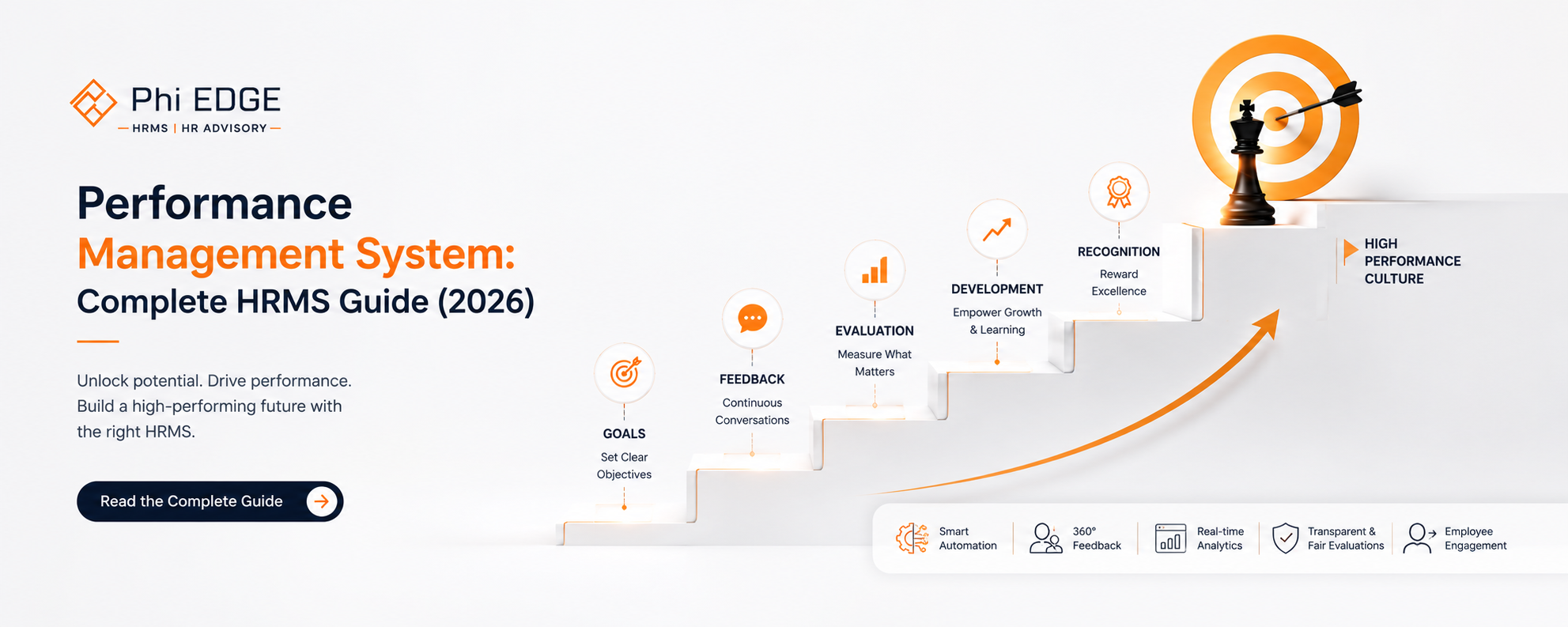
    Performance Management System: Complete Guide to Performance Management Process in HRMS (2026)

    Table of Contents

    1. What is a Performance Management System?
    2. Quick Answer (AI Overview)
    3. Why Every Business Needs a Performance Management System
    4. Key Components of the Performance Management Process
    5. How Performance Management Works in HRMS
    6. Benefits of a Performance Management System
    7. Features to Look For
    8. Industry Use Cases
    9. Before vs After Examples
    10. Case Study
    11. Latest Statistics
    12. Comparison of Leading Performance Management Software
    13. Common Mistakes
    14. Best Practices
    15. FAQs

    What is a performance management system?

    A Performance Management System (PMS) is a structured HR process that helps organizations set employee goals, track progress, provide continuous feedback, conduct performance appraisals, and align individual achievements with business objectives.

    Unlike traditional annual appraisals, modern performance management focuses on ongoing communication, measurable goals, employee development, and data-driven decision-making.

    A cloud-based Performance Management System in HRMS centralizes every stage of the employee performance lifecycle—from goal setting and KPI tracking to 360-degree feedback, manager reviews, competency assessments, and performance analytics.

    Whether you are a startup, SME, or enterprise, implementing a digital performance management solution helps improve productivity, employee engagement, accountability, and retention while reducing manual HR effort.

    What is a Performance Management System?

    A Performance Management System is HR software that enables organizations to plan, monitor, evaluate, and improve employee performance through continuous feedback, goal tracking, performance reviews, competency assessments, and analytics.

    In Simple Terms

    It helps HR managers and business leaders answer questions such as:

    • Are employees achieving their goals?
    • Which teams need coaching?
    • Who deserves promotion?
    • Which employees require additional training?
    • How can overall productivity be improved?

    Modern HRMS platforms automate these activities through dashboards, reminders, performance scorecards, and real-time reports.

    Why is Performance Management Important?

    An effective performance management process helps organizations:

    • Align employee goals with company objectives.
    • Increase productivity through measurable KPIs.
    • Improve employee engagement with regular feedback.
    • Simplify performance appraisal cycles.
    • Identify future leaders and high performers.
    • Support fair compensation and promotion decisions.
    • Build a culture of continuous improvement.

    Organizations that replace annual reviews with continuous performance management often experience stronger employee engagement, better manager-employee communication, and faster achievement of business goals.

    Why Every Business Needs a Performance Management System in 2026

    The workplace has evolved significantly. Hybrid work, distributed teams, AI-assisted workflows, and changing employee expectations require organizations to move beyond spreadsheets and manual appraisal forms.

    A modern Performance Management System in HRMS enables businesses to:

    • Set SMART goals and OKRs for every employee.
    • Track KPI progress in real time.
    • Automate appraisal workflows.
    • Capture continuous feedback from managers and peers.
    • Conduct 360-degree performance reviews.
    • Monitor competency and skill development.
    • Generate performance insights using dashboards and analytics.
    • Connect performance outcomes with learning and career growth.

    Instead of evaluating employees once a year, organizations can continuously monitor progress, identify challenges early, and provide timely coaching.

    This approach improves transparency, accountability, and employee satisfaction while helping HR teams make faster, data-driven decisions.

    Why Choose PhiEDGE Performance Management System?

    PhiEDGE HRMS offers an intelligent, scalable, and user-friendly performance management solution designed for modern businesses.

    With PhiEDGE, organizations can:

    • Automate the complete performance management process.
    • Create customizable appraisal cycles.
    • Define KPIs, KRAs, and OKRs.
    • Collect continuous feedback.
    • Enable 360-degree performance reviews.
    • Monitor employee goals through intuitive dashboards.
    • Generate AI-powered performance insights.
    • Reduce manual HR workload.
    • Improve employee engagement and retention.
    • Scale seamlessly as the organization grows.

    Whether you manage 50 employees or 5,000, PhiEDGE helps transform performance reviews into an ongoing process that supports business growth and employee success.


    Performance Management Process: How It Works in an HRMS

    A successful performance management process is more than conducting annual appraisals. It is a continuous cycle that helps organizations align employee goals with business objectives, provide regular feedback, measure performance, and support employee development.

    A modern Performance Management System in HRMS automates this entire process, making it transparent, data-driven, and efficient.

    What is the Performance Management Process?

    The performance management process is a structured framework used by organizations to plan, monitor, evaluate, and improve employee performance throughout the year.

    Instead of relying on yearly reviews, organizations use continuous performance management to encourage regular communication between managers and employees. This approach helps employees stay aligned with business priorities while giving managers real-time visibility into performance.

    The Six Stages of the Performance Management Process

    1. Goal Setting

    Every performance cycle begins with clearly defined goals.

    Organizations typically use:

    • SMART Goals
    • KPIs (Key Performance Indicators)
    • KRAs (Key Result Areas)
    • OKRs (Objectives and Key Results)

    For example:

    Sales Executive

    • Increase quarterly revenue by 20%
    • Generate 100 qualified leads every month

    HR Manager

    • Reduce hiring time by 25%
    • Improve employee retention by 15%

    Clear goals ensure employees understand expectations from day one.

    2. Continuous Performance Tracking

    Managers should monitor progress throughout the year instead of waiting for annual reviews.

    An HRMS enables organizations to:

    • Track completed tasks
    • Measure KPI achievement
    • View project milestones
    • Identify performance gaps
    • Monitor productivity trends

    Real-time dashboards help managers make proactive decisions rather than reactive ones.

    3. Continuous Feedback

    One of the biggest shifts in modern HR is moving from annual feedback to continuous feedback.

    Employees receive:

    • Weekly check-ins
    • Monthly reviews
    • Peer recognition
    • Manager feedback
    • Coaching sessions

    Continuous feedback helps employees improve immediately rather than discovering issues months later.

    4. Performance Appraisal

    The performance appraisal system evaluates employee achievements against predefined goals and competencies.

    Organizations may conduct:

    • Quarterly appraisals
    • Half-yearly reviews
    • Annual performance reviews
    • Project-based evaluations

    Appraisals usually include:

    • Goal achievement
    • Behavioral competencies
    • Technical skills
    • Leadership capabilities
    • Attendance
    • Productivity metrics
    • Overall performance rating

    An HRMS automates workflows, approvals, reminders, and appraisal documentation, reducing manual effort and ensuring consistency.

    5. Employee Development

    Performance management is not only about evaluation—it is also about growth.

    After identifying strengths and improvement areas, organizations create personalized development plans.

    These may include:

    • Training programs
    • Certifications
    • Leadership development
    • Mentorship
    • Upskilling initiatives
    • Career progression plans

    This stage helps employees build new skills while preparing future leaders within the organization.

    6. Rewards and Recognition

    Outstanding performance should be acknowledged.

    Organizations can link performance ratings to:

    • Salary increments
    • Bonuses
    • Promotions
    • Awards
    • Incentives
    • Employee recognition programs

    Recognizing achievements motivates employees and strengthens engagement.

    How a Performance Management System Works in HRMS

    A Performance Management System in HRMS digitizes and automates every stage of the performance lifecycle.

    Step 1: Define Organizational Goals

    HR leaders establish company-wide objectives and align departmental goals.

    Example:

    Business Goal
    Increase annual revenue by 30%.

    Marketing Goal:
    Generate 5,000 qualified leads.

    Sales Goal:
    Improve conversion rate by 15%.

    Customer Success Goal:
    Increase customer retention to 95%.

    Step 2: Assign Individual Goals

    Managers assign measurable goals to employees based on their roles.

    Each employee receives:

    • KPIs
    • KRAs
    • Deadlines
    • Weightage
    • Success metrics

    The HRMS tracks progress automatically throughout the review cycle.

    Step 3: Monitor Progress

    Employees update task completion while managers monitor dashboards showing:

    • Goal completion percentage
    • KPI achievement
    • Delayed tasks
    • Performance trends
    • Department-wise performance

    Automated reminders keep everyone on track.

    Step 4: Collect Feedback

    The system gathers feedback from:

    • Reporting managers
    • Team members
    • Cross-functional colleagues
    • Employees (self-assessment)

    This creates a balanced and transparent evaluation process.

    Step 5: Conduct Performance Reviews

    Managers review:

    • Goal completion
    • Behavioral competencies
    • Skill development
    • Productivity
    • Attendance
    • Project contributions

    The HRMS generates performance reports that simplify decision-making.

    Step 6: Generate Analytics

    HR leaders access dashboards showing:

    • High-performing employees
    • Employees needing support
    • Department performance
    • Promotion readiness
    • Skill gaps
    • Attrition risks

    These insights enable data-driven workforce planning.

    What is a Performance Appraisal System?

    A Performance Appraisal System is a structured method for assessing employee performance against predefined goals, competencies, and organizational expectations.

    While the terms are often used interchangeably, they are not identical.

    • Performance Management System: A continuous process focused on planning, monitoring, coaching, evaluating, and developing employees throughout the year.
    • Performance Appraisal System: A specific evaluation stage within the broader performance management process, typically conducted quarterly, half-yearly, or annually.

    A modern HRMS integrates appraisals into the overall performance cycle, ensuring reviews are based on real-time data rather than memory or manual records.

    Traditional Appraisals vs Modern Performance Management

    Traditional Performance Appraisal Modern Performance Management
    Annual review Continuous process
    Paper forms or spreadsheets Cloud-based HRMS
    Manager-only feedback 360-degree feedback
    Focus on past performance Focus on continuous improvement
    Limited visibility Real-time dashboards
    Manual calculations Automated scoring and analytics
    Generic development plans Personalized learning paths

    Organizations adopting modern performance management benefit from more frequent feedback, greater transparency, and better alignment between employee efforts and business goals.

    Example Workflow

    Imagine a software company implementing a Performance Management System:

    1. HR defines company objectives.
    2. Department heads create team goals.
    3. Managers assign KPIs to each employee.
    4. Employees update progress weekly.
    5. Managers provide monthly feedback.
    6. Peers contribute 360-degree feedback.
    7. The HRMS calculates performance scores.
    8. HR reviews analytics to identify high performers and skill gaps.
    9. Training and development plans are assigned.
    10. Promotions, rewards, and succession planning are based on performance data.

    This automated workflow reduces administrative effort, improves fairness, and helps organizations make informed talent decisions.


    Benefits of a Performance Management System

    A modern Performance Management System (PMS) is more than an appraisal tool. It is a strategic HR solution that helps organizations improve employee performance, align business goals, and build a culture of continuous learning. By integrating a Performance Management System in HRMS, businesses can automate reviews, track employee progress, and make data-driven decisions.

    Below are the key benefits organizations can expect in 2026.

    Top Benefits of a Performance Management System

    1. Aligns Employee Goals with Business Objectives

    One of the biggest advantages of a performance management system is goal alignment.

    Every employee understands:

    • Their responsibilities
    • Individual KPIs
    • Department goals
    • Company objectives

    When employees know how their work contributes to organizational success, productivity and accountability naturally improve.

    Example

    Company Goal:
    Increase annual revenue by 25%.

    Marketing Goal:
    Generate 20,000 qualified leads.

    Sales Goal:
    Increase conversion rate to 18%.

    Individual Goal:
    Close 30 qualified deals every month.

    This structured alignment ensures every employee works toward the same strategic vision.

    2. Improves Employee Productivity

    Employees perform better when expectations are clear.

    A performance management process provides:

    • Measurable goals
    • Regular feedback
    • Progress tracking
    • Performance dashboards

    Instead of waiting for annual reviews, employees receive continuous guidance, enabling them to improve throughout the year.

    3. Enables Continuous Feedback

    Traditional annual appraisals often come too late to address performance issues.

    Modern HRMS platforms support:

    • Weekly check-ins
    • Monthly one-on-one meetings
    • Instant recognition
    • Coaching conversations
    • Continuous feedback

    Employees gain timely insights, helping them improve performance before small issues become larger challenges.

    4. Supports Fair Performance Appraisals

    Manual evaluations can be subjective.

    A digital performance appraisal system uses measurable data such as:

    • KPI achievement
    • Goal completion
    • Attendance
    • Project delivery
    • Competency ratings
    • Manager feedback
    • Peer reviews

    This creates a more transparent and objective appraisal process.

    5. Identifies High Performers

    A Performance Management System helps HR identify employees who consistently exceed expectations.

    High-performing employees can be considered for:

    • Promotions
    • Leadership development
    • Succession planning
    • Incentive programs
    • Special projects

    Recognizing top talent also boosts employee motivation and retention.

    6. Detects Skill Gaps

    Performance reviews highlight areas where employees need additional support.

    Organizations can then create personalized development plans, including:

    • Technical training
    • Leadership workshops
    • Soft-skill development
    • Certifications
    • Mentoring programs

    Closing skill gaps strengthens workforce capabilities and prepares employees for future roles.

    7. Increases Employee Engagement

    Employees are more engaged when they receive:

    • Recognition
    • Constructive feedback
    • Career growth opportunities
    • Transparent evaluations

    A strong performance management process encourages regular communication between managers and employees, fostering trust and collaboration.

    8. Simplifies HR Operations

    Manual appraisal cycles involve spreadsheets, emails, reminders, and paperwork.

    An integrated HRMS automates:

    • Goal creation
    • Review scheduling
    • Feedback collection
    • Approval workflows
    • Performance scoring
    • Report generation

    Automation saves HR teams significant administrative time.

    9. Supports Better Business Decisions

    Performance analytics help leaders answer questions such as:

    • Which departments perform best?
    • Which employees are ready for promotion?
    • Where are the biggest skill gaps?
    • Which teams require additional support?

    These insights enable informed decisions rather than relying on assumptions.

    10. Improves Employee Retention

    Employees are more likely to stay with organizations that:

    • Provide regular feedback
    • Recognize achievements
    • Invest in learning
    • Offer career progression
    • Maintain fair evaluation processes

    A transparent Performance Management System contributes to a positive employee experience and reduces voluntary turnover.

    Key Features of a Modern Performance Management System

    Choosing the right Performance Management System in HRMS requires evaluating features that support both employees and HR teams.

    Goal & OKR Management

    Create and monitor:

    • SMART Goals
    • KPIs
    • KRAs
    • OKRs

    Goals can be assigned at organizational, departmental, team, and individual levels.

    Continuous Feedback

    Enable employees and managers to exchange feedback regularly through structured check-ins, comments, and coaching sessions.

    360-Degree Feedback

    Collect feedback from multiple sources, including:

    • Managers
    • Peers
    • Direct reports
    • Cross-functional teams
    • Self-assessments

    This provides a well-rounded view of employee performance.

    Performance Appraisals

    Automate quarterly, half-yearly, or annual review cycles with customizable appraisal templates, rating scales, and approval workflows.

    Competency Management

    Evaluate employees on competencies such as:

    • Communication
    • Leadership
    • Problem-solving
    • Teamwork
    • Technical expertise
    • Customer focus

    Competency tracking helps identify strengths and development areas.

    Dashboards & Analytics

    HR leaders can monitor:

    • Goal completion rates
    • Department performance
    • Employee ratings
    • High-potential talent
    • Training needs
    • Performance trends

    Interactive dashboards make workforce planning easier.

    Automated Notifications

    The system automatically reminds users about:

    • Pending reviews
    • Goal deadlines
    • Feedback requests
    • Appraisal schedules
    • Manager approvals

    Automation ensures no important activity is missed.

    Learning & Development Integration

    Connect performance outcomes with learning recommendations.

    For example:

    • Employees with communication gaps receive communication training.
    • High-potential employees are enrolled in leadership programs.
    • Technical skill gaps trigger relevant certification courses.

    This creates a continuous learning culture.

    Mobile Accessibility

    Modern employees expect access from anywhere.

    A cloud-based HRMS allows users to:

    • Update goals
    • Submit self-assessments
    • Complete reviews
    • View dashboards
    • Provide feedback

    from desktop, tablet, or mobile devices.

    Industry Use Cases in 2026

    IT & Software Companies

    Challenges:

    • Managing hybrid teams
    • Tracking project delivery
    • Measuring productivity

    Performance Management Solution:

    • Sprint goals
    • OKRs
    • Continuous feedback
    • Skill tracking

    Manufacturing

    Challenges:

    • Production targets
    • Quality compliance
    • Workforce efficiency

    Solution:

    • KPI dashboards
    • Productivity monitoring
    • Supervisor reviews

    Healthcare

    Challenges:

    • Compliance
    • Patient care quality
    • Clinical performance

    Solution:

    • Competency assessments
    • Certification tracking
    • Department scorecards

    Retail

    Challenges:

    • Sales performance
    • Customer satisfaction
    • Attendance

    Solution:

    • Sales KPIs
    • Store performance dashboards
    • Incentive management

    Banking & Financial Services (BFSI)

    Challenges:

    • Regulatory compliance
    • Sales targets
    • Customer service

    Solution:

    • KPI tracking
    • Risk-based performance metrics
    • Balanced scorecards

    Education

    Challenges:

    • Faculty performance
    • Student outcomes
    • Administrative efficiency

    Solution:

    • Academic KPIs
    • Faculty evaluations
    • Continuous improvement plans

    Startups

    Challenges:

    • Fast growth
    • Lean HR teams
    • Changing priorities

    Solution:

    • Agile goal setting
    • OKRs
    • Automated performance reviews
    • Real-time feedback

    Before vs After: Performance Management System

    Before Implementing a PMS After Implementing a PMS
    Annual paper-based reviews Continuous digital performance tracking
    Manual spreadsheets Automated HRMS workflows
    Delayed feedback Real-time feedback and coaching
    Subjective ratings Data-driven evaluations
    Limited visibility Live dashboards and analytics
    Inconsistent goals Aligned KPIs and OKRs
    Separate appraisal records Centralized employee performance history
    Reactive HR decisions Predictive workforce insights

    Case Study: Improving Performance with PhiEDGE HRMS

    Industry: Mid-sized IT Services Company

    Employees: 450

    Challenges

    • Annual appraisal process took nearly six weeks.
    • Managers used multiple spreadsheets for reviews.
    • Employees received feedback only once a year.
    • Promotions lacked standardized evaluation criteria.

    Solution

    The company implemented the PhiEDGE Performance Management System with:

    • KPI-based goal setting
    • Quarterly appraisal cycles
    • 360-degree feedback
    • Automated review workflows
    • Real-time performance dashboards
    • Employee self-assessments

    Results After 12 Months

    • Appraisal cycle completion time reduced by 65%.
    • Goal completion visibility improved across all departments.
    • Managers conducted regular monthly feedback sessions.
    • HR reduced administrative effort through workflow automation.
    • Employees reported greater transparency in the performance review process.
    • Leadership gained better insights into succession planning and employee development.

    This example illustrates how a digital performance management system in an HRMS can streamline HR operations while supporting employee growth and organizational performance.


    Latest Performance Management Statistics (2025–2026)

    Using recent HR and workplace research helps organizations understand why investing in a modern Performance Management System is a business necessity rather than just an HR initiative.

    Key Statistics

    Statistic Why It Matters
    Global employee engagement declined to 20% in 2025, the lowest level since 2020. Organizations need better coaching, feedback, and performance management.
    Only 23% of employees strongly agree they have a clear understanding of what exceptional performance looks like in their role. Clear goals and continuous feedback are critical for improving performance.
    Employee engagement decline is estimated to cost the global economy around $10 trillion in lost productivity annually. Poor performance management directly affects business growth.
    Among employees using AI at work, 65% report that AI has had a positive impact on their individual productivity. AI-powered HRMS platforms can improve productivity when combined with effective management practices.

    Sources: Gallup State of the Global Workplace 2026, Gallup Workplace Research.

    Why These Statistics Matter

    These findings highlight several important trends:

    • Annual performance reviews alone are no longer sufficient.
    • Employees perform better when expectations are clearly defined.
    • Continuous coaching has become more valuable than once-a-year evaluations.
    • Organizations need real-time visibility into employee goals, KPIs, and development.
    • AI enhances performance management when paired with effective leadership rather than replacing managers.

    Performance Management Software Comparison

    Feature PhiEDGE HRMS HROne Keka Darwinbox Zoho People
    Goal & KPI Management ✅ ✅ ✅ ✅ ✅
    OKR Management ✅ ✅ ✅ ✅ Limited
    Continuous Feedback ✅ ✅ ✅ ✅ ✅
    360° Feedback ✅ ✅ ✅ ✅ Limited
    Performance Appraisal ✅ ✅ ✅ ✅ ✅
    Competency Assessment ✅ ✅ ✅ ✅ Partial
    AI Performance Insights ✅ Limited Partial ✅ Limited
    Performance Analytics Dashboard ✅ ✅ ✅ ✅ ✅
    Learning & Development Integration ✅ ✅ ✅ ✅ Partial
    Custom Review Cycles ✅ ✅ ✅ ✅ ✅
    Mobile Accessibility ✅ ✅ ✅ ✅ ✅
    Suitable for SMEs & Enterprises ✅ ✅ ✅ ✅ ✅

    Why PhiEDGE stands out

    • End-to-end HRMS platform
    • Automated appraisal workflows
    • Goal, KPI, KRA, and OKR management
    • AI-powered insights and analytics
    • Easy-to-use dashboards
    • Scalable for growing businesses
    • Customizable workflows for different industries

    Common Mistakes Organizations Make

    Even with the right software, poor implementation can limit results.

    1. Conducting Only Annual Reviews

    Many organizations still evaluate employees once a year.

    Problem

    • Feedback arrives too late.
    • Employees cannot improve in real time.

    Best approach

    Use monthly check-ins and quarterly reviews.

    2. Setting Unclear Goals

    Goals like “Improve performance” are difficult to measure.

    Instead, define measurable objectives such as:

    • Increase sales by 15%
    • Reduce customer response time to under 2 hours
    • Achieve 95% project delivery on time

    3. Ignoring Continuous Feedback

    Performance discussions should not happen only during appraisal season.

    Managers should provide:

    • Coaching
    • Recognition
    • Constructive feedback
    • Career guidance

    throughout the year.

    4. Measuring Only Results

    High-performing employees also demonstrate collaboration, communication, innovation, and leadership.

    An effective performance appraisal system evaluates both outcomes and behaviors.

    5. Using Manual Spreadsheets

    Manual processes often lead to:

    • Missing reviews
    • Data inconsistencies
    • Delayed approvals
    • Reporting errors

    A cloud-based HRMS automates these tasks and provides a single source of truth.

    6. Treating Performance Reviews as a Formality

    Performance management should support employee growth—not simply assign ratings.

    Employees expect actionable feedback, development plans, and opportunities to improve.

    7. Failing to Train Managers

    Even the best software cannot replace skilled managers.

    Managers should be trained to:

    • Set SMART goals
    • Deliver constructive feedback
    • Conduct objective evaluations
    • Coach employees effectively

    Best Practices for Performance Management in 2026

    Organizations achieving strong performance outcomes typically follow these practices.

    Set SMART Goals

    Every objective should be:

    • Specific
    • Measurable
    • Achievable
    • Relevant
    • Time-bound

    Align Individual Goals with Business Strategy

    Employees should clearly understand how their work contributes to company objectives.

    Alignment improves accountability and collaboration.

    Schedule Regular Check-ins

    Recommended review cadence:

    • Weekly team check-ins
    • Monthly manager one-on-ones
    • Quarterly performance reviews
    • Annual development planning

    Regular conversations prevent surprises during formal appraisals.

    Use Data Instead of Assumptions

    Leverage HRMS dashboards to evaluate:

    • KPI achievement
    • Goal completion
    • Attendance
    • Productivity
    • Competency development

    Objective data supports fair and transparent decisions.

    Encourage Two-Way Feedback

    Performance management should be collaborative.

    Employees should have opportunities to:

    • Share challenges
    • Request support
    • Provide upward feedback
    • Discuss career aspirations

    Recognize Achievements Frequently

    Recognition motivates employees and reinforces desired behaviors.

    Celebrate:

    • Goal completion
    • Innovation
    • Teamwork
    • Customer success
    • Leadership

    Recognition does not always need to be monetary; timely appreciation also has a positive impact.

    Link Performance with Learning

    Performance reviews should lead to action.

    Examples include:

    • Technical certifications
    • Leadership development
    • Mentorship programs
    • Cross-functional projects
    • Personalized learning paths

    This transforms the performance management process into a continuous cycle of growth.

    Key Takeaways

    An effective performance management system is not just an appraisal tool—it is a strategic platform that helps organizations improve productivity, strengthen employee engagement, and make informed talent decisions.

    Businesses that combine continuous feedback, measurable goals, manager coaching, and data-driven insights are better positioned to build high-performing teams and adapt to the evolving workplace.


    Frequently Asked Questions (FAQs)

    1. What is a Performance Management System?

    A Performance Management System (PMS) is an HR solution that helps organizations set employee goals, monitor progress, provide continuous feedback, conduct performance appraisals, and improve productivity. It aligns employee performance with business objectives through a structured and measurable process.

    2. What is the Performance Management Process?

    The performance management process is a continuous cycle of goal setting, performance tracking, regular feedback, employee development, performance appraisal, and recognition. It ensures employees remain aligned with organizational goals while supporting continuous improvement.

    3. What is the difference between Performance Management and Performance Appraisal?

    A Performance Management System is a continuous process that focuses on planning, monitoring, coaching, and improving employee performance throughout the year. A Performance Appraisal System is one stage of that process where employee performance is formally evaluated against predefined goals and competencies.

    4. Why is a Performance Management System important?

    A modern Performance Management System helps organizations improve employee productivity, increase engagement, identify skill gaps, support fair appraisals, strengthen leadership development, and make data-driven HR decisions.

    5. What are the key components of a Performance Management System?

    Most systems include:

    • Goal and KPI management
    • OKR tracking
    • Continuous feedback
    • Performance reviews
    • 360-degree feedback
    • Competency assessments
    • Performance analytics
    • Employee development planning
    • Rewards and recognition

    6. How does a Performance Management System work in an HRMS?

    An HRMS-based Performance Management System automates goal setting, KPI tracking, appraisal workflows, feedback collection, performance scoring, analytics, and reporting. Managers and employees can monitor progress in real time through centralized dashboards.

    7. What are the benefits of using a Performance Management System?

    Key benefits include:

    • Higher employee productivity
    • Better goal alignment
    • Transparent performance evaluations
    • Continuous feedback
    • Improved employee engagement
    • Faster appraisal cycles
    • Better talent development
    • Data-driven workforce planning

    8. What is the role of KPIs in Performance Management?

    Key Performance Indicators (KPIs) are measurable metrics used to evaluate employee performance. They help managers monitor progress, assess goal achievement, and make objective performance decisions.

    9. What is the difference between KPIs, KRAs, and OKRs?

    • KPIs (Key Performance Indicators): Measure performance using specific metrics.
    • KRAs (Key Result Areas): Define the core responsibilities of a role.
    • OKRs (Objectives and Key Results): Combine ambitious objectives with measurable outcomes to track progress.

    Together, these frameworks create a balanced and measurable performance management process.

    10. What is 360-degree feedback?

    360-degree feedback is a review method where employees receive performance feedback from multiple sources, including managers, peers, direct reports, cross-functional colleagues, and self-assessments. This provides a more comprehensive evaluation than manager-only reviews.

    11. How often should performance reviews be conducted?

    Many organizations now use continuous performance management with monthly check-ins, quarterly reviews, and annual development discussions. Regular feedback helps employees improve faster than relying solely on annual appraisals.

    12. Can small businesses benefit from a Performance Management System?

    Yes. Small and medium-sized businesses can improve employee productivity, streamline appraisals, reduce manual HR work, and prepare for growth by implementing a scalable Performance Management System within their HRMS.

    13. Which industries use Performance Management Systems?

    Performance Management Systems are widely used across:

    • Information Technology (IT)
    • Manufacturing
    • Healthcare
    • Retail
    • Banking and Financial Services (BFSI)
    • Education
    • Logistics
    • Hospitality
    • Professional Services
    • Startups

    Any organization that manages employee performance can benefit from a structured system.

    14. How does AI improve Performance Management?

    AI-powered Performance Management Systems can:

    • Recommend performance insights
    • Detect skill gaps
    • Identify high-potential employees
    • Predict training needs
    • Automate reporting
    • Support workforce planning through analytics

    AI enhances decision-making while allowing managers to focus on coaching and employee development.

    15. What should you look for in a Performance Management System?

    When selecting a solution, consider features such as:

    • Goal management
    • KPI and OKR tracking
    • Continuous feedback
    • 360-degree reviews
    • Performance analytics
    • Mobile accessibility
    • Workflow automation
    • HRMS integration
    • Customizable appraisal cycles
    • Reporting dashboards

    16. How does a Performance Management System improve employee engagement?

    Employees become more engaged when they receive clear goals, regular feedback, recognition, and career development opportunities. Continuous communication builds trust and helps employees understand how their work contributes to organizational success.

    17. What challenges can a Performance Management System solve?

    A digital system helps address common HR challenges, including:

    • Manual appraisal processes
    • Inconsistent evaluations
    • Lack of goal visibility
    • Delayed feedback
    • Limited performance insights
    • Poor documentation
    • Difficulty identifying high performers
    • Weak succession planning

    18. How is a cloud-based Performance Management System better than spreadsheets?

    Unlike spreadsheets, a cloud-based HRMS offers real-time dashboards, automated reminders, secure data storage, approval workflows, analytics, and centralized employee records. This reduces administrative effort and improves accuracy.

    19. How does Performance Management support business growth?

    By aligning employee objectives with business strategy, organizations can improve productivity, develop future leaders, strengthen collaboration, reduce turnover, and make informed talent decisions that contribute to long-term growth.

    20. Why choose PhiEDGE Performance Management System?

    PhiEDGE provides an integrated Performance Management System in HRMS that helps organizations automate appraisals, manage KPIs and OKRs, collect continuous feedback, enable 360-degree reviews, generate performance analytics, and support employee development through an intuitive, scalable platform suitable for growing businesses.
  • Best HRMS Software in India 2026: The Complete HR & Payroll Buying Guide

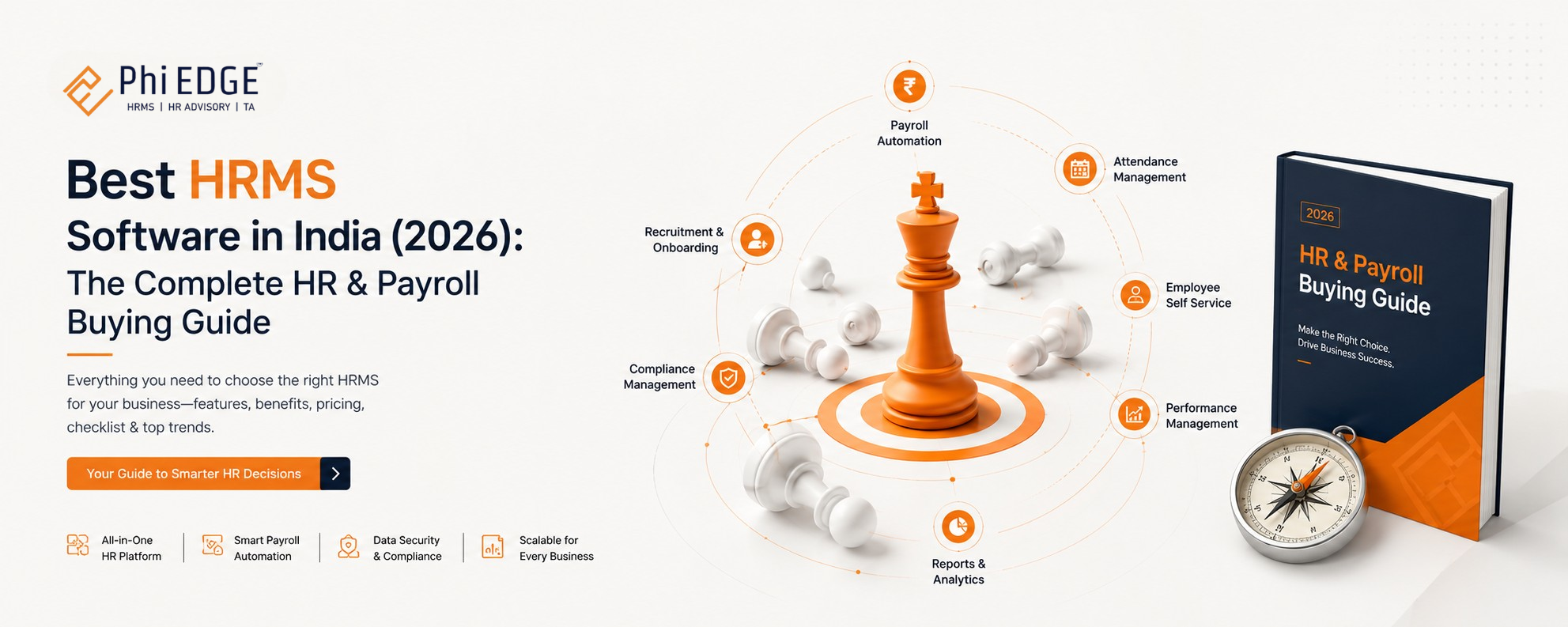
    Best HRMS Software in India 2026: The Complete HR & Payroll Buying Guide

    If you are comparing HRMS software in India right now, you are probably doing it for one of three reasons: payroll errors are creating trust problems, attendance and leave are still tracked on spreadsheets, or your company just crossed a headcount where “we’ll manage it manually” stopped being true. This guide walks through what the best HRMS platforms in India actually do differently in 2026, what a fair comparison looks like, and how to avoid the mistakes that turn an HRMS rollout into six months of frustration.

    Table of Contents

    1. Quick Answer
    2. How HRMS Software Works
    3. Why HRMS Matters More in 2026
    4. Benefits of a Modern HRMS
    5. Core Features to Look For
    6. Before vs After: What Changes
    7. Case Study: A Pune Manufacturing Rollout
    8. HRMS Market Statistics (India, 2026)
    9. Comparison: Phi EDGE vs Other HRMS Platforms
    10. Common Mistakes When Choosing HRMS
    11. Best Practices for HRMS Selection & Rollout
    12. FAQs

    Quick Answer

    The best HRMS software in India for 2026 combines core HR, payroll, and attendance in one system, automates PF/ESI/TDS compliance, and gives HR leaders real-time dashboards instead of month-end spreadsheet reconciliation. Best HRMS Software in India 2026: The Complete HR & Payroll Buying. For manufacturing and mid-market companies, an HRMS system that pairs software with HR advisory support (not just a login) tends to outperform pure self-serve tools, because policy design and configuration matter as much as the platform itself. Phi EDGE, built in Pune, positions itself in this “consulting + technology” category alongside larger national HRMS players.

    How HRMS Software Works

    An HRMS (Human Resource Management System) works by pulling every stage of the employee lifecycle into one connected database instead of scattered files:

    1. Employee data capture — Onboarding forms, documents, and records feed a single master profile.
    2. Attendance and leave — Biometric, geo-tagged, or mobile punches sync automatically into payroll inputs.
    3. Payroll processing — Salary structures, statutory deductions (PF, ESI, TDS, professional tax), and payslips are generated from that same synced data.
    4. Performance and growth — Goals, KPIs, 360° feedback, and increments link back to the same employee record.
    5. Analytics — Dashboards surface attrition risk, headcount cost, and compliance status without manual pivot tables.

    The core idea is to have one source of truth that feeds every HR process, so nobody re-enters the same employee data five times across five different tools.

    Why HRMS Matters More in 2026

    Why has payroll compliance got harder? India’s labour codes continue to tighten timelines — full and final settlements, statutory filings, and multi-state PF/ESI obligations all carry real penalty risk, and manual tracking across locations is where errors often creep in.

    Why is manufacturing HR different this year? Field and shop-floor workforces need geo-fenced attendance, role-based punch rules, and daily-wage payroll accuracy that generic HR tools weren’t built for—this is the segment where Phi EDGE’s manufacturing client base (rubber, auto components, polymers) feels the gap most.

    Why are HR teams asking for analytics, not just records? Boards now expect attrition, cost-per-hire, and engagement data on demand, not once a quarter — so an HRMS that only stores records and doesn’t report on them is already behind.

    Why does SME adoption keep rising? Cloud-based, modular HRMS pricing has made enterprise-grade HR tooling affordable for smaller teams, which is a major reason smaller companies (under 1,000 employees) now make up the largest share of India’s HR tech market.


    Benefits of a Modern HRMS

    • Time back for HR — Automating attendance-to-payroll flow removes the week-long manual reconciliation many teams still do every month.
    • Fewer payroll errors — Automated PF/ESI/TDS calculations reduce the manual mistakes that damage employee trust.
    • Faster decisions — Real-time dashboards replace static, backwards-looking spreadsheets.
    • Compliance confidence — Statutory filings and exit timelines are tracked systematically, not remembered.
    • Better retention signal — Attrition, tenure band, and engagement data surface risk before resignations, not after.
    • Consistency across locations — One policy engine instead of different spreadsheets per plant or branch.

    Core Features to Look For

    Feature area What it should do
    Core HR/employee database Single record per employee, org structure, documents
    Payroll software Auto PF, ESI, TDS, professional tax, multi-state compliance
    Attendance & leave Biometric, mobile, geo-fenced punch; auto leave accrual
    Performance management Goal-setting, KRA/KPI tracking, 360° feedback
    Employee self-service Payslips, leave requests, document access without HR tickets
    Analytics & reporting Attrition, headcount cost, manager-level breakdowns
    Configurability Different rules for field staff vs office staff (equity, not uniform policy)
    Integrations Biometric devices, accounting/ERP, background verification


    Before vs After Examples

    Process Before HRMS (manual/Excel) After a proper HRMS
    Monthly attendance-to-payroll 2–3 people spend days chasing punches across sheets Auto-synced; payroll run in hours
    Attrition tracking Reviewed only after resignation letters arrive Manager/tenure-level risk visible on a dashboard
    Payslip accuracy Manual formulas, frequent correction requests System-calculated PF/ESI/TDS, fewer disputes
    Policy consistency Different rules by plant/branch, tracked informally One configurable policy engine, applied consistently
    Exit processing Full-and-final dues delayed past statutory windows Time-boxed workflow inside the compliance deadline


    Case Study: A Pune Manufacturing Rollout

    Illustrative example based on the type of mid-market manufacturing implementation Phi EDGE commonly runs — presented as a composite scenario, not a single named client’s confidential figures.

    A ~350-employee auto-component manufacturer near Pune ran attendance on biometric machines that didn’t talk to payroll, and performance reviews happened once a year on paper forms. HR spent roughly a week each month reconciling attendance before payroll could even start, and two plants had quietly drifted onto different leave policies.

    After moving core HR, attendance, payroll, and performance into a single HRMS with role-based configuration (dual punch for shop floor, single punch for office staff), the same team cut its monthly payroll-prep time from days to under one working day, standardised leave policy across both plants, and got a live view of appraisal-cycle completion instead of chasing paper forms in March. The bigger shift was cultural: HR moved from “chasing data” to reviewing a dashboard and acting on it.


    Statistics (with Sources)

    • India’s HRMS market was valued at roughly USD 0.87 billion in 2025 and is projected to reach USD 2.27 billion by 2031, growing at a 17.34% CAGR — one of the fastest-growing HR tech markets globally.
    • The broader India HR technology market was valued at USD 1,208.26 million in 2025, projected to reach USD 2,329.11 million by 2034 (7.56% CAGR); recruitment tools hold the largest application share at 25%.
    • Companies under 1,000 employees represent 41% of India’s HR tech market in 2025 — the largest single segment — driven by affordable, modular cloud HRMS pricing.
    • India’s HR analytics market alone is projected to grow from USD 161.5 million (2025) to USD 553.9 million by 2033, a 16.8% CAGR, reflecting rising demand for attrition and workforce analytics.
    • North India holds the largest regional share (30%) of the HR tech market, while South India (notably Bengaluru) remains a major hub for HRMS product development; West India — where Pune sits — is one of the four core regional markets tracked by industry researchers.

    Comparison Table (Competitor Landscape)

    Platform Positioning Strongest for Consulting layer
    Phi EDGE HRMS + HR Advisory + Talent Acquisition, Pune-based Manufacturing & mid-market companies wanting software and HR strategy support Yes — advisory, culture, and PMS design bundled in
    HROne Large-scale cloud HCM suite Enterprises wanting AI agents, a broad module marketplace Limited — primarily self-serve software
    Keka Modern UI-first HRMS Startups and tech companies are prioritising employee experience Limited
    Zoho People Part of the Zoho suite Companies already using other Zoho products Limited
    greytHR SMB payroll-first HRMS Small businesses needing a straightforward statutory payroll Limited

    Note: feature sets and pricing change frequently — verify current specifics directly with each vendor before a purchase decision. This table reflects general market positioning, not a live feature audit.


    Common Mistakes When Choosing HRMS

    1. Buying software to fix a culture problem. An HRMS makes existing policy consistent — it doesn’t invent policy, values, or manager accountability.
    2. Ignoring role-based configuration. Applying one attendance or leave rule to both office and field staff creates fraud gaps and frustration.
    3. Skipping the implementation timeline conversation. Real HR process redesign takes months, not the “go live in 2 weeks” pitch.
    4. Choosing on price alone. The cheapest per-employee rate often means the thinnest compliance and support layer – expensive later during an audit.
    5. Not checking multi-state compliance depth. If you operate in more than one state, PF/ESI/professional tax rules differ — confirm the platform actually handles this, not just claims to.
    6. No named internal owner. Even the best HRMS underperforms if no one is accountable for acting on the dashboards it produces.

    Best Practices

    • Map your current process before evaluating vendors — you can’t compare tools against a workflow you haven’t written down.
    • Involve payroll, IT, and floor/plant managers early, not just HR — attendance and payroll touch all three.
    • Pilot on one location or department before a company-wide rollout.
    • Ask vendors for reference clients in your industry and size band, not generic case studies.
    • Budget time for change management — training and adoption typically need as much attention as the software configuration.
    • Revisit configuration annually — labour codes, statutory rates, and your own org structure change; policies encoded in software should keep pace.

    Frequently Asked Questions

    1. What is the best HRMS software in India for manufacturing companies? The best fit is usually a platform that combines core HR, payroll, and attendance with configurable, role-based rules for shop-floor vs office staff, plus a consulting layer for policy design – which is where Phi EDGE positions itself for manufacturing clients.
    2. What does HRMS stand for? HRMS stands for Human Resource Management System — software that manages the employee lifecycle from hiring through exit, including payroll, attendance, and performance.
    3. What is the difference between HRMS and HRIS? HRIS typically focuses on storing and managing core employee data (records, payroll, and compliance). HRMS includes all of that plus broader functionality like performance management, learning, and engagement tools.
    4. How much does HRMS software cost in India? Pricing is usually per-employee-per-month and varies by module count, company size, and whether implementation/consulting support is bundled in — get a quote based on your actual headcount and required modules rather than a published “starting price.”
    5. Is HRMS software worth it for a small business? Yes, for most businesses past roughly 30–50 employees, since manual payroll and attendance tracking starts breaking down around that size — modular, cloud-based pricing has made HRMS accessible for smaller teams too.
    6. What features should every HRMS have in 2026? Core HR, statutory payroll (PF/ESI/TDS), attendance/leave, performance management, employee self-service, and analytics dashboards are the baseline; AI-assisted features are increasingly common but not yet universal.
    7. Can HRMS software reduce employee attrition? HRMS software surfaces the data (tenure, manager, engagement scores) that helps predict and act on attrition risk earlier — but it doesn’t fix attrition on its own; the underlying management and culture work still has to happen.
    8. How long does HRMS implementation typically take? Basic core HR and payroll setup can go live in weeks, but full process redesign, data migration, and change management across a mid-size company typically takes a few months.
    9. What is the best HRMS software in Pune? Pune has several manufacturing and IT-services companies with multi-plant or field operations, so an HRMS with strong attendance geo-fencing and role-based payroll — combined with local HR advisory support — tends to fit best; Phi EDGE is headquartered in Pune and built around this segment.
    10. Does HRMS handle statutory compliance automatically? A good HRMS automates PF, ESI, TDS, and professional tax calculations and keeps filings on schedule, but compliance ownership still sits with the company — the software reduces manual error, it doesn’t replace legal accountability.
    11. What is the difference between HRMS and payroll software? Payroll software focuses narrowly on salary processing and statutory deductions. HRMS is broader, including payroll as one module alongside attendance, performance, and employee records.
    12. How do I choose between HRMS vendors? Compare them against your mapped current process; ask for same-industry references, check multi-state compliance depth, and evaluate the implementation/support model — not just the feature list or price sheet.
    13. Can HRMS integrate with biometric attendance devices? Most modern HRMS platforms support biometric, RFID, and mobile geo-tagged attendance integration; confirm compatibility with your existing hardware before switching platforms.
    14. Is cloud-based HRMS safe for employee data in India? Reputable HRMS vendors carry data-security certifications (such as ISO/IEC 27001) and role-based access controls; verify a vendor’s specific certifications and hosting practices before onboarding sensitive payroll data.
    15. What HRMS features matter most for field or blue-collar teams? Geo-fenced and offline-capable attendance, role-based punch rules, and accurate daily-wage payroll matter most, since generic office-first HR tools often miss these needs.
    16. Does Phi EDGE offer HR consulting alongside HRMS software? Yes—Phi EDGE operates across three verticals: HRMS software, HR advisory, and talent acquisition, positioning it as a combined consulting-plus-technology provider rather than software-only.
    17. What industries does Phi EDGE’s HRMS typically serve? Phi EDGE’s client base includes manufacturing, automotive components, polymers/rubber, and mid-market industrial companies, largely across Maharashtra and pan-India.
    18. How is HRMS evolving in 2026 compared to earlier years? 2026-era HRMS platforms lean more heavily on AI-assisted analytics, predictive attrition flags, and mobile-first employee self-service, compared to the record-keeping-first systems common a few years ago.
    19. What is the typical ROI timeline for HRMS software? Most companies see time-savings (reduced manual payroll/attendance work) within the first quarter, with harder ROI metrics like reduced attrition or compliance-error costs becoming visible over two to four quarters.
    20. Should a company build its own HR tracking system instead of buying HRMS software? Generally, no for most mid-market companies, since the ongoing maintenance, compliance updates, and security burden of a custom-built system usually outweighs the cost of an established HRMS vendor, unless HR needs are extremely non-standard.


     Author & Reviewed By

    Written by: Phi EDGE HR Advisory Desk — HRMS implementation and HR consulting team, Phi EDGE (Pune)

    Reviewed by: Rahul, Lead HR Consultant, Phi EDGE — 15+ years advising manufacturing and mid-market Indian companies on HRIS rollouts and compliance

    Published: July 2026 | Last updated: July 2026

  • How AI is Transforming HRMS Software in India

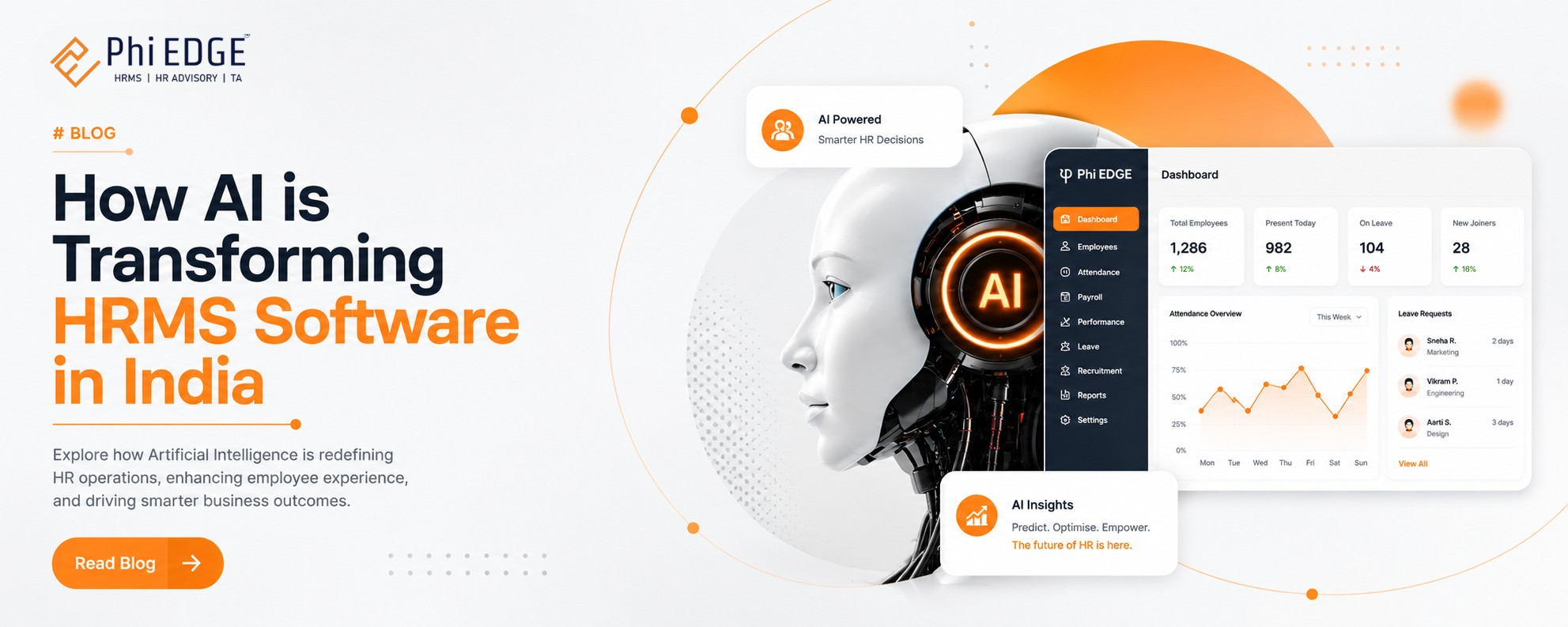
    How AI is Transforming HRMS Software in India

    The Future of Human Resource Management is Here

    The workplace is evolving faster than ever, and Human Resource Management Systems (HRMS) are at the center of this transformation. As organizations across India embrace digitalization, Artificial Intelligence (AI) is redefining how businesses manage their workforce, automate processes, and make strategic people decisions.

    At Phi EDGE, we believe that AI-powered HRMS is not just a technological advancement—it is a strategic tool that enables organizations to build smarter, more agile, and employee-centric workplaces.

    Understanding AI-Powered HRMS

    Traditional HRMS solutions primarily focus on automating administrative tasks such as attendance tracking, payroll processing, leave management, and employee record maintenance. HRMS Software in India. While these functions remain essential, modern AI-powered HRMS platforms go several steps further.

    By leveraging machine learning, predictive analytics, and intelligent automation, AI-driven HRMS systems can:

    • Analyze workforce trends
    • Predict employee attrition
    • Automate repetitive HR tasks
    • Improve recruitment efficiency
    • Personalize employee experiences
    • Support data-driven decision-making

    The result is a more efficient HR function that contributes directly to organizational growth.

    Why AI Adoption in HR is Growing in India

    Indian businesses are increasingly recognizing the need for smarter workforce management solutions. With hybrid work models, changing employee expectations, and growing compliance requirements, HR teams require tools that can deliver speed, accuracy, and actionable insights.

    AI helps organizations address these challenges by reducing manual effort and enabling HR professionals to focus on strategic initiatives such as talent development, employee engagement, and workforce planning.

    Key Ways AI is Transforming HRMS Software

    1. Smarter Recruitment and Talent Acquisition

    Hiring the right talent remains one of the biggest challenges for organizations. AI-powered HRMS systems can significantly streamline the recruitment process.

    AI can:

    • Screen thousands of resumes within minutes
    • Match candidate profiles with job requirements
    • Rank applicants based on suitability
    • Reduce hiring bias through data-driven evaluation
    • Improve candidate experience through automated communication

    This allows recruiters to focus their time on engaging with high-potential candidates rather than managing administrative tasks.

    1. Predictive Employee Attrition Analysis

    Employee turnover can be costly for organizations. Modern AI-powered HRMS platforms use predictive analytics to identify patterns that indicate potential attrition risks.

    By analyzing factors such as:

    • Employee engagement levels
    • Performance trends
    • Attendance records
    • Internal mobility
    • Compensation data

    AI can help HR leaders proactively address concerns before valuable employees decide to leave.

    1. Intelligent Performance Management

    Traditional annual performance reviews are gradually being replaced by continuous performance management systems.

    AI-enabled HRMS solutions can:

    • Track employee performance in real time
    • Identify skill gaps
    • Recommend development programs
    • Provide objective performance insights
    • Support fair and transparent appraisals

    This creates a culture of continuous improvement and accountability.

    1. Enhanced Employee Experience

    Today’s employees expect personalized workplace experiences similar to the digital experiences they receive as consumers.

    AI-powered HRMS platforms enhance employee engagement through:

    • Personalized learning recommendations
    • AI-driven employee self-service portals
    • Instant query resolution through chatbots
    • Automated onboarding journeys
    • Customized career development pathways

    These capabilities improve employee satisfaction while reducing HR workload.

    1. Automated Payroll and Compliance Management

    Payroll accuracy and regulatory compliance are critical for every organization.

    AI-enabled HRMS systems help by:

    • Automating payroll calculations
    • Identifying anomalies and errors
    • Managing statutory compliance requirements
    • Generating compliance reports
    • Reducing administrative overhead

    This minimizes human errors and ensures organizations remain compliant with changing regulations.

    1. Data-Driven Workforce Planning

    One of the most valuable contributions of AI is its ability to convert workforce data into actionable insights.

    HR leaders can use AI-powered analytics to:

    • Forecast future hiring needs
    • Identify workforce productivity trends
    • Measure employee engagement
    • Monitor organizational performance
    • Make informed strategic decisions

    This transforms HR from an operational function into a strategic business partner.

    Benefits of AI-Powered HRMS for Indian Businesses

    Improved Efficiency

    Automation significantly reduces manual processes, allowing HR teams to focus on high-value initiatives.

    Better Decision-Making

    AI-generated insights support evidence-based workforce planning and management.

    Enhanced Employee Engagement

    Personalized employee experiences contribute to higher satisfaction and retention rates.

    Reduced Operational Costs

    Automated workflows help reduce administrative expenses and improve productivity.

    Increased Scalability

    As businesses grow, AI-powered HRMS platforms can easily accommodate expanding workforce requirements.

    Challenges Organizations Should Consider

    While AI offers significant advantages, successful implementation requires careful planning.

    Organizations should focus on:

    • Data quality and accuracy
    • Employee privacy and security
    • Ethical AI usage
    • Change management and adoption
    • Continuous system optimization

    The right technology partner can help businesses navigate these challenges effectively.

    The Future of AI in HRMS

    The next generation of HRMS solutions will become increasingly intelligent and predictive. Emerging capabilities such as conversational AI, advanced workforce analytics, skills intelligence, and predictive talent management will further transform how organizations manage people.

    As AI continues to evolve, HR professionals will spend less time on administrative work and more time driving employee growth, organizational culture, and business success.

    How Phi EDGE is Leading the Transformation

    At Phi EDGE, we understand that every organization has unique workforce challenges. Our AI-powered HRMS solutions are designed to simplify HR operations, improve employee experiences, and provide actionable insights that support business growth.

    From recruitment and performance management to payroll and workforce analytics, Phi EDGE helps organizations build future-ready HR ecosystems that drive efficiency, engagement, and measurable results.

    Conclusion

    Artificial intelligence is no longer a future concept—it is actively transforming HRMS software across India. Businesses that embrace AI-powered HR solutions today will be better positioned to attract talent, improve employee experiences, enhance productivity, and achieve sustainable growth.

    As organizations continue their digital transformation journey, AI-driven HRMS will become an essential component of modern workforce management.

    Ready to transform your HR operations with AI-powered HRMS?

    Connect with Phi EDGE and discover how intelligent HR technology can help your organisation unlock its full workforce potential.


  • HR Lifecycle Management Services

    HR Lifecycle Management Services

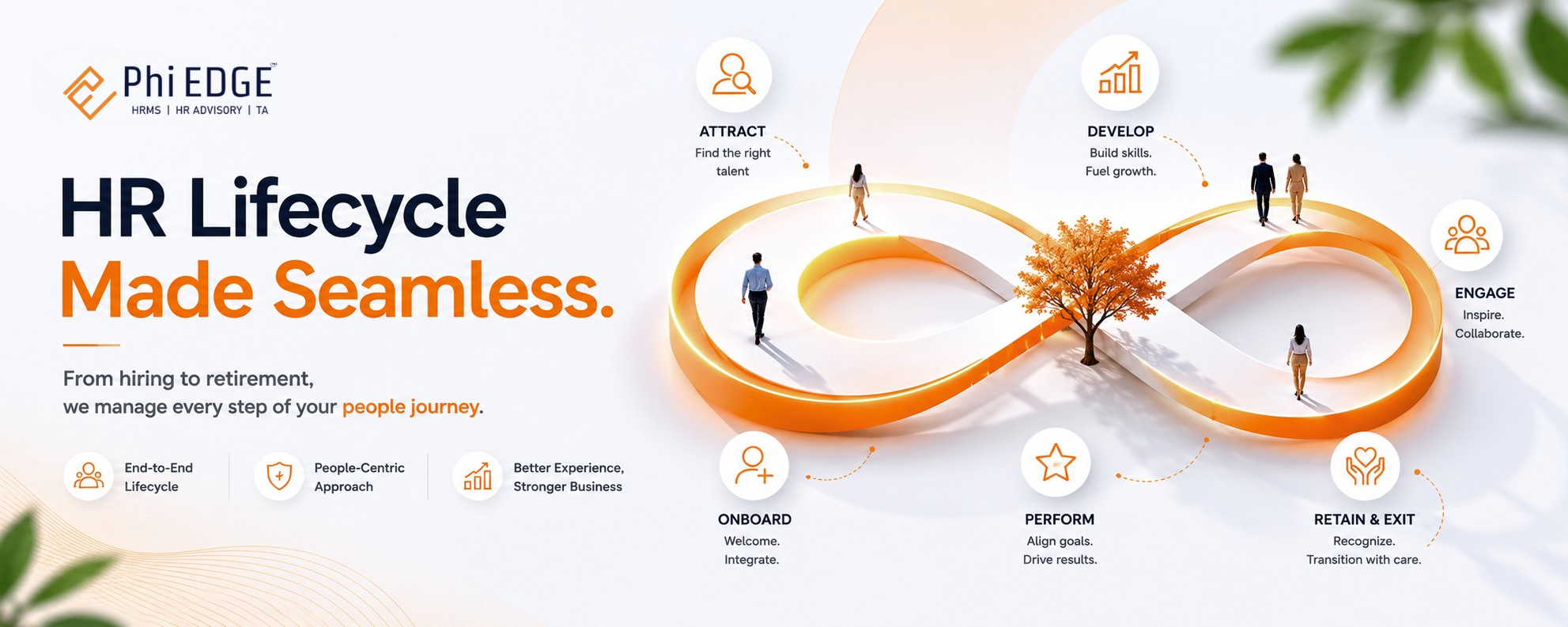
    HR Lifecycle Management Services: The Foundation of a Successful Workforce Strategy

    Employees are the backbone of every organization. However, managing employees effectively requires much more than recruitment and payroll processing. Organizations must create a structured journey that supports employees from their first interaction with the company to their final day of employment.

    This journey is known as the Employee Lifecycle.

    In today’s competitive business environment, companies that invest in HR Lifecycle Management Services experience higher employee satisfaction, improved productivity, stronger retention, and better compliance.

    As organizations adopt digital transformation initiatives, integrated HRMS platforms like Phi EDGE HRMS are helping businesses automate and optimize every stage of the employee lifecycle.

    This comprehensive guide explains what HR lifecycle management services are, their benefits, real-world applications, comparisons, buying considerations, expert recommendations, and how Phi EDGE HRMS helps businesses create a high-performing workforce in 2026.

    What Are HR Lifecycle Management Services?

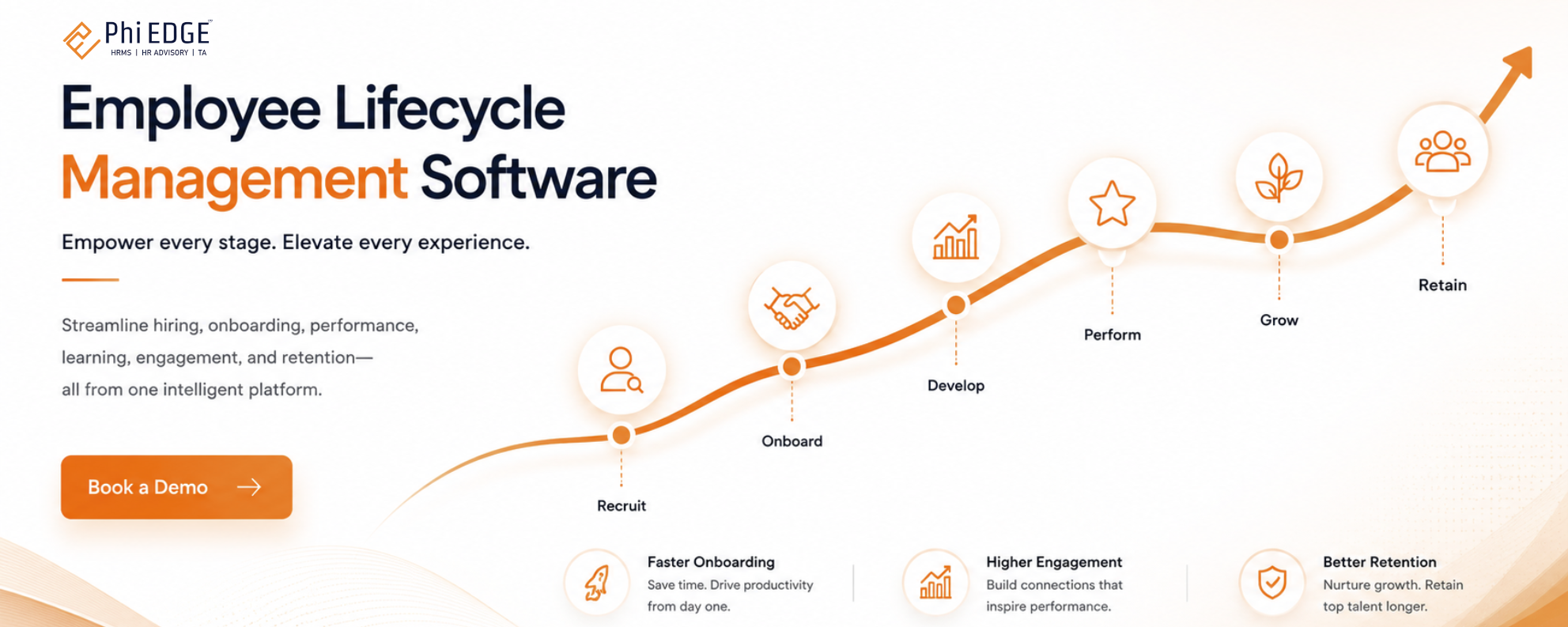
    HR Lifecycle Management Services refer to the processes, tools, and technologies used to manage every stage of an employee’s relationship with an organization.

    The lifecycle typically includes:

    Recruitment

    Attracting and hiring the right talent.

    Onboarding

    Helping new employees become productive quickly.

    Training and Development

    Building employee skills and capabilities.

    Performance Management

    Monitoring and improving employee performance.

    Employee Engagement

    Enhancing workplace satisfaction and motivation.

    Career Development

    Supporting employee growth and leadership development.

    Retention

    Reducing employee turnover.

    Offboarding

    Managing employee exits professionally and compliantly.

    A structured lifecycle management approach ensures employees receive consistent support throughout their journey.

    Why HR Lifecycle Management Matters in 2026

    Modern workplaces are evolving rapidly.

    Organisations deal with issues like:

    • Hybrid workplaces
    • Lack of talent
    • Higher standards for employees


    Diversity in the workforce

    • Initiatives for digital transformation
    • In the absence of an effective lifecycle management plan, companies frequently face:
    • High rates of attrition
    • Low levels of engagement among employees
    • Unsatisfactory onboarding experiences
    • Inconsistent assessments of performance
    • Inefficiencies in administration

    Organisations can overcome these obstacles and increase worker productivity with the use of HR lifecycle management services.


    The Seven Stages of HR Lifecycle Management

    Talent Acquisition and Recruitment

    Recruitment is the first interaction between an organisation and a potential employee.

    Effective recruitment strategies help businesses:

    • Attract qualified candidates
    • Reduce hiring costs
    • Improve candidate experience
    • Shorten hiring timelines

    Example

    A technology company receiving hundreds of applications every month can use automated recruitment workflows to identify the best candidates faster.

    Employee Onboarding

    The onboarding process significantly influences employee retention.

    Research consistently shows that employees who experience structured onboarding adapt more quickly and remain with organizations longer.

    Effective onboarding includes:

    Documentation Management

    Digital collection and verification of employee documents.

    Policy Training

    Introduction to company policies and workplace expectations.

    Team Integration

    Helping employees understand organizational culture and workflows.

    Learning and Development

    Employee skills require continuous improvement.

    Organizations that invest in learning and development benefit from:

    • Higher productivity
    • Better innovation
    • Increased employee satisfaction

    Training programs may include:

    • Technical skills
    • Leadership development
    • Compliance training
    • Industry certifications

    Performance Management

    Performance management ensures employees remain aligned with organizational goals.

    Modern performance management focuses on:

    Goal Setting

    Clear expectations and measurable objectives.

    Continuous Feedback

    Regular communication between managers and employees.

    Performance Reviews

    Data-driven evaluation processes.

    Organizations that provide ongoing feedback typically achieve stronger workforce performance.

    Employee Engagement

    Engaged employees contribute more effectively to business success.

    HR Lifecycle Management Services help organizations measure and improve:

    • Employee satisfaction
    • Workplace culture
    • Team collaboration
    • Recognition programs

    Highly engaged employees are generally more productive and less likely to leave.

    Retention and Career Growth

    Retaining top talent is often more cost-effective than hiring replacements.

    Organizations can improve retention by providing:

    • Career progression opportunities
    • Leadership development programs
    • Internal mobility options
    • Personalized growth plans

    Employees who see long-term opportunities are more likely to remain committed to the organization.

    Offboarding and Exit Management

    A structured offboarding process protects organizational knowledge and maintains professional relationships.

    Effective offboarding includes:

    • Exit interviews
    • Asset recovery
    • Final settlements
    • Documentation completion
    • Knowledge transfer

    A positive exit experience can strengthen employer branding and future recruitment efforts.

    Key Benefits of HR Lifecycle Management Services

    Improved Employee Experience

    Employees receive a consistent and structured experience throughout their journey.

    This increases satisfaction and engagement.

    Increased Productivity

    Automated workflows reduce administrative delays and help employees focus on meaningful work.

    Better Employee Retention

    Organizations can identify and address issues before employees decide to leave.

    Enhanced Compliance

    Lifecycle management helps maintain:

    • Employee records
    • Policy acknowledgments
    • Audit trails
    • Regulatory compliance

    Data-Driven Workforce Decisions

    Organizations gain valuable insights into:

    • Employee performance
    • Attrition trends
    • Recruitment effectiveness
    • Workforce planning

    These insights improve decision-making.

    Real-World Example of HR Lifecycle Management Success

    Consider a manufacturing company with 1,200 employees across multiple locations.

    Before Lifecycle Management Implementation

    The company faced:

    • High employee turnover
    • Delayed onboarding
    • Inconsistent performance reviews
    • Manual HR processes
    • Limited workforce visibility

    After Adopting HR Lifecycle Management Services

    The organization achieved:

    • Faster onboarding
    • Better employee engagement
    • Improved retention
    • Enhanced compliance
    • Stronger workforce productivity

    Management gained complete visibility into the employee journey from hiring to exit.

    HR Lifecycle Management Services vs Traditional HR Management

    Traditional HR Management

    Traditional HR systems typically focus on:

    • Employee records
    • Payroll
    • Attendance

    Limitations

    • Fragmented processes
    • Limited automation
    • Minimal employee engagement support
    • Weak reporting capabilities

    HR Lifecycle Management Services

    Lifecycle-focused solutions provide:

    • End-to-end employee management
    • Automated workflows
    • Employee self-service
    • Performance tracking
    • Workforce analytics

    This creates a more connected and efficient employee experience.

    How to Choose the Right HR Lifecycle Management Solution

    Selecting the right solution requires evaluating several important factors.

    Scalability

    The system should support future business growth.

    Ease of Use

    Employees and HR teams should be able to use the platform easily.

    Automation Features

    Look for automation in:

    • Recruitment workflows
    • Onboarding processes
    • Performance reviews
    • Leave approvals
    • Exit management

    Integration Capabilities

    The platform should integrate with:

    • Payroll systems
    • Attendance management
    • ERP software
    • Learning management systems

    Reporting and Analytics

    Advanced reporting helps organizations make informed workforce decisions.

    Why Phi EDGE HRMS Is a Preferred HR Lifecycle Management Solution in 2026

    Many organizations struggle with disconnected HR tools and manual processes.

    Phi EDGE HRMS provides a unified platform that manages every stage of the employee lifecycle efficiently.

    End-to-End Employee Lifecycle Management

    Phi EDGE HRMS supports:

    Recruitment Management

    Simplified hiring workflows and candidate tracking.

    Digital Onboarding

    Faster employee integration and documentation management.

    Attendance and Leave Management

    Accurate workforce tracking and policy compliance.

    Performance Management

    Goal setting, feedback, and employee evaluations.

    Employee Engagement

    Tools designed to improve workplace satisfaction.

    Offboarding Management

    Structured exit processes and documentation workflows.

    Smart HR Automation

    Manual HR tasks consume significant time and resources.

    Phi EDGE automates:

    • Employee workflows
    • Approval processes
    • Notifications
    • Documentation tracking

    This improves efficiency while reducing administrative burden.

    Employee Self-Service Portal

    Employees can:

    • Apply for leave
    • Access documents
    • Update personal information
    • View attendance records

    This enhances transparency and employee satisfaction.

    Advanced Workforce Analytics

    Organizations gain visibility into:

    • Employee productivity
    • Retention trends
    • Performance metrics
    • Workforce planning

    These insights support strategic HR decision-making.

    Compliance and Security

    Phi EDGE HRMS helps businesses maintain:

    • Secure employee records
    • Regulatory compliance
    • Audit-ready documentation
    • Standardized HR processes

    Common Mistakes Organizations Make in Lifecycle Management

    Focusing Only on Recruitment

    Hiring is important, but employee success depends on the entire lifecycle.

    Neglecting Employee Development

    Lack of growth opportunities often leads to turnover.

    Conducting Annual Performance Reviews Only

    Continuous feedback is more effective than yearly evaluations.

    Ignoring Employee Engagement

    Engagement directly impacts productivity and retention.

    Using Multiple Disconnected Systems

    Fragmented tools create inefficiencies and inconsistent employee experiences.

    Integrated platforms provide a better solution.

    Future Trends in HR Lifecycle Management Services

    Artificial Intelligence in HR

    AI will help organizations predict turnover risks and identify development opportunities.

    Personalized Employee Experiences

    Future HR systems will deliver customized career paths and learning recommendations.

    Predictive Workforce Planning

    Advanced analytics will improve hiring and succession planning decisions.

    Hybrid Workforce Support

    Lifecycle management solutions will continue evolving to support remote and distributed teams.

    Expert Advice: Building a Strong Employee Lifecycle Strategy

    Organizations should focus on:

    Employee-Centric Processes

    Design workflows around employee needs rather than administrative convenience.

    Continuous Communication

    Encourage regular feedback and transparent communication.

    Technology-Driven Automation

    Reduce manual tasks through intelligent HRMS solutions.

    Data-Based Decision Making

    Use workforce analytics to improve employee experiences and business outcomes.

    Conclusion

    For companies looking for long-term success and workforce excellence, HR Lifecycle Management Services are now a must.

    Stronger employee experiences and improved business outcomes are produced by companies that successfully handle hiring, onboarding, development, performance, engagement, retention, and offboarding.

    Organisations may automate HR procedures, boost employee engagement, increase compliance, and make more informed workforce decisions by putting in place a complete system like Phi EDGE HRMS.

    A planned employee lifecycle strategy will continue to be a vital component of productivity, retention, and organisational success as companies continue to adjust to the nature of work in 2026.


    FAQ Section

    What are HR Lifecycle Management Services?

    HR Lifecycle Management Services help organizations manage employee journeys from recruitment to offboarding through structured processes and technology.

    Why is HR Lifecycle Management important?

    It improves employee experience, productivity, retention, compliance, and workforce visibility.

    How does Phi EDGE HRMS support employee lifecycle management?

    Phi EDGE HRMS provides recruitment, onboarding, attendance, payroll, performance management, employee engagement, analytics, and offboarding tools in a single platform.

    Which industries benefit from HR Lifecycle Management Services?

    Manufacturing, IT, healthcare, education, retail, logistics, professional services, and enterprises of all sizes can benefit.

    What is the biggest advantage of lifecycle management software?

    It creates a connected employee experience while improving efficiency, retention, and workforce performance.

  • Payroll Software in India

    Payroll Software in India

    Payroll Software in India: Why Modern Businesses Can No Longer Rely on Manual Payroll

    One of the most important tasks in any business is payroll. Workers anticipate transparent paystubs, regular payments, accurate salaries, and tax compliance. However, when organisations expand, manually handling payroll becomes more difficult.

    Payroll management requires accuracy and consistency in all aspects, from calculating salaries and overtime to managing deductions, taxes, PF, ESI, bonuses, reimbursements, and compliance reporting.

    Employee discontent, fines for noncompliance, and administrative inefficiencies can all arise from a single error.

    To automate payroll processing and minimise manual labour, companies across India are rapidly adopting payroll software.


    Organisations are adopting integrated HRMS solutions, such as Phi EDGE HRMS, in 2026. These solutions consolidate payroll, attendance, leave management, compliance, and workforce analytics on a single platform.

    Everything you need to know about payroll software in India is included in this book, including advantages, real-world examples, comparisons, purchasing considerations, and the reasons why Phi EDGE HRMS is increasingly being chosen by expanding companies.


    What is payroll software?

    Payroll Software is a digital system designed to automate employee salary processing, statutory compliance, deductions, tax calculations, and payroll reporting.

    Instead of manually calculating salaries every month, organizations can use payroll software to process payroll accurately and efficiently.

    Payroll software typically handles:

    • Salary calculations
    • Attendance integration
    • Leave deductions
    • Overtime calculations
    • Bonus processing
    • Incentive management
    • Tax calculations
    • PF compliance
    • ESI compliance
    • Professional Tax calculations
    • Payslip generation
    • Bank transfer reports
    • Payroll reporting

    The primary objective is to ensure accurate and compliant payroll processing while reducing administrative workload.

    Why Payroll Automation is Essential in 2026

    Today’s businesses operate in a complex regulatory environment.

    HR teams must manage:

    Growing Workforce Sizes

    As organizations expand, payroll complexity increases significantly.

    Hybrid and Remote Employees

    Businesses need flexible payroll systems capable of managing diverse workforce structures.

    Compliance Requirements

    Indian payroll regulations continue evolving, making manual management increasingly risky.

    Employee Expectations

    Employees expect timely salary payments, instant access to payslips, and transparent payroll information.

    Modern payroll software addresses these challenges through automation and real-time data processing.

    How Payroll Software Works

    Payroll software automatically collects and processes workforce data from multiple sources.

    Attendance Collection

    The system gathers employee attendance information through:

    • Biometric devices
    • Mobile attendance
    • Web check-ins
    • Attendance management systems

    Leave and Overtime Integration

    Approved leaves and overtime records are automatically incorporated into payroll calculations.

    Salary Computation

    The software calculates:

    • Basic salary
    • HRA
    • Special allowances
    • Incentives
    • Overtime
    • Deductions

    Statutory Compliance Processing

    The system computes:

    • Provident Fund (PF)
    • Employee State Insurance (ESI)
    • Professional Tax
    • Income Tax (TDS)

    Payslip Generation

    Employees receive detailed digital payslips instantly.

    Reporting and Auditing

    HR and finance teams gain access to payroll reports and compliance documentation.


    Key Benefits of Payroll Software in India

    Improved Payroll Accuracy

    Manual payroll calculations often lead to errors.

    Payroll software eliminates calculation mistakes through automation.

    Benefits include:

    • Accurate salary calculations
    • Reduced payroll disputes
    • Improved employee trust


    Significant Time Savings

    Payroll processing that previously required several days can now be completed in hours.

    Automation reduces:

    • Manual calculations
    • Spreadsheet dependency
    • Data entry tasks

    HR teams can focus on strategic initiatives rather than administrative work.


    Better Compliance Management

    Compliance is one of the biggest challenges for Indian organizations.

    Payroll software helps manage:

    Provident Fund (PF)

    Automated PF calculations reduce compliance risks.

    Employee State Insurance (ESI)

    The system automatically calculates ESI contributions.

    Tax Deducted at Source (TDS)

    Income tax deductions are processed according to applicable regulations.

    Professional Tax

    State-specific tax requirements are managed efficiently.


    Enhanced Employee Experience

    Employees gain access to:

    • Digital payslips
    • Salary history
    • Tax information
    • Reimbursement records

    Self-service functionality improves transparency and employee satisfaction.


    Real-Time Reporting

    Management can access:

    • Payroll summaries
    • Cost analysis reports
    • Departmental salary expenses
    • Compliance reports

    This supports better financial planning and workforce management.


    Real-World Example of Payroll Automation Success

    Consider a manufacturing company employing 2,000 workers across multiple facilities.

    Before Payroll Software

    Challenges included:

    • Manual attendance reconciliation
    • Salary calculation errors
    • Compliance delays
    • High HR workload
    • Employee payroll disputes

    After Payroll Automation

    The company achieved:

    • Faster payroll processing
    • Improved salary accuracy
    • Reduced compliance risks
    • Higher employee satisfaction
    • Better reporting visibility

    Management gained complete control over payroll operations while significantly reducing administrative costs.

    Payroll Software vs Manual Payroll Processing

    Manual Payroll Processing

    Characteristics:

    • Spreadsheet calculations
    • Manual data entry
    • Human-dependent processes
    • Limited reporting

    Challenges

    • Higher error rates
    • Compliance risks
    • Slow processing
    • Increased workload


    Payroll Software

    Characteristics:

    • Automated calculations
    • Compliance integration
    • Real-time reporting
    • Employee self-service

    Advantages

    • Improved efficiency
    • Better accuracy
    • Stronger compliance
    • Enhanced scalability

    For growing businesses, payroll software provides a clear operational advantage.


    Essential Features to Look for in Payroll Software

    Automated Payroll Processing

    The software should automate:

    • Salary calculations
    • Deductions
    • Overtime processing
    • Incentive calculations

    Attendance Integration

    Attendance should directly influence payroll calculations.

    This eliminates duplicate data entry and improves accuracy.


    Compliance Management

    A strong payroll solution should support:

    • PF
    • ESI
    • TDS
    • Professional Tax


    Employee Self-Service Portal

    Employees should be able to:

    • Download payslips
    • Access salary records
    • View tax details


    Customizable Salary Structures

    Organizations require flexibility in:

    • Salary components
    • Allowances
    • Incentives
    • Reimbursements


    Reporting and Analytics

    Advanced payroll reporting supports:

    • Budget planning
    • Workforce cost analysis
    • Financial forecasting


    How to Choose the Best Payroll Software in India

    Choosing payroll software requires evaluating several factors.

    Business Size

    Select software capable of supporting future growth.

    A payroll system suitable for 100 employees should also support 5,000 employees as the company expands.

    Compliance Capabilities

    The software should stay updated with changing regulations.

    Ease of Use

    Complex systems often result in poor adoption.

    Look for intuitive interfaces and simple workflows.

    Integration Support

    Payroll software should integrate with:

    • Attendance systems
    • Leave management platforms
    • HRMS solutions
    • Accounting software

    Customer Support

    Reliable vendor support is essential for payroll continuity.

    Why Phi EDGE HRMS is a Smart Payroll Solution in 2026

    Payroll, attendance, and HR administration are all handled by different tools in many organisations.

    Data discrepancies and inefficiencies result from this.

    Payroll and labour administration are streamlined by the integrated environment offered by Phi EDGE HRMS.


    End-to-End Payroll Automation

    Phi EDGE HRMS automates:

    Salary Processing

    Accurate monthly payroll calculations.

    Attendance-Based Payroll

    Automatic attendance synchronization.

    Leave Management Integration

    Leave deductions are processed automatically.

    Bonus and Incentive Calculations

    Flexible payroll configurations support diverse compensation structures.

    Built for Indian Compliance Requirements

    Phi EDGE helps organizations manage:

    • Provident Fund
    • ESI
    • TDS
    • Professional Tax
    • Payroll documentation

    This reduces compliance risks and administrative effort.

    Employee Self-Service Portal

    Employees can:

    • Download payslips
    • Access salary history
    • View tax information
    • Track reimbursements

    This improves transparency and reduces HR queries.

    Advanced Payroll Analytics

    Organizations gain access to:

    • Payroll dashboards
    • Salary cost analysis
    • Department-wise reports
    • Compliance reports

    Leadership teams can make data-driven workforce decisions.


    Scalable for Every Business

    Phi EDGE HRMS supports:

    Startups

    Affordable payroll automation.

    SMEs

    Centralized workforce management.

    Large Enterprises

    Scalable payroll and compliance management.

    Manufacturing Organizations

    Complex shift-based payroll processing.

    Common Payroll Mistakes Businesses Should Avoid

    Manual Salary Calculations

    Manual processing increases errors and compliance risks.


    Delayed Payroll Processing

    Late salary payments negatively impact employee morale.


    Ignoring Compliance Updates

    Regulatory changes must be tracked consistently.


    Lack of Payroll Transparency

    Employees expect visibility into salary calculations.


    Using Disconnected Systems

    Separate attendance and payroll systems create inefficiencies.

    Integrated HRMS platforms provide a better solution.


    Future Trends in Payroll Software

    Artificial Intelligence in Payroll

    AI will improve anomaly detection and payroll accuracy.

    Cloud-Based Payroll Systems

    Organizations are increasingly adopting cloud payroll platforms for accessibility and scalability.

    Employee Self-Service Expansion

    Employees will gain greater control over payroll-related activities.

    Advanced Workforce Analytics

    Payroll data will increasingly support workforce planning and financial forecasting.


    Conclusion

    Payroll management has evolved from a back-office administrative function into a strategic business process.

    Organizations that adopt modern Payroll Software benefit from:

    • Faster payroll processing
    • Improved accuracy
    • Better compliance
    • Enhanced employee satisfaction
    • Data-driven decision making

    Phi EDGE HRMS offers payroll automation, compliance management, workforce analytics, attendance integration, and employee self-service features all on one platform for companies looking for a complete payroll and HR solution.

    Investing in a contemporary payroll system is now necessary for operational effectiveness, compliance, and long-term business growth as labour expectations and regulatory requirements continue to change in 2026.


    FAQ 

    What is Payroll Software?

    Payroll Software automates salary processing, deductions, compliance calculations, payslip generation, and payroll reporting.

    Why is Payroll Software important for Indian businesses?

    It improves accuracy, saves time, ensures compliance, and enhances employee experience.

    Can Payroll Software calculate PF and ESI automatically?

    Yes, modern payroll systems automatically calculate PF, ESI, TDS, and other statutory deductions.

    How does Phi EDGE HRMS help with payroll management?

    Phi EDGE HRMS automates payroll processing, attendance integration, compliance management, reporting, and employee self-service.

    Which businesses should use Payroll Software?

    Startups, SMEs, enterprises, manufacturing companies, educational institutions, healthcare organizations, and service businesses can all benefit from payroll automation.

  • Employee Performance Software

    Employee Performance Software

    Employee performance is one of the most important factors determining an organization’s success. No matter how strong a company’s products, services, or technology may be, sustainable growth depends on how effectively employees perform and contribute toward organizational goals.

    Traditional performance reviews conducted once or twice a year are no longer sufficient. Modern organizations require continuous performance monitoring, goal alignment, real-time feedback, and data-driven workforce decisions.

    This is where employee performance software plays a critical role.

    In 2026, companies are increasingly adopting advanced HRMS platforms like Phi EDGE HRMS to automate performance management, enhance employee engagement, and create high-performing teams.

    This comprehensive guide explains everything businesses need to know about employee performance software, including its benefits, features, comparisons, implementation strategies, and how Phi EDGE HRMS helps organizations build a performance-driven culture.

    What is Employee Performance Software?

    Employee Performance Software is a digital platform that helps organizations track, evaluate, manage, and improve employee performance throughout the employee lifecycle.

    The software provides a structured framework for:

    • Goal setting
    • KPI tracking
    • Performance reviews
    • Continuous feedback
    • Employee development
    • Manager assessments
    • Performance analytics
    • Succession planning

    Instead of relying on spreadsheets and manual evaluations, businesses can manage performance processes through a centralized platform.

    The objective is simple:

    Improve employee productivity while helping individuals achieve professional growth.


    Why Performance Management Matters in 2026

    The workplace has undergone significant transformation.

    Organizations now face challenges such as:

    • Hybrid work environments
    • Remote teams
    • Skill shortages
    • Increased competition for talent
    • Rising employee expectations

    Without a structured performance management system, companies often experience:

    • Poor productivity
    • Lack of accountability
    • Employee disengagement
    • Higher turnover
    • Inconsistent evaluations

    Modern employee performance software helps businesses overcome these challenges through transparency, automation, and measurable performance metrics.

    Key Components of Employee Performance Software

    Goal Management

    Employees perform better when expectations are clearly defined.

    Performance software enables organizations to:

    • Set individual goals
    • Align goals with company objectives
    • Track progress continuously
    • Monitor achievement rates

    When employees understand how their work contributes to business success, motivation naturally increases.

    Example

    A sales executive may have quarterly revenue targets while a marketing manager may focus on lead generation metrics.

    The software tracks both objectives and measures progress automatically.

    Continuous Feedback

    Traditional annual reviews often fail because feedback comes too late.

    Modern performance platforms encourage:

    • Real-time feedback
    • Manager check-ins
    • Peer recognition
    • Continuous coaching

    Employees can address challenges immediately rather than waiting months for evaluation.


    KPI and Performance Tracking

    Organisations need measurable performance indicators.

    Employee performance software helps monitor:

    • Productivity metrics
    • Sales targets
    • Project completion rates
    • Customer satisfaction scores
    • Attendance trends

    Managers gain clear visibility into employee contributions.

    Performance Reviews and Appraisals

    Performance reviews become more objective when supported by data.

    The software enables:

    • Self-assessments
    • Manager evaluations
    • Peer reviews
    • 360-degree feedback

    This creates a balanced evaluation process while reducing bias.

    Learning and Development Integration

    Performance management is not only about measuring results.

    It is also about helping employees improve.

    Modern software identifies:

    • Skill gaps
    • Training requirements
    • Career development opportunities
    • Leadership potential

    Organizations can create personalized development plans for employees.

    Top Benefits of Employee Performance Software

    Increased Productivity

    Employees become more focused when goals are clearly defined and progress is measurable.

    Organizations often experience significant productivity improvements after implementing performance management software.

    Better Employee Engagement

    Employees who receive regular feedback feel more connected to their work.

    Engaged employees are:

    • More motivated
    • More productive
    • Less likely to leave

    Performance software supports continuous communication between managers and employees.

    Improved Retention Rates

    One of the biggest reasons employees leave organizations is a lack of growth opportunities.

    Performance platforms help employees:

    • Understand career paths
    • Receive development support
    • Track achievements

    This strengthens retention efforts.

    Data-Driven Decision Making

    Managers no longer need to rely on assumptions.

    Performance software provides actionable insights into:

    • High performers
    • Skill gaps
    • Promotion readiness
    • Workforce productivity

    These insights improve talent management decisions.

    Fair and Transparent Evaluations

    Manual reviews often suffer from inconsistency and bias.

    Employee Performance Software creates standardized evaluation processes based on measurable data.

    This improves employee trust and organizational fairness.

    Real-World Example of Employee Performance Software Success

    Consider a manufacturing company employing 1,500 workers across multiple locations.

    Before Implementation

    The company faced:

    • Delayed appraisals
    • Lack of performance visibility
    • Employee dissatisfaction
    • Manual review processes
    • Limited career planning

    After Implementing Performance Software

    The organization achieved:

    • Faster review cycles
    • Improved employee engagement
    • Better manager accountability
    • Enhanced workforce productivity
    • Data-backed promotion decisions

    Leadership gained complete visibility into employee performance across departments.

    Employee Performance Software vs Traditional Performance Reviews

    Traditional Reviews

    Characteristics include:

    • Annual evaluations
    • Limited feedback
    • Manual documentation
    • Delayed performance discussions

    Challenges

    • Feedback becomes outdated
    • Employees lose motivation
    • Performance issues remain unresolved

    Modern Employee Performance Software

    Characteristics include:

    • Continuous feedback
    • Real-time tracking
    • Automated workflows
    • Goal alignment
    • Advanced reporting

    Advantages

    • Improved productivity
    • Better employee development
    • Higher engagement
    • Stronger business outcomes

    The shift from annual reviews to continuous performance management is one of the most important HR trends of 2026.

    Essential Features to Look for in Employee Performance Software

    Goal and OKR Management

    The software should support:

    • Goal setting
    • Objective tracking
    • Department alignment
    • Progress dashboards

    360-Degree Feedback

    Comprehensive feedback improves evaluation quality.

    The system should allow:

    • Self-assessments
    • Peer reviews
    • Manager evaluations
    • Leadership assessments

    Performance Analytics

    Organizations need meaningful insights.

    Look for dashboards that display:

    • Productivity trends
    • Employee ratings
    • Team performance
    • Development opportunities

    Automated Review Cycles

    Automation reduces HR workload while ensuring timely evaluations.

    Employee Development Tools

    The best platforms combine performance tracking with employee growth initiatives.

    This helps businesses create future leaders.

    How to Choose the Right Employee Performance Software

    Selecting the right solution requires careful consideration.

    Business Size and Scalability

    Choose software that can grow with your organization.

    A system that supports 50 employees today should support 5,000 tomorrow.

    Ease of Use

    Complicated systems reduce adoption rates.

    Employees and managers should find the platform intuitive and user-friendly.

    Integration Capabilities

    The software should integrate with:

    • HRMS platforms
    • Payroll systems
    • Attendance management
    • Learning management systems

    Customization Options

    Every organization has unique performance management requirements.

    The software should support:

    • Custom KPIs
    • Review templates
    • Department-specific workflows

    Reporting and Analytics

    Advanced reporting capabilities are essential for strategic workforce planning.

    Why Phi EDGE HRMS is the Ideal Employee Performance Software in 2026

    Organizations increasingly prefer integrated HRMS platforms rather than standalone performance tools.

    Phi EDGE HRMS offers a comprehensive performance management ecosystem designed for modern businesses.

    End-to-End Performance Management

    Phi EDGE HRMS supports:

    Goal Setting

    Employees and managers can establish measurable objectives aligned with organizational goals.

    Continuous Feedback

    Real-time communication enables continuous improvement and stronger manager-employee relationships.

    Performance Reviews

    Structured appraisal workflows simplify evaluation processes.

    KPI Tracking

    Organizations gain visibility into employee productivity and goal achievement.

    Workforce Analytics

    Advanced dashboards provide meaningful performance insights.

    Automation That Saves Time

    Manual performance management consumes significant HR resources.

    Phi EDGE automates:

    • Review scheduling
    • Notifications
    • Feedback collection
    • Approval workflows
    • Performance reporting

    This allows HR teams to focus on strategic initiatives.

    Employee-Centric Experience

    Employees can:

    • Track goals
    • View performance history
    • Access feedback
    • Monitor career progression

    This creates greater transparency and engagement.

    Advanced Reporting and Decision Support

    Phi EDGE HRMS enables leaders to identify:

    • High performers
    • Future leaders
    • Skill gaps
    • Training requirements
    • Retention risks

    These insights support long-term workforce planning.

    Common Mistakes Organizations Make in Performance Management

    Conducting Reviews Only Once a Year

    Performance conversations should be continuous rather than annual.

    Ignoring Employee Development

    Measuring performance without supporting growth creates frustration.

    Lack of Goal Alignment

    Employees perform better when organizational expectations are clearly communicated.

    Relying on Subjective Evaluations

    Data-backed performance management improves fairness and accuracy.

    Using Multiple Disconnected Systems

    Fragmented tools create reporting inconsistencies and administrative complexity.

    Integrated platforms like Phi EDGE HRMS solve these challenges.


    Future Trends in Employee Performance Software

    Artificial Intelligence and Predictive Analytics

    AI will help organizations identify performance risks and development opportunities earlier.


    Personalized Employee Development

    Future systems will recommend customized learning paths based on employee performance data.


    Continuous Performance Management

    Annual reviews will continue disappearing in favor of ongoing coaching and feedback.


    Skills-Based Workforce Planning

    Organizations will increasingly evaluate employees based on skills, capabilities, and future potential.


    Conclusion

    Employee Performance Software has evolved from a simple appraisal tool into a strategic workforce management solution.

    Organizations that invest in modern performance management systems experience:

    • Higher productivity
    • Improved employee engagement
    • Better retention
    • Data-driven decision making
    • Stronger organizational growth

    For businesses looking to build a high-performance culture in 2026, Phi EDGE HRMS provides the technology, automation, analytics, and employee-centric capabilities needed to transform performance management into a competitive advantage.

    By adopting a comprehensive solution like Phi EDGE HRMS, organizations can empower employees, strengthen leadership decisions, and create a workforce prepared for long-term success.


  • Lifecycle Management Software: Why Businesses Need AI-Ready Workflow Solutions in 2026 | Phi EDGE

    Lifecycle Management Software: Why Businesses Need AI-Ready Workflow Solutions in 2026 | Phi EDGE

    Employee management is no longer limited to attendance tracking and payroll processing. Organizations today need a comprehensive approach to manage every stage of an employee’s journey—from recruitment and onboarding to performance management, engagement, growth, and offboarding.

    This is where lifecycle management software becomes essential.

    Companies that effectively manage employee lifecycles experience higher productivity, improved retention rates, better compliance, and stronger workforce engagement. In 2026, businesses are increasingly adopting integrated HRMS platforms like Phi EDGE HRMS to automate and optimize employee lifecycle management.

    In this guide, we will explore lifecycle management software, its benefits, real-world examples, comparisons, buying considerations, and how Phi EDGE HRMS helps organizations build a future-ready workforce.

    What is Lifecycle Management Software?

    Lifecycle Management Software is a digital solution that manages and automates every phase of an employee’s journey within an organization.

    The employee lifecycle typically includes:

    • Recruitment
    • Hiring
    • Onboarding
    • Training and Development
    • Performance Management
    • Employee Engagement
    • Career Growth
    • Retention
    • Exit Management

    Instead of using multiple disconnected systems, organizations can centralize employee data, workflows, approvals, documentation, and analytics through a unified HRMS platform.

    The goal is simple: create a seamless experience for both employees and HR teams.

    Why Employee Lifecycle Management Matters in 2026

    The workplace has evolved significantly.

    Today’s workforce expects:

    • Faster onboarding experiences
    • Self-service HR portals
    • Digital documentation
    • Transparent performance reviews
    • Continuous learning opportunities
    • Flexible work arrangements

    Without proper lifecycle management, businesses often face:

    • High employee turnover
    • Poor onboarding experiences
    • Compliance risks
    • Low engagement levels
    • Manual HR inefficiencies
    • Increased operational costs

    Modern lifecycle management software addresses these challenges through automation, analytics, and employee-centric workflows.

    Key Stages of Employee Lifecycle Management

    1. Recruitment and Talent Acquisition

    The employee journey starts before the first day at work.

    Lifecycle Management Software helps HR teams:

    • Publish job openings
    • Manage applications
    • Track candidates
    • Schedule interviews
    • Evaluate talent efficiently

    A streamlined recruitment process helps businesses attract top candidates while reducing hiring costs and time-to-fill positions.

    Example

    A growing IT company receives 500 applications monthly. Instead of manually reviewing resumes, HR teams can use automated screening and applicant tracking features to shortlist qualified candidates quickly.

    2. Employee Onboarding

    First impressions matter.

    A structured onboarding process helps new employees become productive faster.

    Key onboarding features include:

    • Digital document collection
    • Policy acknowledgments
    • Employee information management
    • Training assignments
    • Welcome workflows

    Organizations with effective onboarding programs often see improved retention and employee satisfaction.

    3. Learning and Development

    Continuous skill development is essential in today’s competitive environment.

    Lifecycle management platforms support:

    • Employee training programs
    • Skill assessments
    • Certification tracking
    • Learning management integration
    • Career development planning

    Businesses can identify skill gaps and create personalized growth plans for employees.

    4. Performance Management

    Performance management is no longer an annual activity.

    Modern organizations require:

    • Goal setting
    • KPI tracking
    • Continuous feedback
    • Performance reviews
    • Development discussions

    Lifecycle software enables managers to monitor employee progress and align performance with organizational objectives.

    5. Employee Engagement

    Employee engagement directly impacts productivity and retention.

    Software solutions help organizations:

    • Conduct surveys
    • Gather feedback
    • Measure employee sentiment
    • Track engagement metrics
    • Recognize achievements

    Engaged employees are more likely to stay committed and contribute to business success.

    6. Career Growth and Succession Planning

    Organizations that invest in employee growth build stronger teams.

    Lifecycle Management Software supports:

    • Internal mobility
    • Leadership development
    • Career path planning
    • Succession management

    This helps companies retain high-performing employees while preparing future leaders.

    7. Exit and Offboarding Management

    Employee departures should be handled professionally and systematically.

    Offboarding workflows may include:

    • Exit interviews
    • Asset recovery
    • Knowledge transfer
    • Final settlements
    • Compliance documentation

    A structured exit process protects organizational knowledge and maintains positive employer branding.

    Top Benefits of Lifecycle Management Software

    Improved Employee Experience

    Employees enjoy smoother interactions throughout their journey.

    From onboarding to promotions, every process becomes faster and more transparent.

    Increased Productivity

    Automation eliminates repetitive HR tasks, allowing teams to focus on strategic initiatives.

    Examples include:

    • Automated approvals
    • Leave management
    • Attendance tracking
    • Payroll integration

    Better Employee Retention

    Organizations can proactively identify engagement issues and address them before employees decide to leave.

    Enhanced Compliance

    Managing employee records manually increases compliance risks.

    Lifecycle software helps maintain:

    • Audit trails
    • Policy compliance
    • Documentation accuracy
    • Regulatory reporting

    Data-Driven Decision Making

    Advanced analytics provide insights into:

    • Attrition rates
    • Employee performance
    • Recruitment efficiency
    • Workforce planning

    Real-World Example of Lifecycle Management Success

    Consider a manufacturing company with 1,000 employees operating across multiple locations.

    Before Implementation

    The company faced:

    • Delayed onboarding
    • Attendance discrepancies
    • High turnover
    • Manual payroll processing
    • Inconsistent performance reviews

    After Implementing Lifecycle Management Software

    Results included:

    • Faster onboarding processes
    • Reduced administrative workload
    • Improved attendance accuracy
    • Better employee engagement
    • Enhanced reporting capabilities

    Management gained complete visibility into workforce performance and employee satisfaction.

    Lifecycle Management Software vs Traditional HR Systems

    Traditional HR Systems

    Typically focus on:

    • Employee records
    • Payroll
    • Attendance

    Limitations include:

    • Siloed data
    • Limited automation
    • Poor employee experience
    • Minimal analytics

    Modern Lifecycle Management Software

    Provides:

    • End-to-end employee management
    • Workflow automation
    • Self-service capabilities
    • Advanced reporting
    • Employee engagement tools
    • Performance management

    Modern solutions create a connected employee experience rather than isolated HR functions.

    How to Choose the Right Lifecycle Management Software

    Selecting the right solution requires careful evaluation.

    Scalability

    Choose software that can grow with your organization.

    A system suitable for 50 employees should also support future expansion.

    User Experience

    Employees and HR teams should find the platform intuitive and easy to use.

    Complex systems often result in low adoption rates.

    Automation Capabilities

    Look for automation in:

    • Recruitment workflows
    • Leave approvals
    • Performance reviews
    • Employee onboarding

    Integration Support

    The software should integrate with:

    • Payroll systems
    • Attendance devices
    • ERP platforms
    • Learning systems

    Analytics and Reporting

    Comprehensive reporting helps organizations make informed decisions.

    Look for customizable dashboards and workforce analytics.

    Why Phi EDGE HRMS Stands Out in 2026

    Many organizations struggle with fragmented HR processes spread across multiple tools.

    Phi EDGE HRMS offers a unified platform designed to manage the complete employee lifecycle efficiently.

    End-to-End Employee Lifecycle Management

    Phi EDGE HRMS supports:

    • Recruitment management
    • Digital onboarding
    • Attendance tracking
    • Leave management
    • Performance monitoring
    • Employee engagement
    • Exit management

    Everything is managed from a centralized platform.

    Smart Automation

    Manual HR processes consume valuable time.

    Phi EDGE automates:

    • Employee workflows
    • Approval chains
    • Notifications
    • Documentation processes

    This reduces administrative workload significantly.

    Advanced Workforce Analytics

    Organizations gain actionable insights through:

    • Real-time dashboards
    • Attrition analysis
    • Productivity tracking
    • Performance reporting

    These insights support strategic workforce planning.

    Employee Self-Service Portal

    Employees can independently:

    • Apply for leave
    • Access documents
    • Update information
    • View attendance records

    This improves transparency while reducing HR queries.

    Compliance-Focused Architecture

    Phi EDGE HRMS helps businesses maintain compliance through:

    • Secure employee records
    • Audit-ready documentation
    • Policy management
    • Process standardization

    Scalable for Growing Businesses

    Whether you’re a startup, SME, manufacturing company, educational institution, or enterprise organization, Phi EDGE HRMS can adapt to evolving workforce requirements.

    Common Mistakes Businesses Make When Managing Employee Lifecycles

    Ignoring Employee Experience

    A poor employee experience often leads to disengagement and turnover.

    Relying on Manual Processes

    Manual tracking creates errors and inefficiencies.

    Lack of Performance Visibility

    Without proper performance data, managers struggle to support employee growth.

    Poor Offboarding Practices

    Unstructured exits can create compliance and operational risks.

    Using Multiple Disconnected Systems

    Fragmented tools create data inconsistencies and reporting challenges.

    Lifecycle Management Software eliminates these issues through a unified approach.

    Future Trends in Lifecycle Management Software

    The future of HR technology is driven by:

    AI-Powered Workforce Analytics

    Artificial intelligence will help predict attrition and identify engagement risks.

    Personalized Employee Experiences

    Organizations will deliver customized learning and career development paths.

    Predictive Talent Management

    Advanced analytics will support workforce planning and succession management.

    Hybrid Workforce Support

    Lifecycle platforms will continue evolving to support remote and distributed teams.

    Businesses adopting these innovations will gain a competitive advantage in talent management.

    Conclusion

    Employee lifecycle management is no longer optional for modern organizations. As businesses compete for talent and operational efficiency, managing every stage of the employee journey becomes a strategic priority.

    Lifecycle Management Software helps organizations improve employee experiences, enhance productivity, ensure compliance, and make smarter workforce decisions.

    For businesses seeking a comprehensive and future-ready HRMS solution, Phi EDGE HRMS delivers end-to-end lifecycle management capabilities, automation, analytics, and scalability needed to thrive in 2026 and beyond.

    By investing in the right lifecycle management platform today, organizations can build a stronger, more engaged, and more productive workforce for the future.

    FAQ 

    Q. What is lifecycle management software?
    Lifecycle management software helps organizations manage employee journeys from recruitment to exit through a single platform.

    1. Why is employee lifecycle management important?
      It improves employee experience, retention, compliance, and overall workforce productivity.
    2. How does Phi EDGE HRMS support lifecycle management?
      Phi EDGE HRMS provides recruitment, onboarding, attendance, payroll, performance, engagement, analytics, and offboarding tools in one platform.
    3. Who should use lifecycle management software?
      Startups, SMEs, enterprises, manufacturing companies, educational institutions, and service organizations can benefit from lifecycle management solutions.
    4. What are the key benefits of lifecycle management software?
      Automation, better employee experience, workforce analytics, compliance management, and improved retention rates.


  • Build a Winning Workforce with a Competency Model Framework Using Phi EDGE

    Build a Winning Workforce with a Competency Model Framework Using Phi EDGE

    Every growing business wants a high-performing workforce, but strong performance rarely happens by chance. It is built when organizations clearly define what success looks like in each role, identify the skills and behaviors employees need, and create systems that develop those capabilities over time.

    That is exactly where a competency model framework becomes valuable. With Phi EDGE, companies can move beyond basic performance tracking and build a more structured, data-backed approach to talent development, workforce planning, and long-term organizational growth.

    What is a competency model framework?

    A competency model framework is a structured method for identifying the knowledge, skills, behaviours, and attributes required for success in a role, function, or leadership level. It helps organizations create a common language for performance, hiring, development, and succession planning.

    Instead of evaluating employees only on output, a competency framework shows how performance is achieved. That makes it easier to assess potential, identify gaps, guide learning, and align people’s decisions with business strategy.

    For modern businesses, this matters because job roles are evolving quickly. Companies need a reliable way to define critical capabilities, not just current tasks, so they can build teams that are ready for both present demands and future change.

    Why competency frameworks matter

    Many organizations still rely on loosely defined job expectations, manager opinion, or annual reviews that focus heavily on results but not enough on capability. That approach can create inconsistency in hiring, promotions, appraisals, and development planning.

    A competency model framework helps solve this by bringing clarity and objectivity into workforce management. It supports recruitment, learning and development, performance reviews, and succession planning through a common structure that links employee capability with business goals.

    When done well, competency mapping also improves fairness. Employees understand what is expected, managers assess against more consistent standards, and HR teams gain better visibility into where the organization is strong and where intervention is needed.

    How Phi EDGE supports competency-based workforce building

    Phi EDGE positions competency mapping as a core part of its HRMS and talent management ecosystem. Its platform highlights competency models alongside performance management, learning and development, 360-degree feedback, 9-box assessments, rewards, and employee lifecycle management.

    This is important because competency management works best when it is connected to the broader talent system. Phi EDGE links competency data with performance processes, enabling companies to assess employee capability in a more complete and actionable way.

    The platform also presents competency scores as part of decision-making for salary increments and variable pay. That creates a stronger performance culture because it rewards not only outcomes, but also the capabilities that drive sustained contribution.

    Keyways Phi EDGE helps build a winning workforce

    Role clarity and skill alignment

    Phi EDGE competency mapping approach helps organizations define the right competencies for each role and evaluate employees against those expectations. This creates stronger role fit and helps ensure the right talent is placed in the right positions.

    That kind of alignment is especially useful in businesses that are scaling quickly or hiring across multiple departments. A structured competency framework reduces ambiguity and makes talent decisions more consistent.

    Better performance management

    Phi EDGE performance management system emphasizes goal alignment, continuous feedback, and 360-degree reviews. When paired with competency models, this creates a richer performance process that looks not only at what employees delivered, but also at the behaviors and capabilities behind those outcomes.

    This gives managers a more balanced way to coach employees. It also helps organizations create stronger development conversations instead of limiting appraisals to ratings and short-term targets.

    Smarter learning and development

    Competency frameworks are most effective when they lead directly to action. Phi EDGE talent management content highlights competency mapping as a way to identify skill gaps and support learning and development with more targeted interventions.

    That means training becomes more strategic. Instead of generic learning programs, organizations can focus on the exact capabilities employees need to improve performance, prepare for larger roles, and support future business priorities.

    Stronger succession planning

    The winning workforce is not only about current productivity; it is also about future readiness. Phi EDGE talent management positioning includes succession planning, leadership identification, and workforce optimization as key outcomes of an integrated HRMS system.

    When competency data is available across roles and levels, HR teams can identify high-potential employees more accurately. This helps businesses build internal leadership pipelines rather than depending only on external hiring.

    Data-backed people decisions

    Phi EDGE emphasizes real-time analytics and integrated decision-making across HR workflows. This makes competency management more than a conceptual framework; it becomes a measurable system that can support workforce planning, development priorities, and performance interventions.

    For leadership teams, this is a major advantage. Better data leads to better talent decisions, especially when organizations are trying to balance growth, productivity, engagement, and retention at the same time.

    Business impact of a competency-led approach

    Organizations that adopt a competency model framework usually gain more consistency across talent processes. Hiring becomes sharper, development becomes more focused, appraisals become more meaningful, and succession planning becomes more realistic.

    Phi EDGE strengthens this model by embedding competency mapping inside a broader HRMS environment rather than offering it as an isolated feature. That integrated structure can help businesses reduce fragmentation across HR processes and build a more connected employee experience.

    For enterprises and growth-stage companies alike, this approach supports a shift from administrative HR to strategic workforce building. The result is a stronger, more adaptable organization with clearer expectations and better talent visibility.

    Why Phi EDGE is a practical choice

    Phi EDGE stands out because it combines competency frameworks with performance management, talent management, analytics, and HR process integration. Its positioning shows that the platform is designed not just to evaluate employees, but to help organizations systematically improve capability across the workforce.

    The company also frames its solution around real business use cases in India, which adds relevance for organizations that need practical HR systems instead of generic global templates. For businesses looking to create a future-ready workforce, that combination of structure, flexibility, and integration is a strong advantage.

    Final thoughts

    A winning workforce is built when companies know what great performance looks like, measure it consistently, and develop people with intention. A competency model framework gives organizations that structure, and Phi EDGE extends it into a wider HRMS system that supports performance, development, succession, and workforce planning in one connected environment.

    For businesses that want to move from fragmented people processes to a more strategic talent model, Phi EDGE offers a compelling foundation for building capability at scale.