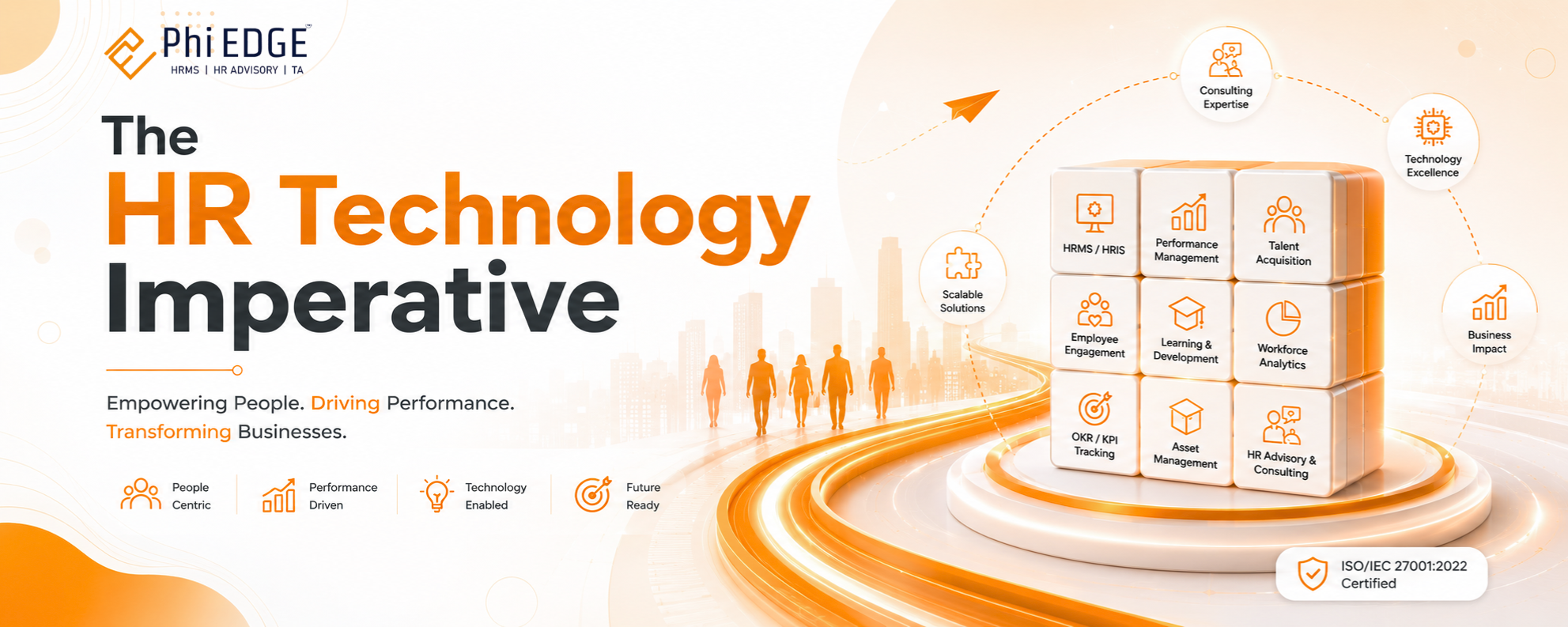
About This White Paper
This paper is written for CHROs, HR Directors, CEOs, and business leaders at Indian enterprises navigating the move from manual or fragmented HR processes to integrated, technology-enabled people management. It draws on Phi EDGE’s seven-plus years of advisory and implementation experience across 30 or more organisations in manufacturing, auto-components, industrial engineering, and related sectors.
Executive Summary
India’s workforce is at an inflection point. As organisations grow from 100 to 1,000 employees and beyond, the systems that once managed people — spreadsheets, standalone payroll tools, informal performance conversations — begin to collapse under their own weight. The cost of this collapse is not just operational inconvenience. It shows up in salary errors, compliance penalties, attrition spikes, productivity gaps, and leadership blind spots that compound silently over years.
This white paper presents the case for integrated HR technology as a strategic imperative, not a back-office upgrade. It examines the specific failure modes of legacy HR systems in Indian enterprises, outlines the capabilities that modern platforms must deliver, and explores how Phi EDGE’s consulting-plus-software model is helping organisations across India move from reactive HR to predictive, performance-driven people management.
The central argument is simple: organisations that invest in coherent HR systems today are building an operational advantage that compounds over time. Those that delay are accumulating a hidden liability—in attrition costs, compliance risk, and the opportunity cost of HR teams that spend their time on administration rather than strategy.
1. The State of HR in Indian Enterprises: A Diagnostic
To understand why the moment for HR technology Imperative is now, it is worth diagnosing the current state of people management in Indian enterprises — particularly in mid-to-large organisations that have scaled rapidly but whose HR infrastructure has not kept pace.
1.1 The Spreadsheet Trap
The majority of Indian organisations with fewer than 1,000 employees still manage core HR processes — leave tracking, attendance reconciliation, performance appraisals, and payroll inputs — on spreadsheets. This is not a judgment. It is a rational response to cost and complexity at early stages of growth. But the spreadsheet trap becomes costly as organisations scale.
Consider the compounding effect: a 300-person organisation processes roughly 300 monthly attendance records, 300 payroll inputs, and 300 leave balances. Every error in any of these — a missed leave entry, an incorrect carry-forward, a wrong loss-of-pay calculation — creates a downstream correction cycle that consumes HR bandwidth and erodes employee trust. At 600 employees, the same error rate doubles in absolute terms while HR headcount rarely doubles alongside it.
In Phi EDGE’s advisory engagements, organisations transitioning from manual HR processes to integrated HRMS typically report a 40 to 60 percent reduction in HR team time spent on routine administration within six months of go-live. This time is not eliminated — it is redirected to employee engagement, talent development, and strategic workforce planning.
1.2 The Compliance Blind Spot
India’s labour law framework is among the most complex in the world. The Factories Act, Shops and Establishments Act, Maternity Benefit Act, Payment of Gratuity Act, ESIC provisions, and state-specific variations create a compliance matrix that requires active management, not periodic review. For most organisations managing HR manually, compliance is reactive: they respond to audits, correct after penalties, and rely on institutional memory that walks out the door when key staff leave.
The risk is asymmetric. A single compliance failure — unpaid gratuity, incorrect PF deductions, miscalculated maternity entitlements — can result in penalties, legal exposure, and reputational damage that far outweighs the cost of the system that would have prevented it.
1.3 The Visibility Problem
Perhaps the most consequential failure of legacy HR systems is the visibility problem: leaders and managers cannot see what is actually happening with their people in real time. Who is at flight risk? Which department has declining performance? Where is leave abuse concentrated? Which roles are perpetually understaffed because attrition is not visible until it happens?
Without data, leadership defaults to anecdote and instinct. With data — even imperfect data — decisions improve measurably. HR technology does not replace managerial judgment. It gives that judgment a foundation.
1.4 The Employee Experience Gap
The expectations of the Indian workforce have shifted permanently. Employees who interact with consumer apps for banking, food delivery, and travel expect the same self-service experience from their employer for leave applications, salary slips, and performance feedback. When HR processes require physical forms, email chains, or waiting three days for a leave approval, it communicates — subtly but persistently — that the organisation does not respect employees’ time.
This is not merely an engagement issue. In a tight labour market, particularly for skilled roles in manufacturing and engineering, the quality of the employee experience is a retention factor that organisations cannot afford to ignore.
2. What Modern HR Technology Must Do
The market is full of HR software. Not all of it is equal, and not all of it is designed for the Indian context. Based on Phi EDGE’s experience, the following capabilities are non-negotiable for organisations seeking to build a sustainable HR technology foundation.
2.1 Integrated Data Architecture
The most important capability is one that is invisible to end users: integration. Leave data must flow directly into payroll. Attendance records must connect to performance analytics. Attrition signals must surface in the same dashboard as recruitment data. When HR data lives in separate systems, the reconciliation burden falls on HR teams — and the insights that would improve decisions never materialise.
True integration means a single source of truth for employee data, not a collection of loosely connected applications with periodic data exports between them.
2.2 Indian Compliance by Design
Generic HRMS platforms built for global markets often require significant configuration — and ongoing maintenance — to handle Indian labour law requirements. The Maternity Benefit Act’s 26-week entitlement, ESIC deduction thresholds, and state-specific shop and establishment rules must be pre-configured and regularly updated as regulations evolve. Organisations should evaluate HR platforms not on their international compliance credentials, but on the depth of their Indian compliance architecture.
2.3 Configurable Policy Engine
No two Indian organisations have identical HR policies, and no HR platform should expect them to. Leave type definitions, accrual logic, carry-forward caps, encashment eligibility, probation period rules, shift definitions, and holiday calendars vary by industry, geography, grade, and organisational philosophy. A platform that requires organisations to adapt their policies to its templates imposes hidden costs that accumulate over years.
2.4 Mobile-First and WhatsApp-Ready
In Indian enterprises — particularly manufacturing, logistics, and industrial organisations — a significant proportion of the workforce is not desk-bound. For these employees, a desktop HRMS is inaccessible. Mobile-first design is table stakes. WhatsApp integration goes further: it meets employees and managers on the channel they already use, enabling leave applications, approvals, payslip access, and notifications without requiring any additional app download or login.
2.5 Real-Time Analytics and Manager Dashboards
The shift from reactive to proactive HR requires data visibility at the manager level, not just in HR reports. When a manager can see, in real time, which team members are on leave this week, who has had three consecutive below-target performance ratings, and which employees have not taken any leave in six months — a potential burnout signal — the quality of management decisions improves measurably.
2.6 Advisory and Implementation Support
Technology implementation without organisational change management fails more often than it succeeds. The HR systems that deliver lasting value are those where the vendor brings domain expertise — understanding of HR practice, Indian regulatory context, and change management — alongside the software. This is the distinction between an HRMS vendor and an HR partner.
3. The Phi EDGE Approach: For HR, By HR
Phi EDGE was founded on a premise that remains relatively rare in the Indian HRMS market: that the people who build HR technology should have lived the practice of HR, not just observed it from the outside. This origin shapes every product and advisory decision the company makes.
The company operates across three interconnected verticals: an AI-powered HRMS platform with 19 integrated modules; an HR Advisory practice covering culture transformation, OKR design, competency frameworks, DEI, and compensation strategy; and a Talent Acquisition practice focused on senior and executive hiring. The combination is not coincidental — it reflects the belief that technology and human expertise must work together for organisations to realise meaningful improvement.
3.1 Platform Architecture: 19 Modules, One Data Layer
The Phi EDGE HRMS is structured around a unified employee data model, where every module draws from and contributes to the same underlying record. This architecture eliminates the reconciliation burden that plagues organisations using multiple disconnected tools. The 19 modules span the full employee lifecycle:
- Leave and Attendance Management — biometric sync, mobile punch-in, WhatsApp approvals, and customisable policy configuration
- Payroll Management — automated salary calculations, loss-of-pay processing, encashment, and statutory compliance
- Performance Management — OKR-based goal setting, KPI tracking, and continuous feedback workflows
- 360-Degree Feedback — multi-rater assessments, gap analysis, and individual development planning
- 9-Box Talent Grid — succession planning, high-potential identification, and talent placement strategy
- Learning and Development — training calendars, skill gap mapping, and training effectiveness tracking
- Competency Mapping — role-specific competency frameworks and structured assessment workflows
- Attrition Analytics — early warning signals, retention dashboards, and flight risk scoring
- Manpower Planning — headcount forecasting, resource allocation, and gap analysis
- HR MIS and Analytics — real-time dashboards, custom reports, and board-ready visualisations
3.2 The Consulting-Plus-Software Model
A core differentiation of Phi EDGE is the inclusion of HR advisory expertise as part of the client relationship — not as a premium add-on. When an organisation onboards onto the Phi EDGE platform, the implementation team includes HR consultants who understand policy design, Indian labour law, change management, and HR best practice — not just software configuration specialists.
This matters because the majority of HRMS implementation failures are not technical failures. They are organisational ones: policies that were never clearly defined, processes that were never properly documented, or adoption that stalled because employees and managers were not equipped to use the system. Phi EDGE’s approach addresses these risks by design.
3.3 Free Customisations: A Structural Commitment
Most HRMS vendors charge for customisations — policy-specific configurations, reporting adjustments, and workflow modifications. Over time, these charges accumulate and create friction between the organisation’s evolving needs and the platform’s capabilities. Phi EDGE’s commitment to free customisations reflects the belief that a long-term client relationship is more valuable than short-term configuration revenue.
This policy also has a practical effect: organisations are not incentivised to constrain their HR policies to fit the software. They can design the right HR framework first, and configure the platform to match — not the other way around.
3.4 Security and Certification
Employee data is among the most sensitive information an organisation holds — salary details, performance records, health information, personal identification. Phi EDGE’s ISO/IEC 27001:2022 certification provides clients with independently verified assurance that data is protected to international standards. For organisations evaluating HRMS platforms, security certification should be a baseline requirement. In the Indian market, it remains a meaningful point of distinction.
4. The Business Case for HR Technology Investment
For organisations evaluating HRMS investment, the business case must go beyond feature comparison. The ROI drivers fall into three categories: cost reduction, risk mitigation, and value creation.
4.1 Cost Reduction
- HR team time reallocation: a 40 to 60 percent reduction in administrative burden, redirected to strategic work
- Payroll processing efficiency: a 50 to 70 percent reduction in month-end processing time through automation
- Attrition cost reduction: each avoided voluntary resignation saves 50 to 150 percent of the role’s annual salary, accounting for recruitment, onboarding, and productivity ramp costs
- Error correction costs: elimination of salary correction cycles, overpayment recoveries, and manual audit preparation
4.2 Risk Mitigation
- Compliance penalties: automated statutory calculations eliminate the most common source of labour law violations
- Audit readiness: time-stamped, immutable records for every HR transaction reduce audit preparation time and risk
- Data security: ISO/IEC 27001:2022 certification reduces the risk of data breaches and associated consequences
- Institutional knowledge retention: process documentation and system configuration reduce dependence on individual knowledge holders
4.3 Value Creation
- Performance visibility: real-time KPI and OKR tracking enables faster intervention and course correction
- Talent development: integrated learning and development, competency, and 9-Box frameworks enable systematic capability building
- Leadership pipeline: succession planning data reduces the risk of critical role vacancies and supports internal mobility
- Employee experience: self-service, WhatsApp integration, and transparent processes improve engagement and employer brand
5. Client Outcomes: Evidence from the Field
Phi EDGE’s client base spans manufacturing conglomerates, auto-component manufacturers, industrial engineering firms, and diversified enterprise groups. The following outcome patterns are drawn from the company’s portfolio of 30 or more active enterprise clients across India.
5.1 Attrition Reduction Through Early Warning Systems
One of the most tangible ROI drivers of integrated HR technology is attrition reduction. When leave patterns, performance trends, and engagement signals are visible in a unified dashboard, HR and line managers can identify at-risk employees weeks or months before they resign — rather than learning about flight risk at the exit interview.
An industrial manufacturing client with over 400 employees reduced annualised attrition by approximately 18 percent within 14 months of implementing Phi EDGE’s integrated leave, performance, and attrition analytics modules. The primary driver was early identification of at-risk employees based on combined leave pattern and performance trend signals, enabling targeted retention conversations before resignation decisions were finalised.
5.2 Payroll Accuracy and Month-End Efficiency
For organisations processing payroll for hundreds of employees, month-end is consistently one of HR’s highest-pressure periods. The integration of leave, attendance, and payroll in Phi EDGE eliminates the manual reconciliation step that consumes HR bandwidth and introduces errors.
A Pune-based auto-components manufacturer processing payroll for 650 employees reported reducing month-end payroll processing time by approximately 65 percent following Phi EDGE implementation. The primary driver was elimination of the leave-to-payroll reconciliation step, with secondary savings from automated loss-of-pay calculation and removal of manual error-correction cycles.
5.3 Culture Transformation and Recognition
HR technology is often positioned as an operational efficiency tool. Phi EDGE’s client outcomes demonstrate that it can also be a culture-building platform when the right data enables the right conversations. Orbittal Electromech’s journey to Great Place to Work recognition was supported by the people data and transparency that Phi EDGE’s HRMS made possible, enabling HR to move from reactive administration to proactive employee experience design.
5.4 Long-Term Partnership
The most compelling evidence of platform value is client retention over time. ADM Group’s Founder and CEO has described a seven-year relationship with Phi EDGE encompassing culture transformation, HRMS implementation, HR advisory engagements, and ongoing performance system refinement. This duration reflects the compounding value of a platform-plus-advisory relationship: as the organisation evolves, the HR system evolves with it — without the disruption and cost of platform migration.
6. Implementation Framework: What Success Looks Like
The difference between HRMS implementations that deliver sustained value and those that stall at partial adoption is rarely about the technology. It is almost always about the implementation approach.
Phase 1: Discovery and Policy Mapping — Weeks 1 to 4
Before any system is configured, the organisation’s HR policies must be documented, rationalised, and where necessary redesigned. Phi EDGE’s HR advisory team conducts a structured audit of existing policies, identifies gaps and inconsistencies, and works with the client to define the policy framework that will govern the system configuration. This step is skipped by most HRMS vendors and is the primary reason implementations fail.
Phase 2: System Configuration and Testing — Weeks 3 to 8
With policy documentation in place, system configuration is a structured, repeatable process rather than an open-ended discovery exercise. Phi EDGE’s implementation team configures each module against documented policy requirements, conducts parallel testing against existing processes, and validates outputs before go-live.
Phase 3: Go-Live and Change Management — Weeks 7 to 12
Go-live is a change management event, not just a technical deployment. Phi EDGE’s implementation approach includes manager training, employee communications, and a structured support model during the first payroll cycle and leave period. The goal is not just system adoption — it is confident adoption, where managers and employees understand why the new process is better and how to use it effectively.
Phase 4: Optimisation and Evolution — Ongoing
The relationship does not end at go-live. As organisations evolve — adding locations, changing policies, scaling headcount, or responding to regulatory changes — the platform evolves with them. Phi EDGE’s free customisations policy and in-house advisory team ensure that this evolution is managed as a continuous, low-friction process rather than a series of costly change requests.
7. Strategic Implications
The organisations that will lead their industries in the next decade are not necessarily those with the most capital or the most aggressive growth strategies. They are the organisations that can deploy their human capital most effectively — identifying talent early, developing capability systematically, retaining key contributors, and building cultures that attract the people they need.
HR technology is the infrastructure that makes this possible at scale. Without it, people management remains artisanal — dependent on the quality of individual managers, constrained by the bandwidth of the HR team, and invisible to leadership until problems surface as crises.
The question is not whether to invest in HR technology. For organisations with 200 or more employees, that question has been answered by the cumulative cost of not investing — in attrition, compliance risk, and the strategic opportunity cost of HR teams that administer rather than advise. The real question is how to invest wisely: choosing a platform built for the Indian context, with the advisory depth to support implementation and the flexibility to evolve as the organisation grows.
8. Conclusion and Recommendations
The case for integrated HR technology in Indian enterprises is clear and urgent. The compounding costs of manual processes, compliance risk, and leadership blindness are not abstract — they show up in attrition reports, payroll error cycles, and the quiet departure of key talent.
For organisations evaluating their HR technology strategy, Phi EDGE offers the following recommendations:
- Start with policy, not software. Document and rationalise your HR policies before configuring any system. The system should serve your policy framework, not define it.
- Demand integration, not just functionality. A platform that excels at one module but does not connect to payroll and performance creates a new class of reconciliation problems.
- Evaluate the advisory depth, not just the feature list. The platforms that deliver sustained value are those where the vendor brings HR expertise alongside technology.
- Insist on Indian compliance specificity. Generic global platforms require significant configuration to handle Indian labour law. That cost is often invisible in the procurement stage but significant in production.
- Think in decades, not deployment timelines. The right HR platform is one your organisation grows into, not one you grow out of. Evaluate flexibility, customisation commitment, and the vendor’s advisory capacity for the long term.
Phi EDGE’s combination of a 19-module integrated platform, in-house HR advisory, free customisations, WhatsApp-native integration, and ISO/IEC 27001:2022 certification represents a considered response to all five of these principles. We believe the evidence from our client portfolio demonstrates that the platform-plus-advisory model consistently outperforms software-only alternatives when measured over a meaningful time horizon.
We invite you to test this claim directly. Book a free consultation with the Phi EDGE team. We will audit your current HR processes, identify the gaps that are costing you the most, and show you exactly how our platform maps to your organisation’s specific context — with no obligation and no generic demo.
Schedule a consultation: www.phiedge.co.in/contact
Email: contact@phiedge.co.in | Phone: +91-8956049164
About Phi EDGE
Phi EDGE HR Tech Pvt. Ltd. is an ISO/IEC 27001:2022 certified HR technology and advisory company headquartered in Baner, Pune. Founded on the principle of For HR, By HR, the company serves enterprise clients across India with an integrated suite of HRMS software, HR advisory services, and talent acquisition solutions.
The Phi EDGE HRMS platform comprises 19 integrated modules covering the full employee lifecycle — from recruitment and onboarding through performance management, learning and development, succession planning, and attrition analytics. The company’s HR advisory practice has supported culture transformation, OKR implementation, competency framework design, DEI strategy, and compensation restructuring at organisations ranging from family-owned manufacturers to publicly listed industrial groups.
Client organisations include JSW Steel, ADM Group, Mega Rubber Technologies, Orbittal Electromech, Mubea, Advik Group, and Ognibene India, among others.
Disclaimer
This white paper is published for informational purposes by Phi EDGE HR Tech Pvt. Ltd. Client outcomes described are based on reported experience from Phi EDGE’s engagements. This document does not constitute legal or compliance advice. Copyright 2026 Phi EDGE HR Tech Pvt. Ltd. All rights reserved.
Published by Phi EDGE HR Tech Pvt. Ltd.
Baner, Pune, Maharashtra, India | April 2026 | Edition 1.0