+91 8956049164
  contact@phiedge.co.in


5 Workforce Shifts in 2026 Every HR Leader Should Act On Powered by Phi EDGE HRMS
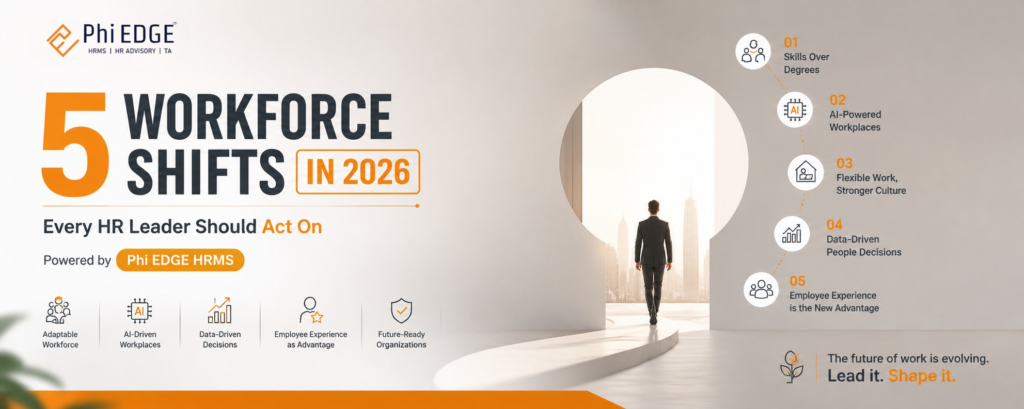
The workplace of 2026 doesn’t look like the one HR leaders planned for even two years ago. Hybrid work has matured into something more complex, employees expect transparency and growth in equal measure, and AI has moved from “nice to have” to the backbone of everyday HR operations.
For HR leaders, the question isn’t whether to adapt — it’s how fast and with what tools. 5 Workforce Shifts in 2026 Every HR Leader Should Act On Powered by Phi EDGE HRMS Below are five workforce shifts defining 2026 and how a modern, AI-powered HRMS like Phi EDGE helps you act on each one before it becomes a problem.
Skills Are Replacing Job Titles — Build a Real Competency Model Framework
Job descriptions are losing relevance. Companies are hiring, promoting, and rewarding based on demonstrated skills rather than static titles. This means HR teams need a structured competency model framework that maps the exact skills required for each role, tracks employee proficiency against that map, and flags gaps before they become performance issues.
Without this framework, promotions feel arbitrary, training budgets get wasted on the wrong programs, and succession planning becomes guesswork. With Phi EDGE, HR leaders can build role-specific competency frameworks natively inside the platform, linking skills directly to appraisals, learning paths, and career progression — so every development conversation is backed by data, not opinion.
Action item: Audit your current job architecture. If competencies aren’t formally mapped and tracked, 2026 is the year to fix that.
- Feedback Has to Be Continuous, Not Annual
The once-a-year review is dead weight in 2026. Employees expect real-time, multi-source feedback that reflects how they actually work with peers, managers, and cross-functional teams. This is why 360-degree feedback software has become a core HR tech investment rather than an optional add-on.
Good 360 feedback software does more than collect ratings — it aggregates feedback from managers, peers, direct reports, and even clients, then turns it into clear development insights. Phi EDGE’s built-in 360-feedback module lets HR teams launch feedback cycles in minutes, customize question sets by role or competency, and generate individual growth reports automatically — closing the loop between feedback and action.
Action item: If your feedback process still runs once a year through spreadsheets or forms, it’s time to move to continuous, software-driven feedback loops.
- Leave and Attendance Management Needs to Be Smart, Not Manual
Hybrid and distributed teams have made manual leave tracking unsustainable. HR leaders are under pressure to reduce administrative overhead while still maintaining accuracy, compliance, and visibility across locations. That’s where AI leave management software comes in — automating approvals, flagging patterns (like recurring Monday leaves or burnout risk), and syncing seamlessly with payroll.
Phi EDGE combines leave and attendance tracking with AI-driven insights, so managers get real-time visibility into team availability, and HR gets predictive analytics on absenteeism trends — before they affect productivity or morale.
Action item: Move away from manual leave approvals and spreadsheet-based attendance logs. AI-based automation isn’t a luxury anymore; it’s table stakes for a distributed workforce.
- AI Is Now Expected Across the Entire HR Stack
By 2026, employees and HR teams alike expect AI to be embedded everywhere — from resume screening to performance insights to chatbot-driven employee support. Standalone tools that don’t talk to each other are becoming a liability. This is driving demand for unified AI HR software platforms that bring recruitment, performance, payroll, and engagement together under one intelligent system.
As an HRMS company in India built for scale, Phi EDGE integrates AI across the entire employee lifecycle — smart candidate matching, predictive attrition alerts, automated payroll reconciliation, and conversational support for employee queries — all within a single dashboard, rather than a patchwork of disconnected tools.
Action item: Evaluate whether your current HR stack is genuinely AI-enabled or just marketed that way. Look for platforms where AI improves decision-making, not just automates data entry.
- Payroll and Talent Management Can No Longer Sit in Silos
In 2026, employees expect payroll accuracy and career growth conversations to feel connected, not like they belong to two different departments. HR leaders are increasingly evaluating HR & payroll management software, as well as talent management software, together, because disconnected systems create errors, delays, and a disjointed employee experience.
Among the best HRMS tools available today, those that win the trust of HR leaders are those that unify payroll, compliance, performance, and talent development on a single platform. Phi EDGE was built on exactly this principle — payroll runs are linked to attendance and leave data automatically, while talent management modules use the same employee data to power appraisals, succession planning, and internal mobility.
Action item: If your payroll and talent systems don’t share data in real time, you’re likely creating friction — and risk — that a unified HRMS can eliminate.
The Conclusion
2026 isn’t asking HR leaders to do more with less — it’s asking them to do it smarter. Competency-based growth, continuous feedback, AI-driven leave and attendance, unified AI HR software, and integrated payroll and talent management aren’t separate initiatives anymore. They’re pieces of the same connected HR strategy.
Phi EDGE HRMS was built to bring all five of these shifts together in one platform — helping HR leaders move from reactive administra