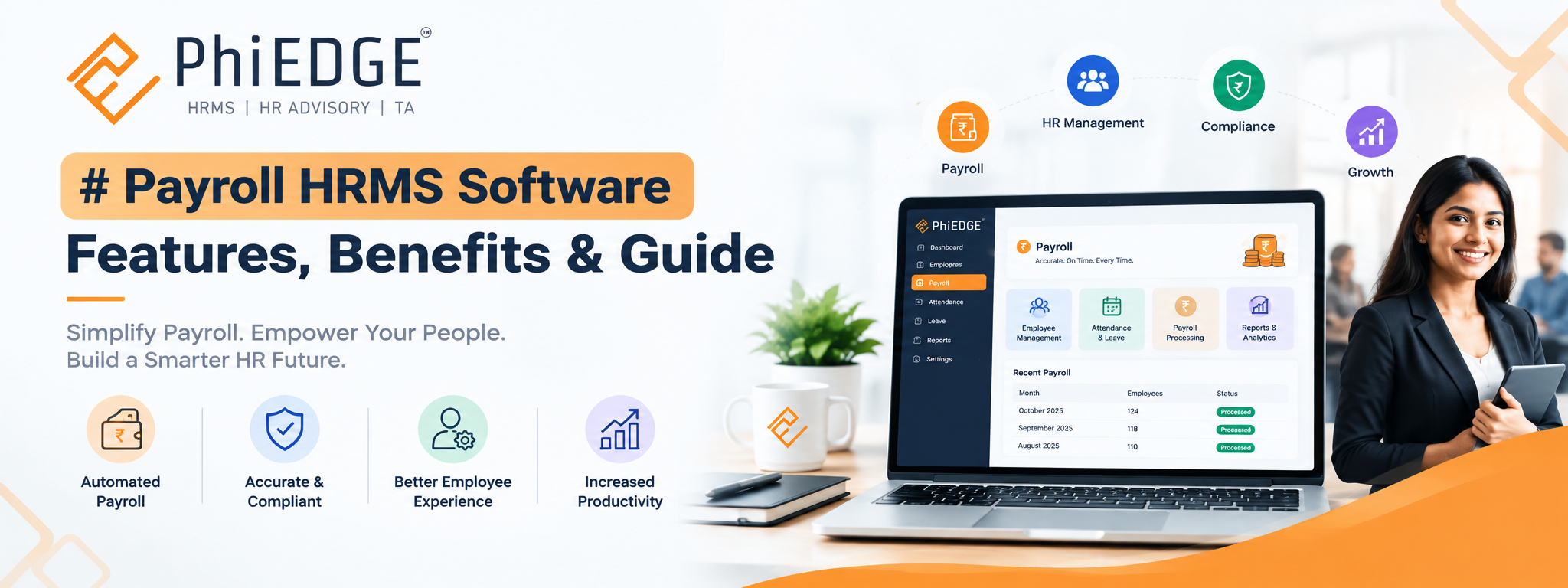
Managing employee salaries involves much more than transferring money at the end of the month. HR teams must coordinate employee records, attendance, leave, salary structures, deductions, approvals and payroll reports. As a business grows, managing these activities through disconnected spreadsheets and manual calculations can become increasingly difficult.
Payroll HRMS software helps organizations bring payroll-related information and HR processes into a more organized digital workflow. When payroll is integrated with attendance, leave management and employee records, HR teams can work with consistent information and reduce repetitive administrative tasks.
In this guide, we explain how payroll HRMS software works, its essential features, its benefits for Indian businesses and what organizations should consider before choosing a solution such as Phi EDGE HRMS.
What Is Payroll HRMS Software?
Payroll HRMS software is a digital system that helps businesses manage employee salary processing alongside other human resource activities. HRMS stands for Human Resource Management System.
A payroll management system can support salary calculations, earnings and deductions, payslip preparation and payroll reporting. When integrated with a broader HRMS platform, payroll processes can use relevant employee, attendance and leave information from a centralized system.
For example, an HR team can maintain employee records, review attendance data, process approved salary changes and prepare payroll reports through connected workflows instead of relying on multiple disconnected files.
The exact features available depend on the software and its configuration.
Why Do Businesses Need Payroll HRMS Software?
Manual payroll management can become complicated when an organization has multiple departments, different salary structures, shift-based employees or several office locations.
Common challenges include inconsistent employee records, missing attendance information, repeated data entry, delayed approvals and difficulty reviewing payroll reports.
Payroll HRMS software can help address these challenges by organizing payroll information, supporting repeatable processes and improving visibility into payroll-related activities.
Businesses should still establish appropriate approval controls, review calculations and verify statutory requirements. Automation supports payroll operations, but it does not eliminate the need for human oversight.
What Are the Key Features of Payroll HRMS Software?
1. Employee Information Management
Payroll processing depends on accurate employee information. A connected HRMS can help maintain employee details, employment records, salary structures and other relevant information in a centralized system.
Authorized HR personnel can review and update records according to established company procedures.
2. Attendance and Leave Integration
Attendance and leave information can affect payable days, approved leave adjustments and other salary components, depending on company policy.
Integrating these records with payroll can reduce duplicate data entry and help HR teams identify discrepancies before payroll is finalized.
3. Salary Processing and Payslips
Payroll software can support the calculation and organization of salary components, approved deductions, incentives and other applicable payments.
It can also help generate employee payslips and payroll reports. Organizations should verify the software’s support for their specific salary structures, approval workflows and reporting requirements before implementation.
4. Payroll Compliance Support
Businesses operating in India may need to account for applicable provident fund, employee state insurance, professional tax, tax deductions and other statutory obligations, depending on employee eligibility and the organization’s circumstances.
Payroll HRMS software can support relevant calculations, records and reports where those capabilities are available. Employers remain responsible for verifying current rules, eligibility conditions, filing obligations and payment deadlines.
Useful official references include the Employees’ Provident Fund Organisation, the Employees’ State Insurance Corporation and the Income Tax Department.
5. Payroll Reports and Analytics
Payroll reports help HR teams review salary costs, deductions, employee-level records and other payroll information.
Depending on the platform, reporting tools can help management review workforce costs and identify inconsistencies that require investigation. Access to sensitive payroll information should be restricted to authorized users.
How Does Payroll HRMS Software Improve HR Efficiency?
Payroll HRMS software can improve efficiency by connecting information that HR teams otherwise manage separately.
For example, an organization may use attendance records to prepare payroll inputs, route salary changes through an approval process and generate reports after payroll review. These workflows can reduce repetitive tasks and make responsibilities easier to track.
The benefits depend on data quality, software configuration, employee adoption and the effectiveness of the organization’s existing processes. Businesses should measure improvements through relevant indicators, such as payroll processing time, correction rates and the number of manual steps required each month.
How Should You Choose the Right Payroll HRMS Software in India?
Before selecting a payroll management system, businesses should evaluate their operational requirements rather than choosing software based on feature lists alone.
Consider the following questions:
- Does the software support your employee strength and salary structures?
- Can attendance, leave and employee information connect with payroll?
- Does it support the statutory calculations and reports your organization requires?
- Can payroll data be reviewed and approved before finalization?
- What access controls and security measures protect sensitive employee information?
- Can the system integrate with your existing HR or finance applications?
- What implementation, training and ongoing support are available?
- Can the solution accommodate future workforce growth?
Request a demonstration using representative business scenarios. Ask the provider to explain how the system handles exceptions, corrections, approvals, data migration and compliance updates.
How Can Phi EDGE HRMS Support Payroll and HR Management?
Phi EDGE HRMS offers a broader human resource management platform with a listed Payroll module and other HR capabilities, including performance management, employee records, leave and attendance management, and related workforce processes.
For organizations evaluating payroll HRMS software, an integrated approach can help connect payroll with relevant employee information and HR workflows.
The suitability of Phi EDGE HRMS for a particular organization depends on its payroll requirements, configuration and the specific capabilities confirmed during a product demonstration. Businesses should discuss their statutory reporting needs, integrations, data security requirements and implementation process with the Phi EDGE team before making a decision.
Explore the Phi EDGE official website to learn more about its HRMS solutions.
Frequently Asked Questions About Payroll HRMS Software
What is the difference between payroll software and HRMS software?
Payroll software focuses primarily on salary processing, deductions, payslips and payroll reports. HRMS software covers a broader range of HR activities, which may include employee records, attendance, leave management and performance processes. An integrated HRMS may include payroll as one of its modules.
Is payroll HRMS software suitable for small and medium-sized businesses?
It can be suitable for small and medium-sized businesses that need more structured payroll processes. The right solution depends on employee strength, salary complexity, compliance requirements, budget and the level of support needed.
Can payroll HRMS software automate salary calculations?
Many payroll systems support automated calculations based on configured salary structures, approved payroll inputs and applicable rules. HR teams should validate the calculations, review exceptions and approve payroll before payments are processed.
Does payroll HRMS software support statutory compliance in India?
Some solutions support relevant statutory calculations, records and reports. Businesses must confirm which requirements are supported and independently ensure that their processes meet applicable laws and deadlines.
How can a company evaluate Phi EDGE HRMS?
A business can review the official product information and request a demonstration. During the demo, it should assess payroll workflows, attendance integration, reporting, access controls, implementation support and compatibility with its specific requirements.
Conclusion
Payroll HRMS software can help businesses organize salary processing, connect payroll with employee information and establish more consistent HR workflows. The most appropriate solution is one that fits the organization’s operational requirements, supports accurate processing and provides suitable controls for sensitive employee data.
Phi EDGE HRMS is an option for businesses exploring integrated HR management capabilities. Before selecting a platform, review its relevant features, verify compliance requirements and request a demonstration based on your actual payroll scenarios.
Interested in exploring HRMS solutions for your organization? Visit the Phi EDGE website to learn more and enquire about a product demonstration.
Leave a Reply