
Quick Answer: The bell curve in performance appraisal is not automatically good or bad. In 2026, rigid forced ranking is increasingly difficult to justify because employee performance does not always follow a fixed statistical distribution. However, data-driven calibration, clear KPIs, continuous feedback, and evidence-based performance ratings can still help organizations differentiate performance fairly.
For HR leaders, the better question is not “Should we use a bell curve?” but “How can we make performance evaluation fair, measurable, transparent, and development-focused?”
Research published on forced distribution systems highlights both sides: standardized distributions can reduce rating inflation, but they can also create perceptions of unfairness, discrimination, unhealthy competition, and reduced collaboration.
This is where modern performance management software and HRMS platforms such as Phi EDGE can help organizations move from forced ranking toward structured, data-backed performance management.
What Is a Bell Curve in Performance Appraisal?
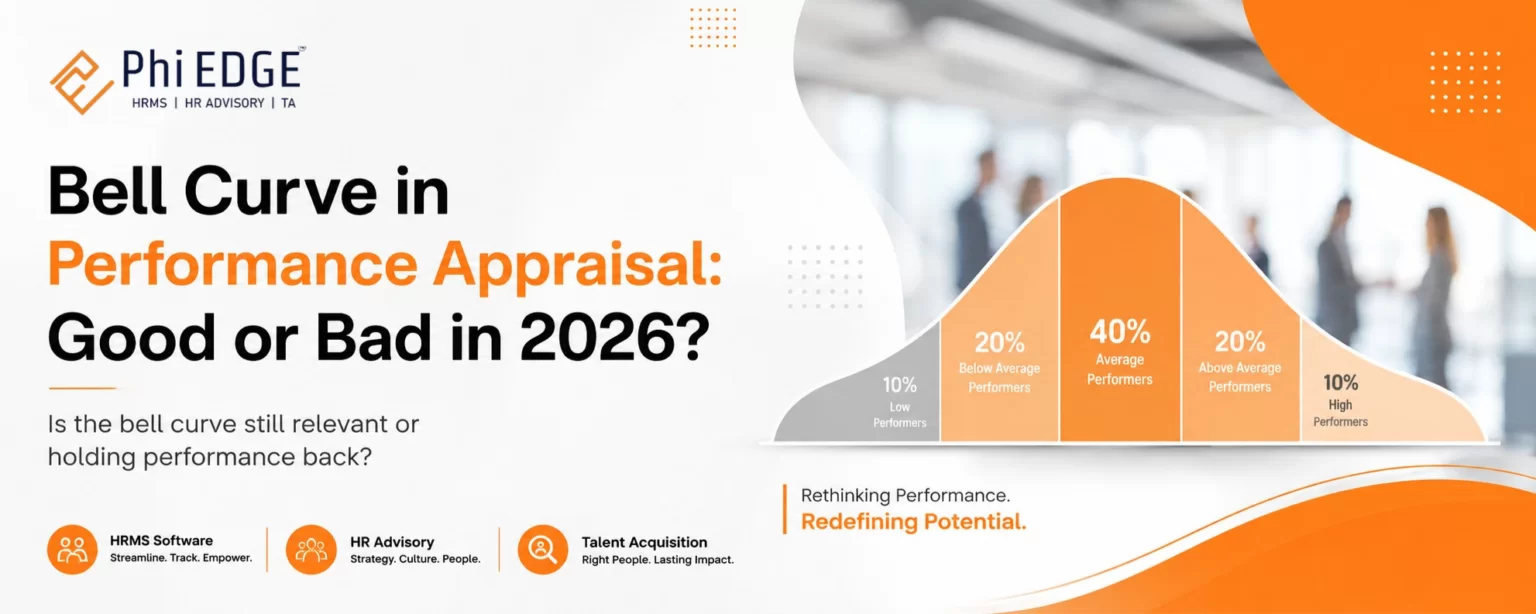
Bell Curve in Performance Appraisal: Good or Bad in 2026? A bell curve appraisal, also called forced distribution, forced ranking, or stack ranking, requires managers to distribute employees into predefined performance categories.
A traditional example could look like this:
- Top 20%: Exceptional/high performers
- Middle 70%: Meets expectations
- Bottom 10%: Needs improvement
Other organisations may use a 10-80-10 distribution or divide employees into five performance groups.
The purpose is to prevent managers from rating almost everyone as “excellent” and to create differentiation between employees. Historically, the approach became particularly associated with General Electric’s 20-70-10 model.
But the business environment has changed.
Modern employees often work collaboratively across projects, functions, locations, and teams. Therefore, comparing employees purely against each other can fail to capture individual contribution, role complexity, teamwork, innovation, and context.
How Does Bell Curve Performance Appraisal Work?
The process generally follows five steps:
1. Define Performance Criteria
HR establishes KPIs, competencies, goals, behavioral expectations, and rating levels.
2. Collect Performance Data
Managers evaluate employees using targets, project outcomes, competencies, feedback, attendance, achievements, and other relevant evidence.
3. Assign Preliminary Ratings
Managers provide initial performance ratings based on employee contribution.
4. Apply Calibration or Distribution
Employees are compared across a group and placed into predetermined performance categories.
5. Link Ratings to HR Decisions
Ratings may influence:
- Salary increments
- Bonuses
- Promotions
- Recognition
- Development plans
- Performance improvement plans
The biggest concern arises when the distribution becomes more important than actual performance evidence.
Is the Bell Curve Good for Performance Appraisals in 2026?
The Short Answer
A rigid bell curve is usually not the best standalone performance appraisal method in 2026.
However, a flexible calibration framework can still be useful.
The distinction is important.
A company can use performance distribution data to identify unusual rating patterns without forcing managers to artificially place a fixed percentage of employees into a low-performance category.
Recent research has found that employees downgraded because of forced ranking cutoffs were significantly more likely to leave the organisation, highlighting the potential retention consequences of rigid forced ranking.
When Bell Curve Can Be Useful
A controlled distribution approach can help when:
- Managers routinely give everyone similar ratings.
- Performance standards are unclear.
- The organization needs stronger rating differentiation.
- HR wants to identify rating inflation.
- Large employee populations are performing comparable roles.
- Calibration discussions are already mature.
When Bell Curve Can Become Harmful
It can create problems when:
- A fixed percentage must be classified as poor performers.
- Employees compete rather than collaborate.
- Different jobs are compared using identical standards.
- Ratings are based on relative ranking instead of evidence.
- Managers manipulate rankings to meet quotas.
- Performance ratings directly determine termination without adequate process.
Benefits of Bell Curve Performance Appraisal
The bell curve continues to attract organizations because it can solve some real HR challenges.
1. Reduces Rating Inflation
Managers may hesitate to give low ratings because difficult conversations can create conflict. A structured distribution can encourage greater differentiation.
The U.S. Office of Personnel Management’s 2026 performance appraisal discussion also recognises that standardised distributions can help address leniency bias, while noting important risks.
2. Identifies High Performers
A distribution framework can help HR identify employees who consistently deliver exceptional results.
These employees can then be considered for:
- Leadership programmes
- Promotions
- Succession planning
- Higher responsibilities
- Performance-linked rewards
3. Creates Rating Consistency
Without calibration, one manager may rate employees very strictly while another may rate everyone generously.
Comparative analysis can expose these inconsistencies.
4. Supports Reward Differentiation
When used carefully, differentiated performance ratings can support merit-based compensation and recognition.
5. Provides a Simple Management Framework
For organizations with large workforces, a standardized framework can make performance review discussions easier to structure.
Disadvantages of Bell Curve Performance Appraisal
The biggest issue is that employee performance is not necessarily distributed according to a predetermined curve.
1. Creates Artificial Low Performers
Imagine a team of 10 employees where all 10 have achieved or exceeded their objectives.
If the organisation mandates that one employee must be placed in the bottom category, the system may create a low performer where none actually exists.
This is one of the fundamental criticisms of forced distribution.
2. Can Damage Employee Morale
An employee may feel unfairly evaluated if their rating depends on how colleagues performed rather than whether they achieved their own objectives.
3. Encourages Internal Competition
When employees know that only a fixed percentage can receive the highest rating, collaboration can suffer.
Research on forced distribution has identified potential negative effects on citizenship behaviour and knowledge sharing.
4. Can Increase Employee Turnover
A 2025 Management Science study examining forced ranking found that employees downgraded from top performance levels because of a strict ranking cutoff were at least 34% more likely to voluntarily leave.
5. Does Not Always Reflect Role Complexity
Comparing a salesperson, software developer, HR professional, plant manager, and customer service executive using the same distribution logic can produce misleading results.
6. Can Encourage Short-Term Behaviour
Employees may focus heavily on measurable targets while neglecting:
- Knowledge sharing
- Mentoring
- Teamwork
- Long-term innovation
- Employee development
- Customer relationships
Bell Curve vs Modern Performance Management
| Factor | Bell Curve | Modern Performance Management |
|---|---|---|
| Evaluation | Relative ranking | Goal and evidence based |
| Employee comparison | High | Limited |
| Fixed distribution | Often used | Usually avoided |
| Feedback | Periodic | Continuous |
| KPIs | Important | Central |
| Collaboration | Can be affected | Encouraged |
| Development | Secondary | Core objective |
| Calibration | Often distribution-driven | Evidence-driven |
| Technology | Optional | Highly valuable |
| Employee visibility | Can be limited | More transparent |
The modern approach does not mean “everyone gets a high rating.” It means high and low performance should be differentiated based on actual evidence, rather than an artificial quota.
Real Example of Bell Curve Appraisal
Example: 100-Employee Organisation
Suppose an organisation has 100 employees and adopts a 20-70-10 model.
The appraisal committee must classify:
- 20 employees as high performers
- 70 employees as average performers
- 10 employees as low performers
Now consider a high-performing department where 95 employees meet or exceed their KPIs.
The fixed model may still require approximately 10 employees to fall into the lowest category.
This creates a fundamental question:
Are those employees genuinely low performers, or are they simply lower-ranked within a strong group?
A better 2026 approach would use the distribution as a diagnostic signal, then review actual KPI achievement, competencies, role expectations, manager evidence, peer feedback, and business impact.
A Better Alternative to the Bell Curve in 2026
Modern organisations can retain the useful part of calibration while removing the forced quota.
Use Goal-Based Performance Reviews
Every employee should have measurable goals aligned with business objectives.
For example:
Sales Executive
- Revenue target
- Conversion rate
- Customer retention
- New account acquisition
HR Manager
- Hiring turnaround time
- Employee engagement
- Attrition
- HR process efficiency
Operations Manager
- Productivity
- Quality
- Cost control
- Process improvement
Add Competency-Based Evaluation
Performance is more than numbers.
Competencies can include:
- Leadership
- Communication
- Problem-solving
- Collaboration
- Innovation
- Customer focus
Introduce Continuous Feedback
Instead of waiting for an annual appraisal, managers can provide feedback throughout the year.
Use Calibration Without Forced Ranking
HR can compare ratings across teams and ask:
What evidence supports this rating?”
Rather than:
Who must go into the bottom 10%?”
This creates calibration without artificial ranking.
How HRMS Software Can Improve Performance Appraisals
A modern HRMS can make performance management more structured and transparent.
With the right technology, HR teams can manage:
Goal Setting and KPI Tracking
Employees and managers can define goals and monitor progress throughout the appraisal cycle.
Appraisal Workflows
Automated workflows can guide employees, managers, HR, and leadership through each stage of the review process.
360-Degree Feedback
Feedback from multiple stakeholders provides a broader view of employee performance instead of relying exclusively on one manager.
Performance Analytics
HR can identify rating trends, department-level differences, high performers, skill gaps, and unusual rating patterns.
Learning and Development Integration
Performance results can be connected to development plans and training.
Phi EDGE’s Talent Management System includes goal setting, appraisal cycles, 360° feedback, succession planning, performance management, and learning & development capabilities.
Why Phi EDGE Is a Smarter Choice for Performance Management
If your organisation is reconsidering the traditional bell curve, Phi EDGE can help build a more structured and data-driven performance management process.
Performance + Talent Management in One Ecosystem
Phi EDGE combines performance management with broader talent management capabilities, helping organisations connect employee performance with development and succession planning.
Goal Setting and Appraisal Cycles
Instead of relying only on end-of-year rankings, organisations can establish goals and appraisal workflows that create a clearer performance trail.
360-Degree Feedback
Multi-source feedback can provide additional context around leadership, collaboration, and employee contribution.
Performance-Linked Learning
Performance and competency data can help identify employees who need specific development interventions. Phi EDGE’s L&D approach connects performance and competency information with learning recommendations.
Integrated HRMS
Performance data can sit alongside other HR processes instead of operating as an isolated spreadsheet-based activity.
Built for Different Industries
Phi EDGE states that its talent management platform supports organisations across sectors including manufacturing, financial services, real estate, hospitality, construction, academics, and IT.
Buying Guide: What Should You Look for in Performance Management Software?
Before purchasing performance management software, HR leaders should evaluate these capabilities.
Essential Features Checklist
Look for:
- KPI and goal management
- Configurable appraisal cycles
- Competency management
- 360-degree feedback
- Manager and employee self-service
- Performance dashboards
- Calibration support
- Automated workflows
- Development planning
- Learning integration
- Talent and succession management
- HRMS integration
- Reports and analytics
- Mobile accessibility
- Role-based access and security
Ask Vendors These Questions
Before selecting a platform, ask:
- Can we customise appraisal cycles?
- Can managers define role-specific KPIs?
- Can we use calibration without forced ranking?
- Can employees view their goals and feedback?
- Can performance data support learning plans?
- Can HR generate department-level performance reports?
- Can the platform integrate with our existing HRMS?
- Can the system scale as our workforce grows?
The right platform should adapt to your performance philosophy—not force your organisation into a rigid process.
Expert Advice: Should Your Organisation Stop Using the Bell Curve?
Do not eliminate differentiation. Eliminate artificial differentiation.
That is the key distinction for 2026.
A high-performing employee should receive recognition. An employee consistently missing expectations should receive clear feedback and a development plan. But neither outcome should be created merely because a predetermined percentage requires it.
A stronger performance management framework combines:
Clear KPIs + Competencies + Continuous Feedback + 360° Feedback + Calibration + Analytics + Development Plans
This approach provides the differentiation HR needs while maintaining greater focus on fairness and employee development.
2026 Performance Appraisal Framework: A Better Model
Step 1 — Set Clear Goals
Define measurable employee and team objectives.
Step 2 — Track Progress
Review performance throughout the year rather than only during annual appraisal.
Step 3 — Collect Evidence
Use KPIs, project results, competencies, feedback, and manager observations.
Step 4 — Calibrate Ratings
Compare ratings across managers to identify inconsistencies.
Step 5 — Avoid Automatic Quotas
Do not force employees into a low-performance category simply to satisfy a distribution.
Step 6 — Create Development Plans
Connect performance gaps to coaching, training, mentoring, or role-specific development.
Step 7 — Recognise Real Performance
Use evidence to guide promotions, increments, rewards, and succession decisions.
Final Verdict: Is Bell Curve Good or Bad in 2026?
The bell curve is not inherently useless, but a rigid forced-ranking model is increasingly difficult to align with modern, collaborative workplaces.
Its strongest benefit is the ability to challenge rating inflation and encourage performance differentiation.
Its biggest weakness is forcing employee performance into a predetermined statistical pattern.
For most organisations in 2026, the smarter strategy is:
Use performance distribution as an analytical input—not as an artificial quota.
HR leaders should focus on measurable goals, continuous feedback, competency-based evaluation, fair calibration, employee development, and actionable analytics.
If your organisation is still managing appraisals through spreadsheets, disconnected feedback, or rigid ranking systems, it may be time to modernise the process.
Phi EDGE can help organisations build a more connected approach to performance, talent, feedback, learning, and workforce management. Its talent management platform supports goal setting, appraisal cycles, 360° feedback, succession planning, learning and development, and HRMS integration.
Ready to Move Beyond the Traditional Bell Curve?
Talk to Phi EDGE today to explore a modern performance management approach designed around measurable goals, continuous feedback, talent development, and data-driven HR decisions.
CTA: Book a Demo | Talk to a Performance Management Expert | Explore Phi EDGE HRMS
Frequently Asked Questions
Is bell curve appraisal good or bad?
It depends on implementation. A rigid forced distribution can create unfair rankings, while data-driven calibration can help identify rating inconsistencies without forcing employees into fixed categories.
What is a 20-70-10 bell curve?
It generally means 20% of employees are placed in the top category, 70% in the middle, and 10% in the bottom category.
Why is bell curve appraisal controversial?
Because it can require organisations to classify a fixed percentage of employees as low performers even when actual performance does not follow that distribution.
What is better than bell curve appraisal?
Goal-based performance management combined with competency evaluation, continuous feedback, 360-degree feedback, calibration, and development planning can be a stronger alternative.
Can HRMS software replace bell curve appraisal?
HRMS software does not automatically replace an appraisal philosophy. It provides the technology to manage goals, feedback, ratings, analytics, workflows, and development more effectively.
Does Phi EDGE support performance management?
Yes. Phi EDGE’s talent management platform includes goal setting, appraisal cycles, 360° feedback, performance management, succession planning, and integration with HRMS capabilities.
- Talent Management System Software — use around “modern talent management” or “performance and talent management”.
- Learning & Development — use around “performance-linked learning” or “employee development”.
- Leave & Attendance Management System — use naturally around integrated HRMS and workforce data.
- Phi EDGE Case Studies — use around “real-world HR transformation” or “performance management case studies”.