+91 8956049164
  contact@phiedge.co.in


Build a Winning Workforce with a Competency Model Framework Using Phi EDGE
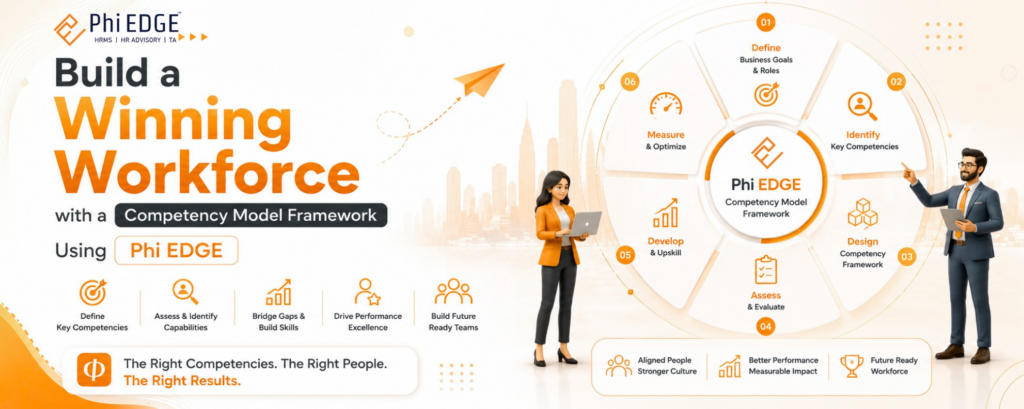
Every growing business wants a high-performing workforce, but strong performance rarely happens by chance. It is built when organizations clearly define what success looks like in each role, identify the skills and behaviors employees need, and create systems that develop those capabilities over time.
That is exactly where a competency model framework becomes valuable. With Phi EDGE, companies can move beyond basic performance tracking and build a more structured, data-backed approach to talent development, workforce planning, and long-term organizational growth.
What is a competency model framework?
A competency model framework is a structured method for identifying the knowledge, skills, behaviours, and attributes required for success in a role, function, or leadership level. It helps organizations create a common language for performance, hiring, development, and succession planning.
Instead of evaluating employees only on output, a competency framework shows how performance is achieved. That makes it easier to assess potential, identify gaps, guide learning, and align people’s decisions with business strategy.
For modern businesses, this matters because job roles are evolving quickly. Companies need a reliable way to define critical capabilities, not just current tasks, so they can build teams that are ready for both present demands and future change.
Why competency frameworks matter
Many organizations still rely on loosely defined job expectations, manager opinion, or annual reviews that focus heavily on results but not enough on capability. That approach can create inconsistency in hiring, promotions, appraisals, and development planning.
A competency model framework helps solve this by bringing clarity and objectivity into workforce management. It supports recruitment, learning and development, performance reviews, and succession planning through a common structure that links employee capability with business goals.
When done well, competency mapping also improves fairness. Employees understand what is expected, managers assess against more consistent standards, and HR teams gain better visibility into where the organization is strong and where intervention is needed.
How Phi EDGE supports competency-based workforce building
Phi EDGE positions competency mapping as a core part of its HRMS and talent management ecosystem. Its platform highlights competency models alongside performance management, learning and development, 360-degree feedback, 9-box assessments, rewards, and employee lifecycle management.
This is important because competency management works best when it is connected to the broader talent system. Phi EDGE links competency data with performance processes, enabling companies to assess employee capability in a more complete and actionable way.
The platform also presents competency scores as part of decision-making for salary increments and variable pay. That creates a stronger performance culture because it rewards not only outcomes, but also the capabilities that drive sustained contribution.
Keyways Phi EDGE helps build a winning workforce
Role clarity and skill alignment
Phi EDGE competency mapping approach helps organizations define the right competencies for each role and evaluate employees against those expectations. This creates stronger role fit and helps ensure the right talent is placed in the right positions.
That kind of alignment is especially useful in businesses that are scaling quickly or hiring across multiple departments. A structured competency framework reduces ambiguity and makes talent decisions more consistent.
Better performance management
Phi EDGE performance management system emphasizes goal alignment, continuous feedback, and 360-degree reviews. When paired with competency models, this creates a richer performance process that looks not only at what employees delivered, but also at the behaviors and capabilities behind those outcomes.
This gives managers a more balanced way to coach employees. It also helps organizations create stronger development conversations instead of limiting appraisals to ratings and short-term targets.
Smarter learning and development
Competency frameworks are most effective when they lead directly to action. Phi EDGE talent management content highlights competency mapping as a way to identify skill gaps and support learning and development with more targeted interventions.
That means training becomes more strategic. Instead of generic learning programs, organizations can focus on the exact capabilities employees need to improve performance, prepare for larger roles, and support future business priorities.
Stronger succession planning
The winning workforce is not only about current productivity; it is also about future readiness. Phi EDGE talent management positioning includes succession planning, leadership identification, and workforce optimization as key outcomes of an integrated HRMS system.
When competency data is available across roles and levels, HR teams can identify high-potential employees more accurately. This helps businesses build internal leadership pipelines rather than depending only on external hiring.
Data-backed people decisions
Phi EDGE emphasizes real-time analytics and integrated decision-making across HR workflows. This makes competency management more than a conceptual framework; it becomes a measurable system that can support workforce planning, development priorities, and performance interventions.
For leadership teams, this is a major advantage. Better data leads to better talent decisions, especially when organizations are trying to balance growth, productivity, engagement, and retention at the same time.
Business impact of a competency-led approach
Organizations that adopt a competency model framework usually gain more consistency across talent processes. Hiring becomes sharper, development becomes more focused, appraisals become more meaningful, and succession planning becomes more realistic.
Phi EDGE strengthens this model by embedding competency mapping inside a broader HRMS environment rather than offering it as an isolated feature. That integrated structure can help businesses reduce fragmentation across HR processes and build a more connected employee experience.
For enterprises and growth-stage companies alike, this approach supports a shift from administrative HR to strategic workforce building. The result is a stronger, more adaptable organization with clearer expectations and better talent visibility.
Why Phi EDGE is a practical choice
Phi EDGE stands out because it combines competency frameworks with performance management, talent management, analytics, and HR process integration. Its positioning shows that the platform is designed not just to evaluate employees, but to help organizations systematically improve capability across the workforce.
The company also frames its solution around real business use cases in India, which adds relevance for organizations that need practical HR systems instead of generic global templates. For businesses looking to create a future-ready workforce, that combination of structure, flexibility, and integration is a strong advantage.
Final thoughts
A winning workforce is built when companies know what great performance looks like, measure it consistently, and develop people with intention. A competency model framework gives organizations that structure, and Phi EDGE extends it into a wider HRMS system that supports performance, development, succession, and workforce planning in one connected environment.
For businesses that want to move from fragmented people processes to a more strategic talent model, Phi EDGE offers a compelling foundation for building capability at scale.