+91 8956049164
  contact@phiedge.co.in


Competency Based Model with Phi EDGE
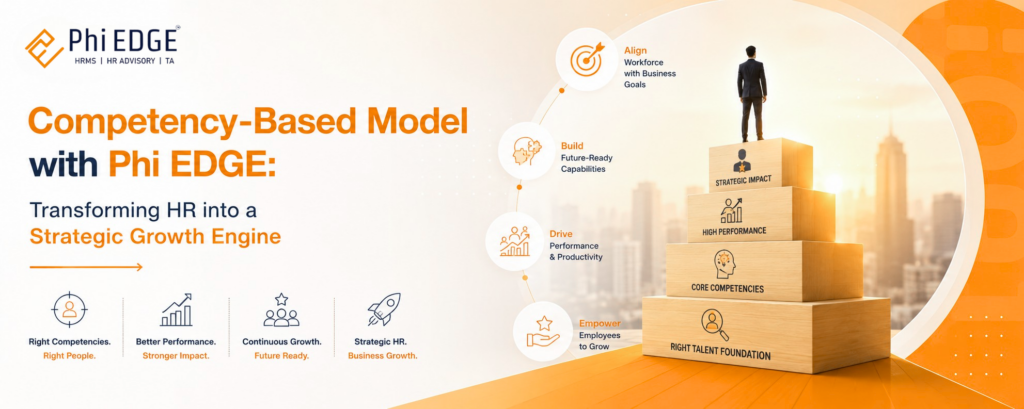
Competency-Based Model with Phi EDGE: Transforming HR into a Strategic Growth Engine
Hiring the proper people is no longer sufficient in today’s cutthroat corporate environment. To promote steady performance and long-term growth, organisations require workers with the appropriate abilities, attitudes, and skills. The Competency-Based Model with Phi EDGE becomes a potent paradigm for contemporary HR management at this point.
A competency-based model assesses employees based on quantifiable abilities, knowledge, and behavioural traits, in contrast to traditional HR systems that primarily consider credentials or experience. Businesses can more successfully match personnel strengths with organisational objectives when they use a smart platform like Phi EDGE.
The end product is an organized, data-driven HR system that boosts hiring, optimizes performance management, and fosters a culture of ongoing improvement.
What is a Competency-Based Model in HR?
A competency-based model is an organized method of managing staff members according to the specific skills needed for each position. Technical proficiency, soft skills, leadership potential, and behavioral characteristics are some of these capabilities.
Instead of asking, “What degree does this person have?”, the focus shifts to:
What can this person actually do, and how well can they perform?
This model helps organizations create clear expectations for every role and measure employee performance against those expectations.
Why Businesses Are Adopting Competency-Based Models
Because old HR procedures frequently fail to evaluate actual performance, modern organizations are abandoning them. A more accurate and useful method of evaluating employees is through competency-based frameworks.
Key Benefits of Competency-Based HR Management
A competency-based approach improves multiple areas of HR operations.
Better Hiring Decisions
Recruitment becomes more precise when based on competencies. Instead of relying only on resumes, HR teams can assess whether candidates actually have the skills required for the job.
This reduces hiring mistakes and improves employee retention.
Improved Employee Performance
When employees know what competencies are expected from them, they perform with more clarity and focus. Managers can also provide more specific feedback based on measurable criteria.
Structured Learning and Development
Training programs become more effective because they are aligned with skill gaps. Employees receive targeted learning opportunities instead of generic training sessions.
Fair and Transparent Evaluations
Performance reviews become unbiased because they are based on defined competencies rather than subjective opinions. This builds trust within the organization.
How Phi EDGE Powers Competency-Based HR Management
Phi EDGE makes it simpler to adopt and expand throughout the company by integrating competency-based frameworks into a unified HR system.
Competency Mapping Based on Roles
Businesses can specify competencies for every role with Phi EDGE. These skills may consist of:
- Technical proficiency
- Communication abilities
- The capacity to solve problems
- Characteristics of a leader
Every employee will be aware of what is required of them in their work thanks to this mapping.
Skill Gap Analysis
One of the most powerful features of Phi EDGE is its ability to identify skill gaps. By comparing required competencies with actual employee performance, HR teams can easily see where improvements are needed.
This helps in creating personalized development plans for employees.
Performance Tracking with Data
Phi EDGE makes it possible to track performance continuously using competency metrics. Instead of depending solely on yearly reviews, managers can assess staff using real-time data.
Better performance results and quicker feedback cycles follow from this.
Integration with HRMS Functions
The competency-based model works seamlessly with other HRMS functions such as:
- Payroll management
- Attendance tracking
- Employee records
- Appraisal systems
This integration ensures that all HR processes are aligned with competency data, creating a unified system.
Competency-Based Model and Employee Lifecycle
A competency-based approach impacts every stage of the employee lifecycle, from hiring to growth and retention.
Recruitment and Selection
Using competency frameworks, HR teams can design better job descriptions and interview processes. Candidates are evaluated based on real-world skills rather than theoretical knowledge.
Onboarding and Training
New employees can be onboarded with clear expectations. Training programs can be customized based on the competencies required for their role.
Performance Management
Managers can track employee progress against predefined competencies. This creates a structured performance review system that is both fair and actionable.
Career Development and Growth
Workers are able to understand exactly what abilities they need to acquire to advance within the company. This lowers attrition and boosts motivation.
Why Competency-Based Models Are the Future of HR
Today’s businesses work in a dynamic environment where capabilities change quickly. Conventional HR systems find it difficult to adapt to these developments.
This issue is resolved by a competency-based paradigm that emphasises flexibility and ongoing education.
Alignment with Business Goals
Overall productivity increases when employee competencies match corporate goals. Teams become more productive, and organizations may accomplish their objectives more quickly.
Data-Driven Decision Making
Because HR choices are grounded in quantifiable facts, they become more accurate. As a result, bias is lessened and overall efficiency is increased.
Enhanced Employee Engagement
Employees feel more engaged when they understand their role clearly and receive structured feedback. This leads to higher job satisfaction and better retention.
Conclusion
The Competency-Based Model with Phi EDGE completely changes how businesses handle talent; it is more than just an HR tactic. Businesses may create stronger teams and achieve sustainable success by emphasising performance, skills, and ongoing development.
By offering a single, data-driven platform that links all HR functions, Phi EDGE facilitates the implementation of this paradigm. Everything becomes more organized, clear, and efficient, from hiring to performance management and career development.
Adopting a competency-based approach is now necessary for businesses hoping to remain competitive in the rapidly evolving world of today.
FAQ Section
Q1. What is a competency-based HR model?
A competency-based HR model concentrates on assessing workers according to the abilities, know-how, and conduct necessary for their position.
Q2. How does Phi EDGE support competency-based management?
In a single, centralized system, Phi EDGE offers capabilities for skill gap analysis, performance monitoring, and competence mapping.
Q3. Why is competency-based hiring important?
It helps organizations select candidates based on real skills, reducing hiring errors and improving productivity.
Q4. Can small businesses use competency-based models?
Yes, even small businesses can benefit by improving hiring, training, and employee performance.
Q5. How does this model improve employee growth?
It provides clear career paths and identifies skill gaps, helping employees develop and advance in their roles.