+91 8956049164
  contact@phiedge.co.in


Top Benefits of Using HRMS for Employee Management
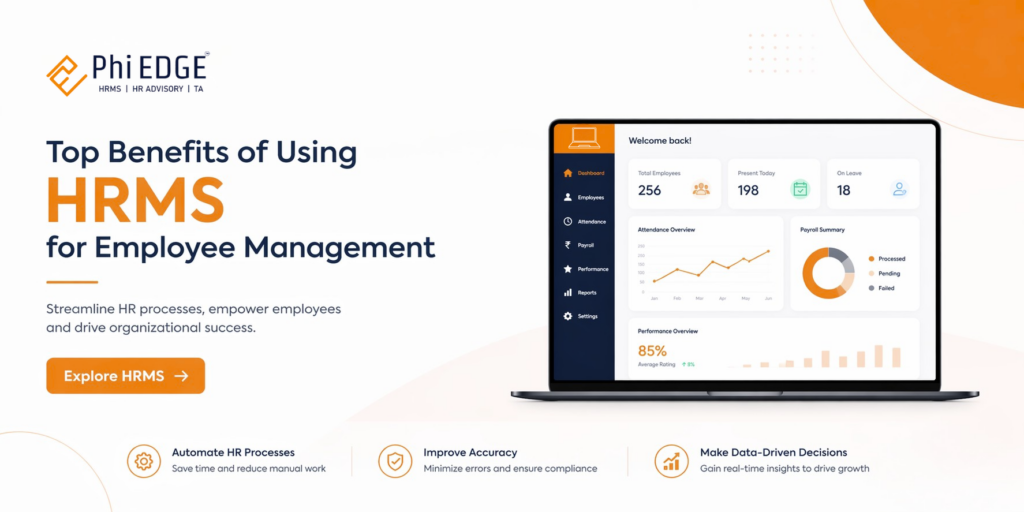
Why Your Business Needs an HRMS — and What You’re Missing Without One
Managing people is one of the most complex parts of running a business. As teams grow, the cracks in spreadsheet-based HR become harder to ignore. Here’s how an HRMS changes the equation—and why more organisations are making the switch.
If you’ve ever spent an afternoon chasing down an employee’s leave balance or reconciling payroll manually, you already understand the problem. Top Benefits of Using HRMS for Employee Management Traditional HR processes were designed for a different era — one where teams were smaller, compliance was simpler, and “data-driven” meant checking a spreadsheet. Today, that approach simply can’t keep up.
An HRMS (Human Resource Management System) brings all of your people operations into one connected platform — cutting out the busywork, reducing errors, and giving HR teams the headspace to actually focus on people. Here’s what that looks like in practice.
1. One place for everything—and everyone
When employee data is scattered across email threads, shared drives, and outdated spreadsheets, things inevitably fall through the cracks. An HRMS consolidates all records—contracts, roles, performance history, contact details — into a single, always-current source of truth.
The result? Less time hunting for information, fewer errors caused by stale data, and faster decisions when it matters most.
HR teams spend up to 40% of their time on manual data management. Centralizing records alone can reclaim a significant portion of that time.
2. Less admin, more strategy
Payroll runs, leave approvals, attendance tracking, document generation — these tasks are necessary, but they don’t require human judgment. An HRMS automates the routine so your HR team can do what only humans can do: build culture, resolve conflicts, and develop talent.
Automation also reduces the kind of small errors that cause big headaches — a miscalculated payslip or a missed compliance deadline can cost far more than the time it takes to fix it.
3. Decisions backed by real data
Good HR decisions shouldn’t rely on gut feel alone. An HRMS surfaces real-time analytics — attrition trends, engagement signals, performance patterns — so leaders can act on evidence rather than assumptions.
Whether you’re planning headcount for the next quarter or trying to understand why a particular team has higher turnover, the data is there. You just need a system that surfaces it clearly.
4. Performance management that actually works
Annual reviews, set once and forgotten, rarely drive growth. A well-implemented HRMS replaces that outdated model with continuous goal tracking, structured feedback, and 360° evaluations—so employees know where they stand and what they’re working toward.
Clarity on expectations isn’t just good for morale. It’s one of the strongest drivers of retention and productivity.
5 A better experience for employees, not just HR
Modern employees expect the same ease-of-use from workplace tools that they get in everyday apps. With self-service portals, staff can apply for leave, access their payslips, update personal details, and get answers—without waiting on HR.
This isn’t just a convenience. Reducing friction in everyday interactions has a measurable impact on how employees feel about where they work.
6 Staying compliant without the constant anxiety
Labour laws change. Statutory deadlines come up fast. In businesses without a dedicated compliance team, it’s easy to miss something critical. An HRMS helps you stay on top of it—automating statutory filings, maintaining audit-ready records, and flagging issues before they become liabilities.
Compliance isn’t just a legal requirement. It’s a foundation of employee trust.
7 Built to grow with you
The HR processes that work for a 20-person team break down fast at 200. An HRMS brings structure that scales — consistent workflows, clear approval chains, and processes that don’t require reinventing the wheel every time you hire a new cohort.
For MSMEs in particular, this kind of infrastructure is often the difference between growing smoothly and growing painfully.
8 AI-powered capabilities are already here
The more forward-looking HRMS platforms are now integrating AI — not as a gimmick, but as a genuine capability. Predictive attrition models, smart hiring recommendations, and workforce planning tools are becoming standard features, not premium add-ons.
Organisations that build on these platforms now will be better positioned when these tools become the baseline expectation.
Conclusion
An HRMS isn’t just an HR tool—it’s an investment in how your organisation operates. It frees your people team to focus on people, gives leaders better information to act on, and creates an experience that employees actually appreciate.
For growing businesses, the question is no longer whether you need one. It’s whether you can afford to keep operating without one.