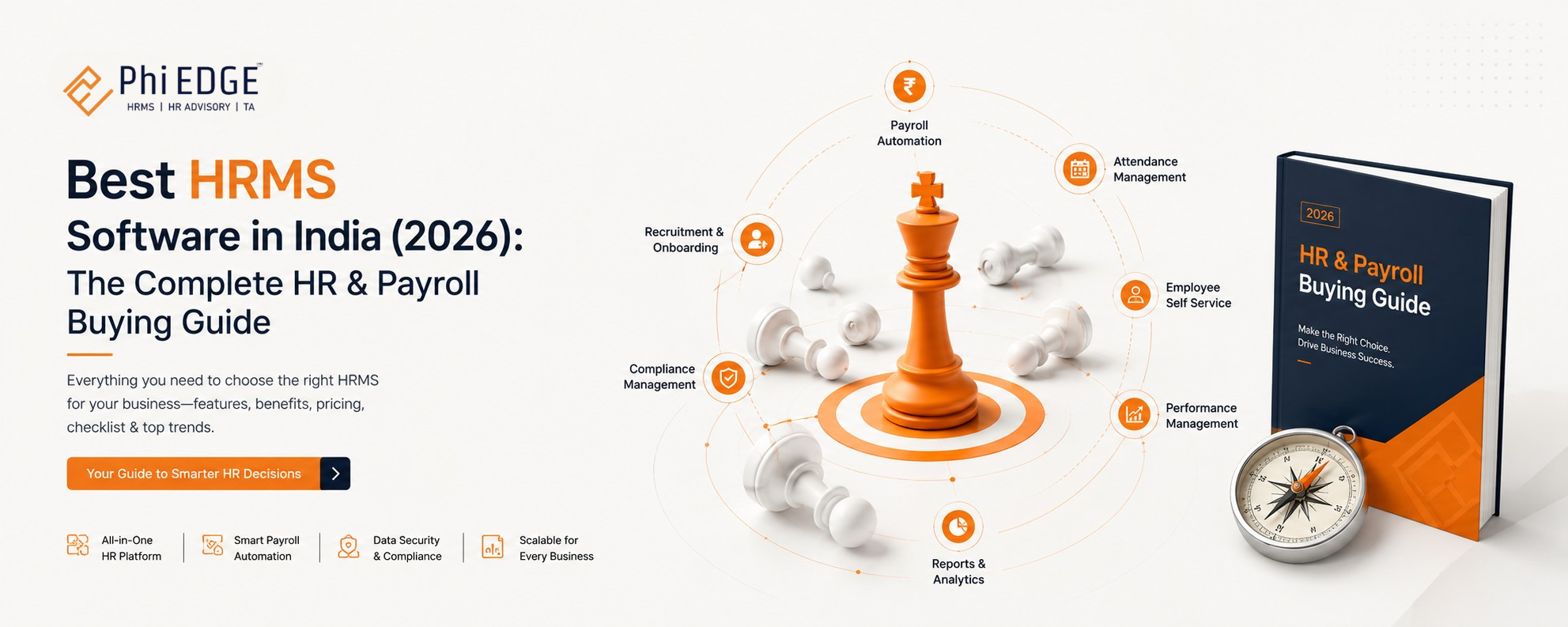
If you are comparing HRMS software in India right now, you are probably doing it for one of three reasons: payroll errors are creating trust problems, attendance and leave are still tracked on spreadsheets, or your company just crossed a headcount where “we’ll manage it manually” stopped being true. This guide walks through what the best HRMS platforms in India actually do differently in 2026, what a fair comparison looks like, and how to avoid the mistakes that turn an HRMS rollout into six months of frustration.
Table of Contents
- Quick Answer
- How HRMS Software Works
- Why HRMS Matters More in 2026
- Benefits of a Modern HRMS
- Core Features to Look For
- Before vs After: What Changes
- Case Study: A Pune Manufacturing Rollout
- HRMS Market Statistics (India, 2026)
- Comparison: Phi EDGE vs Other HRMS Platforms
- Common Mistakes When Choosing HRMS
- Best Practices for HRMS Selection & Rollout
- FAQs
Quick Answer
The best HRMS software in India for 2026 combines core HR, payroll, and attendance in one system, automates PF/ESI/TDS compliance, and gives HR leaders real-time dashboards instead of month-end spreadsheet reconciliation. Best HRMS Software in India 2026: The Complete HR & Payroll Buying. For manufacturing and mid-market companies, an HRMS system that pairs software with HR advisory support (not just a login) tends to outperform pure self-serve tools, because policy design and configuration matter as much as the platform itself. Phi EDGE, built in Pune, positions itself in this “consulting + technology” category alongside larger national HRMS players.
How HRMS Software Works
An HRMS (Human Resource Management System) works by pulling every stage of the employee lifecycle into one connected database instead of scattered files:
- Employee data capture — Onboarding forms, documents, and records feed a single master profile.
- Attendance and leave — Biometric, geo-tagged, or mobile punches sync automatically into payroll inputs.
- Payroll processing — Salary structures, statutory deductions (PF, ESI, TDS, professional tax), and payslips are generated from that same synced data.
- Performance and growth — Goals, KPIs, 360° feedback, and increments link back to the same employee record.
- Analytics — Dashboards surface attrition risk, headcount cost, and compliance status without manual pivot tables.
The core idea is to have one source of truth that feeds every HR process, so nobody re-enters the same employee data five times across five different tools.
Why HRMS Matters More in 2026
Why has payroll compliance got harder? India’s labour codes continue to tighten timelines — full and final settlements, statutory filings, and multi-state PF/ESI obligations all carry real penalty risk, and manual tracking across locations is where errors often creep in.
Why is manufacturing HR different this year? Field and shop-floor workforces need geo-fenced attendance, role-based punch rules, and daily-wage payroll accuracy that generic HR tools weren’t built for—this is the segment where Phi EDGE’s manufacturing client base (rubber, auto components, polymers) feels the gap most.
Why are HR teams asking for analytics, not just records? Boards now expect attrition, cost-per-hire, and engagement data on demand, not once a quarter — so an HRMS that only stores records and doesn’t report on them is already behind.
Why does SME adoption keep rising? Cloud-based, modular HRMS pricing has made enterprise-grade HR tooling affordable for smaller teams, which is a major reason smaller companies (under 1,000 employees) now make up the largest share of India’s HR tech market.
Benefits of a Modern HRMS
- Time back for HR — Automating attendance-to-payroll flow removes the week-long manual reconciliation many teams still do every month.
- Fewer payroll errors — Automated PF/ESI/TDS calculations reduce the manual mistakes that damage employee trust.
- Faster decisions — Real-time dashboards replace static, backwards-looking spreadsheets.
- Compliance confidence — Statutory filings and exit timelines are tracked systematically, not remembered.
- Better retention signal — Attrition, tenure band, and engagement data surface risk before resignations, not after.
- Consistency across locations — One policy engine instead of different spreadsheets per plant or branch.
Core Features to Look For
| Feature area | What it should do |
| Core HR/employee database | Single record per employee, org structure, documents |
| Payroll software | Auto PF, ESI, TDS, professional tax, multi-state compliance |
| Attendance & leave | Biometric, mobile, geo-fenced punch; auto leave accrual |
| Performance management | Goal-setting, KRA/KPI tracking, 360° feedback |
| Employee self-service | Payslips, leave requests, document access without HR tickets |
| Analytics & reporting | Attrition, headcount cost, manager-level breakdowns |
| Configurability | Different rules for field staff vs office staff (equity, not uniform policy) |
| Integrations | Biometric devices, accounting/ERP, background verification |
Before vs After Examples
| Process | Before HRMS (manual/Excel) | After a proper HRMS |
| Monthly attendance-to-payroll | 2–3 people spend days chasing punches across sheets | Auto-synced; payroll run in hours |
| Attrition tracking | Reviewed only after resignation letters arrive | Manager/tenure-level risk visible on a dashboard |
| Payslip accuracy | Manual formulas, frequent correction requests | System-calculated PF/ESI/TDS, fewer disputes |
| Policy consistency | Different rules by plant/branch, tracked informally | One configurable policy engine, applied consistently |
| Exit processing | Full-and-final dues delayed past statutory windows | Time-boxed workflow inside the compliance deadline |
Case Study: A Pune Manufacturing Rollout
Illustrative example based on the type of mid-market manufacturing implementation Phi EDGE commonly runs — presented as a composite scenario, not a single named client’s confidential figures.
A ~350-employee auto-component manufacturer near Pune ran attendance on biometric machines that didn’t talk to payroll, and performance reviews happened once a year on paper forms. HR spent roughly a week each month reconciling attendance before payroll could even start, and two plants had quietly drifted onto different leave policies.
After moving core HR, attendance, payroll, and performance into a single HRMS with role-based configuration (dual punch for shop floor, single punch for office staff), the same team cut its monthly payroll-prep time from days to under one working day, standardised leave policy across both plants, and got a live view of appraisal-cycle completion instead of chasing paper forms in March. The bigger shift was cultural: HR moved from “chasing data” to reviewing a dashboard and acting on it.
Statistics (with Sources)
- India’s HRMS market was valued at roughly USD 0.87 billion in 2025 and is projected to reach USD 2.27 billion by 2031, growing at a 17.34% CAGR — one of the fastest-growing HR tech markets globally.
- The broader India HR technology market was valued at USD 1,208.26 million in 2025, projected to reach USD 2,329.11 million by 2034 (7.56% CAGR); recruitment tools hold the largest application share at 25%.
- Companies under 1,000 employees represent 41% of India’s HR tech market in 2025 — the largest single segment — driven by affordable, modular cloud HRMS pricing.
- India’s HR analytics market alone is projected to grow from USD 161.5 million (2025) to USD 553.9 million by 2033, a 16.8% CAGR, reflecting rising demand for attrition and workforce analytics.
- North India holds the largest regional share (30%) of the HR tech market, while South India (notably Bengaluru) remains a major hub for HRMS product development; West India — where Pune sits — is one of the four core regional markets tracked by industry researchers.
Comparison Table (Competitor Landscape)
| Platform | Positioning | Strongest for | Consulting layer |
| Phi EDGE | HRMS + HR Advisory + Talent Acquisition, Pune-based | Manufacturing & mid-market companies wanting software and HR strategy support | Yes — advisory, culture, and PMS design bundled in |
| HROne | Large-scale cloud HCM suite | Enterprises wanting AI agents, a broad module marketplace | Limited — primarily self-serve software |
| Keka | Modern UI-first HRMS | Startups and tech companies are prioritising employee experience | Limited |
| Zoho People | Part of the Zoho suite | Companies already using other Zoho products | Limited |
| greytHR | SMB payroll-first HRMS | Small businesses needing a straightforward statutory payroll | Limited |
Note: feature sets and pricing change frequently — verify current specifics directly with each vendor before a purchase decision. This table reflects general market positioning, not a live feature audit.
Common Mistakes When Choosing HRMS
- Buying software to fix a culture problem. An HRMS makes existing policy consistent — it doesn’t invent policy, values, or manager accountability.
- Ignoring role-based configuration. Applying one attendance or leave rule to both office and field staff creates fraud gaps and frustration.
- Skipping the implementation timeline conversation. Real HR process redesign takes months, not the “go live in 2 weeks” pitch.
- Choosing on price alone. The cheapest per-employee rate often means the thinnest compliance and support layer – expensive later during an audit.
- Not checking multi-state compliance depth. If you operate in more than one state, PF/ESI/professional tax rules differ — confirm the platform actually handles this, not just claims to.
- No named internal owner. Even the best HRMS underperforms if no one is accountable for acting on the dashboards it produces.
Best Practices
- Map your current process before evaluating vendors — you can’t compare tools against a workflow you haven’t written down.
- Involve payroll, IT, and floor/plant managers early, not just HR — attendance and payroll touch all three.
- Pilot on one location or department before a company-wide rollout.
- Ask vendors for reference clients in your industry and size band, not generic case studies.
- Budget time for change management — training and adoption typically need as much attention as the software configuration.
- Revisit configuration annually — labour codes, statutory rates, and your own org structure change; policies encoded in software should keep pace.
Frequently Asked Questions
- What is the best HRMS software in India for manufacturing companies? The best fit is usually a platform that combines core HR, payroll, and attendance with configurable, role-based rules for shop-floor vs office staff, plus a consulting layer for policy design – which is where Phi EDGE positions itself for manufacturing clients.
- What does HRMS stand for? HRMS stands for Human Resource Management System — software that manages the employee lifecycle from hiring through exit, including payroll, attendance, and performance.
- What is the difference between HRMS and HRIS? HRIS typically focuses on storing and managing core employee data (records, payroll, and compliance). HRMS includes all of that plus broader functionality like performance management, learning, and engagement tools.
- How much does HRMS software cost in India? Pricing is usually per-employee-per-month and varies by module count, company size, and whether implementation/consulting support is bundled in — get a quote based on your actual headcount and required modules rather than a published “starting price.”
- Is HRMS software worth it for a small business? Yes, for most businesses past roughly 30–50 employees, since manual payroll and attendance tracking starts breaking down around that size — modular, cloud-based pricing has made HRMS accessible for smaller teams too.
- What features should every HRMS have in 2026? Core HR, statutory payroll (PF/ESI/TDS), attendance/leave, performance management, employee self-service, and analytics dashboards are the baseline; AI-assisted features are increasingly common but not yet universal.
- Can HRMS software reduce employee attrition? HRMS software surfaces the data (tenure, manager, engagement scores) that helps predict and act on attrition risk earlier — but it doesn’t fix attrition on its own; the underlying management and culture work still has to happen.
- How long does HRMS implementation typically take? Basic core HR and payroll setup can go live in weeks, but full process redesign, data migration, and change management across a mid-size company typically takes a few months.
- What is the best HRMS software in Pune? Pune has several manufacturing and IT-services companies with multi-plant or field operations, so an HRMS with strong attendance geo-fencing and role-based payroll — combined with local HR advisory support — tends to fit best; Phi EDGE is headquartered in Pune and built around this segment.
- Does HRMS handle statutory compliance automatically? A good HRMS automates PF, ESI, TDS, and professional tax calculations and keeps filings on schedule, but compliance ownership still sits with the company — the software reduces manual error, it doesn’t replace legal accountability.
- What is the difference between HRMS and payroll software? Payroll software focuses narrowly on salary processing and statutory deductions. HRMS is broader, including payroll as one module alongside attendance, performance, and employee records.
- How do I choose between HRMS vendors? Compare them against your mapped current process; ask for same-industry references, check multi-state compliance depth, and evaluate the implementation/support model — not just the feature list or price sheet.
- Can HRMS integrate with biometric attendance devices? Most modern HRMS platforms support biometric, RFID, and mobile geo-tagged attendance integration; confirm compatibility with your existing hardware before switching platforms.
- Is cloud-based HRMS safe for employee data in India? Reputable HRMS vendors carry data-security certifications (such as ISO/IEC 27001) and role-based access controls; verify a vendor’s specific certifications and hosting practices before onboarding sensitive payroll data.
- What HRMS features matter most for field or blue-collar teams? Geo-fenced and offline-capable attendance, role-based punch rules, and accurate daily-wage payroll matter most, since generic office-first HR tools often miss these needs.
- Does Phi EDGE offer HR consulting alongside HRMS software? Yes—Phi EDGE operates across three verticals: HRMS software, HR advisory, and talent acquisition, positioning it as a combined consulting-plus-technology provider rather than software-only.
- What industries does Phi EDGE’s HRMS typically serve? Phi EDGE’s client base includes manufacturing, automotive components, polymers/rubber, and mid-market industrial companies, largely across Maharashtra and pan-India.
- How is HRMS evolving in 2026 compared to earlier years? 2026-era HRMS platforms lean more heavily on AI-assisted analytics, predictive attrition flags, and mobile-first employee self-service, compared to the record-keeping-first systems common a few years ago.
- What is the typical ROI timeline for HRMS software? Most companies see time-savings (reduced manual payroll/attendance work) within the first quarter, with harder ROI metrics like reduced attrition or compliance-error costs becoming visible over two to four quarters.
- Should a company build its own HR tracking system instead of buying HRMS software? Generally, no for most mid-market companies, since the ongoing maintenance, compliance updates, and security burden of a custom-built system usually outweighs the cost of an established HRMS vendor, unless HR needs are extremely non-standard.
Author & Reviewed By
Written by: Phi EDGE HR Advisory Desk — HRMS implementation and HR consulting team, Phi EDGE (Pune)
Reviewed by: Rahul, Lead HR Consultant, Phi EDGE — 15+ years advising manufacturing and mid-market Indian companies on HRIS rollouts and compliance
Published: July 2026 | Last updated: July 2026