
How Daily Work Management Impacts Employee Performance
In today’s dynamic workplace, success isn’t determined by isolated goals or long-term projects alone. It’s shaped by what happens every single day—how tasks are assigned, executed, tracked, and completed. Whether your organization operates in Manufacturing, Financial Services, Real Estate, Hospitality, Construction, Academics, or Information Technology, the cornerstone of sustainable performance lies in consistent, efficient daily execution.
At Phi EDGE, we understand this reality deeply. With our experience across HRMS, HR Advisory, and Talent Acquisition, we have witnessed that organizations with strong daily discipline outperform those relying on reactive workflows and disconnected task tracking. In this blog, we will explore how Daily work management impacts employee performance, enhances engagement, fosters accountability, and fuels organizational success. We’ll also explain why adopting a Daily Work Management System and a daily task management app is no longer optional but a strategic imperative.
What Is Daily Work Management?
Before diving into its impact, it’s important to define what we mean by daily work management. At its core, daily work management is the process of planning, assigning, monitoring, and completing daily tasks in a structured, transparent way. It helps employees understand what tasks are expected of them each day, what goals they need to achieve, and how their activities align with broader team and organizational strategies.
A daily task management app is a digital tool that enables teams and individuals to log, update, and track tasks in real time. Combined with a Daily Work Management System, these tools ensure that work doesn’t just happen— it happens with clarity, purpose, and measurable outcomes.
Why Daily Work Management Matters More Than Ever
Workplaces have evolved rapidly. Remote and hybrid work models, fluid team structures, project-based assignments, and fluctuating priorities have made traditional time tracking and task delegation systems inadequate. In the absence of a cohesive daily work framework, teams often struggle with miscommunication, overlapping responsibilities, forgotten tasks, and uneven workloads—all of which impact employee performance and organizational productivity.
Daily work management provides the scaffolding that turns individual tasks into meaningful progress. It creates a rhythm through which work becomes predictable, measurable, and aligned with outcomes that matter.
The Direct Link Between Daily Work Management and Employee Performance
1. Provides Clarity and Focus
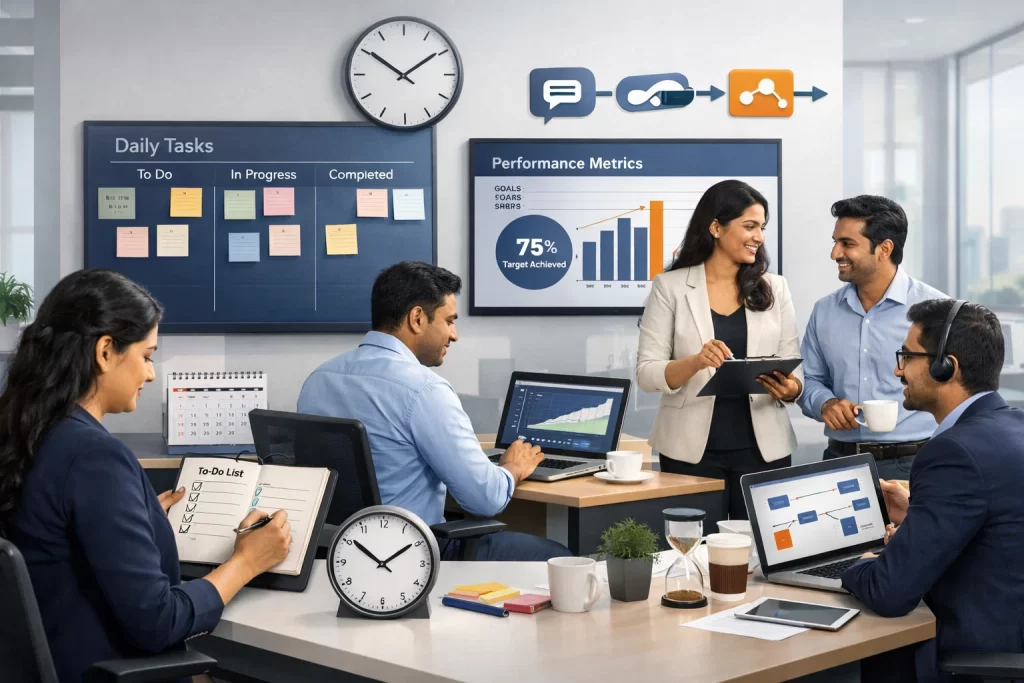
One of the biggest contributors to low performance is lack of clarity. When employees aren’t sure what they should be working on, distraction and ambiguity fill the gap. A Daily Work Management System brings discipline to every workday by clearly defining what needs to be done and when.
With a clear daily task list in a daily task management app, employees spend less time wondering “what’s next” and more time executing with purpose. This clarity enhances focus, reduces procrastination, and aligns individual effort with team goals.
2. Encourages Accountability and Ownership
Performance isn’t just about completing tasks—it’s about taking ownership. When daily work is assigned, tracked, and visible, employees naturally feel a stronger sense of responsibility. A Daily Work Management System records who is accountable for which task and by when, eliminating ambiguity.
At Phi EDGE, we’ve seen how this visibility transforms team behavior. Employees don’t just do the work—they own it. This sense of ownership boosts performance, encourages initiative, and builds trust in team dynamics.
3. Drives Better Time Utilization
Many organizations believe productivity is synonymous with effort. But productivity isn’t about the number of hours worked; it’s about what gets done in those hours. Daily work management helps break down tasks into manageable chunks, allowing employees to allocate time effectively and avoid burnout.
A daily task management app helps teams visualize their workload, prioritize tasks, and manage their time accordingly. When employees know what’s on their plate for the day, and they have the tools to structure their workload, performance naturally improves.
4. Enhances Collaboration and Communication
Work rarely happens in isolation. Team projects depend on multiple contributors, and delays from one person can stall the entire workflow. Daily work management systems enhance collaboration by enabling transparency and shared understanding.
In a Daily Work Management System, tasks are not hidden in inboxes or lost in chat threads. They are visible, assignable, and trackable. This ensures that dependencies are clear, team members can coordinate effectively, and communication flows through a unified platform rather than chaotic channels.
5. Reduces Stress and Cognitive Overload
A disorganized workday results in employees juggling too many priorities at once. This cognitive overload drains energy and negatively impacts performance. Daily work management brings structure, helping employees break down large goals into actionable steps.
When work is organized in a daily task management app, employees can systematically approach their tasks without feeling overwhelmed. This not only enhances productivity but also reduces stress—leading to better performance, higher job satisfaction, and lower burnout rates.
How Daily Work Management Influences Employee Engagement
Employee engagement and performance are two sides of the same coin. Engaged employees tend to be more productive, deliver higher quality work, and contribute actively to organizational success. Daily work management directly influences engagement in several ways:
It offers immediate feedback loops: Instead of waiting for weekly or monthly check-ins, employees get real-time updates on progress, delays, or changes to tasks. This immediacy keeps them engaged in their work.
It provides a sense of achievement: Seeing tasks completed, progress logged, and goals achieved in a daily system gives employees a sense of accomplishment. These small wins compound over time, boosting confidence and motivation.
It aligns individual tasks with bigger goals: When employees see how their daily work contributes to broader objectives, they feel more connected to the organizational mission. This alignment is a powerful driver of engagement.
It fosters collaboration: Engaged teams collaborate more effectively. A daily work management framework promotes teamwork by creating shared visibility, reducing silos, and encouraging supportive coordination.
Performance Insights Through Daily Work Management Data
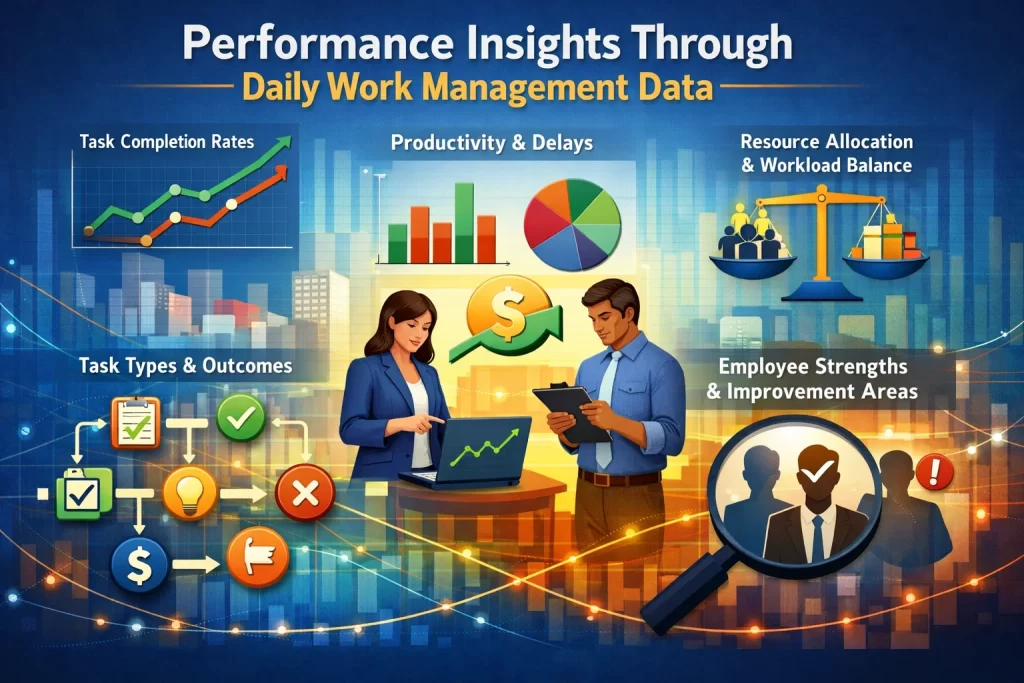
One of the most significant advantages of implementing a structured Daily Work Management System is the rich data it generates. Unlike manual methods that rely on memory or periodic reporting, a digital system records actions in real time. This data can reveal:
● Trends in task completion rates
● Patterns of productivity and delays
● Resource allocation and workload balance
● Correlations between task types and outcomes
● Employee strengths and areas for improvement
At Phi EDGE, we integrate daily work management data with broader HRMS analytics, enabling organizations to monitor performance not just at a task level but across roles, departments, and projects.
This level of insight is invaluable. It helps HR leaders forecast staffing needs, refine training programs, and personalize support for individual employees—all based on real performance data rather than intuition.
Eliminating Redundancy with Intelligent Task Management
Inefficiency often hides in repetition. In traditional work environments, similar tasks are recreated multiple times, updates are sent again and again through separate threads, and clarifications are repeatedly sought. This redundancy eats into performance.
A daily task management app reduces redundancy by centralizing tasks, updates, files, and communications. Instead of sifting through emails, employees can refer to a single interface for everything related to their work. This simplicity directly translates into better performance—time saved on coordination becomes time spent on execution.
Adaptive Workflows for Hybrid and Remote Teams
The modern work landscape includes remote, hybrid, and distributed teams. While this flexibility improves work-life balance and talent access, it also introduces challenges in coordination and accountability.
Daily work management systems were built for such complexities. For remote teams, access to a Daily Work Management System means that physical distance does not equate to informational distance. Team members know what colleagues are working on, what is blocked, and who needs help—all without scheduling additional meetings.
At Phi EDGE, we have enabled multiple organizations to bridge the gap between remote rhythm and real-time productivity by offering integrated daily work management features within our HRMS suite. This ensures that regardless of location, employees remain connected to their tasks, teams, and performance expectations.
The Role of a Daily Task Management App in Employee Development
Performance is not only about completing today’s tasks—it’s about growing tomorrow’s capabilities. A rich daily work management framework supports employee development by helping individuals track recurring patterns, understand their own work habits, and recognize skill gaps. With data from a daily task management app, employees can:
● Understand which tasks consume most of their time
● Identify areas where they excel
● Recognize where additional training may help
● Set personal improvements based on evidence
This reflective aspect transforms task management from a monitoring tool into a personal development companion.
Integrating Daily Work Management with HRMS for Maximum Impact
A standalone daily task tool can offer clarity, but its real power emerges when integrated with broader HRMS functions—attendance, performance appraisal, leave management, payroll, and learning systems.
At Phi EDGE, our integrated HRMS platform connects daily work management data with talent management workflows. This means:
● Performance reviews are informed by daily task completion data
● Workload patterns influence compensation discussions
● Training recommendations are based on task execution gaps
● Employee engagement analysis incorporates task engagement patterns
This seamless integration elevates both performance evaluation and employee experience, making HR more strategic and evidence-based.
Overcoming Common Challenges with Daily Work Management Systems
Many organizations hesitate to adopt formal task systems due to concerns about complexity or resistance from users. However, modern Daily Work Management Systems are intuitive, easy to adopt, and often require minimal training.
Challenges such as:
● Resistance to change
● Fear of micromanagement
● Perception of complexity
are easily overcome when the system is introduced as a supportive tool rather than a surveillance mechanism. A well-implemented daily task management app becomes a partner in productivity, not a watchdog.
Phi EDGE’s approach includes guided onboarding, role-based setups, and personalized configurations that make daily work tools feel natural and empowering to every team member.
Tracking the Performance Impact: What Success Looks Like
When organizations implement Daily Work Management Systems effectively, the impact becomes visible quickly. Some measurable outcomes include:
● Clearer assignment of responsibility
● Higher task completion consistency
● Reduced delays and bottlenecks
● Improved employee morale
● Enhanced collaboration
● Increased visibility into team performance
● Faster onboarding for new team members
These gains contribute to both individual performance and broader organizational effectiveness.
Frequently Asked Questions (FAQs)
Q1. What is daily work management?
A: Daily work management is the structured process of planning, assigning, tracking, and completing daily tasks using digital tools like a daily task management app or integrated system.
Q2. How does a daily task management app improve employee performance?
A: It provides clarity, accountability, transparency, and real-time tracking, enabling employees to focus on productivity and alignment with organizational objectives.
Q3. What is a Daily Work Management System?
A: This is a broader digital framework that manages daily tasks, workflows, priorities, and performance, often integrated within an HRMS Software.
Q4. Can daily work management support hybrid and remote teams?
A: Yes. It offers visibility and coordination irrespective of physical location, making it ideal for hybrid or remote work environments.
Q5. Does integrating daily work management with HRMS improve performance evaluations?
A: Absolutely. When integrated, daily tasks inform performance discussions with real data, making assessments fairer and more accurate.
Q6. Can daily task data help employee development?
A: Yes. It helps individuals identify patterns, strengths, and areas for improvement, supporting personal growth.
Q7. Is adopting a Daily Work Management System difficult?
A: Modern systems are designed to be intuitive. With guided onboarding and role-specific setups, teams can adopt them quickly.
Conclusion: The Link Between Daily Work and Peak Performance
Employee performance is influenced by many factors—skills, motivation, leadership, and culture. Yet, one of the most direct levers for performance lies in how daily tasks are managed.
A well-implemented Daily Work Management System provides clarity, accountability, and insight. It transforms daily responsibilities from a chaotic checklist into a strategic engine that drives productivity, collaboration, and engagement. When teams know what to do, understand how their work fits into larger goals, and have tools that support execution, performance naturally improves.
At Phi EDGE, we believe that daily work management is more than just ticking boxes—it’s about creating predictable, measurable, and meaningful contributions every single day. When daily execution aligns with strategy, performance isn’t just measured—it is maximized.
Whether your organization is headquartered in Mumbai, Bangalore, Delhi, or anywhere in India, adopting an intelligent daily work management approach isn’t just smart—it’s essential for sustainable success in the modern business world.
With Phi EDGE, daily work becomes daily performance—visible, measurable, and impactful.