Category: Case Study

  • Task Management System for EPC Companies | Improve Employee Efficiency | Phi EDGE

    Task Management System for EPC Companies | Improve Employee Efficiency | Phi EDGE

    Task Management System Implementation: Driving Employee Efficiency in an EPC Company

    Engineering, Procurement, and Construction (EPC) companies manage some of the most complex projects across industries such as infrastructure, energy, manufacturing, oil & gas, renewable energy, and commercial construction. Every project involves multiple teams, strict deadlines, compliance requirements, vendor coordination, procurement tracking, and real-time reporting. As projects grow in scale, manual task tracking through spreadsheets, emails, or messaging apps often creates delays, communication gaps, and missed deadlines.

    A Task Management System (TMS) provides a centralized platform where organizations can assign tasks, monitor progress, automate workflows, and measure employee performance in real time. By integrating task management with an advanced HRMS platform such as Phi EDGE, EPC companies can improve operational efficiency, reduce project delays, and increase workforce productivity.

    This comprehensive guide explains how implementing a task management system transforms employee efficiency, strengthens project governance, and supports sustainable business growth for EPC organizations.


    Why Task Management is Critical for EPC Companies

    Unlike traditional businesses, EPC organizations operate across multiple project sites with cross-functional teams. Task Management System for EPC Companies | Improve Employee Efficiency Engineers, procurement specialists, project managers, finance departments, HR teams, and contractors must work together while meeting strict project timelines.

    Without a structured task management process, organizations commonly face:

    • Delayed project execution
    • Poor communication between departments
    • Duplicate work assignments
    • Missed approvals
    • Inefficient resource allocation
    • Lack of accountability
    • Limited visibility into employee productivity
    • Difficulty monitoring project milestones
    • Increased operational costs

    A modern Task Management System eliminates these challenges by providing a single source of truth for all project-related activities.


    What is a Task Management System?

    A Task Management System is a digital platform that enables organizations to create, assign, prioritize, track, and complete tasks throughout the project lifecycle. It helps managers monitor workloads, allocate resources efficiently, and ensure every activity is completed within the planned schedule.

    Modern task management software goes beyond simple task lists by incorporating:

    • Workflow automation
    • Real-time dashboards
    • Employee collaboration
    • Document management
    • Notifications and reminders
    • Performance analytics
    • Mobile accessibility
    • Integration with HRMS and ERP systems

    For EPC companies, these capabilities provide greater visibility into engineering workflows, procurement activities, construction progress, inspections, and project documentation.


    Key Components of a Modern Task Management System

    1. Task Creation and Assignment

    Managers can create tasks with detailed descriptions, assign ownership, define priorities, attach project documents, and set expected completion dates.

    Example:

    • Prepare Structural Design Drawings
    • Vendor Material Inspection
    • Site Safety Audit
    • Procurement Approval
    • Quality Assurance Review

    Every employee clearly understands their responsibilities.


    2. Priority-Based Work Management

    Not every task has the same business impact.

    A task management platform categorizes work based on:

    • High Priority
    • Medium Priority
    • Low Priority
    • Critical Tasks
    • Project Milestones

    This helps project managers allocate resources more effectively.


    3. Deadline Monitoring

    Automated reminders reduce the risk of missed deadlines by notifying employees before due dates.

    Managers receive alerts for:

    • Overdue tasks
    • Pending approvals
    • Escalated issues
    • Delayed activities

    4. Workflow Automation

    Instead of manually assigning every activity, organizations can automate repetitive workflows.

    Examples include:

    • Purchase approval workflows
    • Design approval processes
    • Leave approval linked to project schedules
    • Daily work reporting
    • Incident reporting
    • Client approval notifications

    Automation minimizes manual effort while improving operational consistency.


    5. Real-Time Progress Tracking

    Project managers gain instant visibility into project performance through dashboards displaying:

    • Completed tasks
    • Pending tasks
    • Overdue activities
    • Department-wise progress
    • Employee workload
    • Resource utilization

    Real-time monitoring enables proactive decision-making and faster issue resolution.


    Why Traditional Task Management Fails in EPC Companies

    Many EPC companies continue to rely on spreadsheets, email chains, phone calls, and messaging applications to manage projects. While these methods may work for small teams, they become inefficient as projects increase in size and complexity.

    Common Challenges of Manual Task Management

    Traditional Process Business Impact
    Excel-based task tracking Frequent data inconsistencies and version conflicts
    Email approvals Delayed decision-making and missed responses
    WhatsApp communication No centralized audit trail or reporting
    Manual follow-ups Significant time spent chasing updates
    Paper-based documentation Higher risk of document loss and compliance issues
    Independent departmental tracking Poor collaboration and information silos

    These inefficiencies often lead to increased project costs, reduced productivity, and delayed project delivery.


    How a Task Management System Improves Employee Efficiency

    Employee efficiency is not about working longer hours—it is about enabling employees to focus on the right tasks with the right information at the right time.

    A task management system supports this by:

    Improving Accountability

    Every task has:

    • A designated owner
    • A due date
    • Defined priorities
    • Progress status
    • Performance metrics

    This creates clear ownership and responsibility.


    Increasing Productivity

    Employees spend less time searching for information or waiting for updates. Instead, they can:

    • View assigned tasks in one dashboard
    • Collaborate with team members
    • Upload documents
    • Track progress
    • Receive automated reminders

    This reduces administrative effort and allows teams to focus on value-added work.


    Enhancing Team Collaboration

    Cross-functional collaboration becomes easier through shared workspaces where engineering, procurement, finance, HR, and construction teams can communicate, exchange documents, and monitor project progress in real time.

    This minimizes communication gaps and accelerates project execution.


    Step-by-Step Task Management System Implementation for an EPC Company

    Implementing a Task Management System (TMS) is more than deploying software. It is a strategic initiative that aligns people, processes, and technology to improve project delivery, employee productivity, and operational efficiency. For EPC companies, where multiple departments and project sites operate simultaneously, a structured implementation roadmap minimizes disruption and accelerates user adoption.

    Step 1: Analyze Existing Workflows

    Before implementation, evaluate how tasks are currently managed across departments.

    Assess:

    • Engineering design approvals
    • Procurement workflows
    • Site execution activities
    • Quality inspections
    • Safety audits
    • Vendor coordination
    • Client approvals
    • HR and administrative tasks

    Identify process bottlenecks such as:

    • Manual approvals
    • Duplicate data entry
    • Delayed communication
    • Unclear task ownership
    • Missed deadlines
    • Lack of reporting

    This analysis provides the foundation for designing an efficient digital workflow.


    Step 2: Define Business Objectives

    A successful implementation begins with measurable goals.

    Examples include:

    • Reduce project delays by 30%
    • Improve employee productivity by 25%
    • Achieve 100% task visibility
    • Reduce manual reporting by 80%
    • Improve approval turnaround time
    • Increase project completion rates
    • Strengthen compliance tracking

    Clearly defined KPIs help measure implementation success.


    Step 3: Map Department-Wise Workflows

    Each department has unique responsibilities. Configure workflows accordingly.

    Engineering Department

    Typical tasks include:

    • Design preparation
    • Drawing review
    • Structural calculations
    • Technical approvals
    • Revision management

    Procurement Department

    Workflow examples:

    • Purchase requisitions
    • Vendor quotation reviews
    • Purchase order approvals
    • Material dispatch tracking
    • Inventory updates

    Construction Team

    Daily activities may include:

    • Site inspections
    • Daily progress reporting
    • Equipment allocation
    • Labor management
    • Milestone completion

    Quality Assurance (QA/QC)

    Tasks include:

    • Inspection requests
    • Quality checklists
    • Material testing
    • Non-conformance reporting
    • Corrective actions

    Health, Safety & Environment (HSE)

    Typical workflows:

    • Safety inspections
    • Incident reporting
    • Risk assessments
    • Permit approvals
    • Compliance documentation

    Digitizing these workflows ensures consistency and accountability across the organization.


    Why Phi EDGE is the Right Choice for EPC Companies

    Unlike standalone task management tools, Phi EDGE combines task management with a comprehensive HRMS platform, enabling organizations to manage both workforce operations and project execution from a single system.

    Key advantages include:

    • Integrated Employee Management
    • Attendance and Leave Management
    • Project-Based Task Assignment
    • Workflow Automation
    • Performance Management
    • Document Management
    • Real-Time Analytics
    • Mobile Access for On-Site Teams
    • Approval Workflows
    • Customizable Dashboards

    This unified approach helps EPC organizations improve productivity, strengthen governance, and support scalable growth.


    The client is a leading Engineering, Procurement, and Construction (EPC) company that specializes in delivering complex, large-scale infrastructure projects for industries such as oil & gas, energy, and utilities. With a global presence and a diverse workforce, the company faces the challenge of managing multiple projects simultaneously, each with unique requirements and stringent deadlines.

    Challenges Faced by the Client

    The EPC company was grappling with several operational inefficiencies, primarily related to task management and project delivery. These included:

    1. Fragmented Task Allocation: The company’s task management process was highly decentralized, with tasks being allocated manually through emails, spreadsheets, and informal communication channels. This led to a lack of visibility and accountability across teams.
    2. Lack of Real-Time Tracking: With multiple ongoing projects, managers struggled to keep track of task progress in real time. This resulted in delays, missed deadlines, and an inability to predict potential bottlenecks.
    3. Resource Overload and Underutilization: Without a clear system to monitor employee workloads, there were frequent instances of employees being either overburdened or underutilized, leading to inefficiencies and burnout.
    4. Poor Collaboration Across Teams: As the company operated across different time zones and departments, collaboration on tasks was disjointed, leading to communication gaps and misunderstandings that affected project timelines.
    5. Difficulty Meeting Deadlines: With no automated or centralized system to track deadlines, the company struggled to ensure that project milestones were met consistently, leading to frequent delays and client dissatisfaction.

    Implementing a Task Management System by Phi EDGE

    To address these challenges, the client decided to implement a comprehensive Task Management System (TMS) to streamline task allocation, improve tracking, enhance collaboration, and optimize resource utilization. Phi EDGE was engaged to help design and deploy the solution, leveraging our expertise in integrating technology with business processes to drive operational efficiency.

    The implementation strategy was broken down into the following phases:

    1. Needs Assessment and Customization

    Phi EDGE conducted an in-depth needs assessment, working closely with the client’s management team to understand the specific pain points and project requirements. We customized the Task Management System to meet the needs of the EPC sector, incorporating features that would address:

    • Multi-project Management: The system was configured to handle multiple projects with different deadlines, resource requirements, and client specifications.
    • Task Prioritization: The ability to prioritize tasks based on urgency and importance, ensuring that high-priority tasks were completed on time.
    • Resource Management: Integration with the company’s HR and ERP systems to monitor resource availability and workload distribution in real time.

    2. System Integration and Training

    Phi EDGE worked with the client’s IT department to ensure seamless integration of the Task Management System with existing tools such as ERP, CRM, and time tracking systems. This integration allowed for smooth data exchange and ensured that project managers had access to real-time updates across all platforms.

    Comprehensive training sessions were conducted for employees at all levels, from project managers to team members, ensuring that the system was fully understood and adopted. The training focused on:

    • Task creation, assignment, and tracking
    • Setting deadlines, milestones, and dependencies
    • Real-time collaboration and communication tools within the system

    3. Rollout and Monitoring

    The system was rolled out across multiple teams and projects, starting with a pilot phase for one of the company’s key projects. This allowed Phi EDGE to gather feedback, make necessary adjustments, and ensure that the system was fine-tuned to the specific needs of the client.

    During the rollout, Phi EDGE provided ongoing support to address any technical issues, answer user queries, and optimize system performance.

    4. Post-Implementation Support and Optimization

    Following the successful implementation, Phi EDGE provided post-launch support, including performance monitoring, system optimization, and periodic updates. This ensured that the system continued to evolve with the company’s needs and the challenges presented by ongoing projects.

    Results and Benefits

    The Task Management System implementation brought about several significant improvements for the EPC company, driving employee efficiency and improving project delivery timelines:

    1. Enhanced Task Visibility and Accountability

    With the Task Management System in place, all tasks, deadlines, and assignments were centralized in a single platform, providing both managers and employees with complete visibility. Project managers could easily track task progress, see which team members were responsible for which tasks, and identify potential delays or issues early on.

    • Outcome: There was a 30% improvement in task completion rates on time, as teams had clear visibility into their responsibilities and deadlines.

    2. Streamlined Collaboration and Communication

    The system facilitated real-time communication between teams, with integrated chat, notifications, and file-sharing capabilities. Teams working in different time zones could now collaborate more efficiently, with task dependencies and progress being clearly documented.

    • Outcome: A 60% reduction in miscommunications and delays due to improved collaboration and information sharing.

    3. Optimized Resource Allocation

    By integrating the Task Management System with the company’s HR and ERP systems, the client could track resource availability and workloads across all projects. This enabled project managers to allocate resources based on skills, availability, and project priorities, ensuring that no team member was overburdened or underutilized.

    • Outcome: A 45% improvement in resource utilization, ensuring that projects were staffed appropriately and on time.

    4. Timely Project Deliveries

    With a more organized and structured approach to task management, the company was able to track and meet project deadlines more consistently. The system’s real-time tracking and milestone management ensured that project managers could identify delays early and take corrective action before they impacted the overall timeline.

    • Outcome: A 65% reduction in project delays, with a marked improvement in client satisfaction and on-time delivery rates.

    5. Increased Employee Efficiency

    With a more streamlined task assignment process and clear deadlines, employees could focus on their core responsibilities without the distraction of manual task tracking. This led to a more efficient work environment where team members were empowered to complete their work independently and on schedule.

    • Outcome: A 60% increase in overall employee productivity, with fewer instances of task confusion and delays.

    Conclusion

    The implementation of a Task Management System at the EPC company transformed its approach to project management, driving employee efficiency and ensuring that deadlines were met consistently. By centralizing task allocation, improving real-time tracking, and fostering collaboration across teams, the company was able to enhance productivity, optimize resource utilization, and improve client satisfaction.

    This case study underscores the critical role of technology in modernizing task management processes and demonstrates how an effective Task Management System can drive operational excellence in complex industries such as EPC.


  • Increment and Variable Pay Based on Performance: A Case Study on the IT Industry

    Increment and Variable Pay Based on Performance: A Case Study on the IT Industry

    In the competitive manufacturing industry, maintaining a motivated and engaged workforce is crucial for sustaining growth and innovation. Compensation structures, particularly increments and variable pay, are pivotal in this regard. This case study explores how Phi EDGE, a leading HR consulting and technology firm, successfully resolved increment and variable pay challenges for a mid-sized manufacturing firm. With approximately 1,000 employees, the firm struggled with issues in performance assessment, compensation fairness, and employee retention. Phi EDGE’s tailored solutions not only addressed these challenges but also significantly enhanced overall organizational performance.

    Challenges Identified

    The manufacturing company faced several persistent issues with its existing compensation system:

    Lack of Clear Performance Metrics: The absence of well-defined performance metrics led to subjective evaluations, making it difficult to assess individual contributions accurately.

    Inconsistent Increment Policies: Salary increments were not standardized, resulting in employee perceptions of favoritism and unfair treatment. This inconsistency caused dissatisfaction and eroded trust in the management.

    Variable Pay Discrepancies: The linkage between performance and variable pay was unclear. Employees were uncertain about how their performance translated into bonuses, leading to disengagement and a lack of motivation to excel.

    High Attrition Rates: Dissatisfaction with the compensation structure, particularly among high-performing employees, contributed to a high attrition rate. The loss of top talent posed a significant challenge to the company’s growth and stability.

    Solution Implementation by Phi EDGE

    Phi EDGE employed a multi-faceted approach to revamp the compensation structure, leveraging its expertise in performance management and its SaaS-based HRIS.

    Development of Clear Performance Metrics: Phi EDGE collaborated with the manufacturing company’s leadership to design clear, quantifiable performance metrics aligned with the company’s strategic goals. These metrics were role-specific, ensuring that performance evaluations were relevant, fair, and objective.

    Introduction of a Structured Increment Framework: Phi EDGE introduced a structured framework that linked salary increments directly to performance outcomes. This framework categorized employees into performance tiers, each associated with specific increment percentages:

    • Top Performers (20% of employees): Received a 15% salary increment, recognizing their exceptional contributions.
    • High Performers (30% of employees): Awarded a 10% increment, motivating them to sustain their high performance.
    • Average Performers (40% of employees): Given a 5% increment, encouraging them to strive for higher performance levels.
    • Low Performers (10% of employees): No increment was provided, with a focus on performance improvement plans.

    Revamping the Variable Pay Structure: Phi EDGE revamped the variable pay system to ensure a stronger link between individual performance, team achievements, and company profitability. The revised structure included:

    • Individual Performance Bonus: Ranging from 5% to 20% of the base salary, depending on the employee’s performance tier. This component rewarded personal achievements and contributions.
    • Company Profitability Bonus: An additional bonus ranging from 5% to 10% was awarded based on the company’s annual financial performance, fostering a collective sense of ownership and alignment with organizational goals.

    Enhanced Communication and Transparency: To address issues of transparency, Phi EDGE implemented regular performance review sessions and established clear communication channels. Employees received detailed feedback on their performance evaluations and were provided with comprehensive explanations of how their compensation adjustments were determined. This transparency helped build trust and clarity around the compensation process.

      Results and Impact

      The implementation of Phi EDGE solutions led to significant positive outcomes for the manufacturing company:

      Improved Employee Satisfaction: The clear linkage between performance and compensation improved employee morale and satisfaction. Employees felt valued and fairly rewarded for their contributions.

      Reduced Attrition Rates: The company experienced a 25% reduction in attrition rates within the first year of implementation. The improved compensation structure played a key role in retaining high-performing employees.

      Enhanced Performance: Motivated by the performance-linked incentives, employees exhibited a 15% increase in overall productivity. The structured approach encouraged them to consistently perform at their best.

      Better Financial Performance: The alignment of variable pay with company profitability contributed to a 10% improvement in the company’s financial performance. This improvement underscored the effectiveness of linking compensation with organizational success.

      Conclusion

      This case study highlights the pivotal role of structured performance management systems in addressing compensation challenges in the manufacturing industry. Phi EDGE tailored approach not only resolved the issues of increments and variable pay but also drove significant improvements in employee engagement, retention, and overall performance. Through the implementation of clear metrics, structured frameworks, and enhanced transparency, Phi EDGE successfully transformed the manufacturing company’s compensation strategy, setting a benchmark for performance-driven pay practices in the industry. This case study serves as a testament to the importance of aligning compensation structures with performance to achieve organizational excellence.

      1. HRIS Transformation: Improving Employee Engagement and Organizational Performance

        HRIS Transformation: Improving Employee Engagement and Organizational Performance

        XYZ Automotive, a leading mid-sized automotive manufacturing company with 1,500 employees, was facing significant challenges in managing its HR processes. Despite a strong workforce and a solid brand reputation, the company struggled with low employee engagement, high turnover rates, and inefficient HR operations. The lack of a centralized HRIS system led to fragmented HR processes, miscommunication, and delays in key HR functions, which negatively impacted employee morale and overall productivity.

        Key Challenges:

        • Fragmented HR Systems: Various disconnected systems and manual workflows caused inefficiencies and lack of integration.
        • Manually working : Company was not able to achieve targets & goals for the past fiscal year.
        • Low Employee Engagement: Employees felt disconnected from management due to a lack of transparent feedback, recognition, and growth opportunities.
        • Limited Workforce Insights: Management had limited visibility into employee performance, skill gaps, and workforce trends.
        • High Employee Turnover: Retaining top talent in a competitive automotive industry was difficult due to unclear career development paths and insufficient engagement initiatives.
        • In the past fiscal year, XYZ Automotive struggled to achieve its targets, falling short by approximately 15% in overall sales growth. The manual goal-setting process using Excel, coupled with a lack of structured reviews, contributed to this shortfall. 

        After implementing Phi EDGE goal-setting framework, XYZ Automotive saw a significant improvement, with targets being met 85% of the time in the subsequent review period. This represented a 20% increase in goal achievement compared to the previous year, illustrating the effectiveness of a structured and systematic approach to performance management.

        HRIS Implementation

        XYZ Automotive partnered with Phi EDGE to implement an integrated HRIS solution to streamline its HR processes, enhance employee engagement, and improve overall organizational performance. The primary objectives were:


        • PhiEDGE started with implementing monthly review cycles and setting quantifiable & numerical goals for each employee across 12 months.
        • Streamline HR Operations: Automate HR functions such as payroll, attendance, leave management, asset and expense management and employee lifecycle management to increase efficiency.
        • Enhance Employee Engagement: Provide employees with self-service portals and personalized development paths, and facilitate timely feedback through ESS and 360 modules.
        • Drive Data-Driven Insights: Use advanced analytics across all modules like PMS, Task management, competency, ESS, 360, L&D, payroll, org structure, attrition etc to improve employee satisfaction and growth and guide strategic HR decisions.
        • Build a Recognition Culture: Introduce a robust performance management system and R&R related modules for real-time feedback and recognition.
        • Competency Framework: Align employee skills with organizational goals using a comprehensive competency model.

        Transformation Process

        Phase 1: Assessment and Planning

        Phi EDGE conducted a thorough assessment of XYZ Automotive’s existing HR processes. Key areas of concern were identified.

        -Delayed feedback leading to a lot of back and forth in communication

        -Lack of structured goal review mechanism leading to inflated self achievements 

        -Lack of recognition which lead to a significant drop in employee engagement

        -Inefficient recruitment processes leading to multiple delays in critical projects

        -The company culture was not performance driven

        Phi EDGE then worked with the company to design an HRIS solution that included the following modules:

        • Performance Management System (PMS): For continuous goal setting, feedback, and performance reviews.
        • Talent Management (TM) with Dynamic Workforce Modeling (DWM): To ensure alignment between employee skills and business needs in the automotive sector.
        • Learning & Development: To provide employees with training opportunities and track progress toward key competencies.
        • Employee Satisfaction Surveys: To gather regular feedback and act on areas for improvement.
        • 360-Degree Feedback: For a comprehensive view of employee performance from peers, managers, and subordinates.
        • Recognition & Rewards (R&R): Real-time recognition to motivate employees and celebrate their achievements.
        • Succession & Career Planning: To define clear career growth paths and identify future leaders in the organization.
        • Payroll and Employee Lifecycle Management: Automating administrative tasks to improve HR efficiency.
        • Competency Model: To align employee skills with business goals and ensure workforce readiness.
        • Increments & Variable pay : Due to the unique module of increments and variable pay in Phi EDGE HRIS,the company was able to streamline a digitized and automated performance based appraisal system.There was significant time and error reduction which was previously encountered with increments & variable pay.

        Phase 2: Implementation

        The HRIS solution was implemented in multiple phases:

        • Core Modules: The first phase included the Payroll and Employee Lifecycle Management modules, automating attendance, payroll processing, and employee onboarding.
        • Employee Engagement Tools: The next phase integrated Employee Satisfaction Surveys, 360-Degree Feedback, and PMS to enhance feedback loops and improve employee development.
        • Learning & Talent Management: The Learning & Development and TM with DWM modules were rolled out to align employee training with organizational goals and ensure skill development.
        • Recognition & Growth: The R&R and Succession & Career Planning modules were deployed to provide employees with recognition for their contributions and clear growth trajectories.
        • Competency Framework: A competency model was developed and aligned with business objectives to foster continuous skill improvement.

        Phase 3: Monitoring and Optimization

        After deployment, Phi EDGE continued to monitor the system’s performance and optimize it based on real-time feedback. Analytics were used to track key metrics such as engagement, performance trends, and employee satisfaction. Continuous improvements were made in HR processes, and management used data-driven insights to make informed decisions.

        Phase 4 : No structured goal review mechanism

        A lack of a structured goal review mechanism often leads to misaligned priorities and reduced employee engagement, as employees struggle to understand their roles and contributions within the organization. Implementing regular, systematic goal reviews can create clarity and foster a culture of accountability, ultimately enhancing individual and organizational performance.

        Phase 5 : Culture was not performance driven

        Results

        Implementing a structured goal review mechanism within the HRIS software, the company successfully achieved its initial objectives. Continuous performance tracking contributed to a significant boost in productivity, with 82% of employees experiencing a remarkable 25% increase in their performance levels. This transformation not only enhanced individual contributions but also propelled the organization toward its larger strategic goals.

        1. Increased Employee Engagement:

        • The Self-Service Portal empowered employees to access their data, track progress, and manage personal tasks, resulting in greater autonomy and engagement.
        • Performance Management System (PMS) enabled employees to receive continuous feedback, fostering a culture of openness and development.
        • The introduction of 360-Degree Feedback and Recognition & Rewards (R&R) led to a 35% improvement in employee engagement within six months.
        • Employee Satisfaction Surveys helped HR identify and resolve key issues, improving overall employee morale.

        2. Improved Operational Efficiency:

        • Automating core HR processes such as Payroll and Employee Lifecycle Management reduced administrative burden by 45%, enabling HR to focus on strategic initiatives.
        • The Onboarding process was optimized, reducing processing time by 50%.
        • Learning & Development and Talent Management (TM with DWM) streamlined employee training and ensured that skill gaps were addressed quickly, improving productivity by 20%.
        • Variable pay and increments were reduced by 60% that resulted for the 1st time that both letters were rolled out on time. This drastically improved employee satisfaction and reduce errors in increment calculation.

        3. Data-Driven Decision-Making:

        • Real-time Analytics provided insights into performance trends, engagement levels, and employee satisfaction.
        • HR used this data to proactively address attrition risks, with targeted actions leading to a 12% reduction in turnover within the first year.
        • The insights gained through Employee Satisfaction Surveys allowed the company to continuously refine HR processes and foster a supportive work environment.
        • Utilizing the Phi EDGE HRIS software the company was able to identify how was the increments being distributed across multiple demographics such as gender and departments.Using the softwares budget analysis the company was able to identify where it was going overboard in terms of increment budget in real time.

        4. Enhanced Career Growth and Retention:

        • The Competency Model helped employees understand the skills required for career progression, aligning their growth with company objectives.
        • Succession & Career Planning created clear growth paths for employees, which improved retention rates by 18%, particularly among high performers.
        • Employees felt more valued and recognized due to the Recognition & Rewards (R&R) system, leading to a stronger sense of loyalty and engagement.
        • At XYZ Automotive, the implementation of Phi EDGE initiatives led to a remarkable improvement in career growth and retention rates. Prior to Phi EDGE’s involvement, employee retention stood at 65%. Following the program’s execution, retention rates soared to 85%, reflecting a substantial 20% increase. These enhancements underscore the effectiveness of targeted career development programs in fostering employee loyalty and progression.

        Key Takeaways

        • Unified HRIS: Integrating all HR processes in one platform eliminated inefficiencies and created a streamlined system.
        • Employee Empowerment: Self-service tools, continuous feedback, and clear career paths drove engagement.
        • Recognition Culture: Real-time recognition and regular feedback systems boosted morale and motivation.
        • Competency Alignment: A clear competency framework ensured employees had the skills needed to excel and grow within the organization.
        • Proactive HR Strategy: Data-driven insights allowed HR to make informed decisions and proactively improve engagement and retention.
        • By automating repetitive tasks through our HRIS, we significantly reduce the time spent on manual processes, allowing employees to focus on more pressing projects and enhancing overall productivity. This shift not only minimizes errors but also streamlines multiple company processes, driving efficiency and effectiveness across the organization.

        Conclusion

        The HRIS transformation at XYZ Automotive showcases the impact of an integrated HR system in enhancing both employee engagement and operational performance. By leveraging Performance Management System, Task Management with DWM, Learning & Development, Employee Satisfaction Surveys, 360-Degree Feedback, Recognition & Rewards (R&R), Succession & Career Planning, Payroll, Employee Lifecycle Management, and a Competency Model, the company was able to streamline HR processes, improve employee satisfaction, and drive long-term business success. This case study underscores the vital role of HRIS in transforming HR operations and driving growth in the automotive industry.

        The implementation of PhiEDGE HRIS has significantly transformed the operational efficiency at XYZ Automotive. Prior to adopting this innovative solution, XYZ Automotive achieved a success rate of 55%. However, after utilizing PhiEDGE HRIS, the organization saw a remarkable increase in performance, reaching an impressive 92%. This improvement highlights the effectiveness of PhiEDGE in streamlining HR processes, enhancing employee engagement, and ultimately driving better business outcomes.

      2. Implementing a Cloud-Based Performance Management Software for Remote Teams in the EPC Industry

        Implementing a Cloud-Based Performance Management Software for Remote Teams in the EPC Industry

        Our client, a prominent company in the Engineering, Procurement, and Construction (EPC) industry, faced significant challenges in managing the performance of their geographically dispersed workforce. With 550 employees, approximately 65% were stationed at remote project sites or off-site locations. These teams were responsible for critical construction and procurement operations that required constant oversight and goal alignment. However, the decentralized nature of their workforce, combined with a lack of sophisticated performance management tools, led to operational inefficiencies, delays, and disengagement.

        Managing performance across such a diverse and decentralized workforce was proving to be increasingly difficult for the company’s leadership. Their existing systems for goal-setting and performance tracking were manual, leading to poor visibility into the progress of remote teams. The absence of real-time data hindered the ability of managers to provide timely feedback and identify performance bottlenecks. This led to frequent delays in achieving project milestones and caused employee morale to dip, as the teams working off-site felt disconnected from the company’s central operations.

        Moreover, the use of manual performance reviews meant that performance data was updated infrequently, creating a reactive rather than proactive management approach. The company experienced an alarming 45% rate of missed deadlines, and their monthly goals were often extended by an additional two weeks, negatively impacting project timelines and client satisfaction.

        Key Challenges

        The company identified several key challenges that were limiting their ability to meet operational goals:

        1. Difficulty in Tracking Progress: With more than half of the workforce located remotely, managers struggled to get real-time updates on task completion and performance. The physical distance between teams and supervisors resulted in delays in tracking progress and identifying issues.
        2. Goal Misalignment: Many remote employees were unsure of how their daily tasks aligned with broader company objectives. Prior to adopting a new system, only 65% of employees had clearly defined, measurable goals, leading to a misalignment between employee efforts and company strategy.
        3. Missed Deadlines and Project Delays: Without effective performance tracking tools, deadlines were frequently missed. Approximately 45% of monthly deadlines were not met, resulting in project delays of up to two weeks. These delays had a cascading effect on subsequent projects, creating a bottleneck in operations and affecting client commitments.
        4. Reduced Employee Engagement: Remote employees felt increasingly isolated due to the lack of regular communication and feedback from managers. This resulted in disengagement, lower productivity, and a diminished sense of accountability toward achieving targets.
        5. Inadequate Real-Time Data: The absence of real-time performance data made it difficult for managers to identify issues early or provide timely interventions. As a result, decision-making was slow, and issues were only addressed after deadlines had already passed.

        Evaluating Potential Solutions

        Recognizing the gravity of these challenges, the company began searching for a comprehensive performance management system (PMS) that could address the specific needs of a decentralized workforce in the EPC industry. Several options were explored, with particular attention given to tools that promised seamless integration with their existing systems, real-time data tracking, and scalability.

        However, during the evaluation process, many of the available performance management systems fell short in critical areas:

        1. Lack of Flexibility for Remote Teams: Several PMS tools on the market were designed primarily for office-based teams, with limited functionality for remote workers. These systems required desktop access, making them unsuitable for employees working on-site or at remote construction locations where access to desktop computers was restricted.
        2. Complex User Interfaces: Many tools had overly complex interfaces that required extensive training for both managers and employees to use effectively. This would have added additional costs and time to the implementation process, as the company would have had to dedicate resources to training remote employees who already had limited access to technology.
        3. Lack of Real-Time Tracking: Some of the systems under consideration did not offer robust real-time tracking capabilities. In an industry like EPC, where project timelines and goals can shift rapidly, the inability to monitor progress in real-time was a critical limitation. The company required a solution that provided up-to-date information, allowing managers to intervene proactively when delays or challenges arose.
        4. Poor Customization Options: Several performance management solutions were rigid in terms of goal-setting and performance tracking. The company needed a highly customizable system that could adapt to the unique workflows and KPIs of remote teams working on diverse projects.
        5. Limited Feedback Mechanisms: A key requirement for the company was a 360-degree feedback system that could function seamlessly across locations. Most solutions lacked comprehensive feedback mechanisms, which would have made it difficult to create an ongoing dialogue between employees and managers.

        After an exhaustive search, **Phi EDGE**, a cloud-based performance management software, emerged as the clear winner. Phi EDGE not only addressed the company’s unique needs but also provided a scalable, flexible, and user-friendly solution capable of transforming how performance was managed across remote teams.

        Why Phi EDGE Came Out on Top

        Phi EDGE stood out from the other options due to its advanced capabilities, designed to address the specific challenges of a decentralized workforce, particularly in industries like EPC where remote work is prevalent. Phi EDGE offered a flexible, cloud-based platform that allowed employees to access the system from any device, irrespective of their location. This was critical for the 65% of employees working remotely, ensuring they remained connected to their goals, tasks, and managers, without being physically present in the office.

        Moreover, Phi EDGE highly customizable nature allowed the company to tailor goal-setting and performance metrics to the unique workflows of each department, making it an ideal fit for the complex and varied tasks associated with EPC projects. Unlike many other systems that required extensive training, Phi EDGE user-friendly interface was intuitive, minimizing downtime and allowing for a smoother implementation.

        Solution: Phi EDGE Performance Management Software

        Phi EDGE cloud-based performance management system provided a complete overhaul of the company’s performance management process. It brought a host of features designed to overcome the challenges posed by the company’s decentralized workforce, ensuring that performance was managed in real-time, goals were clearly defined and aligned, and feedback was provided promptly.

        Key Features of Phi EDGE:

        1. Real-Time Goal Tracking 

        Phi EDGE enabled managers to establish clear, measurable goals and track their progress in real-time. Remote employees could easily log into the system from any device, ensuring that updates were continuous and transparent. This eliminated the delays caused by manual reporting and allowed managers to intervene when tasks fell behind schedule.

        1. Seamless Access for Remote Teams

        Phi EDGE cloud-based system was accessible from any location, enabling remote teams to stay connected to their tasks and goals. Whether using a laptop or tablet, employees could update their progress, submit documentation, and communicate with managers, helping to bridge the gap between remote sites and the central office.

        1. Customizable Performance Dashboards

        Phi EDGE provided managers with powerful, customizable dashboards that displayed real-time data on employee performance. These dashboards allowed for immediate insights into key performance indicators (KPIs), task completion rates, and potential delays. The visual representation of performance data empowered managers to make informed decisions and address issues proactively.

        1. 360-Degree Feedback

        Phi EDGE 360-degree feedback system ensured that feedback was timely and comprehensive. Employees received regular input from peers, supervisors, and other stakeholders, keeping them engaged and aligned with their goals. The system also allowed managers to give continuous feedback, further boosting accountability and performance.

        1. Enhanced Goal Alignment

        One of Phi EDGE standout features was its ability to clearly align individual employee goals with the company’s broader objectives. Remote employees could now easily see how their work contributed to the overall success of the company, improving both engagement and productivity. Goal alignment improved significantly, from 65% pre-Phi EDGE to 95% post-implementation.

        Results

        The implementation of Phi EDGE brought immediate and measurable results for the company.

        – Significant Reduction in Missed Deadlines

        The company saw a dramatic improvement in meeting deadlines. The rate of missed deadlines, which had previously been 45%, dropped to just 8%. This improvement had a direct and positive impact on project timelines and client satisfaction, as projects were now completed on time and within budget.

        – Increased Employee Engagement

        Phi EDGE real-time feedback and easy access led to a 20% increase in employee engagement, particularly among remote teams. The ability to provide continuous feedback kept employees motivated and helped them feel more connected to the company, even when working off-site.

        – Better Managerial Oversight

        Managers now had access to real-time data, allowing them to address performance issues early and take corrective action before they escalated. This resulted in a 30% increase in managerial oversight, leading to smoother project execution and a significant improvement in overall productivity.

        – Improved Goal Alignment

        With Phi EDGE customizable goal-setting and tracking features, 95% of employees had clearly defined and measurable goals that aligned with the company’s strategic objectives. This was a significant improvement from the 65% alignment rate before Phi EDGE implementation.

        – Boost in Overall Productivity

        The company saw a 15% improvement in overall productivity, as tasks were completed on time, employees were more engaged, and managers had the tools they needed to make informed decisions. This boost in productivity contributed to the company’s ability to take on additional projects without needing to expand its workforce.

        Conclusion

        The implementation of **Phi EDGE** transformed the way the company managed its decentralized workforce. By providing real-time performance management software, seamless access for remote employees, and customizable goal-setting tools, Phi EDGE addressed the unique challenges faced by the company. The measurable improvements in deadline adherence, employee engagement, and overall productivity underscore the value of cloud-based performance management systems in industries like EPC, where managing a remote workforce is critical to success.

        This case study highlights how choosing the right performance management solution can make a significant difference in operational efficiency and business outcomes. Phi EDGE proved to be the perfect fit, helping the company align its workforce with its strategic goals, track performance in real time, and foster a culture of continuous feedback and improvement.

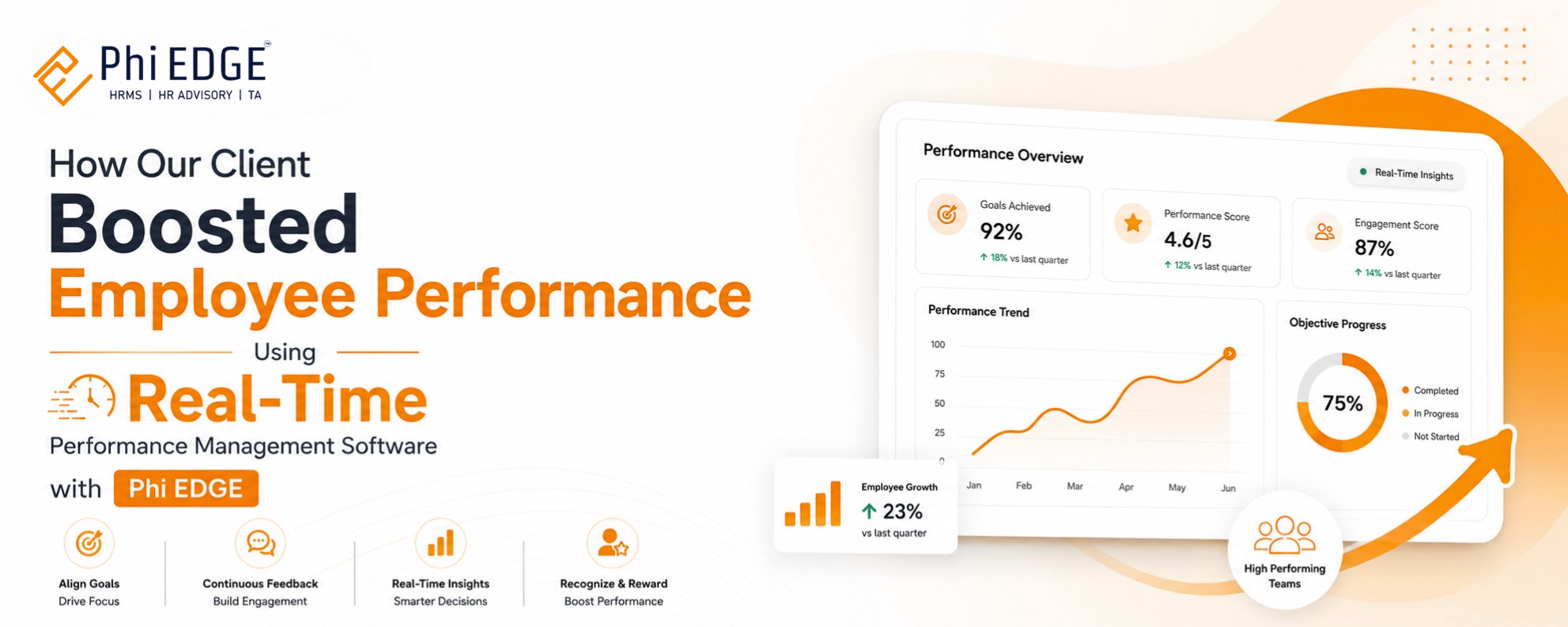
      3. How Our Client Boosted Employee Performance Using Real-Time Performance Management Software with Phi EDGE

        How Our Client Boosted Employee Performance Using Real-Time Performance Management Software with Phi EDGE

        Organizations are always looking for more intelligent ways to boost employee engagement, productivity, and operational efficiency in the fast-paced corporate world of today. For modern businesses, manual performance tracking techniques and traditional rating systems are insufficient. Companies require sophisticated, data-driven, real-time solutions that boost employee happiness while assisting teams in staying in line with corporate objectives.

        Here, Phi EDGE’s cutting-edge real-time performance management software changed the game for one of our clients.

        The customer was dealing with a number of issues, including low team and management communication, delayed appraisals, employee productivity, and a lack of transparency. The company saw notable gains in goal monitoring, workflow management, employee responsibility, and overall business performance following the implementation of Phi EDGE’s performance management system.


        The Challenge: Traditional Performance Management

        Before implementing Phi EDGE a cloud based performance management software, our client relied on an annual performance management system that was typical of many EPC firms but ineffective in addressing modern performance challenges:

        1. Checklist-Style Reviews: Performance evaluations occurred once a year, typically using a checklist format. Employees received feedback based on managers’ short-term memory of their work, which led to biased and incomplete assessments.
        1. Absence of Regular Feedback: Employees often went months without receiving any feedback. The lack of a continuous feedback loop resulted in missed opportunities for employee growth and performance improvement throughout the year.
        1. Unclear Performance Metrics: The Key Performance Indicators (KPIs) used in evaluations were often unclear, making it difficult for employees to understand how their performance would be measured. This ambiguity affected employee motivation and focus.
        1. Biased Performance Ratings: With performance appraisals conducted only once a year, employees felt that their reviews were influenced more by recent events and interactions rather than their overall performance. High performers were demotivated when their contributions throughout the year were overlooked.
        1. Perception of Unfair Increments: Increments and promotions were often perceived as biased or inconsistent, leading to dissatisfaction among employees. High performers were not always rewarded appropriately, while others felt they were penalized without clear reasons.

        This system did not align with the company’s growth goals, as it hindered employee engagement, transparency, and performance development. Our client needed a system that provided regular, unbiased feedback and clear performance metrics to drive employee productivity and accountability.

        By implementing Phi EDGE, the client significantly enhanced employee performance management through real-time insights and feedback:

        Our client decided to implement Phi EDGE- software for tracking employee performance to address these performance management challenges. Phi EDGE was chosen for its ability to provide real-time feedback, data-driven performance appraisals, and an unbiased, transparent system for managing employee performance.

        Key features of our performance management software that addressed the challenges included:

        1. Clear KPIs and Objective Goal Setting:  Our performance evaluation software allowed managers to set clear, measurable KPIs for each employee, which created transparency in expectations. Employees understood what was expected of them, and their performance was evaluated against objective, measurable goals.
        1. Unbiased, Data-Driven Ratings: Performance feedback software introduced an automated rating system that captured performance data over time. This helped eliminate biases and ensured that all employee contributions were considered in their final ratings, making the process fairer and more consistent.
        1. Monthly Performance Reviews: Instead of the once-a-year reviews, Phi EDGE enabled monthly performance reviews. These regular touchpoints provided employees with timely feedback, allowing them to adjust their performance and improve throughout the year.
        1. Real-Time Feedback:  Our real time performance management software enabled continuous feedback between employees and managers, as well as peer-to-peer feedback. This real-time feedback allowed employees to correct issues early, recognize their achievements, and keep track of their progress.
        1. Performance-Linked Increments: Increments were now linked directly to an employee’s year-round performance score. High performers were rewarded more frequently, which created an incentive for continuous improvement.
        1. Comprehensive Dashboards: Our performance management system offered detailed performance dashboards for both managers and employees. Managers could track KPIs in real-time, identify trends, and take corrective actions quickly, while employees could visualise their own progress and understand where they stood.

        Implementation Process

        The implementation of Phi EDGE was carried out in phases. Since our client had 1000 employees, the first phase of implementation covered 750 employees, focusing on critical departments that had the highest need for structured performance management.

        1. Change Management and Training: To ensure a smooth transition, our client’s HR team worked closely with Phi EDGE support team to develop training programs for both managers and employees. These training sessions helped employees understand how to use the platform, set meaningful goals, and navigate the real-time feedback system.
        1. Integration with Existing HR Systems: Online performance management software by Phiedge was integrated with the client’s existing HR systems, ensuring seamless data flow and allowing the platform to capture and analyze employee data in real time.
        1. Pilot Program: The first department to implement Phi EDGE was the Project Management team, as their KPIs were critical to project delivery timelines. The results from the pilot program were so promising that the client rapidly expanded our performance management software to other departments, including Engineering, Procurement, and Operations.

        Understanding the Client’s Challenges

        Before implementing the software, the organisation relied heavily on spreadsheets, manual reports, emails, and traditional review systems. As the company expanded, managing employee performance became increasingly difficult.

        Major Problems Faced by the Client

        Lack of Real-Time Monitoring

        Managers had no clear visibility into employee productivity daily. Performance reviews were conducted quarterly or annually, which delayed feedback and slowed improvement.

        Inconsistent Employee Evaluations

        Different departments followed different evaluation methods, creating confusion and unfair appraisal systems.

        Poor Goal Tracking

        Employees were unaware of their progress toward KPIs and organisational goals. Teams lacked direction and accountability.

        Delayed Feedback System

        Employees only received feedback during formal reviews, making it difficult to improve performance in real time.

        Low Employee Engagement

        Without transparent communication and recognition systems, employee motivation gradually decreased.

        Why the Client Chose Phi EDGE

        The company needed a smart and scalable solution capable of managing employee performance efficiently while supporting future growth.

        After evaluating multiple HR and employee management platforms, they selected Phi EDGE Performance Management Software due to its advanced automation capabilities, real-time tracking, and user-friendly dashboard.


        Key Features That Helped Improve Employee Performance

        Real-Time Performance Tracking

        One of the biggest advantages of Phi EDGE was its real-time employee performance monitoring system.

        Managers could instantly:

        • Track daily productivity
        • Monitor task completion
        • Review employee KPIs
        • Analyse workflow performance
        • Identify performance bottlenecks

        This created a culture of accountability and transparency throughout the organization.


        Goal-Based KPI Management

        Phi EDGE allowed managers to create measurable goals and KPIs for each department and employee.

        Benefits of KPI-Based Tracking

        • Employees clearly understood expectations
        • Teams remained aligned with business objectives
        • Managers could measure progress accurately
        • Employees became more focused on results

        This significantly improved productivity levels across departments.


        Continuous Feedback System

        Instead of waiting for yearly appraisals, employees started receiving continuous performance feedback.

        Real-Time Feedback Benefits

        • Faster improvement cycles
        • Better communication between managers and teams
        • Reduced performance gaps
        • Higher employee confidence

        Employees appreciated the immediate recognition and actionable suggestions provided by the platform.


        Smart Employee Dashboard

        Phi EDGE introduced a centralised dashboard where employees could view:

        • Performance scores
        • Assigned tasks
        • Attendance records
        • Team goals
        • Progress reports
        • Feedback history

        This transparency motivated employees to improve their daily performance.

        Results and Impact

        The implementation of a performance management system had a profound impact on the client’s employee performance and overall organisational culture:

        1. Enhanced Employee Engagement: Employees felt more motivated and involved when they received regular feedback and had clear KPIs. Employee satisfaction increased as a result of the fairness and transparency of performance reviews, particularly for high achievers who were now given more regular recognition.
        2. Increased Productivity: A culture of accountability was established by implementing monthly reviews and ongoing feedback. Because they were aware that their performance was being monitored all year long, workers were more productive as they strived to continuously achieve their objectives.
        3. Fair and Unbiased Appraisals: Favouritism and short-term memory bias were eliminated thanks to our performance management software’s impartial assessment methodology. Workers believed that their evaluations accurately represented their efforts and were founded on objective evidence. This raised spirits and promoted more reliable performance.
        1. Higher Retention of Top Talent: One of the key issues the client faced before Phi EDGE was the potential loss of high performers who felt demotivated by the old system. With the new system in place, high performers were regularly recognized and rewarded, leading to higher retention rates.
        1. Clear Alignment Between Performance and Rewards: By linking increments to performance throughout the year,  Performance assessment software ensured that rewards were directly tied to employee contributions. This created a performance-driven culture where employees were motivated to continuously improve.
        1. Enhanced Managerial Effectiveness: Managers now had access to real-time performance data, enabling them to make informed decisions about promotions, development plans, and salary increments. Phi EDGE data-driven insights allowed managers to identify both top performers and those who needed additional support.

         Financial Impact on the Company

        The implementation of our performance evaluation software not only improved employee performance but also had a positive financial impact on the company. With employees now more motivated and productive, project delivery timelines improved, and the company saw a marked reduction in project delays and cost overruns. Additionally, the retention of top talent reduced recruitment and training costs for our client.

        Challenges Faced

        Despite the overall success of our performance management system (Phi EDGE), our client encountered a few challenges during implementation:

        1. Initial Opposition to Change: Some workers, particularly those who had worked for the company for a long period, were reluctant to abandon the conventional structure. However, this opposition was eventually overcome because of the leadership’s clear communication and efficient change management.
        2. Learning Curve: It took some time to get used to using performance feedback tools. Workers had to become accustomed to getting regular feedback and comprehending how their work was assessed. With continued assistance and instruction, our customer was able to lessen this.
        3. Integration Delays: It took longer than expected to integrate Phi EDGE with the business’s current HR systems. Nevertheless, the problems were fixed and the system was completely integrated with the help of Phi EDGE’s implementation team.

         Conclusion

        The implementation of our online performance management software at our client’s company successfully transformed its approach to performance management. With a focus on real-time feedback, clear performance metrics, and unbiased appraisals, Phi EDGE by Phi EDGE enabled the client to foster a high-performance culture that motivated employees and rewarded them fairly.

        By implementing Phi EDGE Phi EDGE cloud based performance management software, our client was able to increase productivity, retain top talent, and build a performance-driven culture that aligned with its business goals. The success of Phi EDGE has set the foundation for long-term growth and success in a highly competitive EPC industry. The company’s future looks bright as it continues to leverage real-time performance management to stay ahead in the market.