Category: Blog

  • Employee Performance Management

    Employee Performance Management

    Employee Performance Management

    Underperformance occurs when an employee fails to meet expected work standards, productivity levels, or business goals. This can happen for a number of reasons, such as lack of motivation, unclear expectations, inadequate training, workplace stress, or poor communication. Ignoring these issues can lead to a negative work culture and eventually reduce team efficiency. Businesses that proactively address underperformance can identify the root cause early and provide the necessary support to improve employee performance. Consistently underperforming employees have an impact on team morale, workflow efficiency, and overall business success in addition to their own productivity. In order to preserve a productive workplace and avoid long-term operational issues, underperformance must be addressed right away.

    Recognizing Underperformance by Employees

    When an employee falls short of expected job standards, productivity levels, or corporate objectives, it is referred to as underperformance. A number of factors, such as low motivation, ambiguous expectations, inadequate training, stress at work, or poor communication, might cause this. Ignoring these problems might eventually lead to a bad workplace culture and decreased team productivity.

    Proactively addressing underperformance allows businesses to find the underlying cause early on and provide employees the help they need to improve.


    Underperformance in the workplace is an issue that must be addressed immediately, as widespread underperformance can quickly lead to a non-performance culture. Once established, this culture becomes incredibly difficult to reverse and has a spiraling effect on overall business performance.

    There are two primary reasons for underperformance:


    1.Will Issue

    2.Skill Issue

    While skill issues are relatively straightforward to address, will issues often require more time and effort. However, in both cases, the first step is identifying performance gaps—and this is impossible without being backed by data. As the saying goes, “what gets measured gets delivered.”

    Tackling Skill Issues

    Skill issues are more common and can be addressed systematically by taking the following steps:

    1. Set SMART Goals (KRA/KPI/Targets)
      Goals should be specific, measurable, attainable, realistic, and time-bound. However, simply having performance management software (PMS) is not enough to solve this issue. You need specialists who can set SMART goals that are aligned with company and departmental objectives. If goals aren’t aligned or cascaded properly, employees may work toward objectives that are not relevant to the organization.
    2. Quantify Goals and Automate Performance Scoring
      Each KRA/KPI/target must be quantifiable with weightage, so the system can calculate scores automatically. It’s important to select a PMS software that avoids manager bias, as manual ratings often introduce subjective evaluations. Many PMS tools fail when they allow managers to rate performance manually, resulting in bias. Therefore, choose a software that doesn’t rely on managers’ ratings and also encourages employees to upload proof of achievements, building accountability.
    3. Identify Training Needs Based on Performance Gaps
      It’s essential to identify training needs based on actual performance data. This ensures that employees see the value in their training and can relate it directly to their performance gaps. Arbitrarily assigning training without data will likely leave employees unconvinced about its importance.

    Addressing Will Issues

    Will issues can be more challenging to resolve, but they can be addressed using the following approaches:

    1. Consistent Performance Reviews and Feedback
      PMS is not just a tool to measure performance; it should be used to improve it as well. Regular performance reviews and 1:1 feedback sessions are crucial in addressing will issues, where employees may be disengaged or lack motivation.
    2. Leverage Data to Spot Patterns
      A robust PMS software can highlight patterns of performance and non-performance. These patterns should be used to give constructive feedback and identify trends in behavior.
    3. Showcase Performance and Its Impact
      Often, will issues can be tackled by showcasing both strong and weak performances. This can be done through rewards and recognition programs (R&R) within the software. Additionally, linking performance to compensation, such as bonuses and increments, can motivate underperforming employees by showing a direct correlation between effort and reward.

    Why a Unique PMS Software Is Essential

    To effectively address both skill and will issues, it is critical to select a unique PMS software that offers the following characteristics:

    • Real-Time Dashboards: Monthly and Year-to-Date (YTD) performance scores should be displayed in attractive dashboards and reports, making it easy to track progress.
    • Consulting-Backed Software: Choose a software that is supported by a consulting firm capable of aligning individual goals with business objectives, ensuring strategic alignment.
    • Automated Scoring: The system should automate performance scores, eliminating the need for manager ratings and reducing bias.
    • Link Performance to Compensation: Ensure the PMS links performance to rewards such as bonuses and increments, providing motivation for continuous improvement.
    • Pattern Analysis: Look for a software that highlights performance/non-performance trends, broken down by individual KPIs, allowing for targeted interventions.

    Conclusion

    Underperformance can quickly become a company-wide issue if not addressed promptly. By leveraging data-driven insights, setting aligned SMART goals, and selecting the right PMS software, businesses can turn underperformance into an opportunity for growth. A tailored approach, combining technology with strategic human insight, is key to building a high-performance culture.
  • Why Cloud-Based Performance Management Software is Essential for Modern Businesses

    Why Cloud-Based Performance Management Software is Essential for Modern Businesses

    Organizations are continuously looking for more clever ways to boost teamwork, staff productivity, and operational efficiency in today’s cutthroat digital business climate. For modern workplaces that demand speed, flexibility, and real-time decision-making, manual HR systems and traditional employee evaluation techniques are no longer effective.

    The complexity of managing staff performance, measuring KPIs, keeping an eye on productivity, and performing assessments increases as firms expand. Because of this, businesses are quickly adopting cloud-based performance management tools.

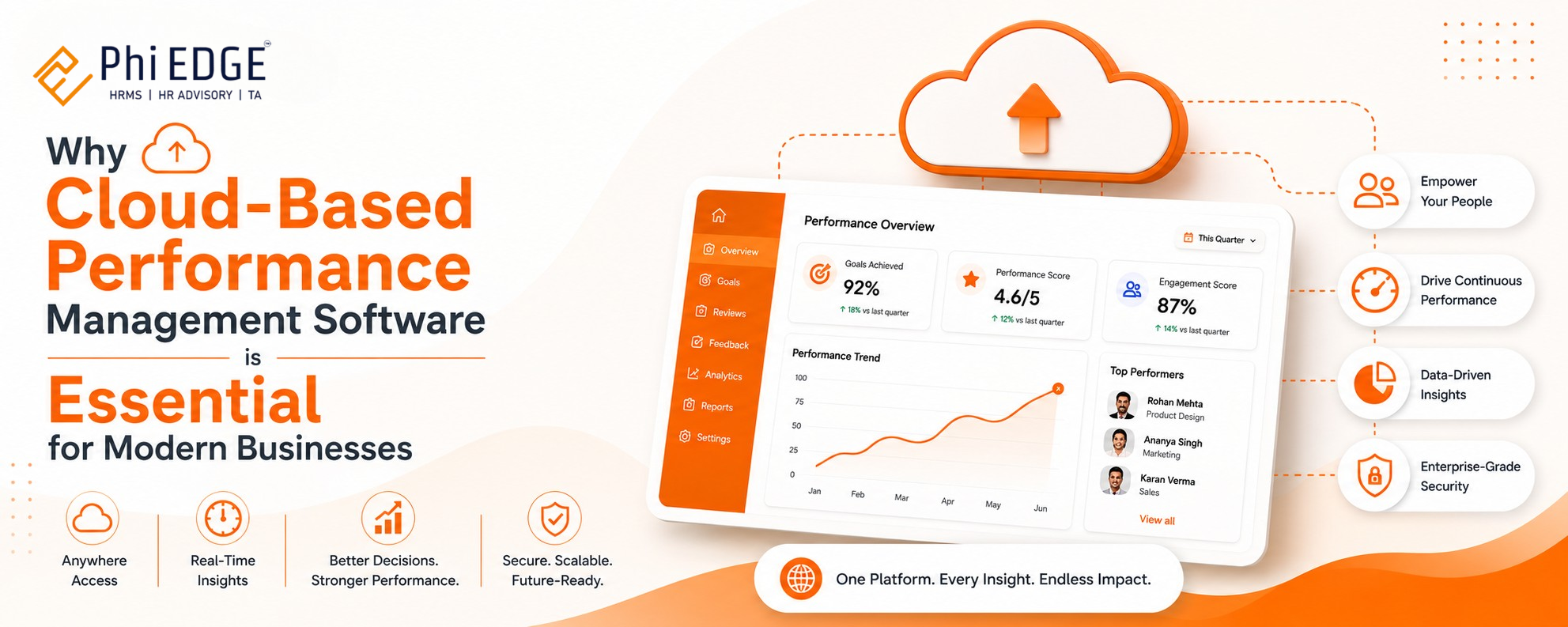
    Phi EDGE provides a cutting-edge cloud-based performance management solution that helps businesses create a high-performance work culture, enhance employee engagement, and simplify HR procedures.

    In the fast-paced and ever-evolving landscape of modern business, efficiency and adaptability are crucial. One area where this is especially evident is performance management. Traditional methods often lack the agility needed to keep up with changing demands. That’s why cloud-based performance management software is becoming a game-changer for businesses of all sizes. This blog explores the reasons why cloud-based performance management software is essential for modern businesses.

    What is Cloud-Based Performance Management Software?

    Cloud-based performance management software is an online platform that allows businesses to use a centralized digital system to track, assess, and enhance employee performance.

    Cloud-based software securely keeps all employee performance data on cloud servers, enabling businesses to access information at any time and from any location, in contrast to traditional systems that rely on spreadsheets, papers, and offline records.

    These platforms assist businesses in managing:

    Monitoring employee performance
    Setting objectives and tracking KPIs
    Instantaneous feedback
    Evaluations of employees
    Analysis of workforce productivity HR reporting and analytics Teamwork.


    Why Traditional Performance Management Systems Fail

    Many businesses still use outdated appraisal systems that create multiple operational challenges.

    Delayed Performance Reviews

    Traditional annual or quarterly reviews often delay employee feedback, making it difficult to improve performance quickly.

    Lack of Transparency

    Employees frequently remain unaware of how their performance is measured, leading to confusion and reduced motivation.

    Manual Reporting Errors

    Spreadsheet-based tracking systems increase the risk of data inaccuracies and reporting mistakes.

    Poor Employee Engagement

    Employees who receive limited feedback often feel disconnected from company goals and expectations.

    Difficulty Managing Remote Teams

    Modern hybrid and remote work environments require cloud accessibility, which traditional systems cannot efficiently provide.


    Real-Time Access and Flexibility

    One of the standout features of cloud-based performance management software is its ability to provide real-time access to data. Managers, HR teams, and employees can access performance reviews, goals, and feedback from anywhere at any time, ensuring seamless workflow continuity.

    For businesses with remote or hybrid teams, this flexibility is invaluable. Employees can track their progress and managers can provide timely feedback, all without being restricted to the office.

    Key Benefits:

    • Access Anytime, Anywhere
    • Ideal for Remote and Hybrid Workforces

      Scalability for Growing Businesses

    As businesses grow, their needs change. Cloud-based systems offer scalability, meaning the software can adapt as your business expands. Whether you’re adding more employees or creating new performance metrics, a cloud-based solution can easily accommodate these changes.

    This scalability ensures that businesses, from startups to large enterprises, only pay for what they need, making it a cost-effective option.

    Key Benefits:

    • Adapts to Business Growth
    • Cost-Effective and Customizable
      Automation for Efficiency

    Manual performance tracking can be tedious and prone to human error. Cloud-based performance management software automates key processes like setting goals, conducting performance appraisals, and generating reports. This saves HR teams and managers valuable time while improving the accuracy and reliability of performance data.

    Automation also reduces the chances of bias, as cloud-based systems often incorporate objective, data-driven metrics.

    Key Benefits:

    • Saves Time Through Automation
    • Improves Accuracy and Reduces Bias
      Data-Driven Decision Making

    Modern businesses thrive on data, and cloud-based performance management software provides real-time analytics to help make data-driven decisions. With detailed reports and insights, managers can easily identify performance trends, spot high achievers, and address underperformance before it becomes a bigger issue.

    By using data to guide decision-making, businesses can align individual performance with overall organizational goals, leading to improved productivity and business outcomes.

    Key Benefits:

    • Access to Real-Time Analytics
    • Informed, Data-Driven Decisions
      Enhanced Employee Engagement

    Employees want regular feedback and recognition. Cloud-based performance management systems provide a platform for continuous feedback, which can significantly enhance employee engagement. By setting clear, measurable goals and offering real-time performance feedback software, businesses can keep employees motivated and aligned with company objectives.

    In addition, these systems can integrate with employee recognition programs, ensuring that top performers are acknowledged and rewarded for their contributions.

    Key Benefits:

    • Continuous Feedback for Increased Engagement
    • Recognition of Top Performers

    Cloud-based performance management software is no longer a luxury; it’s a necessity for modern businesses. By providing real-time performance management access, scalability, automation, data-driven insights, and enhanced employee engagement, it helps organizations streamline performance management and drive business success. Whether you’re a small business or a large enterprise, investing in cloud-based performance management can transform how you manage and optimize employee performance.

    Investing in a cloud-based performance management solution can revolutionize your business. Don’t get left behind—embrace the future of performance management today!

    Conclusion:

    To remain competitive in the fast-paced digital world of today, modern organisations require more intelligent and adaptable personnel management solutions.

    For managing contemporary teams, distant workforces, and expanding organisational needs, traditional performance evaluation techniques are no longer adequate.

    Businesses can increase employee productivity, automate HR processes, expedite evaluations, and create an open, performance-driven culture with Phi EDGE’s potent cloud-based performance management system.

    For more details call us at +91 8956049164 or visit https://www.Phi EDGE-phiedge.com/