Introduction
Open ten job requisitions today, and you’ll likely see the same pattern: hundreds of applications flooding in within hours, a shrinking window to make an offer before top talent disappears, and a hiring manager who still can’t find the “right fit.” This is the paradox defining recruitment in 2026. Application volumes have surged, yet filling the right role has never felt harder. HR leaders are drowning in resumes but starving for qualified candidates.
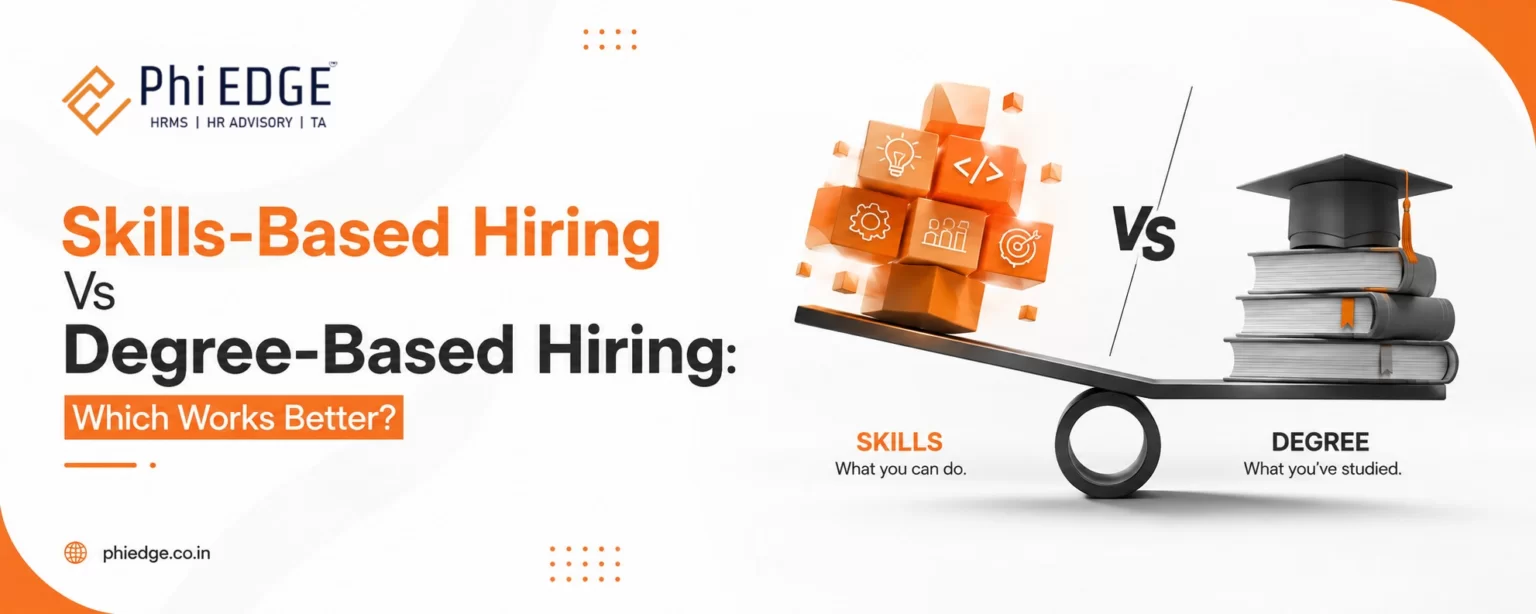
At the center of this challenge sits an old debate that has taken on new urgency: should you hire based on degrees or demonstrated skills? For decades, a four-year degree was the default filter on every job posting. Today, that filter is being dismantled quietly by some companies, loudly by others. Tech giants, airlines, banks, and even state governments have dropped degree requirements for thousands of roles, betting that what a candidate can do matters more than what a transcript says they learned.
But are skills-based hiring actually delivering better outcomes, or is it mostly a talking point that hasn’t changed hiring behaviour on the ground? This article breaks down both approaches, backs the comparison with current data, and explains how the right technology, from an applicant tracking system to AI recruitment software, determines whether either model actually works in practice.
What is Degree-Based Hiring?
Degree-based hiring is a recruitment approach that treats a formal educational credential, typically a bachelor’s degree, as a baseline qualification for a role, regardless of whether the degree’s subject matter is directly relevant to the job’s daily responsibilities.
Pros of Degree-Based Hiring
- Signals a baseline of discipline and commitment. Completing a multi-year program demonstrates the ability to follow through on long-term goals.
- Simplifies initial screening. A degree requirement acts as a quick filter when recruiters are managing high application volumes.
- Still relevant for regulated or technical professions. Fields like law, medicine, engineering, and accounting have degree requirements tied to licensing and safety, not just tradition.
- Provides a shared educational baseline for roles where deep theoretical grounding genuinely predicts performance.
Limitations of Degree-Based Hiring
- Excludes capable candidates. Millions of skilled workers, self-taught developers, boot camp graduates, military veterans, and career changers get filtered out before a human ever reviews their application.
- Doesn’t reliably predict job performance. A degree tells you what someone studied years ago, not what they can execute today.
- Disproportionately screens out underrepresented groups, since access to four-year degrees is uneven across income levels and demographics.
- Shrinks the talent pool at a time when employers are already struggling to fill open roles.
- Expensive by proxy. Employers who insist on degrees are effectively asking candidates to have taken on significant education debt as a prerequisite for consideration, pricing out otherwise strong applicants.
What is Skills-Based Hiring?
Skills-based hiring evaluates candidates primarily on demonstrated competencies like technical skills, problem-solving ability, certifications, portfolios, and real-world experience rather than on where or whether they earned a degree.
Instead of asking, “Does this person have a bachelor’s degree?” skills-based hiring asks, “Can this person do the job we need done?” It relies on structured skill assessments, practical tests, work samples, and competency-based interviews rather than credential checklists.
Why It’s Gaining Popularity
The shift toward skills-based hiring isn’t a fringe experiment; it’s backed by measurable movement across major employers and government bodies:
- Roughly 70% of organizations now report using skills-based hiring practices for at least some roles, up from around 65% the previous year.
- Major employers including IBM, Google, Delta Air Lines, Bank of America, and Accenture have removed four-year degree requirements from a large share of their job postings a shift that has expanded beyond tech into finance, aviation, and retail.
- Skills-based hiring can expand an employer’s addressable talent pool by several multiples in fields like financial services, simply by removing an artificial filter that was never a reliable predictor of ability.
- IBM’s well-known “New Collar” program hires technicians without four-year degrees and trains them in-house treating skill development as an ongoing investment rather than a hiring prerequisite.
That said, the shift is more genuine at some companies than others. Research from Harvard Business School and the Burning Glass Institute found that many organizations that publicly announced they were “dropping degree requirements” saw little actual change in who they hired the job postings changed, but the hiring managers’ habits didn’t. The lesson for HR leaders: intent alone doesn’t create outcomes. Execution does.
Skills-Based Hiring Vs Degree-Based Hiring: A Practical Comparison
- Accuracy in Hiring
Skills-based hiring tends to correlate more closely with actual job performance because it tests for the competencies a role requires, rather than a proxy credential. Structured skill assessments and work-sample tests give hiring teams direct evidence of capability. Degree-based hiring, by contrast, assumes that academic performance transfers cleanly into workplace performance an assumption that frequently breaks down, especially in fast-evolving fields like software development, digital marketing, and data analytics where formal curricula struggle to keep pace with real-world tools.
- Speed of Hiring
This is where the comparison gets interesting. Degree-based hiring can feel faster because a single filter (“Bachelor’s degree required”) quickly trims a large applicant pool. But that speed is often false economy — it screens out qualified candidates early, forcing recruiters to reopen searches when the remaining pool doesn’t deliver strong offers. Skills-based hiring, when supported by the right technology, can actually reduce hiring time more effectively by surfacing genuinely qualified candidates faster, cutting down on false starts and repeat searches later in the pipeline.
- Quality of Candidates
Organizations that have implemented skills-based hiring with real rigor — not just symbolic policy changes — report meaningfully better outcomes. Skills-first hiring has been linked to significantly higher retention among top performers, since candidates are matched to roles based on actual fit rather than credential optics. Degree-based hiring can still deliver quality candidates, particularly in professions where the degree itself is the skill (law, medicine), but it risks false positives: candidates who look strong on paper but underperform in practice.
- Cost Implications
Degree-based hiring carries hidden costs: a narrower talent pool inflates salary expectations for “qualified” candidates, extends time-to-fill for hard-to-source roles, and increases the risk of mis-hires when a degree turns out to be a poor proxy for competence. Skills-based hiring requires upfront investment in structured assessments and technology, but it tends to lower cost-per-hire over time by widening the pool, reducing turnover, and cutting the expense of repeated searches.
The Role of Technology in Modern Hiring
Neither approach works well at scale without the right infrastructure behind it. This is where recruitment technology becomes the deciding factor between a hiring philosophy that sounds good in a policy document and one that actually changes outcomes on the ground.
How an Applicant Tracking System Improves the Hiring Process
A modern applicant tracking system does more than store resumes — it structures the entire hiring workflow so decisions are consistent, auditable, and fast. Here’s how ATS improves the hiring process in practice:
- Standardizes evaluation criteria across recruiters and hiring managers, so candidates are scored against the same rubric instead of individual gut feeling.
- Centralizes candidate data, eliminating the spreadsheet chaos that slows down multi-stage interview loops.
- Flags bias-prone filters. A well-configured ATS can be adjusted so it stops quietly scoring degrees as a positive signal even when a job description no longer requires one, a gap that undermines many companies’ stated skills-based policies.
- Improves compliance and reporting, which matters increasingly as jurisdictions introduce hiring transparency requirements.
Modern HRMS platforms like Phi EDGE HRMS build these capabilities directly into their applicant tracking system, so HR teams aren’t stitching together separate tools for sourcing, screening, and reporting; the workflow stays connected from first application to final offer.
AI Recruitment Software: Matching Skills to Roles at Scale
AI recruitment software extends what an ATS can do by analyzing candidate data against role requirements far faster and more consistently than manual review. In practical terms, this means:
- Ranking candidates by skill fit rather than keyword density on a resume.
- Surfacing non-traditional candidates: career changers, boot camp graduates, and self-taught professionals who would otherwise be filtered out by rigid degree fields.
- Reducing recruiter workload on repetitive screening tasks, freeing them to focus on interviews and candidate experience.
One hospitality-sector employer that adopted AI-assisted skill matching reported a dramatic jump in candidates accepting their first job match, alongside a noticeable drop in mid-process candidate drop-out a strong signal that better matching improves both speed and candidate experience simultaneously.
Resume Screening Software and Recruitment Automation Tools
Resume screening software parses applications for relevant skills, certifications, and experience rather than relying on degree fields as a proxy. Paired with broader recruitment automation tools automated interview scheduling, pre-screening questionnaires, and skill-assessment integrations, HR teams can meaningfully reduce hiring time without sacrificing candidate quality. Automation doesn’t replace human judgment in hiring; it removes the administrative drag that keeps good candidates waiting and lets recruiters spend their time where it matters: evaluating fit, not chasing paperwork.
Real-World Use Cases: Companies Shifting to Skills-Based Hiring
- IBM’s “New Collar” initiative hires technicians directly into technical roles without a four-year degree requirement, then invests in structured on-the-job training. The approach was one of the earliest large-scale proofs that skills-first hiring can work at enterprise scale.
- Delta Air Lines removed degree requirements for many operational and technical roles, widening its applicant pool during a period of acute labour shortages in aviation.
- State governments, starting with Maryland in 2022 and followed by Utah, Pennsylvania, Colorado, and others, removed degree requirements across tens of thousands of public-sector positions an institutional signal that skills-based evaluation isn’t just a private-sector experiment.
- Financial services firms experimenting with skills-based hiring have reported the ability to expand candidate pools many times over compared to degree-gated postings, particularly for operations and analyst-level roles where practical competency matters more than a finance degree.
The common thread across these examples isn’t just a policy change; it’s a shift in mechanics. Companies that saw real results restructured their screening rubrics, retrained hiring managers, and used technology to enforce the new criteria consistently. Companies that only changed the wording on job postings, without changing how resumes were actually scored, saw minimal shifts in who they hired.
Which Approach Works Better?
The honest answer: it depends on the role, the industry, and critically, how disciplined the execution is.
- Skills-based hiring tends to outperform for roles where practical competency is directly observable and testable, such as software engineering, sales, customer support, operations, creative roles, and most technical or trade positions. It also performs better in fast-moving fields where formal curricula lag behind real-world tools and practices.
- Degree-based hiring still holds value for regulated professions where the credential is tied to legal or safety requirements: medicine, law, structural engineering, and similar fields where the degree is the qualification, not a proxy for one.
- A hybrid model is often the most realistic path for most mid-sized and large organizations: use skills assessments as the primary filter, while treating relevant degrees or certifications as a supporting signal rather than a gatekeeping requirement.
The organizations getting the best results aren’t the ones that picked a side dogmatically they’re the ones that matched their hiring criteria to what actually predicts success in each specific role, and then built consistent processes to apply that criteria at scale.
How Businesses Can Transition to Skills-Based Hiring
Moving from degree-gated hiring to a genuine skills-based model takes more than rewriting job descriptions. Practical steps include:
- Audit existing job postings to identify where degree requirements are genuinely necessary versus inherited habit.
- Define the specific skills each role requires, at what proficiency level, before you start screening candidates.
- Build a structured evaluation rubric a consistent scoring system every hiring manager uses, rather than subjective impressions.
- Train hiring managers on the new criteria; policy changes fail when the people doing the actual screening default to old habits.
- Use technology to enforce consistency. This is where a well-configured recruitment platform matters most. Automated skill matching, structured scorecards, and bias-aware screening logic ensure the new criteria are actually applied, not just written down.
- Track outcomes, not just intentions. Monitor time-to-fill, retention, and performance of skills-hired employees to validate (and refine) the approach over time.
This is also where the right HR technology stack becomes less of a “nice to have” and more of an operational necessity. Platforms like Phi EDGE HRMS bring applicant tracking, AI-assisted candidate matching, and hiring automation into a single system, helping HR teams turn a skills-based hiring policy into a consistently applied practice, rather than a good intention that quietly reverts to old habits under deadline pressure.
Conclusion
The degree-versus-skills debate isn’t really about which credential looks better on paper it’s about what genuinely predicts whether someone will succeed in a role. The data increasingly favours skills as the more accurate signal, but the organizations winning this shift are the ones pairing that philosophy with disciplined execution and the right technology to enforce it consistently.
As labour markets keep tightening and required skills keep evolving faster than academic curricula can track, hiring strategies that adapt fastest will win the best talent. Whether your organization leans skills-first, stays degree-anchored for select roles, or builds a hybrid model, the deciding factor will increasingly be the technology behind your hiring process how well your applicant tracking system, AI recruitment software, and automation tools translate strategy into consistent, fair, and fast hiring decisions.
The future of hiring isn’t about choosing a side in this debate. It’s about building a process precise enough to hire the right person, regardless of which path they took to get there.
If your team is ready to move from policy to practice, an HRMS like Phi EDGE HRMS can help connect skills-based screening, AI-assisted matching, and hiring automation into one consistent workflow so the shift shows up in your hiring data, not just your job postings.
Related Resource Curious how a connected HRMS platform actually supports this shift day-to-day? Explore Phi EDGE HRMS or request a free demo to see applicant tracking, AI-assisted matching, and hiring automation in action.
FAQ
Q1: Is skills-based hiring only relevant for tech roles?
No. While it started prominently in technology, skills-based hiring has expanded into finance, aviation, retail, hospitality, and public-sector roles. Any role where practical competency can be assessed and observed is a strong candidate for a skills-first approach.
Q2: Does removing a degree requirement automatically lead to more diverse or non-degree hires?
Not automatically. Research shows many companies that dropped degree requirements on paper saw little actual change in hiring outcomes, because screening habits and ATS configurations weren’t updated to match. Real change requires restructuring the evaluation process itself, not just the job posting.
Q3: Can an applicant tracking system support both degree-based and skills-based hiring?
Yes. A well-configured ATS can be set up to weight skills, certifications, and assessment results alongside or instead of degree fields, depending on how each role is defined. The key is configuring it deliberately rather than relying on default settings.
Q4: Will AI recruitment software replace human judgment in hiring decisions?
No. AI recruitment software is best used to surface and rank qualified candidates faster and more consistently, reducing administrative load and bias-prone shortcuts. Final hiring decisions especially around culture fit and team dynamics still benefit from human judgment.
About the Author
Vibha Anoop is a Director at Phi EDGE and has spent 26 years in organizational and people development, including 8 years in private HR consulting. She has held senior HR leadership roles at Godrej & Boyce (Head HR) and the Aditya Birla Group (Programme Director), leading large-scale HR interventions for MNCs and Indian corporates. She is also the Founder of Phi Consulting Services, where she has delivered end-to-end Core HR solutions for clients across industries and geographies in India. Vibha is an alumna of the Symbiosis Institute of Business Management.