Most organisations run performance reviews. Most run training programmes. Far fewer can confidently answer a simple question: are employees actually developing the competencies the business needs?
It’s a fair question, and an uncomfortable one for many HR teams. Training budgets get spent, and course completions get logged, yet six months later the same competency gaps resurface in appraisal cycles, and the same roles remain hard to backfill internally.
The problem usually isn’t the training itself; it’s that competency assessment, performance management, and L&D operate as separate processes, often in separate systems, and run on different calendars. Nobody looks at all three together, so training decisions get made on instinct rather than evidence.
An integrated competency management system built into a broader HRMS changes this. When competency data, skills data, and learning data sit in one connected system, L&D stops being a generic calendar of courses and starts being a targeted response to measurable gaps. Here’s how that integration actually works.
What Is Competency Management?
Competency management is the structured process of defining, assessing, and developing the behaviours, knowledge, and skills employees need to perform in their roles and grow into future ones. A competency is broader than a single skill it combines technical know-how, behaviour, and applied judgment in context.
Competency frameworks typically organise these into three categories:
- Core competencies — expected of everyone (communication, collaboration, adaptability)
- Functional competencies — specific to a job family (financial analysis, campaign management)
- Behavioural/leadership competencies — how work gets done, especially at senior levels (stakeholder management, decision-making)
Competency management involves three connected activities: building competency frameworks with defined proficiency levels per role, running competency assessments through manager ratings, self-assessment, or 360-degree input, and competency mapping, plotting current proficiency against what the role requires, which is what actually reveals a gap. Competency Management Software digitises this cycle instead of leaving it scattered across spreadsheets and appraisal PDFs.
What Is L&D Management?
Learning and Development (L&D) builds employee capability through structured training, coaching, and development experiences: training programs, learning paths, training calendars, individual development plans, and pre-/post-training assessments that check whether learning actually landed.
Learning and Development Software, L&D Management Software, and Employee Training Management Software give L&D teams a system to plan calendars, manage nominations and attendance, and report on completion instead of running the function through email threads and manual trackers. On its own, L&D software only tells you what training happened, not whether it was the right training for the right gap. That’s where competency data enters the picture.
Why Integrate Competency Management with L&D?
When these run as separate processes, familiar problems show up: training gets picked without competency data; entire teams get the same generic course regardless of individual proficiency; gap identification is manual and inconsistent; leadership has visibility into headcount but not actual capability; and nobody re-assesses competency after training to see if it moved.
Integration fixes this by making learning a response to evidence rather than a routine calendar exercise. The World Economic Forum’s Future of Jobs Report 2025 found skill gaps are now considered the single biggest barrier to business transformation, with 63% of employers surveyed identifying them as a major obstacle through 2030, which makes precision in training investment a genuine business priority, not just an HR nicety.
How HRMS Connects Competency Management with L&D?
An integrated HRMS treats competency development as one continuous workflow:
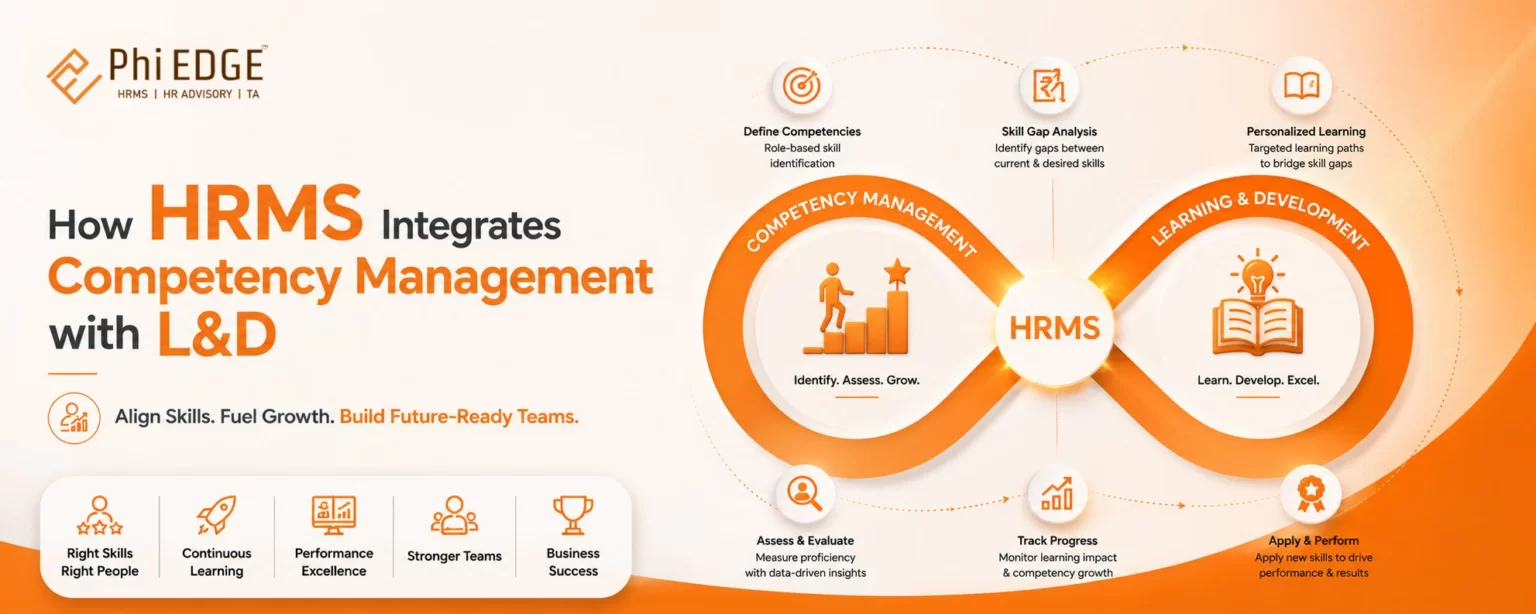
Competency Framework → Competency Mapping → Employee Skill Mapping → Assessment → Gap Identification → Training Needs Analysis → Learning Intervention → Post-Training Assessment → Competency Improvement → Performance & Career Decisions
HR defines required competencies and proficiency levels per role, then maps each employee against that framework through structured assessment. The system automatically flags gaps between required and current proficiency. L&D reviews these flagged gaps to decide what intervention is actually needed, assigns a targeted learning path, and tracks participation. After the intervention, a post-training assessment checks whether proficiency genuinely improved, and the updated score feeds into performance reviews, development plans, and succession discussions.
The value isn’t any single step — it’s that each step’s output automatically becomes the next step’s input, instead of HR manually reconciling data across disconnected systems.
Role of Competency Mapping in L&D
Competency mapping is the foundation everything else depends on. It connects job roles, required competencies, required proficiency levels, and each employee’s current and desired proficiency. When maintained in the HRMS rather than static documents, this mapping becomes the reference point for every downstream decision — what training gets assigned, what gets discussed in a one-on-one, what gets flagged for promotion. This is what makes Employee Skill Mapping genuinely personalised: two employees in the same role with different proficiency get different development plans, not the same course.
Skills Gap Analysis Vs Competency Gap Analysis
| Aspect | Skills Gap Analysis | Competency Gap Analysis |
| Focus | Specific, discrete abilities (a tool, a certification) | Broader combination of knowledge, behaviour, judgment |
| Measurement | Often proficiency-scaled against a defined skill | Rated against a proficiency scale within a framework |
| Typical use | Technical readiness, hiring criteria | Leadership development, succession decisions |
| Data source | Skills inventories, certifications | Manager assessments, 360-degree feedback |
Most organisations need both. A Skills Gap Analysis identifies who needs a specific certification; a Competency Gap Analysis identifies which managers need coaching in delegation before a leadership role. An integrated HRMS supports both because granular skill data and competency assessment data sit in the same employee profile.
How a Skills Matrix Supports Employee Development?
A Skills Matrix is a visual grid mapping employees against relevant skills, showing proficiency per cell. Generated from live assessment data, it helps HR and managers spot high-skill employees who could mentor others, critical skill shortages, training priorities, internal mobility opportunities, succession candidates, and future capability requirements. A matrix maintained manually in a spreadsheet is usually outdated within a quarter; one generated from the HRMS stays current.
From Training Needs Analysis to Personalized Learning
Training Needs Analysis (TNA) determines what training is actually required, based on evidence rather than assumption:
Role Requirements → Employee Assessment → Gap Identification → Training Need → Learning Program → Assessment → Measurement
A traditional training calendar asks, “What should we run this quarter?” A data-driven TNA asks, “Which specific employees have which specific gaps, and what closes them?” Assigning the same training to an entire department wastes time for employees who don’t need it and often under-serves the ones who do. Personalised, gap-driven learning paths are more likely to move the needle on the competency that was actually flagged.
How AI Can Improve Personalization in L&D
AI-Powered Learning and Development is worth being precise about. Realistic, current applications include identifying potential learning needs by scanning assessment data at scale, recommending content matched to a specific gap, supporting personalised learning paths, and flagging recurring gaps across a team — for example, “delegation” appearing repeatedly among first-time managers, pointing to a systemic on boarding issue rather than an individual one.
What AI isn’t: a replacement for manager judgment or a substitute for well-designed competency frameworks. It works with the data it’s given — if assessments are inconsistent, AI recommendations will be too.
Connecting Competencies with Performance Management
Competency-Based Performance Management links demonstrated behaviour against defined competencies to how employees are formally evaluated. When competency data feeds directly into performance management, reviews reference specific competencies rather than general impressions, development plans are built from identified gaps, and succession planning draws on real proficiency data rather than tenure. This is also where the loop closes on measuring training impact: if a competency score improves after an intervention, that’s tangible evidence — not just a completion certificate.
Skills-Based Talent Management
Skills-Based Talent Management shifts workforce planning from managing people by job title to managing them by demonstrated capability — using skill mapping, skills matrices, and competency profiles to inform internal mobility, career pathways, and succession planning. This matters more as skill half-lives shorten: the WEF estimates employers expect roughly 39% of workers’ core skill sets to change by 2030. Organisations that can see actual skills, not just titles, are better positioned to redeploy talent internally rather than defaulting to external hiring for every gap.
Practical Example: From Competency Gap to Improved Capability
A Sales Manager’s role requires strategic selling, negotiation, CRM, and team leadership. A quarterly assessment rates them below required proficiency in strategic selling. The system flags the gap; L&D reviews it against similar flags across the team; a targeted module is assigned and tracked; a post-training assessment checks applied understanding, not just attendance; the competency is reassessed next cycle; and the improved score feeds into the performance review and, over time, a leadership-readiness conversation. The value is the sequence — each stage’s data feeds the next.
Benefits Across the Organisation
- HR — centralised data, less manual reconciliation, more defensible talent decisions
- L&D teams — training grounded in real gaps, easier measurement of impact
- Managers — visibility into team capability, better-structured development conversations
- Employees — personalised development and clear visibility into what the next role requires
- Business leaders — workforce capability aligned to strategy, gaps surfaced early
What to Look for in an HRMS with Competency and L&D Integration?
A genuinely integrated platform — not two bolted-together modules — should include: configurable competency frameworks; competency and employee skill mapping; an auto-generated skills matrix; structured assessments (including 360-degree input); data-driven Training Needs Analysis; a training calendar with nomination and attendance tracking; pre- and post-training assessments; configurable learning paths; competency dashboards; performance management integration; analytics; responsible AI capabilities; LMS integration; and employee/manager self-service. The strongest signal of real integration: a flagged competency gap should trigger a training recommendation without HR manually moving data between modules.
How Phi EDGE HRMS Supports This Integration
Phi EDGE HRMS is built around the idea that competency data shouldn’t sit in an appraisal file waiting for someone to act on it. Within the platform, this shows up through competency tracking and behavioural assessment, Training Needs Identification, an annual training calendar, employee training nomination and attendance tracking, digital pre- and post-training assessments, competency-based appraisals integrated with performance management, talent mapping via the 9-Box Talent Grid, and an LMS-integrated learning ecosystem. The point isn’t a new category of software — it’s that these modules are built to talk to each other, so a flagged gap doesn’t require a separate system or spreadsheet to become a training action.
FAQ
What is a Competency Management System?
HR technology that defines competency frameworks, assesses employees against them, and maps resulting gaps — replacing manual, spreadsheet-based tracking.
How does HRMS support competency mapping?
By maintaining role-based requirements and comparing assessed proficiency against them to surface gaps automatically.
Skills Gap Analysis Vs Competency Gap Analysis?
The former targets discrete abilities like tools or certifications; the latter looks at broader behavioural capability rated on a proficiency scale.
What’s the role of AI in L&D?
Pattern recognition, content recommendation, and personalisation at scale — not a replacement for manager judgment or sound competency data.
How does a Skills Matrix help HR teams?
A current, single view of who has which skills at what proficiency, useful for spotting shortages and succession candidates.
How can competency data support performance management?
By feeding directly into reviews, development plans, and succession decisions, grounded in demonstrated capability.
Conclusion
Competency data shouldn’t end with an assessment sitting in a file. It should trigger action — a targeted learning intervention, a development plan, a re-measured competency. If a competency gap identified in your last appraisal cycle doesn’t automatically inform what training your team runs next quarter, that’s a reasonable starting point for evaluating whether your current HRMS actually connects competency management with L&D — or simply houses them side by side.
Related Resources
- Competency Model — how Phi EDGE structures competency frameworks and tracking
- Learning & Development — training calendars, nominations, and learning workflows
- Performance Management System — connecting competency data to appraisals and goals
- 9-Box Talent Grid — visualising performance against potential
- 360° Feedback — multi-rater input into competency assessments
- Succession and Career Planning — using competency data for readiness decisions
About the Author
Prabhakar Mendhe is Business Head at Phi EDGE HR Tech Private Limited, with 26 years of experience across Business HR, Performance Management, Soft Skills Facilitation, Coaching, and HR Consulting.