Organizations are always looking for more intelligent ways to boost employee engagement, productivity, and operational efficiency in the fast-paced corporate world of today. For modern businesses, manual performance tracking techniques and traditional rating systems are insufficient. Companies require sophisticated, data-driven, real-time solutions that boost employee happiness while assisting teams in staying in line with corporate objectives.
Here, Phi EDGE’s cutting-edge real-time performance management software changed the game for one of our clients.
The customer was dealing with a number of issues, including low team and management communication, delayed appraisals, employee productivity, and a lack of transparency. The company saw notable gains in goal monitoring, workflow management, employee responsibility, and overall business performance following the implementation of Phi EDGE’s performance management system.
The Challenge: Traditional Performance Management
Before implementing Phi EDGE a cloud based performance management software, our client relied on an annual performance management system that was typical of many EPC firms but ineffective in addressing modern performance challenges:
- Checklist-Style Reviews: Performance evaluations occurred once a year, typically using a checklist format. Employees received feedback based on managers’ short-term memory of their work, which led to biased and incomplete assessments.
- Absence of Regular Feedback: Employees often went months without receiving any feedback. The lack of a continuous feedback loop resulted in missed opportunities for employee growth and performance improvement throughout the year.
- Unclear Performance Metrics: The Key Performance Indicators (KPIs) used in evaluations were often unclear, making it difficult for employees to understand how their performance would be measured. This ambiguity affected employee motivation and focus.
- Biased Performance Ratings: With performance appraisals conducted only once a year, employees felt that their reviews were influenced more by recent events and interactions rather than their overall performance. High performers were demotivated when their contributions throughout the year were overlooked.
- Perception of Unfair Increments: Increments and promotions were often perceived as biased or inconsistent, leading to dissatisfaction among employees. High performers were not always rewarded appropriately, while others felt they were penalized without clear reasons.
This system did not align with the company’s growth goals, as it hindered employee engagement, transparency, and performance development. Our client needed a system that provided regular, unbiased feedback and clear performance metrics to drive employee productivity and accountability.
By implementing Phi EDGE, the client significantly enhanced employee performance management through real-time insights and feedback:
Our client decided to implement Phi EDGE- software for tracking employee performance to address these performance management challenges. Phi EDGE was chosen for its ability to provide real-time feedback, data-driven performance appraisals, and an unbiased, transparent system for managing employee performance.
Key features of our performance management software that addressed the challenges included:
- Clear KPIs and Objective Goal Setting: Our performance evaluation software allowed managers to set clear, measurable KPIs for each employee, which created transparency in expectations. Employees understood what was expected of them, and their performance was evaluated against objective, measurable goals.
- Unbiased, Data-Driven Ratings: Performance feedback software introduced an automated rating system that captured performance data over time. This helped eliminate biases and ensured that all employee contributions were considered in their final ratings, making the process fairer and more consistent.
- Monthly Performance Reviews: Instead of the once-a-year reviews, Phi EDGE enabled monthly performance reviews. These regular touchpoints provided employees with timely feedback, allowing them to adjust their performance and improve throughout the year.
- Real-Time Feedback: Our real time performance management software enabled continuous feedback between employees and managers, as well as peer-to-peer feedback. This real-time feedback allowed employees to correct issues early, recognize their achievements, and keep track of their progress.
- Performance-Linked Increments: Increments were now linked directly to an employee’s year-round performance score. High performers were rewarded more frequently, which created an incentive for continuous improvement.
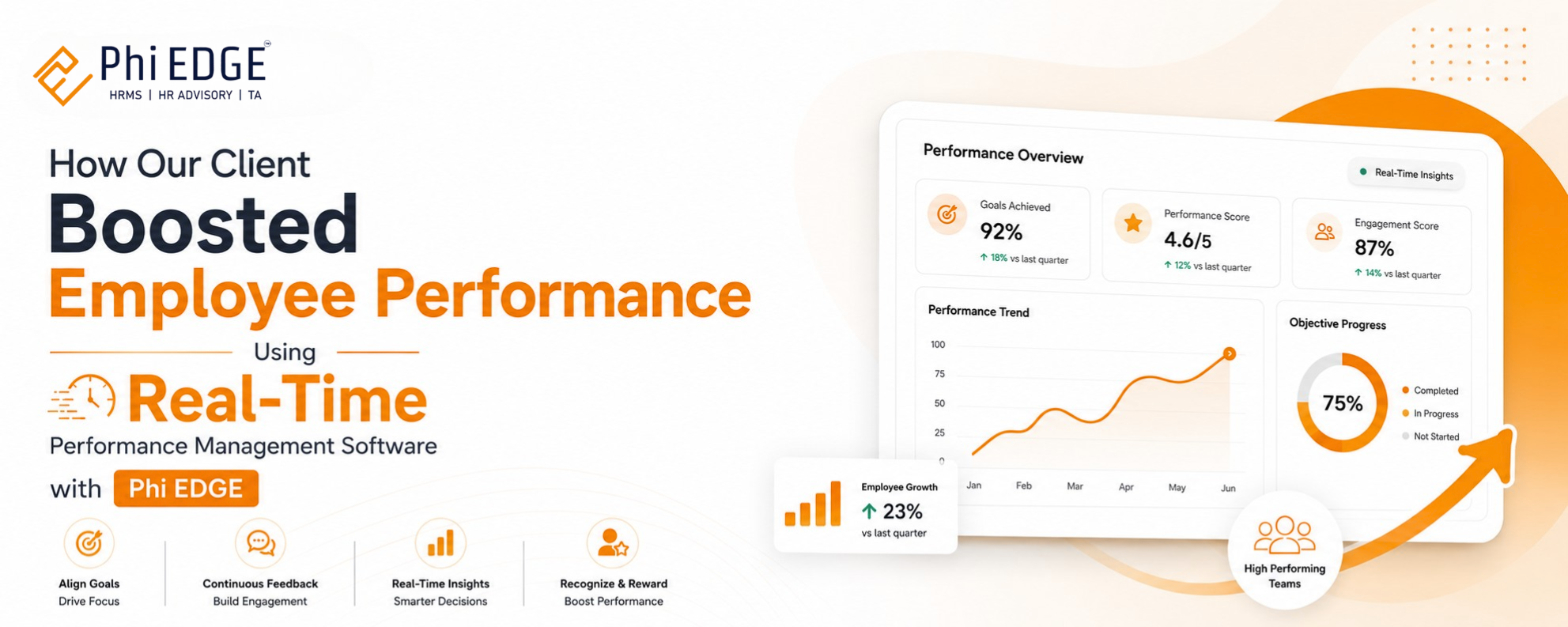
- Comprehensive Dashboards: Our performance management system offered detailed performance dashboards for both managers and employees. Managers could track KPIs in real-time, identify trends, and take corrective actions quickly, while employees could visualise their own progress and understand where they stood.
Implementation Process
The implementation of Phi EDGE was carried out in phases. Since our client had 1000 employees, the first phase of implementation covered 750 employees, focusing on critical departments that had the highest need for structured performance management.
- Change Management and Training: To ensure a smooth transition, our client’s HR team worked closely with Phi EDGE support team to develop training programs for both managers and employees. These training sessions helped employees understand how to use the platform, set meaningful goals, and navigate the real-time feedback system.
- Integration with Existing HR Systems: Online performance management software by Phiedge was integrated with the client’s existing HR systems, ensuring seamless data flow and allowing the platform to capture and analyze employee data in real time.
- Pilot Program: The first department to implement Phi EDGE was the Project Management team, as their KPIs were critical to project delivery timelines. The results from the pilot program were so promising that the client rapidly expanded our performance management software to other departments, including Engineering, Procurement, and Operations.
Understanding the Client’s Challenges
Before implementing the software, the organisation relied heavily on spreadsheets, manual reports, emails, and traditional review systems. As the company expanded, managing employee performance became increasingly difficult.
Major Problems Faced by the Client
Lack of Real-Time Monitoring
Managers had no clear visibility into employee productivity daily. Performance reviews were conducted quarterly or annually, which delayed feedback and slowed improvement.
Inconsistent Employee Evaluations
Different departments followed different evaluation methods, creating confusion and unfair appraisal systems.
Poor Goal Tracking
Employees were unaware of their progress toward KPIs and organisational goals. Teams lacked direction and accountability.
Delayed Feedback System
Employees only received feedback during formal reviews, making it difficult to improve performance in real time.
Low Employee Engagement
Without transparent communication and recognition systems, employee motivation gradually decreased.
Why the Client Chose Phi EDGE
The company needed a smart and scalable solution capable of managing employee performance efficiently while supporting future growth.
After evaluating multiple HR and employee management platforms, they selected Phi EDGE Performance Management Software due to its advanced automation capabilities, real-time tracking, and user-friendly dashboard.
Key Features That Helped Improve Employee Performance
Real-Time Performance Tracking
One of the biggest advantages of Phi EDGE was its real-time employee performance monitoring system.
Managers could instantly:
- Track daily productivity
- Monitor task completion
- Review employee KPIs
- Analyse workflow performance
- Identify performance bottlenecks
This created a culture of accountability and transparency throughout the organization.
Goal-Based KPI Management
Phi EDGE allowed managers to create measurable goals and KPIs for each department and employee.
Benefits of KPI-Based Tracking
- Employees clearly understood expectations
- Teams remained aligned with business objectives
- Managers could measure progress accurately
- Employees became more focused on results
This significantly improved productivity levels across departments.
Continuous Feedback System
Instead of waiting for yearly appraisals, employees started receiving continuous performance feedback.
Real-Time Feedback Benefits
- Faster improvement cycles
- Better communication between managers and teams
- Reduced performance gaps
- Higher employee confidence
Employees appreciated the immediate recognition and actionable suggestions provided by the platform.
Smart Employee Dashboard
Phi EDGE introduced a centralised dashboard where employees could view:
- Performance scores
- Assigned tasks
- Attendance records
- Team goals
- Progress reports
- Feedback history
This transparency motivated employees to improve their daily performance.
Results and Impact
The implementation of a performance management system had a profound impact on the client’s employee performance and overall organisational culture:
- Enhanced Employee Engagement: Employees felt more motivated and involved when they received regular feedback and had clear KPIs. Employee satisfaction increased as a result of the fairness and transparency of performance reviews, particularly for high achievers who were now given more regular recognition.
- Increased Productivity: A culture of accountability was established by implementing monthly reviews and ongoing feedback. Because they were aware that their performance was being monitored all year long, workers were more productive as they strived to continuously achieve their objectives.
- Fair and Unbiased Appraisals: Favouritism and short-term memory bias were eliminated thanks to our performance management software’s impartial assessment methodology. Workers believed that their evaluations accurately represented their efforts and were founded on objective evidence. This raised spirits and promoted more reliable performance.
- Higher Retention of Top Talent: One of the key issues the client faced before Phi EDGE was the potential loss of high performers who felt demotivated by the old system. With the new system in place, high performers were regularly recognized and rewarded, leading to higher retention rates.
- Clear Alignment Between Performance and Rewards: By linking increments to performance throughout the year, Performance assessment software ensured that rewards were directly tied to employee contributions. This created a performance-driven culture where employees were motivated to continuously improve.
- Enhanced Managerial Effectiveness: Managers now had access to real-time performance data, enabling them to make informed decisions about promotions, development plans, and salary increments. Phi EDGE data-driven insights allowed managers to identify both top performers and those who needed additional support.
Financial Impact on the Company
The implementation of our performance evaluation software not only improved employee performance but also had a positive financial impact on the company. With employees now more motivated and productive, project delivery timelines improved, and the company saw a marked reduction in project delays and cost overruns. Additionally, the retention of top talent reduced recruitment and training costs for our client.
Challenges Faced
Despite the overall success of our performance management system (Phi EDGE), our client encountered a few challenges during implementation:
- Initial Opposition to Change: Some workers, particularly those who had worked for the company for a long period, were reluctant to abandon the conventional structure. However, this opposition was eventually overcome because of the leadership’s clear communication and efficient change management.
- Learning Curve: It took some time to get used to using performance feedback tools. Workers had to become accustomed to getting regular feedback and comprehending how their work was assessed. With continued assistance and instruction, our customer was able to lessen this.
- Integration Delays: It took longer than expected to integrate Phi EDGE with the business’s current HR systems. Nevertheless, the problems were fixed and the system was completely integrated with the help of Phi EDGE’s implementation team.
Conclusion
The implementation of our online performance management software at our client’s company successfully transformed its approach to performance management. With a focus on real-time feedback, clear performance metrics, and unbiased appraisals, Phi EDGE by Phi EDGE enabled the client to foster a high-performance culture that motivated employees and rewarded them fairly.
By implementing Phi EDGE Phi EDGE cloud based performance management software, our client was able to increase productivity, retain top talent, and build a performance-driven culture that aligned with its business goals. The success of Phi EDGE has set the foundation for long-term growth and success in a highly competitive EPC industry. The company’s future looks bright as it continues to leverage real-time performance management to stay ahead in the market.