Every organization wants employees who can perform well today and develop the capabilities required for tomorrow. However, traditional performance reviews often focus mainly on targets, completed tasks, and business results. They may not fully explain which skills, behaviours, and capabilities employees need to improve.
A competency based model helps organizations define what successful performance looks like for each role. It creates a structured framework for assessing employee capabilities, identifying skill gaps, planning training, and supporting career development.
With a connected HRMS and talent management approach, organizations can use competency data to support more consistent performance management, employee development, and succession planning.
In this guide, we explain what a competency-based model is, how it works, its key benefits, and how businesses can implement it effectively with support from Phi EDGE HRMS.
What Is a Competency Based Model?
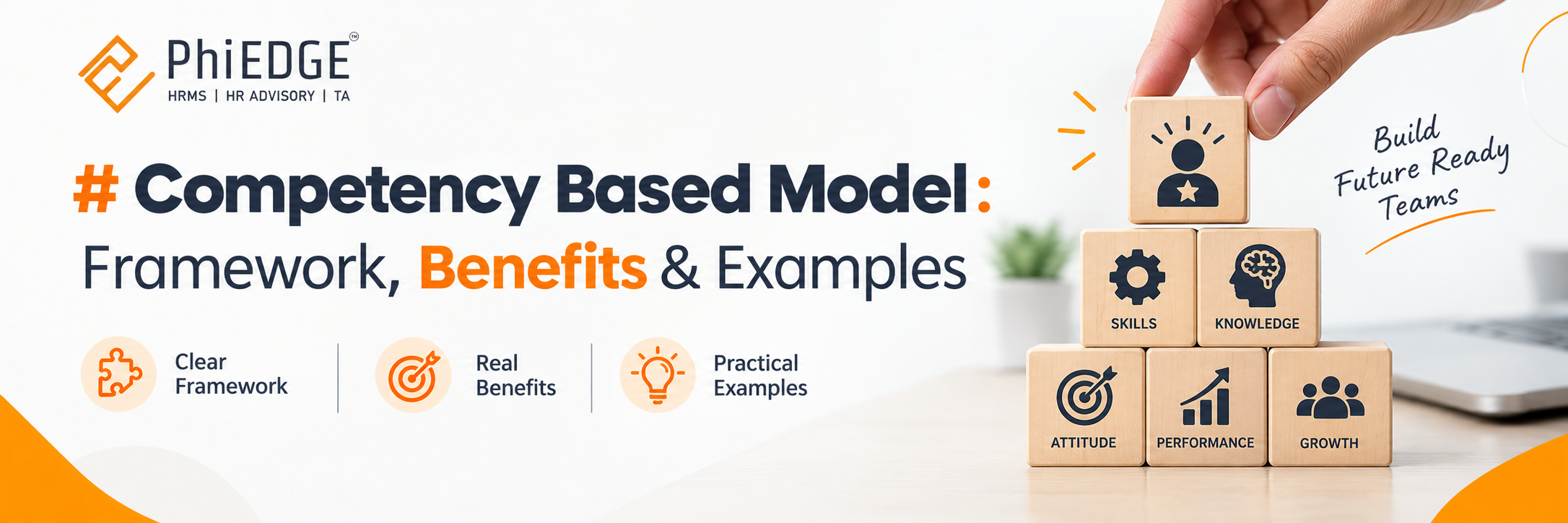
A competency based model is a structured framework that defines the knowledge, skills, behaviours, and capabilities employees need to perform successfully in a specific role.
For example, a sales executive may need product knowledge, customer communication, negotiation, and relationship management skills. A sales manager may require these capabilities along with team leadership, coaching, decision-making, and strategic planning.
A competency model makes these expectations clear and helps managers assess employees against defined role requirements rather than relying entirely on subjective opinions.
A typical competency based model includes:
- Core competencies: Communication, collaboration, adaptability, and problem-solving.
- Functional competencies: Technical knowledge and role-specific expertise.
- Leadership competencies: Decision-making, delegation, coaching, and strategic thinking.
- Proficiency levels: Clearly defined expectations for beginner, intermediate, advanced, and expert capabilities.
Why Is a Competency Based Model Important for Modern Businesses?
Organizations may experience inconsistent performance evaluations, unclear promotion criteria, or training programs that do not address actual employee development needs.
A competency framework provides a common reference point for HR teams, managers, and employees.
It helps organizations:
- Define clear expectations for every role.
- Identify capability gaps before they affect performance.
- Make employee development more targeted.
- Support structured recruitment and internal mobility.
- Improve consistency in performance assessments.
- Prepare employees for future responsibilities.
A well-designed framework should reflect the organization’s actual business objectives and job requirements. It should also be reviewed regularly as roles, technologies, and workforce priorities change.
How Does Competency Mapping Work?
Competency mapping identifies the capabilities required for a role and compares them with an employee’s current proficiency.
For example, a company may define five competencies for a team leader: communication, delegation, conflict resolution, coaching, and decision-making.
The organization then establishes expected proficiency levels for each competency and assesses the employee using appropriate evidence, such as manager feedback, work examples, assessments, and performance reviews.
The process generally follows these steps:
- Identify the roles and business priorities that matter most.
- Define the competencies required for each role.
- Establish observable behaviours and proficiency levels.
- Assess employees against the defined requirements.
- Identify competency gaps and development priorities.
- Create individual development plans.
- Review progress and reassess capabilities periodically.
This approach helps HR teams move from general statements such as “improve leadership skills” to specific development goals, such as improving delegation or conducting more effective feedback conversations.
What Are the Main Benefits of a Competency Model Framework?
1. More Consistent Performance Management
A competency framework helps managers assess both what employees achieve and how they achieve it. When combined with measurable goals, it provides a more complete view of performance.
2. Targeted Learning and Development
Competency assessments can reveal where employees need support. HR teams can then connect identified gaps with relevant training, coaching, mentoring, or practical assignments.
3. Better Career Development
Employees can understand the competencies required for their next role and work toward measurable development goals. This makes career discussions more structured and actionable.
4. Stronger Succession Planning
Organizations can assess whether potential successors possess the capabilities needed for critical roles. Development plans can then focus on the gaps that must be addressed before a transition.
5. Clearer Talent Decisions
Consistent competency definitions can support recruitment, internal mobility, and development decisions. However, competency scores should be considered alongside job performance, experience, business context, and professional judgement.
How Is a Competency Based Model Different from a Skills Matrix?
A skills matrix typically shows which skills employees possess and their proficiency levels. A competency framework has a broader scope: it can include technical skills, behavioural expectations, leadership capabilities, and the behaviours associated with successful performance.
For example, a skills matrix may record whether a manager can use a reporting tool. A competency model may also assess whether the manager can interpret the report, make informed decisions, communicate findings, and guide the team.
Both tools can complement each other. A skills matrix provides a snapshot of current capabilities, while a competency framework connects those capabilities to role expectations and development priorities.
How Can HRMS Software Support Competency Management?
Managing competency frameworks through disconnected spreadsheets can become difficult as organizations grow. Different departments may use inconsistent definitions, outdated assessments, or separate records for training and performance reviews.
A suitable HRMS can help centralize competency information, maintain role-based frameworks, record assessments, and connect development needs with other HR processes.
The Phi EDGE Competency Model supports role-based competency mapping, competency repositories, skill-gap analysis, competency-driven performance management, and talent development.
Organizations can explore the Phi EDGE Competency Model to understand its capabilities.
Related HRMS capabilities can also support a connected talent management process:
- Learning and Development helps connect development activities with identified learning needs.
- Succession and Career Planning supports career pathways and successor development.
- 9 Box Talent Management can help organizations assess performance and potential together.
Technology should support—not replace—manager judgement, transparent assessment criteria, and meaningful employee conversations.
What Are the Best Practices for Implementing a Competency Based Model?
Start with a small number of business-critical roles instead of attempting to map every position at once.
Involve experienced managers and employees when defining competencies. Use observable behaviours rather than vague descriptions, and explain how assessments will be used.
Train managers to apply proficiency levels consistently. Give employees opportunities to review feedback and discuss their development needs.
Finally, evaluate whether the framework is producing useful outcomes. Relevant indicators may include competency improvement, completion of targeted development plans, internal promotion readiness, and time taken to reach proficiency in a role.
Avoid treating competency scores as a standalone measure of employee value. Assessment methods should be relevant to the role, consistently applied, and reviewed for potential bias.
What Do Phi EDGE Clients Say About Their Experience?
Phi EDGE publishes client testimonials describing its work in performance management, goal alignment, organizational development, and HR technology.
For example, Nicky Sujan, CEO of Mega Rubber Technologies Pvt. Ltd., describes the value of KPI monitoring in improving clarity, accountability, ownership, and decision-making.
Aman Mehtani, Founder and Group CEO of ADM Group, also describes a long-standing partnership with Phi EDGE in business excellence, culture transformation, and accountability.
These are broader client testimonials about Phi EDGE’s work; they should not be presented as specific proof of competency-model outcomes unless the client has explicitly confirmed that connection.
Read the official Phi EDGE Client Testimonials for the full context of these experiences.
Frequently Asked Questions About Competency Based Models
What is the main purpose of a competency based model?
Its main purpose is to define the knowledge, skills, and behaviours required for successful performance in a role and provide a consistent foundation for assessment and development.
What is competency mapping in HR?
Competency mapping identifies the competencies required for a role and compares them with an employee’s current capabilities to highlight development needs.
How does a competency framework improve employee performance?
It clarifies expectations, helps managers identify capability gaps, and supports focused development activities linked to role requirements.
What is competency management software?
Competency management software helps organizations maintain competency frameworks, map capabilities to roles, record assessments, identify gaps, and monitor development activities.
How does competency management support succession planning?
It helps organizations identify the capabilities required for future leadership roles and assess development needs among potential successors.
Can a competency based model be used for performance appraisals?
Yes. Organizations can combine competency assessments with KPIs, KRAs, feedback, and role-specific objectives to evaluate both results and work behaviours.
Build a More Structured Approach to Employee Development with Phi EDGE
A competency based model helps organizations connect role expectations with employee capabilities, targeted learning, performance management, and career development.
When supported by appropriate HR technology and consistent assessment practices, it can give HR teams and managers a clearer view of workforce strengths and development priorities.
Explore the Phi EDGE Competency Model or contact Phi EDGE to discuss your organization’s competency management requirements.