For decades, career development followed a simple, mostly unquestioned path: Job Title → Promotion → New Responsibilities. Tenure and performance ratings did most of the talking.
That path is breaking down. A strong performer doesn’t automatically have the delegation, coaching, or decision-making ability a bigger role demands a promotion doesn’t create those capabilities on its own. Meanwhile, the skills required inside existing roles are shifting faster than annual review cycles can track, particularly as AI and automation reshape day-to-day work.
Competency-based career development follows a different sequence instead: Skills → Competencies → Development → Performance → Career Growth. Rather than moving people up a ladder based on job title and time served, it maps what a role actually requires, measures how close an employee is to that requirement, and builds a plan to close the gap. This guide, brought to you by the team at Phi EDGE HRMS, walks through what that looks like in practice, the frameworks, the common pitfalls, and where HR technology genuinely helps.
What Is Competency-Based Career Development?
Competency-based career development is an approach that plans employee growth around the specific knowledge, skills, and behaviours a role requires, rather than around job titles, tenure, or general work experience.
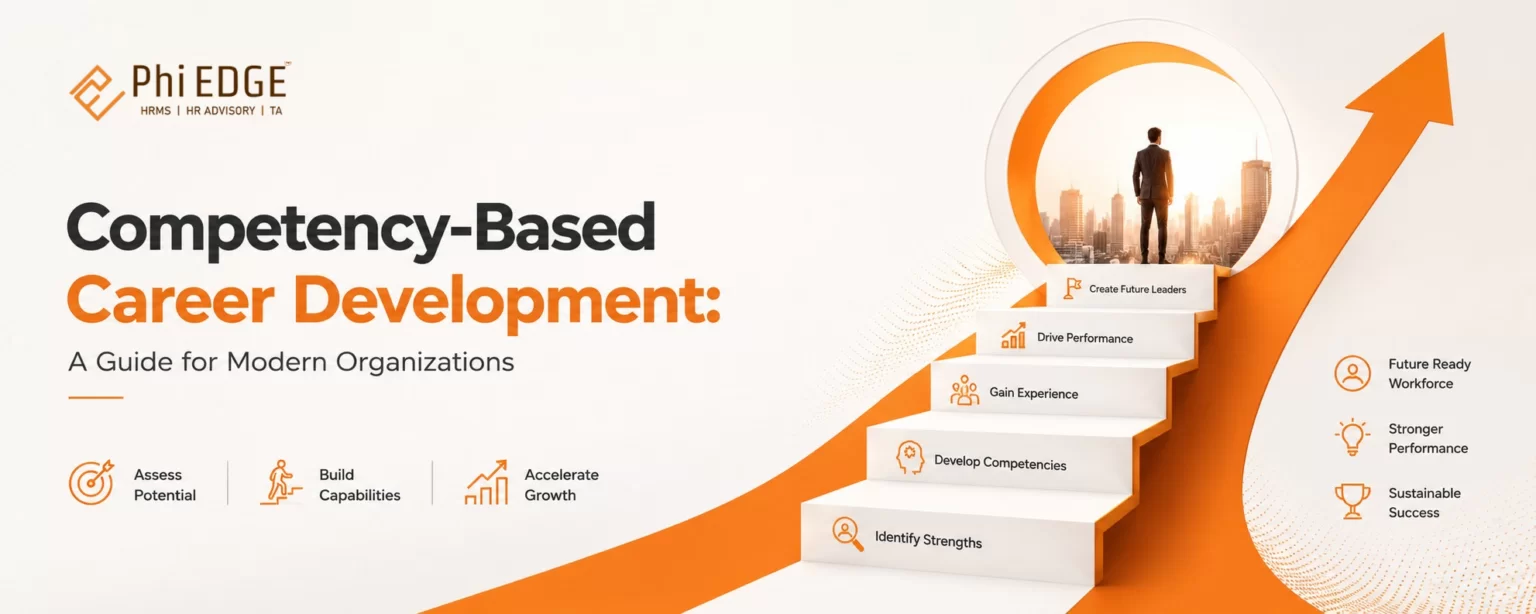
It differs from two more traditional models: job-based development, which assumes performing well in Role A qualifies someone for Role B simply because B is the “next step,” and experience-based development, which assumes years in a function translate into readiness. Competency-Based Career Development: A Guide for Modern Organisations. Competency-based development instead asks: what does this specific role need, and does this employee have it? The logic runs: Role → Required Competencies → Employee’s Current Skill Level → Gap → Development Plan → Career Path
Consider a common scenario: a technically excellent senior software engineer gets promoted to engineering manager. Six months in, sprint planning is chaotic and delegation barely happens. The engineer didn’t lack capability; the organisation never assessed whether leadership and delegation competencies existed before handing over a role that depended on them. Competency-based development is designed to catch that gap before the promotion, not after.
Why Competency-Based Career Development Matters Today?
Several trends make this approach more urgent than it was even five years ago. According to the World Economic Forum’s Future of Jobs Report 2025, based on responses from more than 1,000 global employers, nearly 39% of core workforce skills are expected to be transformed or become obsolete by 2030. The same report finds that 59% of the global workforce will need some form of retraining by 2030, and 85% of employers plan to prioritise upskilling over that period.
Hiring is moving in the same direction. LinkedIn’s 2025 Workplace Learning Report indicates that around half of hiring managers now use some form of skills-based hiring, rewriting job descriptions around required competencies rather than degree requirements. Internal mobility is lagging, even though the same report found that only about 24% of organisations currently have structured internal mobility programmes, even though companies that invest in this tend to retain talent longer.
The Role of Competency Mapping in Career Development
Competency mapping is the process of identifying and documenting the specific technical, behavioural, and leadership competencies required for a role, along with the proficiency level expected at each stage of that role.
A thorough competency map typically covers technical competencies (role-specific tools and domain knowledge), behavioural competencies (communication, adaptability, problem-solving), leadership competencies (delegation, decision-making, and coaching), and proficiency expectations at each level, from entry to expert.
Once a role is mapped, HR can compare it against an individual’s actual capability, a process often called employee skill mapping. This is where the gap between “capable in the current role” and “ready for the next one” becomes visible.
Example: A regional sales executive consistently exceeds quota and knows the CRM inside out. Competency mapping for the Sales Manager role, however, shows requirements around coaching and cross-functional negotiation, none of which show up in quota numbers. Without mapping the target role explicitly, that gap stays invisible until after the promotion.
Skills Matrix Vs Competency Framework: What’s the Difference?
These two terms get used interchangeably, but they serve different purposes.
| Skills Matrix | Competency Framework | |
| Primary focus | What skills employees currently have vs. what’s required | Broader definition of knowledge, skills, behaviours, and attitudes needed for a role |
| Scope | Usually narrower — specific, often technical, skills | Includes technical, behavioural, and leadership dimensions |
| Typical use | Quick view of skill availability and coverage across a team | Structuring career paths, performance criteria, and development plans |
| Granularity | Proficiency scored per skill (e.g., 1–5 scale) | Defines expected behaviours at each proficiency level |
A skills matrix is the more tactical tool useful for staffing decisions or short-term training planning. A competency framework is the strategic layer, tying those skills to what a career path demands over time. In practice, the two work best together: the matrix gives you a current-state inventory, and the framework gives that inventory direction.
How Skills Gap Analysis and Competency Gap Analysis Support Career Growth?
These two are related but not identical, and conflating them leads to poorly targeted training.
Skills Gap Analysis compares an employee’s current, specific skills (technical or functional) against what’s required for their role today. For example, whether someone can use a particular software tool or execute a defined process.
Competency Gap Analysis looks at a broader, more behavioural picture whether someone has the judgment, leadership, or interpersonal capability a role (current or future) demands.
Example: An employee might pass every skill check on the company’s CRM logging calls, updating pipelines, generating reports and still lack the competency to manage a sales team, because managing people requires coaching ability and accountability that a tool-proficiency test never measures.
The distinction matters because the fix differs. A skills gap is closed with a specific training module. A competency gap usually needs coaching, mentoring, or stretch assignments not a one-off course. Running both analyses together, rather than treating “training needs” as one undifferentiated bucket, is what allows HR to build targeted development plans instead of generic ones.
From Training Needs Analysis to Personalized Development
The traditional process looks like this: Employee raises a need → Manager approves → the employee is enrolled in a generic program. It’s reactive, rarely tied to actual performance data, and tends to over-serve popular, easy-to-schedule courses.
A more effective Training Needs Analysis follows a different sequence: Competency Assessment → Gap Identification → Training Needs Analysis → Personalized Development Plan → Training Delivery → Reassessment → Performance Improvement.
This is where Learning and Development Software, L&D Management Software, and Employee Training Management Software earn their place. Rather than managing course catalos in isolation, these platforms can connect to competency and skills-gap data, so recommendations reflect documented gaps rather than a manager’s best guess.
Connecting Competency Management with Performance Management
Competency data loses much of its value when it lives only inside the L&D function, disconnected from how performance is actually reviewed. Competency-based performance management ties KPIs and KRAs (which measure what was delivered) to competencies (which explain how it was delivered). Outcome metrics alone don’t tell you why performance is inconsistent.
Example: A customer support team lead hits resolution-time targets, but team engagement is declining, and turnover is creeping up. The KPI data looks fine. Layering in competency data, coaching and feedback delivery specifically reveals the lead manages tickets well but not people. A pure metrics review would miss that; a connected view surfaces it.
When reviews, development goals, and training outcomes share a competency structure, they stop being separate conversations and start informing each other.
How Technology Enables Competency-Based Career Development
A modern Competency Management System typically brings together capabilities that are hard to maintain manually: centralised competency libraries and role-based mapping, employee skill profiles built from assessments and performance data, skills matrix views across teams, automated gap identification, development plans linked to specific gaps, training recommendations, progress tracking, and reporting for workforce planning.
Whether an organization calls this a competency management system or competency management software, the underlying need is the same: a single, current source of truth for role requirements and employee capability. Platforms such as Phi EDGE HRMS are built around this idea, bringing competency, performance, and L&D data into one place rather than leaving HR teams to reconcile it by hand. For many organizations, the alternative is spreadsheets maintained by different people in different formats: one for competency definitions, another for scores, and another for training records. It’s an understandable starting point, but it creates real problems: data goes stale, managers score the same competency inconsistently with no shared calibration, and nobody has a single view connecting competencies to training history and performance. A connected system doesn’t remove the need for HR judgement; it just gives that judgement better, more current data to work with.
The Role of AI in Competency and Career Development
AI-powered learning and development is increasingly used to support, not replace, the analysis HR teams already do: flagging likely skill gaps from role requirements and assessment history, recommending learning content matched to a specific gap, personalising the pacing of a development path, analysing patterns across large volumes of competency data, and surfacing emerging skill needs as role requirements shift.
It’s worth being direct about the limits. AI can process competency data faster than any HR team could manually, but it cannot decide, on its own, whether an employee is ready for promotion or how to have a sensitive career conversation. Those remain judgement calls for managers and HR professionals. AI is most useful for surfacing patterns and recommendations that a human then reviews, not as a replacement decision-maker.
A Practical Framework for Implementing Competency-Based Career Development
- Define critical roles with outsized business impact or turnover risk, rather than mapping every role at once.
- Identify required competencies (technical, behavioural, and leadership) for each critical role.
- Establish proficiency levels so “beginner” through “expert” is defined, not left to manager interpretation.
- Map employee skills using self-assessment, manager assessment, and available performance data.
- Identify gaps through both skills gap analysis and competency gap analysis.
- Build individual development plans with specific, time-bound goals rather than generic “attend training” line items.
- Connect learning to the specific gap identified, not the nearest course in the catalogue.
- Measure progress by reassessing competencies, not just tracking course completion.
- Connect development to career progression and feed updated competency data into promotion and succession decisions.
Common Challenges Organizations Face
| Challenge | Practical Response |
| Incomplete competency frameworks | Start with critical roles; expand gradually |
| Subjective, inconsistent assessments | Define proficiency levels clearly and calibrate managers |
| Outdated skills data | Build a regular reassessment cadence, not a one-time exercise |
| Excel-based tracking | Consolidate into a single system of record where feasible |
| Generic training programs | Tie recommendations to a specific, documented gap |
| Low manager participation | Fold assessment into existing review cycles |
| Disconnected L&D and performance data | Use shared competency definitions across both |
| Difficulty measuring training impact | Reassess competency post-training, not just completion rates |
| Employee resistance | Frame assessment around growth, not evaluation alone |
| Lack of continuous assessment | Shift from annual reviews to lighter, frequent check-ins |
How Organizations Can Measure the Success of Competency-Based Career Development?
Training completion rates are the easiest metric to track and the least meaningful on their own they measure participation, not capability change. More useful indicators include competency score improvement over time, internal mobility rates, promotion readiness (meeting target competency levels before a role change), time to proficiency for new hires or newly promoted employees, and skill coverage across critical roles.
The organizations that get the most value from this approach track capability improvement and business outcomes retention in critical roles, reduced time-to-proficiency, stronger succession bench strength rather than treating completed training hours as the finish line.
Competency-Based Career Development Example
Consider a mid-sized organization with roughly 700 employees across sales, operations, and technology. Leadership notices first-time managers struggling engagement scores are inconsistent, and several recently promoted managers are asking to step back into individual contributor roles.
HR maps the Manager-level competencies required across departments coaching, delegation, conflict resolution, feedback and builds a skills matrix for likely promotion candidates. The data shows a consistent pattern: strong technical proficiency, but a leadership and coaching gap across nearly 60% of employees flagged as promotion-ready.
Rather than enrolling everyone in a generic “leadership fundamentals” course, HR runs a Training Needs Analysis and segments the group by specific gap, some need delegation practice, others need feedback-delivery skills. Development plans combine targeted coaching, peer mentoring, and short modules matched to each gap. Six months later, competencies are reassessed to check whether scores actually improved, not just whether modules were completed, and the updated scores feed into performance conversations and the next round of promotion decisions.
Building a Future-Ready Learning and Development Strategy
A durable learning and development strategy connects business direction to individual development, rather than running as a parallel, disconnected calendar of courses: Business Strategy → Workforce Skills Needed → Competencies → Skill Gaps → Learning → Performance → Career Development.
That means L&D planning starts with where the business is heading new markets, new technology, changing customer expectations and works backward to the competencies needed, rather than starting from an existing course catalogue. It also means shifting away from annual training calendars as the primary planning unit; skills are changing too quickly for once-a-year cycles to keep pace. Continuous, smaller-scale assessment built into regular check-ins tends to hold up better against fast-moving skill requirements.
This is one of the areas where an integrated HRMS earns its place not by replacing HR judgment, but by keeping competency, performance, and learning data connected as the business strategy evolves, so the framework doesn’t need to be rebuilt from scratch every planning cycle. Platforms like Phi EDGE HRMS are designed with this continuity in mind.
FAQ
What is competency-based career development?
An approach to employee growth that plans progression around the specific competencies a role requires technical, behavioural, and leadership rather than job titles, tenure, or general experience.
What is the difference between skills and competencies?
Skills are specific, teachable abilities (using a tool, writing SQL). Competencies are broader they combine skills with behaviours and judgment needed to perform a role well, like leadership or decision-making.
How does competency mapping support career development?
It documents what a role requires, at what proficiency level, so HR can compare that against an employee’s current capability and identify where development is needed before a role change.
How does a Competency Management System help HR teams?
It centralizes frameworks, skill profiles, gap analysis, and development tracking, replacing fragmented spreadsheets with a consistent view of workforce readiness.
What is the difference between Skills Gap Analysis and Competency Gap Analysis?
Skills Gap Analysis compares technical abilities against role requirements. Competency Gap Analysis looks at broader behavioural and leadership capability. Both are needed for an accurate development plan.
How does AI support employee development?
It flags likely skill gaps, recommends learning, and personalizes development paths from data patterns supporting HR decisions, not replacing the judgment needed for calls like promotion readiness.
How can organizations connect L&D with performance management?
By using a shared competency framework across both functions, so reviews, development goals, and training records reference the same definitions instead of operating as separate processes.
About the Author
Gaurav Anoop is the Sales Head at Phi EDGE HRMS, specializing in HR technology, workforce management, and digital HR transformation. He works closely with organizations to identify technology-driven HR solutions that improve efficiency, employee management, and business growth. Through his articles, he shares practical insights on HRMS, talent management, L&D, competency management, and modern HR practices.
Related Resources
- Competency Model — Phi EDGE HRMS
- Learning & Development Module — Phi EDGE HRMS
- Performance Management System — Phi EDGE HRMS
- Succession and Career Planning — Phi EDGE HRMS
- 9 Box Grid: Identifying and Nurturing High-Potential Employees — Phi EDGE HRMS
- Employee Life Cycle Management — Phi EDGE HRMS