Performance Management System: Complete Guide to Performance Management Process in HRMS (2026)
Table of Contents
- What is a Performance Management System?
- Quick Answer (AI Overview)
- Why Every Business Needs a Performance Management System
- Key Components of the Performance Management Process
- How Performance Management Works in HRMS
- Benefits of a Performance Management System
- Features to Look For
- Industry Use Cases
- Before vs After Examples
- Case Study
- Latest Statistics
- Comparison of Leading Performance Management Software
- Common Mistakes
- Best Practices
- FAQs
What is a performance management system?
A Performance Management System (PMS) is a structured HR process that helps organizations set employee goals, track progress, provide continuous feedback, conduct performance appraisals, and align individual achievements with business objectives.
Unlike traditional annual appraisals, modern performance management focuses on ongoing communication, measurable goals, employee development, and data-driven decision-making.
A cloud-based Performance Management System in HRMS centralizes every stage of the employee performance lifecycle—from goal setting and KPI tracking to 360-degree feedback, manager reviews, competency assessments, and performance analytics.
Whether you are a startup, SME, or enterprise, implementing a digital performance management solution helps improve productivity, employee engagement, accountability, and retention while reducing manual HR effort.
What is a Performance Management System?
A Performance Management System is HR software that enables organizations to plan, monitor, evaluate, and improve employee performance through continuous feedback, goal tracking, performance reviews, competency assessments, and analytics.
In Simple Terms
It helps HR managers and business leaders answer questions such as:
- Are employees achieving their goals?
- Which teams need coaching?
- Who deserves promotion?
- Which employees require additional training?
- How can overall productivity be improved?
Modern HRMS platforms automate these activities through dashboards, reminders, performance scorecards, and real-time reports.
Why is Performance Management Important?
An effective performance management process helps organizations:
- Align employee goals with company objectives.
- Increase productivity through measurable KPIs.
- Improve employee engagement with regular feedback.
- Simplify performance appraisal cycles.
- Identify future leaders and high performers.
- Support fair compensation and promotion decisions.
- Build a culture of continuous improvement.
Organizations that replace annual reviews with continuous performance management often experience stronger employee engagement, better manager-employee communication, and faster achievement of business goals.
Why Every Business Needs a Performance Management System in 2026
The workplace has evolved significantly. Hybrid work, distributed teams, AI-assisted workflows, and changing employee expectations require organizations to move beyond spreadsheets and manual appraisal forms.
A modern Performance Management System in HRMS enables businesses to:
- Set SMART goals and OKRs for every employee.
- Track KPI progress in real time.
- Automate appraisal workflows.
- Capture continuous feedback from managers and peers.
- Conduct 360-degree performance reviews.
- Monitor competency and skill development.
- Generate performance insights using dashboards and analytics.
- Connect performance outcomes with learning and career growth.
Instead of evaluating employees once a year, organizations can continuously monitor progress, identify challenges early, and provide timely coaching.
This approach improves transparency, accountability, and employee satisfaction while helping HR teams make faster, data-driven decisions.
Why Choose PhiEDGE Performance Management System?
PhiEDGE HRMS offers an intelligent, scalable, and user-friendly performance management solution designed for modern businesses.
With PhiEDGE, organizations can:
- Automate the complete performance management process.
- Create customizable appraisal cycles.
- Define KPIs, KRAs, and OKRs.
- Collect continuous feedback.
- Enable 360-degree performance reviews.
- Monitor employee goals through intuitive dashboards.
- Generate AI-powered performance insights.
- Reduce manual HR workload.
- Improve employee engagement and retention.
- Scale seamlessly as the organization grows.
Whether you manage 50 employees or 5,000, PhiEDGE helps transform performance reviews into an ongoing process that supports business growth and employee success.
Performance Management Process: How It Works in an HRMS
A successful performance management process is more than conducting annual appraisals. It is a continuous cycle that helps organizations align employee goals with business objectives, provide regular feedback, measure performance, and support employee development.
A modern Performance Management System in HRMS automates this entire process, making it transparent, data-driven, and efficient.
What is the Performance Management Process?
The performance management process is a structured framework used by organizations to plan, monitor, evaluate, and improve employee performance throughout the year.
Instead of relying on yearly reviews, organizations use continuous performance management to encourage regular communication between managers and employees. This approach helps employees stay aligned with business priorities while giving managers real-time visibility into performance.
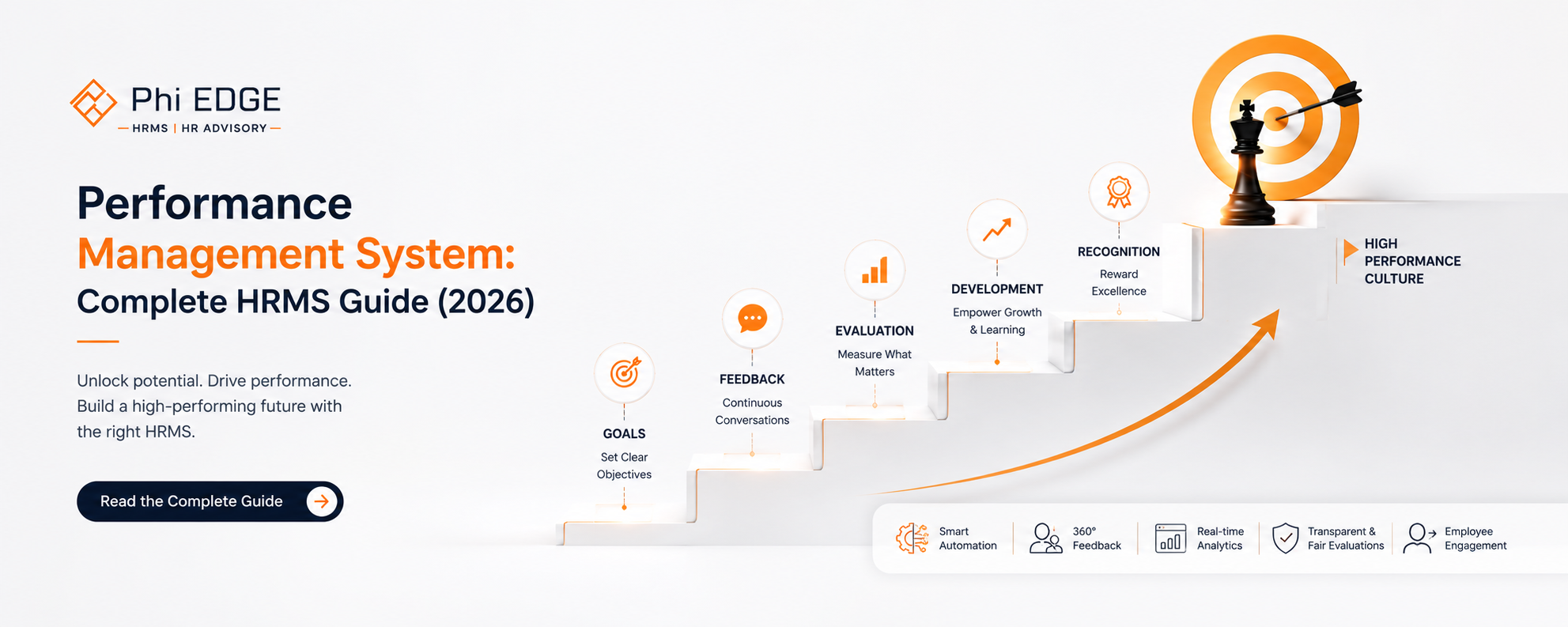
The Six Stages of the Performance Management Process
1. Goal Setting
Every performance cycle begins with clearly defined goals.
Organizations typically use:
- SMART Goals
- KPIs (Key Performance Indicators)
- KRAs (Key Result Areas)
- OKRs (Objectives and Key Results)
For example:
Sales Executive
- Increase quarterly revenue by 20%
- Generate 100 qualified leads every month
HR Manager
- Reduce hiring time by 25%
- Improve employee retention by 15%
Clear goals ensure employees understand expectations from day one.
2. Continuous Performance Tracking
Managers should monitor progress throughout the year instead of waiting for annual reviews.
An HRMS enables organizations to:
- Track completed tasks
- Measure KPI achievement
- View project milestones
- Identify performance gaps
- Monitor productivity trends
Real-time dashboards help managers make proactive decisions rather than reactive ones.
3. Continuous Feedback
One of the biggest shifts in modern HR is moving from annual feedback to continuous feedback.
Employees receive:
- Weekly check-ins
- Monthly reviews
- Peer recognition
- Manager feedback
- Coaching sessions
Continuous feedback helps employees improve immediately rather than discovering issues months later.
4. Performance Appraisal
The performance appraisal system evaluates employee achievements against predefined goals and competencies.
Organizations may conduct:
- Quarterly appraisals
- Half-yearly reviews
- Annual performance reviews
- Project-based evaluations
Appraisals usually include:
- Goal achievement
- Behavioral competencies
- Technical skills
- Leadership capabilities
- Attendance
- Productivity metrics
- Overall performance rating
An HRMS automates workflows, approvals, reminders, and appraisal documentation, reducing manual effort and ensuring consistency.
5. Employee Development
Performance management is not only about evaluation—it is also about growth.
After identifying strengths and improvement areas, organizations create personalized development plans.
These may include:
- Training programs
- Certifications
- Leadership development
- Mentorship
- Upskilling initiatives
- Career progression plans
This stage helps employees build new skills while preparing future leaders within the organization.
6. Rewards and Recognition
Outstanding performance should be acknowledged.
Organizations can link performance ratings to:
- Salary increments
- Bonuses
- Promotions
- Awards
- Incentives
- Employee recognition programs
Recognizing achievements motivates employees and strengthens engagement.
How a Performance Management System Works in HRMS
A Performance Management System in HRMS digitizes and automates every stage of the performance lifecycle.
Step 1: Define Organizational Goals
HR leaders establish company-wide objectives and align departmental goals.
Example:
Business Goal
Increase annual revenue by 30%.
Marketing Goal:
Generate 5,000 qualified leads.
Sales Goal:
Improve conversion rate by 15%.
Customer Success Goal:
Increase customer retention to 95%.
Step 2: Assign Individual Goals
Managers assign measurable goals to employees based on their roles.
Each employee receives:
- KPIs
- KRAs
- Deadlines
- Weightage
- Success metrics
The HRMS tracks progress automatically throughout the review cycle.
Step 3: Monitor Progress
Employees update task completion while managers monitor dashboards showing:
- Goal completion percentage
- KPI achievement
- Delayed tasks
- Performance trends
- Department-wise performance
Automated reminders keep everyone on track.
Step 4: Collect Feedback
The system gathers feedback from:
- Reporting managers
- Team members
- Cross-functional colleagues
- Employees (self-assessment)
This creates a balanced and transparent evaluation process.
Step 5: Conduct Performance Reviews
Managers review:
- Goal completion
- Behavioral competencies
- Skill development
- Productivity
- Attendance
- Project contributions
The HRMS generates performance reports that simplify decision-making.
Step 6: Generate Analytics
HR leaders access dashboards showing:
- High-performing employees
- Employees needing support
- Department performance
- Promotion readiness
- Skill gaps
- Attrition risks
These insights enable data-driven workforce planning.
What is a Performance Appraisal System?
A Performance Appraisal System is a structured method for assessing employee performance against predefined goals, competencies, and organizational expectations.
While the terms are often used interchangeably, they are not identical.
- Performance Management System: A continuous process focused on planning, monitoring, coaching, evaluating, and developing employees throughout the year.
- Performance Appraisal System: A specific evaluation stage within the broader performance management process, typically conducted quarterly, half-yearly, or annually.
A modern HRMS integrates appraisals into the overall performance cycle, ensuring reviews are based on real-time data rather than memory or manual records.
Traditional Appraisals vs Modern Performance Management
| Traditional Performance Appraisal | Modern Performance Management |
| Annual review | Continuous process |
| Paper forms or spreadsheets | Cloud-based HRMS |
| Manager-only feedback | 360-degree feedback |
| Focus on past performance | Focus on continuous improvement |
| Limited visibility | Real-time dashboards |
| Manual calculations | Automated scoring and analytics |
| Generic development plans | Personalized learning paths |
Organizations adopting modern performance management benefit from more frequent feedback, greater transparency, and better alignment between employee efforts and business goals.
Example Workflow
Imagine a software company implementing a Performance Management System:
- HR defines company objectives.
- Department heads create team goals.
- Managers assign KPIs to each employee.
- Employees update progress weekly.
- Managers provide monthly feedback.
- Peers contribute 360-degree feedback.
- The HRMS calculates performance scores.
- HR reviews analytics to identify high performers and skill gaps.
- Training and development plans are assigned.
- Promotions, rewards, and succession planning are based on performance data.
This automated workflow reduces administrative effort, improves fairness, and helps organizations make informed talent decisions.
Benefits of a Performance Management System
A modern Performance Management System (PMS) is more than an appraisal tool. It is a strategic HR solution that helps organizations improve employee performance, align business goals, and build a culture of continuous learning. By integrating a Performance Management System in HRMS, businesses can automate reviews, track employee progress, and make data-driven decisions.
Below are the key benefits organizations can expect in 2026.
Top Benefits of a Performance Management System
1. Aligns Employee Goals with Business Objectives
One of the biggest advantages of a performance management system is goal alignment.
Every employee understands:
- Their responsibilities
- Individual KPIs
- Department goals
- Company objectives
When employees know how their work contributes to organizational success, productivity and accountability naturally improve.
Example
Company Goal:
Increase annual revenue by 25%.
Marketing Goal:
Generate 20,000 qualified leads.
Sales Goal:
Increase conversion rate to 18%.
Individual Goal:
Close 30 qualified deals every month.
This structured alignment ensures every employee works toward the same strategic vision.
2. Improves Employee Productivity
Employees perform better when expectations are clear.
A performance management process provides:
- Measurable goals
- Regular feedback
- Progress tracking
- Performance dashboards
Instead of waiting for annual reviews, employees receive continuous guidance, enabling them to improve throughout the year.
3. Enables Continuous Feedback
Traditional annual appraisals often come too late to address performance issues.
Modern HRMS platforms support:
- Weekly check-ins
- Monthly one-on-one meetings
- Instant recognition
- Coaching conversations
- Continuous feedback
Employees gain timely insights, helping them improve performance before small issues become larger challenges.
4. Supports Fair Performance Appraisals
Manual evaluations can be subjective.
A digital performance appraisal system uses measurable data such as:
- KPI achievement
- Goal completion
- Attendance
- Project delivery
- Competency ratings
- Manager feedback
- Peer reviews
This creates a more transparent and objective appraisal process.
5. Identifies High Performers
A Performance Management System helps HR identify employees who consistently exceed expectations.
High-performing employees can be considered for:
- Promotions
- Leadership development
- Succession planning
- Incentive programs
- Special projects
Recognizing top talent also boosts employee motivation and retention.
6. Detects Skill Gaps
Performance reviews highlight areas where employees need additional support.
Organizations can then create personalized development plans, including:
- Technical training
- Leadership workshops
- Soft-skill development
- Certifications
- Mentoring programs
Closing skill gaps strengthens workforce capabilities and prepares employees for future roles.
7. Increases Employee Engagement
Employees are more engaged when they receive:
- Recognition
- Constructive feedback
- Career growth opportunities
- Transparent evaluations
A strong performance management process encourages regular communication between managers and employees, fostering trust and collaboration.
8. Simplifies HR Operations
Manual appraisal cycles involve spreadsheets, emails, reminders, and paperwork.
An integrated HRMS automates:
- Goal creation
- Review scheduling
- Feedback collection
- Approval workflows
- Performance scoring
- Report generation
Automation saves HR teams significant administrative time.
9. Supports Better Business Decisions
Performance analytics help leaders answer questions such as:
- Which departments perform best?
- Which employees are ready for promotion?
- Where are the biggest skill gaps?
- Which teams require additional support?
These insights enable informed decisions rather than relying on assumptions.
10. Improves Employee Retention
Employees are more likely to stay with organizations that:
- Provide regular feedback
- Recognize achievements
- Invest in learning
- Offer career progression
- Maintain fair evaluation processes
A transparent Performance Management System contributes to a positive employee experience and reduces voluntary turnover.
Key Features of a Modern Performance Management System
Choosing the right Performance Management System in HRMS requires evaluating features that support both employees and HR teams.
Goal & OKR Management
Create and monitor:
- SMART Goals
- KPIs
- KRAs
- OKRs
Goals can be assigned at organizational, departmental, team, and individual levels.
Continuous Feedback
Enable employees and managers to exchange feedback regularly through structured check-ins, comments, and coaching sessions.
360-Degree Feedback
Collect feedback from multiple sources, including:
- Managers
- Peers
- Direct reports
- Cross-functional teams
- Self-assessments
This provides a well-rounded view of employee performance.
Performance Appraisals
Automate quarterly, half-yearly, or annual review cycles with customizable appraisal templates, rating scales, and approval workflows.
Competency Management
Evaluate employees on competencies such as:
- Communication
- Leadership
- Problem-solving
- Teamwork
- Technical expertise
- Customer focus
Competency tracking helps identify strengths and development areas.
Dashboards & Analytics
HR leaders can monitor:
- Goal completion rates
- Department performance
- Employee ratings
- High-potential talent
- Training needs
- Performance trends
Interactive dashboards make workforce planning easier.
Automated Notifications
The system automatically reminds users about:
- Pending reviews
- Goal deadlines
- Feedback requests
- Appraisal schedules
- Manager approvals
Automation ensures no important activity is missed.
Learning & Development Integration
Connect performance outcomes with learning recommendations.
For example:
- Employees with communication gaps receive communication training.
- High-potential employees are enrolled in leadership programs.
- Technical skill gaps trigger relevant certification courses.
This creates a continuous learning culture.
Mobile Accessibility
Modern employees expect access from anywhere.
A cloud-based HRMS allows users to:
- Update goals
- Submit self-assessments
- Complete reviews
- View dashboards
- Provide feedback
from desktop, tablet, or mobile devices.
Industry Use Cases in 2026
IT & Software Companies
Challenges:
- Managing hybrid teams
- Tracking project delivery
- Measuring productivity
Performance Management Solution:
- Sprint goals
- OKRs
- Continuous feedback
- Skill tracking
Manufacturing
Challenges:
- Production targets
- Quality compliance
- Workforce efficiency
Solution:
- KPI dashboards
- Productivity monitoring
- Supervisor reviews
Healthcare
Challenges:
- Compliance
- Patient care quality
- Clinical performance
Solution:
- Competency assessments
- Certification tracking
- Department scorecards
Retail
Challenges:
- Sales performance
- Customer satisfaction
- Attendance
Solution:
- Sales KPIs
- Store performance dashboards
- Incentive management
Banking & Financial Services (BFSI)
Challenges:
- Regulatory compliance
- Sales targets
- Customer service
Solution:
- KPI tracking
- Risk-based performance metrics
- Balanced scorecards
Education
Challenges:
- Faculty performance
- Student outcomes
- Administrative efficiency
Solution:
- Academic KPIs
- Faculty evaluations
- Continuous improvement plans
Startups
Challenges:
- Fast growth
- Lean HR teams
- Changing priorities
Solution:
- Agile goal setting
- OKRs
- Automated performance reviews
- Real-time feedback
Before vs After: Performance Management System
| Before Implementing a PMS | After Implementing a PMS |
| Annual paper-based reviews | Continuous digital performance tracking |
| Manual spreadsheets | Automated HRMS workflows |
| Delayed feedback | Real-time feedback and coaching |
| Subjective ratings | Data-driven evaluations |
| Limited visibility | Live dashboards and analytics |
| Inconsistent goals | Aligned KPIs and OKRs |
| Separate appraisal records | Centralized employee performance history |
| Reactive HR decisions | Predictive workforce insights |
Case Study: Improving Performance with PhiEDGE HRMS
Industry: Mid-sized IT Services Company
Employees: 450
Challenges
- Annual appraisal process took nearly six weeks.
- Managers used multiple spreadsheets for reviews.
- Employees received feedback only once a year.
- Promotions lacked standardized evaluation criteria.
Solution
The company implemented the PhiEDGE Performance Management System with:
- KPI-based goal setting
- Quarterly appraisal cycles
- 360-degree feedback
- Automated review workflows
- Real-time performance dashboards
- Employee self-assessments
Results After 12 Months
- Appraisal cycle completion time reduced by 65%.
- Goal completion visibility improved across all departments.
- Managers conducted regular monthly feedback sessions.
- HR reduced administrative effort through workflow automation.
- Employees reported greater transparency in the performance review process.
- Leadership gained better insights into succession planning and employee development.
This example illustrates how a digital performance management system in an HRMS can streamline HR operations while supporting employee growth and organizational performance.
Latest Performance Management Statistics (2025–2026)
Using recent HR and workplace research helps organizations understand why investing in a modern Performance Management System is a business necessity rather than just an HR initiative.
Key Statistics
| Statistic | Why It Matters |
| Global employee engagement declined to 20% in 2025, the lowest level since 2020. | Organizations need better coaching, feedback, and performance management. |
| Only 23% of employees strongly agree they have a clear understanding of what exceptional performance looks like in their role. | Clear goals and continuous feedback are critical for improving performance. |
| Employee engagement decline is estimated to cost the global economy around $10 trillion in lost productivity annually. | Poor performance management directly affects business growth. |
| Among employees using AI at work, 65% report that AI has had a positive impact on their individual productivity. | AI-powered HRMS platforms can improve productivity when combined with effective management practices. |
Sources: Gallup State of the Global Workplace 2026, Gallup Workplace Research.
Why These Statistics Matter
These findings highlight several important trends:
- Annual performance reviews alone are no longer sufficient.
- Employees perform better when expectations are clearly defined.
- Continuous coaching has become more valuable than once-a-year evaluations.
- Organizations need real-time visibility into employee goals, KPIs, and development.
- AI enhances performance management when paired with effective leadership rather than replacing managers.
Performance Management Software Comparison
| Feature | PhiEDGE HRMS | HROne | Keka | Darwinbox | Zoho People |
| Goal & KPI Management | ✅ | ✅ | ✅ | ✅ | ✅ |
| OKR Management | ✅ | ✅ | ✅ | ✅ | Limited |
| Continuous Feedback | ✅ | ✅ | ✅ | ✅ | ✅ |
| 360° Feedback | ✅ | ✅ | ✅ | ✅ | Limited |
| Performance Appraisal | ✅ | ✅ | ✅ | ✅ | ✅ |
| Competency Assessment | ✅ | ✅ | ✅ | ✅ | Partial |
| AI Performance Insights | ✅ | Limited | Partial | ✅ | Limited |
| Performance Analytics Dashboard | ✅ | ✅ | ✅ | ✅ | ✅ |
| Learning & Development Integration | ✅ | ✅ | ✅ | ✅ | Partial |
| Custom Review Cycles | ✅ | ✅ | ✅ | ✅ | ✅ |
| Mobile Accessibility | ✅ | ✅ | ✅ | ✅ | ✅ |
| Suitable for SMEs & Enterprises | ✅ | ✅ | ✅ | ✅ | ✅ |
Why PhiEDGE stands out
- End-to-end HRMS platform
- Automated appraisal workflows
- Goal, KPI, KRA, and OKR management
- AI-powered insights and analytics
- Easy-to-use dashboards
- Scalable for growing businesses
- Customizable workflows for different industries
Common Mistakes Organizations Make
Even with the right software, poor implementation can limit results.
1. Conducting Only Annual Reviews
Many organizations still evaluate employees once a year.
Problem
- Feedback arrives too late.
- Employees cannot improve in real time.
Best approach
Use monthly check-ins and quarterly reviews.
2. Setting Unclear Goals
Goals like “Improve performance” are difficult to measure.
Instead, define measurable objectives such as:
- Increase sales by 15%
- Reduce customer response time to under 2 hours
- Achieve 95% project delivery on time
3. Ignoring Continuous Feedback
Performance discussions should not happen only during appraisal season.
Managers should provide:
- Coaching
- Recognition
- Constructive feedback
- Career guidance
throughout the year.
4. Measuring Only Results
High-performing employees also demonstrate collaboration, communication, innovation, and leadership.
An effective performance appraisal system evaluates both outcomes and behaviors.
5. Using Manual Spreadsheets
Manual processes often lead to:
- Missing reviews
- Data inconsistencies
- Delayed approvals
- Reporting errors
A cloud-based HRMS automates these tasks and provides a single source of truth.
6. Treating Performance Reviews as a Formality
Performance management should support employee growth—not simply assign ratings.
Employees expect actionable feedback, development plans, and opportunities to improve.
7. Failing to Train Managers
Even the best software cannot replace skilled managers.
Managers should be trained to:
- Set SMART goals
- Deliver constructive feedback
- Conduct objective evaluations
- Coach employees effectively
Best Practices for Performance Management in 2026
Organizations achieving strong performance outcomes typically follow these practices.
Set SMART Goals
Every objective should be:
- Specific
- Measurable
- Achievable
- Relevant
- Time-bound
Align Individual Goals with Business Strategy
Employees should clearly understand how their work contributes to company objectives.
Alignment improves accountability and collaboration.
Schedule Regular Check-ins
Recommended review cadence:
- Weekly team check-ins
- Monthly manager one-on-ones
- Quarterly performance reviews
- Annual development planning
Regular conversations prevent surprises during formal appraisals.
Use Data Instead of Assumptions
Leverage HRMS dashboards to evaluate:
- KPI achievement
- Goal completion
- Attendance
- Productivity
- Competency development
Objective data supports fair and transparent decisions.
Encourage Two-Way Feedback
Performance management should be collaborative.
Employees should have opportunities to:
- Share challenges
- Request support
- Provide upward feedback
- Discuss career aspirations
Recognize Achievements Frequently
Recognition motivates employees and reinforces desired behaviors.
Celebrate:
- Goal completion
- Innovation
- Teamwork
- Customer success
- Leadership
Recognition does not always need to be monetary; timely appreciation also has a positive impact.
Link Performance with Learning
Performance reviews should lead to action.
Examples include:
- Technical certifications
- Leadership development
- Mentorship programs
- Cross-functional projects
- Personalized learning paths
This transforms the performance management process into a continuous cycle of growth.
Key Takeaways
An effective performance management system is not just an appraisal tool—it is a strategic platform that helps organizations improve productivity, strengthen employee engagement, and make informed talent decisions.
Businesses that combine continuous feedback, measurable goals, manager coaching, and data-driven insights are better positioned to build high-performing teams and adapt to the evolving workplace.
Frequently Asked Questions (FAQs)
1. What is a Performance Management System?
A Performance Management System (PMS) is an HR solution that helps organizations set employee goals, monitor progress, provide continuous feedback, conduct performance appraisals, and improve productivity. It aligns employee performance with business objectives through a structured and measurable process.
2. What is the Performance Management Process?
The performance management process is a continuous cycle of goal setting, performance tracking, regular feedback, employee development, performance appraisal, and recognition. It ensures employees remain aligned with organizational goals while supporting continuous improvement.
3. What is the difference between Performance Management and Performance Appraisal?
A Performance Management System is a continuous process that focuses on planning, monitoring, coaching, and improving employee performance throughout the year. A Performance Appraisal System is one stage of that process where employee performance is formally evaluated against predefined goals and competencies.
4. Why is a Performance Management System important?
A modern Performance Management System helps organizations improve employee productivity, increase engagement, identify skill gaps, support fair appraisals, strengthen leadership development, and make data-driven HR decisions.
5. What are the key components of a Performance Management System?
Most systems include:
- Goal and KPI management
- OKR tracking
- Continuous feedback
- Performance reviews
- 360-degree feedback
- Competency assessments
- Performance analytics
- Employee development planning
- Rewards and recognition
6. How does a Performance Management System work in an HRMS?
An HRMS-based Performance Management System automates goal setting, KPI tracking, appraisal workflows, feedback collection, performance scoring, analytics, and reporting. Managers and employees can monitor progress in real time through centralized dashboards.
7. What are the benefits of using a Performance Management System?
Key benefits include:
- Higher employee productivity
- Better goal alignment
- Transparent performance evaluations
- Continuous feedback
- Improved employee engagement
- Faster appraisal cycles
- Better talent development
- Data-driven workforce planning
8. What is the role of KPIs in Performance Management?
Key Performance Indicators (KPIs) are measurable metrics used to evaluate employee performance. They help managers monitor progress, assess goal achievement, and make objective performance decisions.
9. What is the difference between KPIs, KRAs, and OKRs?
- KPIs (Key Performance Indicators): Measure performance using specific metrics.
- KRAs (Key Result Areas): Define the core responsibilities of a role.
- OKRs (Objectives and Key Results): Combine ambitious objectives with measurable outcomes to track progress.
Together, these frameworks create a balanced and measurable performance management process.
10. What is 360-degree feedback?
360-degree feedback is a review method where employees receive performance feedback from multiple sources, including managers, peers, direct reports, cross-functional colleagues, and self-assessments. This provides a more comprehensive evaluation than manager-only reviews.
11. How often should performance reviews be conducted?
Many organizations now use continuous performance management with monthly check-ins, quarterly reviews, and annual development discussions. Regular feedback helps employees improve faster than relying solely on annual appraisals.
12. Can small businesses benefit from a Performance Management System?
Yes. Small and medium-sized businesses can improve employee productivity, streamline appraisals, reduce manual HR work, and prepare for growth by implementing a scalable Performance Management System within their HRMS.
13. Which industries use Performance Management Systems?
Performance Management Systems are widely used across:
- Information Technology (IT)
- Manufacturing
- Healthcare
- Retail
- Banking and Financial Services (BFSI)
- Education
- Logistics
- Hospitality
- Professional Services
- Startups
Any organization that manages employee performance can benefit from a structured system.
14. How does AI improve Performance Management?
AI-powered Performance Management Systems can:
- Recommend performance insights
- Detect skill gaps
- Identify high-potential employees
- Predict training needs
- Automate reporting
- Support workforce planning through analytics
AI enhances decision-making while allowing managers to focus on coaching and employee development.
15. What should you look for in a Performance Management System?
When selecting a solution, consider features such as:
- Goal management
- KPI and OKR tracking
- Continuous feedback
- 360-degree reviews
- Performance analytics
- Mobile accessibility
- Workflow automation
- HRMS integration
- Customizable appraisal cycles
- Reporting dashboards
16. How does a Performance Management System improve employee engagement?
Employees become more engaged when they receive clear goals, regular feedback, recognition, and career development opportunities. Continuous communication builds trust and helps employees understand how their work contributes to organizational success.
17. What challenges can a Performance Management System solve?
A digital system helps address common HR challenges, including:
- Manual appraisal processes
- Inconsistent evaluations
- Lack of goal visibility
- Delayed feedback
- Limited performance insights
- Poor documentation
- Difficulty identifying high performers
- Weak succession planning
18. How is a cloud-based Performance Management System better than spreadsheets?
Unlike spreadsheets, a cloud-based HRMS offers real-time dashboards, automated reminders, secure data storage, approval workflows, analytics, and centralized employee records. This reduces administrative effort and improves accuracy.
19. How does Performance Management support business growth?
By aligning employee objectives with business strategy, organizations can improve productivity, develop future leaders, strengthen collaboration, reduce turnover, and make informed talent decisions that contribute to long-term growth.
20. Why choose PhiEDGE Performance Management System?
PhiEDGE provides an integrated Performance Management System in HRMS that helps organizations automate appraisals, manage KPIs and OKRs, collect continuous feedback, enable 360-degree reviews, generate performance analytics, and support employee development through an intuitive, scalable platform suitable for growing businesses.