
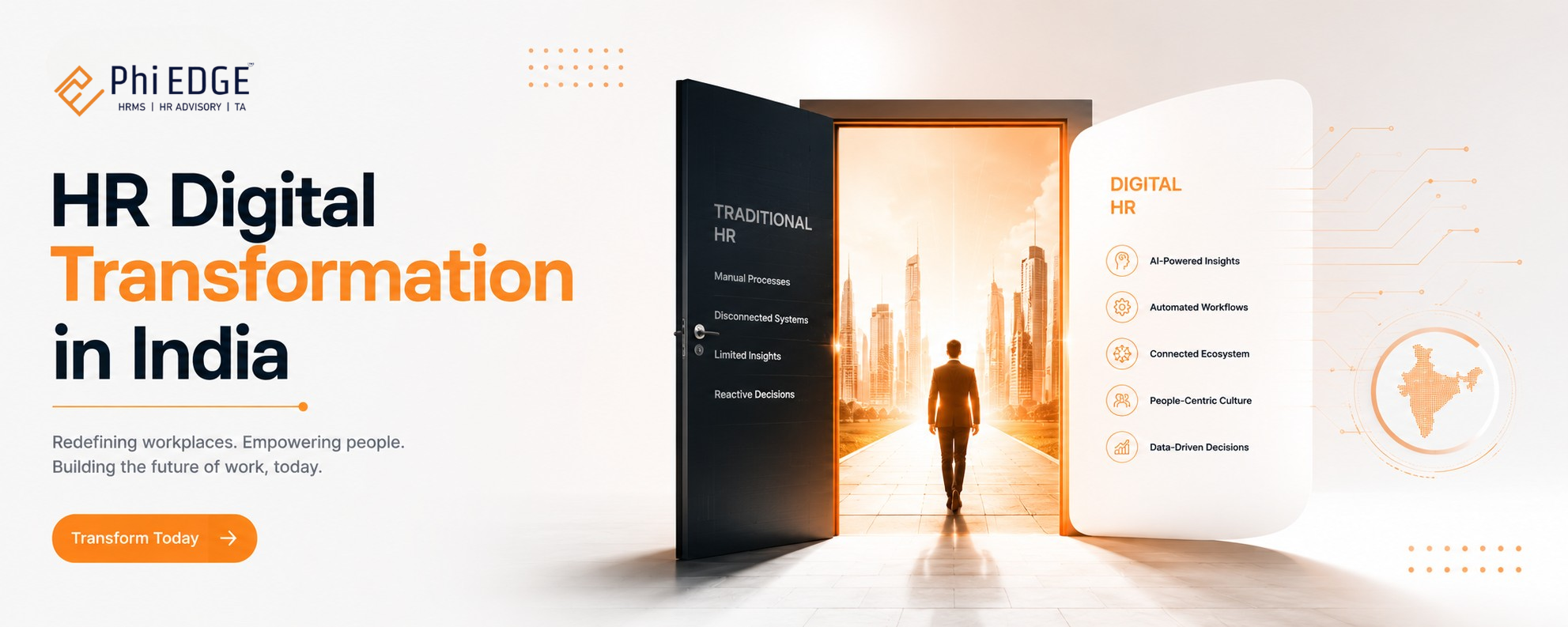
1. Executive Summary
India stands at a defining inflection point in workforce management. As organizations scale, compete for scarce talent, and navigate an increasingly complex regulatory environment, the traditional approach to HR — built on spreadsheets, manual processes, and fragmented tools — is no longer sufficient.
This white paper examines why HR digital transformation has moved from a departmental initiative to a board-level priority, and what it means in practice for Indian businesses across industries and sizes.
Key themes explored in this paper:
- The urgency of HR digital transformation in post-pandemic India
- Why traditional HR processes are a business liability in 2025
- What leaders across industries are doing differently
- Key outcomes: cost reduction, talent retention, compliance accuracy, and productivity
2. The State of HR in India Today
Despite rapid economic growth, HR Digital Transformation in India HR function maturity in Indian organizations has lagged behind business ambitions. The gap between leadership expectation and HR capability has never been wider.
- 70% of mid-size Indian companies still rely on manual or semi-digital HR processes
- Rising workforce complexity — multi-location, hybrid, contractual, and gig workers
- Growing compliance burden — PF, ESI, gratuity, and frequent labour law amendments
- HR teams spending 60%+ of their time on administrative tasks versus strategic work
- Talent war intensifying — attrition rates hitting all-time highs across sectors
3. What Is HR Digital Transformation?
HR digital transformation is not simply about purchasing new software. It is a fundamental shift in how people, processes, and technology work together to drive business outcomes.
Three Pillars of HR Transformation
- Automation — eliminating repetitive, manual work to free HR bandwidth
- Analytics — turning people data into strategic decisions
- Employee Experience — creating digital-native journeys from hire to retire
It is also important to distinguish between related but distinct concepts:
- Digitization — converting paper to digital formats
- Digitalization — using digital tools to improve existing processes
- Digital Transformation — rethinking how the organization operates at its core
An HRMS (Human Resource Management System) is the technological foundation upon which any meaningful HR transformation strategy must be built.
4. Why C-Suite Must Own This Agenda
HR digital transformation cannot succeed as a departmental project. It requires executive sponsorship, strategic vision, and cross-functional commitment from the very top.
- HR transformation is a business transformation — not an HR department initiative
- Direct impact on revenue, productivity, and employer brand
- Cost of inaction — attrition costs, compliance penalties, and low engagement scores
- Board-level metric: Human Capital ROI is now a financial imperative
- CEOs and CFOs are increasingly measured on talent retention and workforce productivity
5. Key Drivers Pushing Indian Businesses to Transform
- Regulatory Pressure — frequent labour law changes demand real-time compliance capability
- Remote and Hybrid Workforce — need for digital-first, location-agnostic people management
- Gen Z Workforce Entry — employees expecting seamless, mobile-first HR experiences
- Data-Driven Decision Making — leadership demanding real-time people analytics
- Global Competition — MNCs raising the bar on employee experience in Indian markets
6. Core Areas of HR Digital Transformation
A comprehensive HR transformation covers the full employee lifecycle. Key functional areas include:
- Recruitment and Onboarding Automation
- Attendance, Leave, and Payroll Management
- Performance Management and KRA/KPI Tracking
- Learning and Development (L&D) Platforms
- Employee Self-Service Portals
- Predictive Attrition and Workforce Analytics
- Compliance and Statutory Reporting
- HR Helpdesk and Chatbot Integration
7. The Role of People Analytics
Data is now the most underutilised asset in most HR functions. People analytics bridges the gap between HR intuition and business intelligence.
- Moving from gut-feel hiring to data-backed talent decisions
- Predictive Attrition Analysis — identifying flight risks before they resign
- Workforce planning using real-time dashboards and trend modeling
- Linking HR metrics directly to business KPIs
- Empowering both HR heads and C-suite with a single source of people intelligence
8. Challenges Indian Businesses Face in Transformation
Recognizing the need for transformation is one thing. Executing it successfully is another. The most common barriers include:
- Resistance to Change — employee and middle management adoption challenges
- Data Silos — disconnected systems across HR, Finance, and Operations
- Budget Constraints — perception that enterprise HR technology is unaffordable
- Customization Needs — India-specific payroll, compliance, and regional diversity
- Vendor Selection Confusion — too many tools, unclear ROI, and opaque pricing
- Implementation Risk — fear of operational disruption during deployment
9. How to Choose the Right HRMS
Selecting an HRMS is one of the most consequential technology decisions an Indian organization will make. Key evaluation criteria:
- Build vs Buy vs SaaS — what model fits Indian mid-market business realities
- India-specific compliance coverage — PF, ESI, gratuity, TDS, new labour codes
- Scalability — can it grow from 50 to 5,000 employees without re-implementation
- Integration capability — ERP, Finance, CRM, and third-party tool compatibility
- Mobile-first access for field and distributed teams
- Vendor credibility — implementation depth, post-sales support, and domain expertise
10. The PhiEDGE Approach to HR Digital Transformation
PhiEDGE is built differently. Where most HR technology vendors start with software and add HR context later, PhiEDGE starts with deep HR expertise — and builds technology around it.
- Built by HR practitioners — not just technology developers
- Three verticals working in sync: HR Advisory, Talent Acquisition, and HRMS
- India-first platform — designed for local compliance, culture, and workforce complexity
- Modular and scalable — fits startups, SMEs, and large enterprises equally
- Predictive Attrition Analysis, Payroll Automation, and Performance Tracking in one platform
- Real implementation support — not just a software license
11. ROI of HR Digital Transformation
The return on investment from a well-implemented HRMS is measurable, significant, and fast-acting:
- 40-60% reduction in HR administrative workload post-automation
- 25-35% improvement in employee retention with predictive analytics tools
- Near-zero errors in statutory compliance with automated regulatory updates
- Faster hiring cycles reducing time-to-productivity across roles
- 3x higher employee satisfaction scores in digital-first HR companies
- CFO perspective: HR tech shifting from a cost centre to a profit enabler
12. Implementation Roadmap
Successful HR transformation follows a structured, phased approach. PhiEDGE recommends a 90-day quick-start model for mid-size organizations:
Phase 1 — HR Audit: Process mapping, pain point identification, compliance gap analysis
Phase 2 — Technology Selection: Vendor evaluation, customization scoping, data migration planning
Phase 3 — Pilot Deployment: Core module rollout, change management, user training
Phase 4 — Full Rollout: Enterprise-wide deployment, integrations, go-live support
Phase 5 — Analytics & Scale: Dashboard activation, predictive tools, ongoing optimization
13. Case for Action — Key Statistics
- India’s HR tech market is projected to reach USD 2.4 Billion by 2027
- Companies with advanced HR analytics are 2.5x more likely to outperform peers
- Cost of replacing one employee equals 6 to 9 months of their salary
- Businesses with automated payroll report 80% fewer compliance errors
- Digital-first HR companies report 3x higher employee satisfaction scores
14. Conclusion and Call to Action
HR digital transformation is no longer a future aspiration — it is a present competitive necessity. Every month of delay compounds the cost: in attrition, in compliance risk, in lost productivity, and in competitive disadvantage.
The organizations that will lead India’s next decade of growth are those investing today in the systems, data, and people infrastructure that make great work possible.
PhiEDGE offers a proven, India-built pathway to full HR digital transformation — combining deep domain expertise with a scalable HRMS platform and end-to-end implementation support.
Next Step: Schedule a free HR Digital Readiness Assessment with the PhiEDGE team and discover exactly where your organization stands — and where it needs to go.
15. About PhiEDGE
PhiEDGE is a Pune-based HR Technology company helping Indian businesses transform their people management through a powerful combination of advisory expertise and cutting-edge technology.
- Three verticals: HR Advisory | Talent Acquisition Management | HRMS
- India-first HRMS platform — built for local compliance and workforce diversity
- Trusted by HR leaders and business owners across industries
- End-to-end support: from strategy and implementation to ongoing optimization
www.phiedge.com
Systems • Scale • Performance
Built by HR expertise. Not just tech.