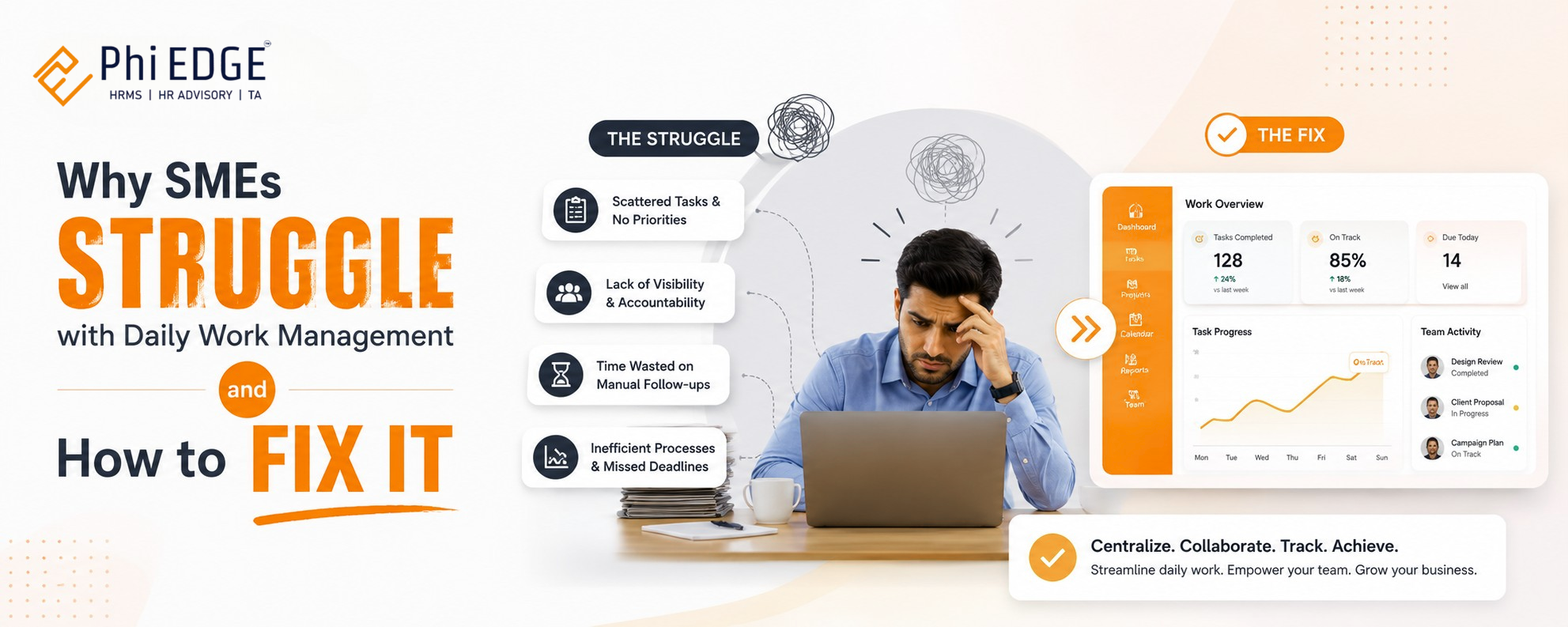
SMEs face daily work management
In the fast-moving world of small and medium enterprises (SMEs), every decision, deadline, and deliverable matters. Yet while strategy and vision draw senior leadership’s focus, what happens every single day—the tasks, handoffs, follow-ups, and assignments that shape outcomes—often gets overlooked.
Ask almost any SME leader what keeps them up at night, and you’ll find that Daily work management consistently ranks high on the list of operational challenges. Teams juggle responsibilities, individual work habits differ, and priorities shift like sand under pressure. When workflows aren’t structured, productivity doesn’t just slow down—it becomes unpredictable.
At Phi EDGE, we have a front-row view of these challenges. With our integrated experience across HRMS, HR Advisory, and Talent Acquisition, and through our HRMS software and HRIS talent management solutions deployed across industries such as Manufacturing, Financial Services, Real Estate, Hospitality, Construction, Academics, and Information Technology, we have seen how effective work management—or the lack of it—can make or break performance.
In this blog, we’ll explore why SMEs struggle with daily work management, and more importantly, how they can fix it using structured systems like a Daily Work Management System and practical tools like a daily task management app. This isn’t theoretical. These are strategies you can implement now to transform productivity, accountability, and team morale in your business.
The Heart of the Problem: Why Daily Work Management Is Hard for SMEs
1. Lack of Clear Visibility and Consistency
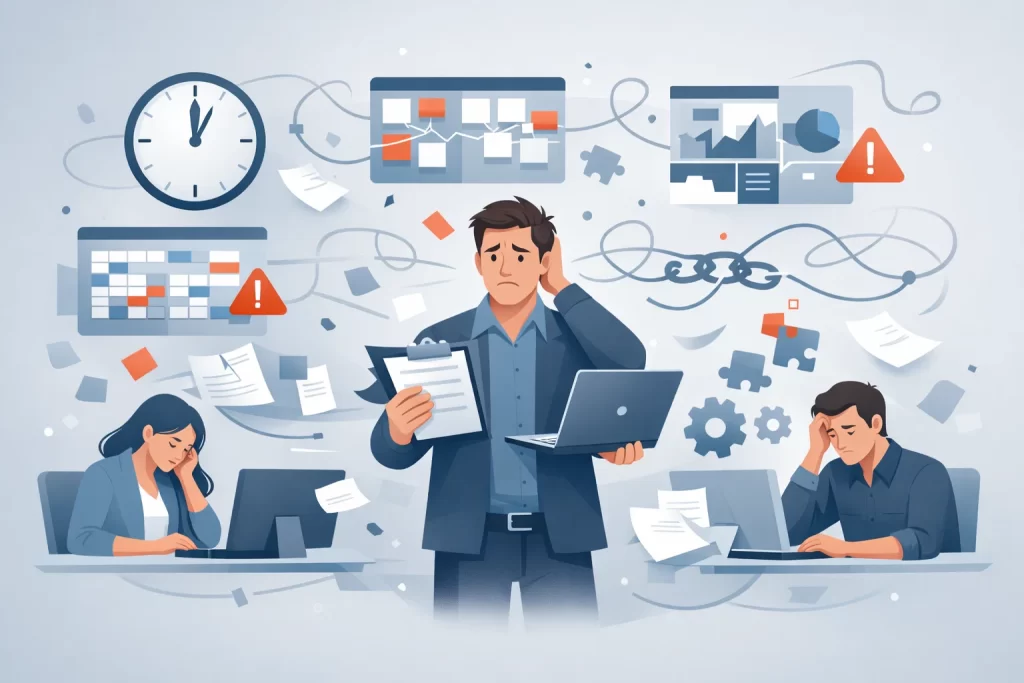
Many SMEs function on informal communication—teams follow their own rhythms and methods. In one corner of the company, tasks might be tracked through group chats. In another, spreadsheets collect dust in forgotten folders. Without a central system, it’s impossible to know what work is being done, by whom, and by when. This lack of visibility is a root cause of confusion and missed commitments.
This problem gets amplified as businesses scale. When SMEs reach 20, 50, or 200 employees, individual habits, inconsistent workflows, and siloed task tracking create chaos rather than clarity.
A Daily Work Management System solves this by creating one source of truth—where all tasks, timelines, and responsibilities live in a single platform accessible to everyone who needs them. At Phi EDGE, we’ve seen how this clarity directly improves performance and prevents tasks from falling through the cracks.
2. Reliance on Manual or Fragmented Tools
Word documents, spreadsheets, sticky notes, email threads, and chat apps have their place—but they are not designed for structured task tracking. These tools were never built to answer the critical question: What should each employee be working on TODAY?
For SMEs without an integrated daily task management app, processes become fragmented. Even if a team wants to stay organized, the tools they use don’t scale with complexity. What works for two people quickly collapses when there are ten, and even faster when dependencies multiply.
A dedicated Daily Work Management System replaces this patchwork of tools with a unified workflow where tasks are created, assigned, tracked, and measured—all in a single place. This not only reduces the time wasted switching between apps but also brings disciplined process to daily execution.
3. Lack of Defined Accountability
In many SMEs, accountability happens informally. Managers assume someone is responsible because the work exists. Employees assume someone else is handling it because no one has clearly been assigned. The result? Work gets delayed, misaligned, and ultimately disconnected from business priorities.
When accountability isn’t formally embedded in daily processes, performance suffers. Deadlines blur, quality drops, and team frustration increases.
A Daily Work Management System assigns clear ownership of every task. A good daily task management app shows who is doing what and by when, preventing confusion. This clarity in accountability ensures that tasks are not just expected—but owned.
4. Unclear Priorities and Overload
In growing SMEs, priorities change rapidly—often without clear communication. Team members can find themselves pulled in multiple directions, unsure whether a task on their board is a top priority or a secondary request. This ambiguity worsens with remote or hybrid teams.
Without a system that clarifies urgency and impact, employees resort to guessing, multitasking inefficiently, and experiencing burnout. This directly harms performance and engagement.
The right Daily Work Management solution helps teams rank tasks based on urgency and business value. Managers and employees align on what truly matters today, this week, and this quarter. This prioritization is the backbone of focused work environments.
5. Poor Integration with Broader HR Systems
Daily task tracking on its own can help with task completion—but true performance improvement happens when daily work is connected to bigger HR functions: performance reviews, goal setting, learning, and workforce planning.
Many SMEs use one system for payroll, another for performance reviews, and still others for task tracking. This disconnection creates data silos and prevents leaders from understanding how daily execution impacts performance outcomes.
With an integrated HRMS solution, like the one offered by Phi EDGE, daily work data becomes part of a larger performance ecosystem. This connectivity generates insights that help with personalized reviews, promotions, training plans, and resource allocation—grounded in real work patterns, not guesswork.
How Daily Work Management Impacts Employee Performance
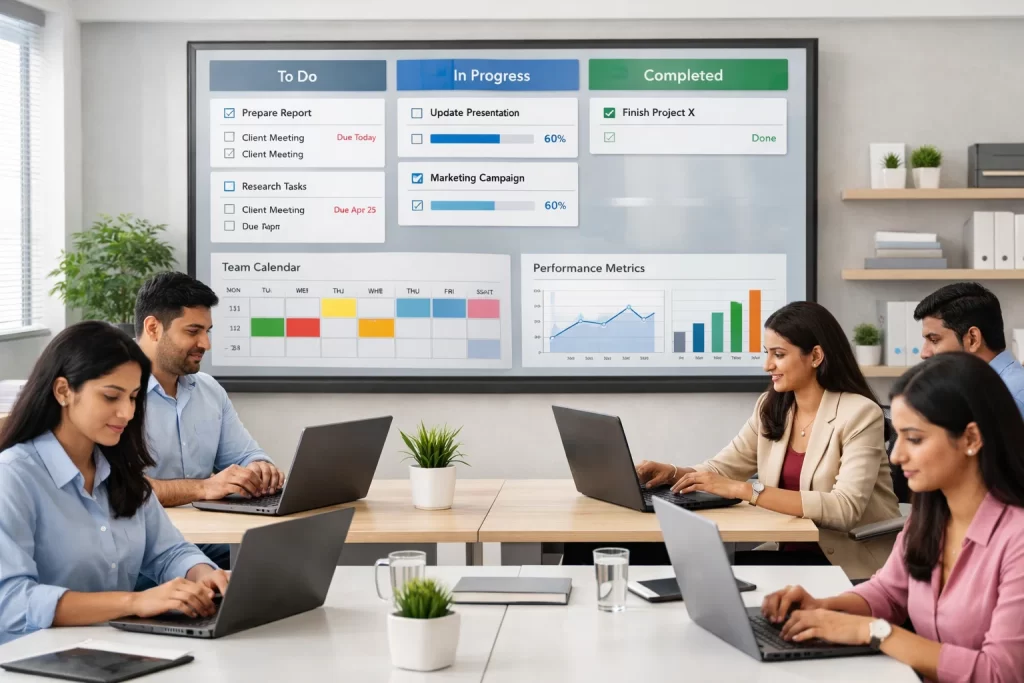
Understanding why SMEs struggle is the first step. The next is recognizing how a structured approach can improve employee performance and, by extension, business outcomes
1. Daily Clarity Boosts Focus
When employees know exactly what they are expected to accomplish each day, they can focus their energy accordingly. A daily task management app provides this clarity by delivering personalized task lists, reminders, and progress indicators.
Researchers consistently show that clarity of expectations directly correlates with performance quality. Employees who know their targets—and see how their work connects to business goals—are more engaged, productive, and motivated.
2. Accountability Improves Completion Rates
As tasks are logged and assigned in a structured Daily Work Management System, accountability becomes measurable. Teams stop guessing who should do what. When tasks are visible, with real deadlines and ownership, employees are more likely to complete work on time.
At Phi EDGE, we’ve seen teams significantly improve task completion rates when they adopt centralized task tracking. It’s not just about seeing tasks—it’s about knowing they are being held accountable every step of the way.
3. Transparency Enhances Collaboration
Teams that use a daily system communicate better. Instead of fragmented updates across emails and chats, task details, comments, attachments, and progress are all in one place. This creates a shared understanding of priorities, removes barriers to collaboration, and eliminates redundant communication.
With team members having shared visibility into tasks and progress, collaboration becomes smoother, less friction-filled, and more efficient—leading to better performance outcomes.
4. Reduced Stress, Better Well-Being
Disorganization creates stress. Unclear responsibilities and shifting priorities leave employees anxious and depleted. A Daily Work Management System reduces this stress by providing clarity of purpose.
When work is structured, predictable, and transparent, employees experience less cognitive overload. This improves both well-being and performance, as individuals can focus their mental energy on execution rather than uncertainty.
5. Real-Time Feedback Leads to Continuous Improvement
When a daily system is integrated with broader HRMS analytics, managers can offer feedback based on real work data—not memory or assumptions. Instead of waiting weeks for periodic reviews, employees receive timely feedback tied to actual task outcomes.
This accelerates performance improvement, fosters a culture of growth, and builds stronger manager-employee relationships.
How to Fix Daily Work Management Challenges in SMEs
Knowing the problem is only half the battle. The next step is implementing solutions that are practical, scalable, and sustainable. Here’s how SMEs can fix their daily work management struggles:
1. Adopt a Unified Daily Work Management Tool
The first step for any SME should be moving away from informal tools and toward a structured Daily Work Management System. A good system provides:
● Centralized task tracking
● Clear assignments and timelines
● Real-time updates
● Reporting and analytics
● Integration with larger HR systems
A daily task management app is central to this transformation—it becomes the engine that drives clarity and execution.
2. Align Tasks with Organizational Goals
Daily tasks should not be isolated checkboxes. They should map back to strategic goals. Employees perform better when they understand how their day-to-day work contributes to broader outcomes.
Using an integrated HRMS platform like Phi EDGE, organizations can ensure that daily work is not just managed—but aligned with performance objectives, learning goals, and long-term growth.
3. Train Teams on Structured Task Habits
Technology is only effective if people use it well. SMEs should invest in training employees on how to use daily work systems effectively—not just how to enter tasks, but how to prioritize, update progress, collaborate, and interpret analytics.
A well-trained team performs better because they use the system to support clarity and execution—not treat it as a filing cabinet.
4. Integrate with Performance Reviews
Daily work data should inform performance evaluations, not be separate from them. When managers use real task outcomes in conversations, the feedback becomes fairer, evidence-based, and actionable.
This integration between a Daily Work Management System and performance appraisal builds a stronger culture of accountability and continuous improvement.
5. Provide Continuous Visibility and Feedback
A daily system is most impactful when it encourages ongoing communication and feedback. Encourage teams to update task progress frequently and share insights within the system—not only at weekly meetings.
This practice fosters transparency, elevates performance discussions, and prevents small issues from becoming major roadblocks.
Case Study: How SMEs Benefit When Daily Work
Management Is Done Right
Consider a mid-sized IT consulting firm struggling with missed deadlines and team burnout. Tasks were scattered across email threads and spreadsheets, and managers had little visibility into individual workloads. Performance reviews became stressful because managers relied on memory rather than real data.
After implementing a Daily Work Management System with a daily task management app integrated into their HRMS, things changed. Tasks were centralized, progress was visible in real time, and priorities were clear. Managers could redistribute work when someone was overloaded, and employees could view what was expected of them each day.
As a result, task completion rates improved by 35%, team collaboration increased, and performance reviews became more constructive because they were backed by daily execution data. This transformation was powered by the clarity, accountability, and transparency provided by a well-implemented system like the one offered by Phi EDGE.
Common Mistakes SMEs Make in Work Management (and How to Avoid Them)
Relying on informal tools – Spreadsheets and chats create silos.
Fix: Use a centralized daily work system for visibility.
Not setting priorities – Employees juggle work without knowing what matters most.
Fix: Use structured task lists with priorities and deadlines.
Disconnect from performance goals – Tasks become disconnected from outcomes.
Fix: Link daily tasks to broader HRMS goals and KPIs.
Lack of real-time updates – Work tracking is stale.
Fix: A daily task management app ensures live updates and accountability.
Frequently Asked Questions (FAQs)
Q1: What is daily work management?
Daily work management refers to organizing, assigning, tracking, and completing daily work tasks in a structured manner that improves clarity, accountability, and performance.
Q2: How does a daily task management app help SMEs?
It provides a centralized platform where teams can view, update, and track tasks in real time—breaking free from scattered spreadsheets and informal communication.
Q3: What is a Daily Work Management System?
A Daily Work Management System is a structured process, supported by software, that ensures tasks are properly assigned, visible, and measurable, helping teams stay aligned and accountable.
Q4: Can daily work management improve performance reviews?
Yes. By connecting daily task execution with performance analytics, SMEs can base reviews on real data rather than impressions.
Q5: Is integrating with HRMS important for task management?
Absolutely. Integration ensures that task outcomes feed into broader HR functions such as performance evaluation, training plans, and workforce planning.
Q6: What challenges do SMEs face with daily work management?
Common challenges include lack of visibility, fragmented tools, unclear ownership, and disconnected reviews—all of which can be fixed with a structured system.
Q7: How quickly can SMEs implement a Daily Work Management System?
With cloud-based solutions like the ones offered by Phi EDGE, implementation can happen quickly—often within weeks, depending on business complexity.
Conclusion: Daily Work Management Is the Foundation of SME Success
In the competitive landscape where SMEs operate, efficiency and accountability can make all the difference. When daily work is structured, visible, and aligned with larger goals, employees perform better, managers lead more effectively, and organizations grow more predictably.
A Daily Work Management System supported by a strong daily task management app transforms how work gets done. It brings clarity, reduces friction, enhances collaboration, and aligns daily effort with strategic performance outcomes.
At Phi EDGE, we help SMEs implement systems that drive sustainable productivity—ensuring that daily execution becomes a competitive advantage rather than a daily struggle.
Today’s daily work becomes tomorrow’s performance. Make it count with the right system in place.